
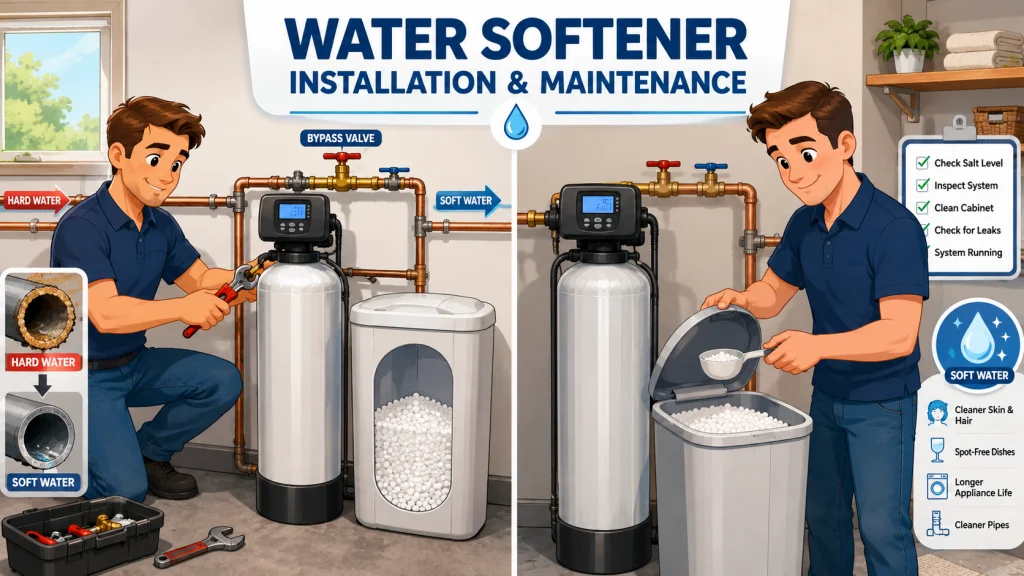
What a Water Softener Installation Actually Involves
The core job is this: shut off the main water supply, cut the supply pipe, install a bypass valve, connect the softener’s inlet and outlet to the cut pipe ends, run a drain line to a floor drain or standpipe, fill the brine tank with salt, plug in the control head, and program the hardness and regeneration time. For most homes with a straightforward plumbing setup, a DIY installation runs three to five hours. A plumber doing the same work typically takes one to two hours. Once the plumbing is connected and the control head is programmed, run the first regeneration cycle manually, check every fitting for leaks, and test an indoor tap after the cycle finishes to confirm the system is producing soft water.
Cost is where the range gets wide. If you buy your own equipment at a box store or online and hire a plumber only for the pipe work, total installation cost runs roughly $150 to $700 in labor on top of $300 to $1,500 for the equipment. If you hire a water treatment dealer who supplies the equipment and installs it, the same job frequently comes in at $1,500 to $4,000. In most cases, the difference comes down to dealer markup on the equipment rather than a difference in installation quality. The complete breakdown of what drives that gap is in the water softener installation cost guide, but knowing the range before you start planning matters. A homeowner who does not know they can separate the equipment purchase from the labor cost often ends up paying dealer prices by default.
Permits are worth checking before you start. Most municipalities do not require a permit for water softener installation as a direct appliance connection, but some do, particularly if the drain connection requires new plumbing. A quick call to the local building department takes five minutes. The full picture of installation scope, DIY versus professional options, and what the decision actually depends on is covered in the water softener installation guide.
Before You Install: 5 Things to Confirm
Before buying your equipment or scheduling a plumber, confirm these five things. Skipping any one of them is how installations get complicated mid-job.
- Main shutoff location. Know where it is and confirm it actually shuts off all water to the house. Some older homes have corroded shutoffs that do not fully close.
- A drain within reach. The drain hose needs to terminate within a reasonable distance of a floor drain, utility sink, or standpipe. Measure before committing to a spot.
- An outlet near the control head. The softener needs a standard 120V outlet close enough for the power cord to reach. Extension cords are not a permanent solution.
- Space for both tanks and salt bag access. The resin tank and brine tank sit side by side. Confirm the space accommodates both, plus enough clearance to load a 40-pound salt bag without contorting.
- An actual water hardness test result. You need a GPG number from a test strip or a lab result to program the control head correctly. Guessing high wastes salt; guessing low means the system underperforms.
If any of these five items turns up a problem, it is better to know before the plumber is standing in your utility room. If you cannot confirm drain access, a working shutoff, or adequate space, factor a plumber into the plan from the start rather than discovering the issue mid-install.

This kit lets you test drinking water, pool water, or any water source in seconds using a simple dip-and-read method with an oversized color chart ranging from red to green, covering 0 to 25 GPG and 0 to 425 PPM. All 100 strips are protected by FreshSeal technology across a ready-to-use bottle and two sealed pouches for long-term accuracy. Each purchase also funds a full year of clean water for someone in the Central African Republic.
Check On AmazonIf you click this link and buy, we earn a commission at no additional cost to you.
Where It Goes: The One Placement Rule That Covers Most Decisions
One rule governs softener placement: after the main shutoff valve, before the water heater. That position means all indoor water, including the hot water supply, gets treated. Installing the softener after the water heater is one of the most common placement errors I see. The homeowner has a working softener and a water heater that is still scaling, because untreated hard water ran through the heater before the softener ever touched it.
The hose bib rule is the one that catches people most often after installation. Outdoor hose bibs, garden irrigation lines, and car wash spigots should be upstream of the softener. Softened water applied repeatedly to soil accumulates sodium and damages plant health over time. This is not a minor concern for anyone with a garden or lawn they care about. If your outdoor bibs were inadvertently plumbed downstream during installation, rerouting them to a point upstream of the softener is the fix.
Inside locations are preferred over outside installations. Resin beads and the brine solution both perform best within a moderate temperature range. Garages in mild climates work well. Unheated garages or outdoor locations in areas where temperatures drop below freezing regularly create problems: salt dissolves more slowly in cold water, brine concentration drops, and regeneration becomes less effective. A basement location near the main line entry point, close to a floor drain, is the setup I would choose every time if the option exists.
| Location | Works well? | Notes |
|---|---|---|
| Basement (near main line entry) | Best option | Temperature stable, floor drain usually nearby, easy salt access |
| Utility room or closet | Yes | Confirm salt bag access fits; allow space for brine tank removal during service |
| Heated garage | Yes | Works well if temperature stays above 35°F year-round |
| Unheated garage (cold climate) | Not recommended | Salt dissolving rate drops; brine concentration inconsistent below 40°F |
| Outdoors (mild climate) | Possible with precautions | Insulate tanks; direct sun degrades brine tank plastic over time |
Drain connection requirements are worth confirming before you pick the final install spot. The drain hose end must terminate above the drain opening to prevent backflow into the resin tank. A floor drain within eight to ten feet is the standard setup. If the nearest drain is a utility sink standpipe, that works too, but the hose end still needs to hang above the water line in the standpipe. Running the drain hose longer than about 20 feet horizontal introduces enough back-pressure to affect drain flow rate, which affects how completely brine flushes from the resin during regeneration.
Why DIY Installation Is More Accessible Now Than It Used to Be
Push-fit fittings changed the DIY equation for water softener installation. Before they became widely available, connecting a softener to copper supply lines required soldering. That single step excluded a large share of homeowners who did not want to learn torch work or risk a poor joint on a pressurized supply line. SharkBite-style push-fit connectors work by pressing directly onto the pipe end; they seat on copper, PEX, and CPVC without heat, tools beyond a pipe cutter, or any special skill. The fittings are also reversible, which matters when you are making connections for the first time and want the option to adjust. Community forum threads on DIY softener installation consistently describe the connection process as taking minutes per fitting with no leaks when the pipe is cut square and clean.
Field Note: The DIY installs I have followed up on that went wrong almost never failed at the fitting connection. They failed at the programming step. A homeowner runs the plumbing correctly, then sets the hardness on the control head to 35 GPG because they rounded up aggressively or did not have a water test. Their actual hardness is 15 GPG. The system regenerates twice as often as it needs to, burns through salt at twice the expected rate, and the homeowner assumes that is normal. Getting the hardness setting right, using an actual test result and not a guess, matters as much as the plumbing. A basic hardness test strip kit runs $10 to $15 at any hardware store and takes five minutes.
The step-by-step installation process, including tools, materials, common first-timer mistakes, and how to test the installation before calling it done, is in the DIY water softener installation guide.

This flexible braided stainless steel connector is compatible with PEX, PE-RT, CPVC, SDR-9 HDPE, and copper pipes, making it a versatile fit for nearly any plumbing setup. Both ends make tight turns without kinking, and installation requires no tools, crimping, glue, or soldering, which is ideal for tight spaces or misaligned pipes. Rated for up to 200 PSI and 200 degrees F, this lead-free connector meets commercial and residential plumbing standards for a clean, reliable, leak-free connection.
Check On AmazonIf you click this link and buy, we earn a commission at no additional cost to you.
What Ongoing Maintenance Actually Looks Like
Ongoing maintenance for a residential water softener comes down to three tasks: checking the salt level, cleaning the venturi valve, and running a resin cleaner on a reasonable schedule. None of these require tools beyond a screwdriver, and none take more than 15 to 20 minutes when done regularly.
Salt check every four to six weeks. Open the brine tank lid and confirm the salt is above the water line. A family of four using a demand-initiated system with water around 10 GPG will typically go through one 40-pound bag of salt per month. That figure shifts with water hardness, household water use, and whether the system uses timer-based or demand-initiated regeneration. Timer-based systems regenerate on a fixed schedule regardless of actual water use and will consume more salt than a metered system in a typical week. Everything that affects how much salt your system goes through, including how to tell if it is using more than it should, is in the water softener salt guide.
Venturi cleaning once a year. The venturi valve, sometimes called the injector, is a small assembly in the control head that creates suction to draw brine from the tank into the resin during regeneration. Sediment and mineral deposits collect in its small orifice over time and gradually restrict brine draw. You do not always notice this happening because the effect is gradual: slightly less brine drawn per cycle, slightly harder water creeping back in over months. Cleaning it involves removing two or three screws, pulling out the venturi assembly, running it under warm water with a toothbrush, and reinstalling. The first time takes maybe 20 minutes. After that it is a 10-minute task. I have seen systems that had not had this done in five years. The orifice was nearly blocked. The homeowner had been calling for a service visit every 18 months because the water was going hard and they could not figure out why.
Resin cleaner every three to six months. Resin beads accumulate iron, manganese, and organic matter over time, which reduces their ion exchange capacity. A resin cleaner added to the brine tank before a manual regeneration cycle strips that buildup off the beads and flushes it to drain. For well water with detectable iron, this matters more than for clean city water. On city water with chlorine, the bigger concern is resin degradation over years rather than fouling. The complete maintenance schedule, including what to do annually versus what to check more frequently, is in the water softener maintenance guide.
- Every 4 to 6 weeks: Check salt level in the brine tank. Salt should be above the water line. Top off if the level has dropped to within a few inches of the water.
- Every 3 to 6 months: Add resin cleaner to the brine tank before a manual regeneration cycle. More frequent with well water or any detectable iron level.
- Once a year: Remove and clean the venturi valve assembly. This is the highest-value maintenance task for softener longevity and consistent performance.
- Every 5 to 7 years: Consider a full brine tank cleanout. Sludge and impurities from salt accumulate at the bottom over time and eventually interfere with brine draw.

This universal cleaner removes iron, sediment, dirt, and rust from your softener's resin bed, valve, and internal components, tackling the tough buildup that salt alone cannot address. It is compatible with virtually any brand including Whirlpool, Culligan, GE, Kenmore, Morton, and more, making it a reliable maintenance choice regardless of your system. Used every 4 months, it restores softening performance and can extend the parts and labor warranty on EcoPure systems up to 5 years with product registration.
Check On AmazonIf you click this link and buy, we earn a commission at no additional cost to you.
What Goes Wrong and What It Usually Costs to Fix
Most water softener problems fall into a short list. The majority have DIY fixes that cost between $0 and $20. The pattern I have watched repeat across enough service calls is that homeowners call a technician before they check the simple things first. A $150 service visit that diagnoses a salt bridge, which is broken up with a broom handle, is not unusual.
Salt bridge is the most commonly misdiagnosed problem. A hard dome of crusted salt forms above the water in the brine tank. The tank looks full from the top because the crust holds the upper layer of salt in place. Below the crust, the water has no dissolved salt to become brine. The system regenerates but draws plain water through the resin instead of brine. Fix: press a broom handle down through the salt until the crust breaks apart. Five minutes, no cost. A family that topped off the brine tank too aggressively and pushed the salt level too high is more prone to this. Keeping the salt at a moderate level, not packed to the top, reduces how often it happens.
Venturi clog is the second most common cause of a softener that appears to be running but has stopped softening effectively. The fix is covered in the maintenance section above. Cost: $0, 15 minutes.
Salt mushing is different from bridging and gets confused with it often. Mushing is dissolved salt that has recrystallized at the bottom of the brine tank into a dense, wet sludge. It blocks the brine intake valve so the system cannot draw brine up during regeneration. The fix involves emptying the brine tank, scooping out the sludge, scrubbing the interior with water, and refilling with fresh high-purity pellets. It is more work than breaking a bridge, but still a DIY task. Switching to high-purity evaporated pellets reduces the likelihood of mushing recurring.
Field Note: The service call trap comes up more often than it should. A homeowner notices the water is going hard again and the salt level looks the same as last month. They call a water treatment company. The technician shows up, finds a venturi clog, cleans it in 15 minutes, and invoices for a service call. I have seen this play out enough times that I now consider venturi cleaning the single most important thing to put in writing for a new softener owner. Clean it once a year before you have a problem. If you already have a problem, check it before you make the call.
For more complex issues including drain problems, control head failures, water that tastes salty, pressure drops after the softener, and resin beads appearing at faucets, the full diagnostic framework is in the water softener troubleshooting guide. Resin beads in faucets in particular is the one problem on this list that requires immediate action rather than scheduled attention.
Final Thoughts: One Install, Then a Simple Maintenance Routine
The reason I put installation and maintenance in the same guide is that they belong together. A homeowner who understands the full picture before installation makes better decisions: they size the system correctly, place it correctly, set the hardness from an actual water test instead of a guess, and know what to check in 30 days when the first bag of salt is running low. Someone who installs correctly but skips maintenance ends up with a slow decline in performance that looks like the softener is failing when it is really just a clogged venturi or a salt bridge that has been sitting there for six months.
Neither job is technically demanding. Installing a water softener is a plumbing task that most handy homeowners can handle in an afternoon with push-fit fittings and the right preparation. Maintaining it is a 15-minute monthly check and one annual valve cleaning. What makes the difference between a system that runs well for 15 years and one that creates recurring problems is usually just knowing what to look for and when. If you are still at the product selection stage and need help deciding which softener to buy before any of this applies, that is a different question and it is covered in the water softener buying guide.

Refined to 99.8% purity, these pellets minimize tank residue and are specifically formulated to resist clumping and salt bridges that can cause system malfunctions. By removing hard minerals like calcium and magnesium, they help extend the life of your dishwasher, washing machine, and water heater while preventing scale buildup in pipes. Compatible with all major water softening systems, the 50-pound bag features a patented dual-handle design for easier and safer lifting and pouring.
Check On AmazonIf you click this link and buy, we earn a commission at no additional cost to you.
Installation and Maintenance: In-Depth Guides
This guide covers the full lifecycle at an overview level. Each of the four topics below goes into the detail that a one-page overview cannot. If you are working through a specific part of installation or running into a particular maintenance issue, the relevant guide below has the full picture.
| Guide | What it covers |
|---|---|
| Water Softener Installation Guide | Full installation scope, DIY versus professional breakdown, cost ranges, and the SharkBite fitting option that changed the DIY calculus |
| Water Softener Salt Guide | Salt type comparison, normal monthly usage ranges, what causes over-consumption, and where to buy for the best value |
| Water Softener Maintenance Guide | Step-by-step instructions for every maintenance task, how to tell when something needs attention, and a schedule that keeps performance consistent over years |
| Water Softener Troubleshooting Guide | Diagnosis framework for the most common problems, DIY fixes with cost and time for each, and when a problem actually does need a technician |
If you are approaching this from the hard water identification side and want to understand what your water test results mean before deciding on treatment, that background is in the complete water softener guide.
FAQs
🔧 How long does it take to install a water softener yourself?
Most DIY installations take three to five hours for a homeowner with basic plumbing experience. The largest variable is whether your existing plumbing requires any rerouting or if you have a straightforward pipe cut and connect. Using push-fit fittings on copper or PEX eliminates the soldering step that used to extend the job significantly.
🧂 How often do I need to add salt to my water softener?
Check the salt level every four to six weeks. A typical household of four with moderately hard water around 10 GPG will go through roughly one 40-pound bag per month on a demand-initiated system. Timer-based systems often use more. If you are going through more than that, check whether your hardness setting is higher than your actual water hardness.
🔍 How do I know if my water softener is actually working?
Three quick checks: test the water at an indoor softened tap with a hardness test strip, confirm the salt level has dropped since your last check, and do a soap lather test on your hands under running water. Soft water lathers immediately. Hard water does not. Do not test from an outdoor hose bib; those are upstream of the softener and will always show hard water.
❄️ Can I install a water softener in an unheated garage or outside?
Outdoors or in unheated spaces is possible in mild climates but not recommended where temperatures drop below about 35°F regularly. Cold temperatures slow salt dissolving, reduce brine concentration, and can affect resin performance. If an outdoor installation is unavoidable, insulate both tanks and monitor performance through winter.
💧 Why does my water feel slippery or slimy after installing a softener?
Nothing is wrong. Hard water strips skin oils and leaves a mineral film that feels dry but clean. Soft water lets your skin’s natural oils remain, which feels slippery or silky by comparison. Most people adjust within two to four weeks. Using slightly less soap also helps, since soft water lathers with less product than hard water.
🛠️ What is a venturi valve and why does it need to be cleaned?
The venturi valve is a small assembly inside the control head that uses water flow to create suction and draw brine from the salt tank into the resin during regeneration. Sediment and mineral deposits collect in its narrow orifice over time and restrict brine draw. Cleaning it annually takes about 10 to 15 minutes and prevents gradual softening failure that is often misdiagnosed as a bigger problem.