
The Best Salt-Free Water Softener Still Cannot Remove Hardness Minerals
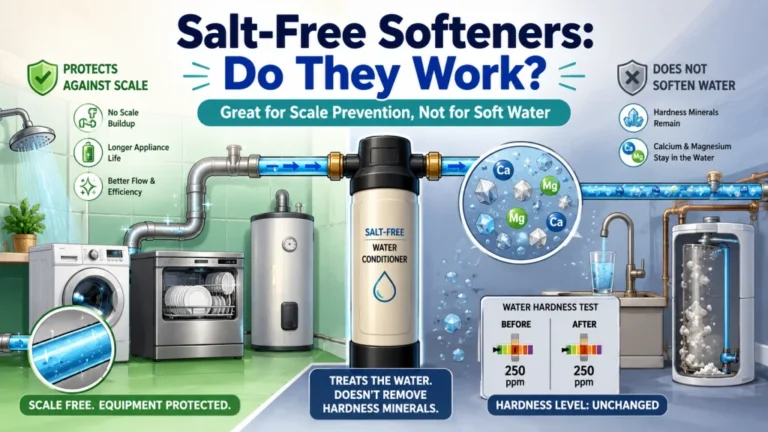
Most people arrive at this category with the same assumption: a salt-free system is a more convenient version of a salt-based one, delivering the same results through a different process. That assumption is wrong in a specific and important way. A salt-based ion exchange system physically removes calcium and magnesium from your water, swapping those minerals for sodium ions across a resin bed. A salt-free conditioner removes nothing. The hardness minerals stay in the water from start to finish. What changes is the form they take, not their presence.
TAC technology, which is the mechanism behind every salt-free conditioner on the residential market, converts dissolved calcium and magnesium into microscopic inert crystals that stay suspended in the water. Those crystals pass through pipes, water heaters, and fixture surfaces without depositing as scale. The minerals are still there. A water hardness test confirms it: your GPG reading after installation is the same as before. This is not a defect or a sign the system is underperforming. It is how the technology works, and understanding that upfront prevents the most common source of frustration with this category. For a full breakdown of what each approach delivers and where the mechanism differs, the article on how water softeners and water conditioners differ covers both technologies side by side.
The sensory difference that comes from ion exchange is also absent with TAC. Soft water produced by a salt-based system feels different on skin because the calcium and magnesium are gone. Soap lathers more easily. Hair behaves differently after washing. Laundry results change. None of those outcomes happen with a salt-free conditioner because the minerals that produce those effects are still present. If skin and hair improvement is on the list of reasons to buy, this is the wrong category to be shopping in. Scale prevention and water softening are different outcomes, and they require different equipment.
How TAC Technology Works and Why the Water Still Tests Hard
TAC media is a polymer material with a textured surface that functions as a crystallization template. As water flows through, dissolved calcium and magnesium ions contact those surfaces and convert into calcium carbonate microcrystals. The crystals detach and remain suspended in the moving water. When that water reaches a pipe wall, a heating element, or the interior of an appliance, the crystals pass through without adhering. Scale accumulation slows because the mineral is no longer in a form that deposits. The process is real, documented, and measurable on appliances over time.
Operationally, it is as close to zero-maintenance as residential water treatment gets. No electricity, no regeneration cycle, no drain connection, no brine discharge, no chemicals added. Water flows in one end and comes out the other with the same dissolved mineral content in a different physical state. That profile genuinely matters for buyers who want effective scale protection without the ongoing involvement of a salt-based system. Salt purchases, hauling bags, checking brine tank levels, and scheduling regeneration cycles are all off the table with a properly matched salt-free setup.
Field Note: One of the most common situations I run into is a homeowner who installed a salt-free conditioner, tested their water six months later, saw the same 14 GPG reading as before, and concluded the system had not done anything. In every one of those cases, the system was working correctly. The GPG reading was not supposed to change. The frustration traces almost entirely to how the product was marketed, not to a failure of the technology. The manufacturer used the word “softener” in the product name, the homeowner expected softened water, and what they got was scale prevention. Those are not the same thing, and the packaging rarely makes that clear.
The field performance for scale protection at the right hardness level is documented and credible. The important question is whether your specific water situation falls within the range where that protection holds up consistently.
Where Salt-Free Systems Perform and Where They Fall Short
Hardness level is the primary variable. At 7 to 15 GPG on city water, certified TAC systems have solid independent evidence for scale prevention performance. The crystallization process runs efficiently in that range, media life stays reasonable, and scale accumulation on water heaters, dishwashers, and fixture surfaces measurably decreases over time. A household in that range with scale protection as the primary goal has a legitimate case for choosing a salt-free conditioner. A city water connection at 10 GPG with no iron and a goal of protecting the water heater and keeping showerheads clear is the scenario these systems were designed for.
Above 25 GPG, the picture changes. TAC media has a throughput limit. At extreme hardness levels, the volume of dissolved minerals exceeds what the crystallization process can handle efficiently, and scale prevention effectiveness falls off. That is a physical constraint of the mechanism, not a brand-specific limitation. A household at 28 GPG is better served by ion exchange, which removes minerals entirely and does not degrade in effectiveness as hardness increases. For buyers on city water at higher hardness levels, the article on water softeners for hard water covers what sizing looks like when GPG is elevated and why ion exchange handles it more reliably.
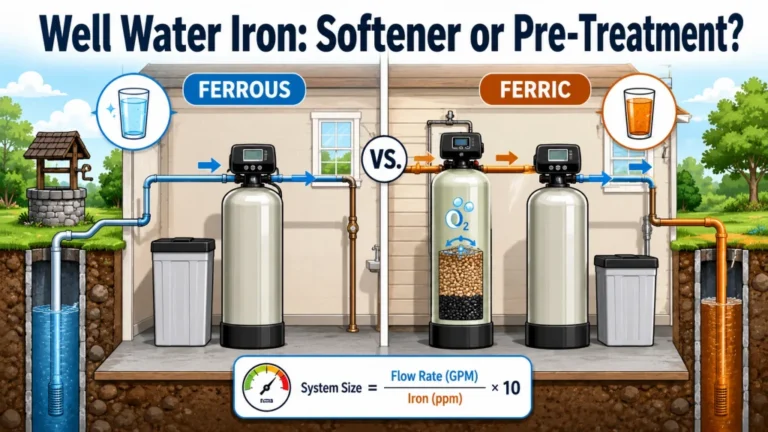
Well water introduces a separate failure mode that has nothing to do with hardness level: iron. Dissolved ferrous iron at concentrations as low as 0.3 PPM begins coating the crystallization sites on TAC media. Once those sites are fouled, the crystallization process stops working regardless of how high or low your hardness is. Most well water contains some dissolved iron, even when a basic home test does not flag it as a problem. A lab test is the only reliable way to know your actual iron level. For well water buyers trying to navigate what pre-treatment is required and when a salt-based system becomes the more practical answer, the article on water softeners for well water explains how iron changes the equipment calculation from the start.
| Water Situation | Salt-Free Viable? | Notes |
|---|---|---|
| City water, 7 to 15 GPG, scale prevention goal | Yes | Best-fit range for certified TAC systems; documented scale prevention at this level |
| City water, 15 to 25 GPG | Marginal | Performance begins to drop at higher loads; confirm media life rating at your hardness level |
| City water above 25 GPG | No | TAC cannot keep up at extreme hardness; ion exchange handles high GPG without effectiveness loss |
| Well water, iron confirmed below 0.1 PPM by lab test | Conditional | Rare well water profile; even trace iron above this level fouls media over time |
| Well water with detectable iron | No | Iron coats TAC crystallization sites regardless of hardness level; system degrades |
| California restricted water district | Yes | No brine discharge produced; compliant in all California districts including restricted areas |
| Goal is soft water feel, skin and hair improvement | No | These results require ion exchange; TAC leaves minerals in water and produces no sensory change |
Two rows in that table tend to surprise buyers the most. The California case surprises people because they assume the salt ban is statewide; it is not. It applies to specific water districts, and within those districts a salt-free conditioner is the compliant path not because it performs better but because brine discharge is restricted. The well water iron row surprises people in the opposite direction: buyers assume that because their iron level is low, it does not affect their equipment choice. At concentrations as low as 0.3 PPM, iron begins fouling TAC media. Low does not mean harmless in this context.
If your water matches the first row of that table, you are in the right category. If it matches one of the “No” rows, do not try to make a salt-free conditioner solve a problem it was not designed for. The articles below will point you toward the right equipment for your actual situation.

This kit lets you test drinking water, pool water, or any water source in seconds using a simple dip-and-read method with an oversized color chart ranging from red to green, covering 0 to 25 GPG and 0 to 425 PPM. All 100 strips are protected by FreshSeal technology across a ready-to-use bottle and two sealed pouches for long-term accuracy. Each purchase also funds a full year of clean water for someone in the Central African Republic.
Check On AmazonIf you click this link and buy, we earn a commission at no additional cost to you.
DVGW Certification and Flow Rate: Two Specs That Separate Real Performance From Marketing
The salt-free category has more unverified performance claims per product listing than almost any other segment of residential water treatment. Every manufacturer says their media prevents scale. The mechanisms described sound similar from the outside. The signal that separates third-party verified performance from copy is DVGW W 512, a German engineering test standard that uses independent laboratory testing to confirm TAC scale prevention. A system certified to this standard has outside evidence that its media achieves 99.6% scale prevention under controlled conditions. A system without that certification is making a claim that has not been independently tested.
Before purchasing any salt-free conditioning system, locate the DVGW W 512 certification on the product specifications or technical sheet. It should be stated clearly. If the product page does not mention it and the manufacturer cannot confirm it on request, the scale prevention claim is unverified marketing. In a category with this much noise, that certification is the clearest available signal that performance has substance behind it. Treating it as a minimum qualification rather than a bonus feature filters out a significant portion of the market.
Two other specifications are worth checking before you narrow your list: flow rate and media life. Flow rate determines whether a system is genuinely whole-house capable or just marketed that way, and the numbers vary significantly between products. Media life determines the primary long-term cost of owning a salt-free system, since TAC media requires replacement every few years rather than ongoing salt purchases. Both specifications are covered in detail in the comparison and product articles below, where the numbers are matched against real household scenarios.

This salt-free conditioning system combines TAC scale control, catalytic carbon filtration, and a sediment pre-stage to address hard water buildup, chloramines, VOCs, and particulates without the use of salt, backwashing, or electricity. Template-assisted crystallization converts hardness minerals into stable particles that resist buildup on plumbing and appliances while keeping naturally occurring minerals intact. Designed for 3 to 4 bathroom homes, it delivers a flow rate of approximately 12 GPM and a total capacity of 450,000 gallons, with installation at the main entry point in a basement, garage, or utility area.
Check On AmazonIf you click this link and buy, we earn a commission at no additional cost to you.
Final Thoughts: Start With Your Water, Not the Product Page
Salt-free conditioners solve a specific problem for a specific buyer. City water, moderate hardness, scale protection as the primary goal, no appetite for ongoing salt and maintenance. Within those parameters, the technology performs as its best-case advocates describe. Outside them, the limitations accumulate into problems rather than manageable tradeoffs. The category is not oversold in concept. It is routinely oversold in application, marketed to buyers whose water conditions are outside the range where it works consistently.
The most useful starting point is a water test. Your GPG reading, your iron level, and whether you are on city or well water narrow the field in about ten minutes. If the numbers put you in range, the articles below cover each specific angle of the salt-free decision in depth: what to buy if you have decided on a conditioner, how the long-term cost math compares to a salt-based system, what flow rate means for whole-house coverage in practice, and how the California regulatory situation actually works at the district level.
Before You Buy a Salt-Free Conditioner, Confirm These Five Things
Most buyer mistakes in this category come from skipping one of the following. A water test answers most of these in a single pass. The rest come from your home.
- Water source: City water or well water? If well, stop and get a lab test before comparing any salt-free systems.
- Hardness level in GPG: Between 7 and 15 GPG puts you in the viable range. Above 25 GPG, ion exchange is the better tool regardless of preference.
- Iron in PPM: Any detectable iron above 0.1 PPM on a lab test rules out salt-free on well water. On city water, iron is rarely an issue.
- Your actual goal: Scale prevention on appliances and pipes is what TAC delivers. Softer skin, better lather, or lower GPG on a test strip requires ion exchange.
- Whole-house or point of use: If you need the system to handle the full home, confirm the flow rate rating covers your peak demand. That number varies significantly between products and it matters.
If all five of those line up, you are in the right category and the articles below will take you from there. If any of them do not fit, the framework article on choosing a water softener by situation will route you to the right starting point instead.
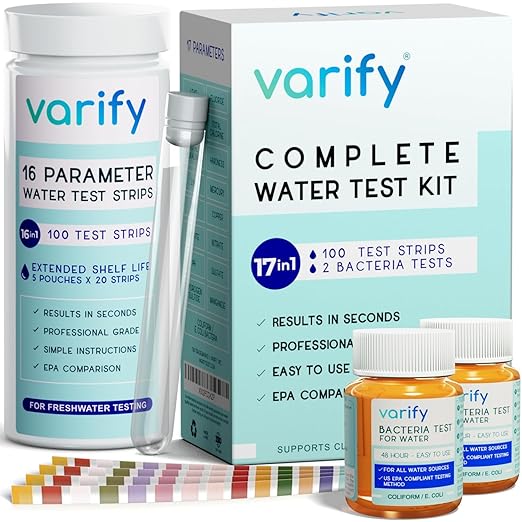
This comprehensive kit tests for 17 parameters including chlorine, fluoride, lead, iron, and bacteria, giving you a full picture of your water's safety in minutes. The 100 color-coded test strips come in 5 individually sealed pouches of 20 for extended freshness, while 2 included bacteria tests deliver results within 48 hours. Every purchase contributes a portion of proceeds to Water For Good, supporting clean water access in Central Africa.
Check On AmazonIf you click this link and buy, we earn a commission at no additional cost to you.

This comprehensive certified lab test analyzes 116 parameters including heavy metals, coliform and E. coli bacteria, disinfection byproducts, nitrates, pH, hardness, and alkalinity, making it especially well-suited for homes near farming or industrial activity on either city or well water. The metals panel alone covers 24 elements including lead, arsenic, uranium, mercury, and chromium, delivered through EPA, NELAC, ISO, and state certified labs for the fastest and most accurate results available. Every kit includes sampling materials, pre-paid return shipping, an award-winning lab report with unbiased filtration recommendations, and direct support from PhD scientists and engineers.
Check On AmazonIf you click this link and buy, we earn a commission at no additional cost to you.
FAQs
💧 Does a salt-free conditioner actually reduce water hardness?
No. A salt-free conditioner does not remove hardness minerals. Your GPG reading will be the same after installation as it was before. TAC technology converts calcium and magnesium into inert crystals that pass through without depositing as scale, but the minerals stay in the water. Only ion exchange actually removes them and lowers your hardness reading.
🛁 Will a salt-free system improve how my skin and hair feel?
No. The soft water feel on skin and hair comes from the physical absence of calcium and magnesium, which is what ion exchange delivers by removing those minerals. Salt-free conditioners leave the minerals in the water, so the sensory experience is unchanged after installation. If that improvement is part of your goal, ion exchange is the right category.
🌊 Can I use a salt-free conditioner on well water?
Only if your iron level is confirmed at 0.1 PPM or below by a lab test, and that is a genuinely rare well water profile. Iron fouls TAC media even at trace concentrations, which shuts down the crystallization process over time. In most well water situations, pre-treatment for iron is required before a salt-free conditioner will function, and once you factor in that cost, a salt-based system often becomes more practical.
🏷️ What is DVGW W 512 certification and why does it matter?
DVGW W 512 is an independent German engineering test standard that uses laboratory testing to verify TAC scale prevention performance. It is the only third-party certification for this technology. Systems with it have documented evidence for 99.6% scale prevention from outside the manufacturer. Systems without it are making a scale prevention claim that has not been independently tested.
⏳ How long does salt-free conditioner media last before it needs to be replaced?
Typically 3 to 10 years, depending on your water hardness level and total daily usage. Higher hardness and higher flow volume exhaust the media faster. Replacement cost is generally $200 to $600 depending on system size and brand. This is the primary ongoing cost of owning a salt-free system, compared to recurring salt purchases for an ion exchange system.
🌴 Are salt-free conditioners legal in California water districts with salt restrictions?
Yes. Salt-free conditioners produce no brine discharge and are compliant in all California water districts, including restricted areas like parts of the Inland Empire and Santa Clarita Valley. In restricted districts where sodium chloride ion exchange is banned or limited, salt-free TAC conditioners, potassium chloride systems, and portable exchange service are among the remaining options.