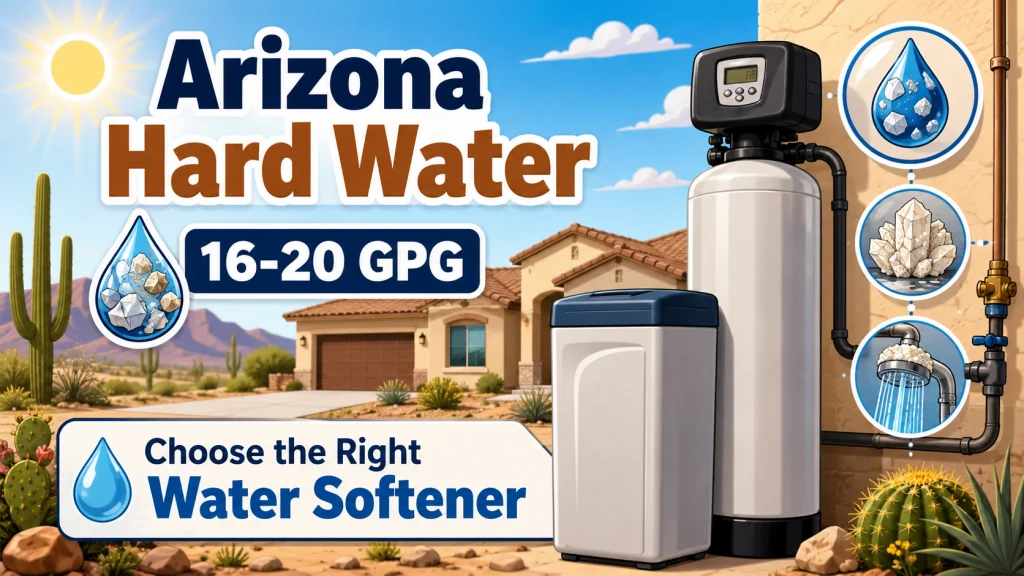
Why Arizona Hard Water Is a Different Problem
The water coming out of a Phoenix faucet is not the same as the water coming out of a faucet in Chicago or Atlanta. Arizona’s municipal water comes primarily from the Colorado River, which picks up calcium and magnesium across hundreds of miles of desert terrain before it reaches treatment plants. The result is water that typically tests between 16 and 20 GPG in the Phoenix metro, with Scottsdale and Chandler often hitting the high end of that range. Tucson draws from a mix of Colorado River water and local groundwater, landing in a similar range. This is not moderately hard water. This is some of the hardest municipal water in the country.
City water in Arizona does not have iron or sulfur the way well water does, which is one thing working in your favor. What it does have is a consistent, heavy mineral load that a correctly sized and specified system handles well, provided you size for the actual GPG and not the national average. The other factor to know: Arizona city water contains chlorine, which is standard for municipal treatment. That matters for resin selection. Over time, chlorine degrades standard 8% crosslink resin faster than 10% crosslink resin. For a system cycling frequently because of high hardness, resin longevity is not a minor concern.
I have seen this pattern repeat across high-hardness cities. The homeowner buys a standard 48,000-grain softener from a big-box store, follows the sizing chart on the box (written for 10 GPG), and within 6-12 months they wonder why the system is cycling more often than expected and why the salt disappears so quickly. The system is not broken. It was just never sized for Arizona water.
How to Size a Water Softener for Arizona Hardness
The standard sizing formula is straightforward: multiply the number of people in the household by daily water use per person (75 gallons is the commonly used figure), then multiply by your GPG hardness level, then multiply by 7 to get weekly grain demand. A well-sized softener should handle 7-10 days of that demand before regenerating. Here is what those numbers look like at Arizona hardness levels.
| Household Size | Hardness (GPG) | Weekly Grain Demand | Minimum Capacity Needed |
|---|---|---|---|
| 2 people | 18 GPG (Phoenix typical) | 18,900 grains/week | 32k minimum (48k preferred) |
| 4 people | 18 GPG (Phoenix typical) | 37,800 grains/week | 64k minimum (80k preferred) |
| 4 people | 20 GPG (Scottsdale high end) | 42,000 grains/week | 80k minimum, twin alternating preferred |
| 5+ people | 18-20 GPG | 52,500+ grains/week | Twin alternating strongly recommended |
A family of 4 at 18 GPG needs a system that can handle roughly 37,800 grains per week, or about 5,400 grains per day. A 48,000-grain softener technically covers that demand, but it leaves very little practical margin. Real-world capacity on a salt-efficient setting runs lower than the nominal grain number, and any week with above-average water use, houseguests, or back-to-back laundry days pushes the system past what it can comfortably handle on a 10-day cycle. The result is a system that regenerates more often than it should, with more salt used per month than a properly sized unit would require. A Phoenix household of 4 at 18 GPG should be looking at 64k-grain capacity at minimum, with 80k being the more practical floor. At 20 GPG with 5 or more people, twin alternating is the more reliable answer.
Field Note: AZ Water Solutions, a Phoenix-area water treatment company, has confirmed publicly that most of the country sits around 7 GPG while Arizona typically runs 12-20 GPG, and that national brands sell systems calibrated for national averages that cycle more frequently and need service sooner when installed in Arizona. That is not a sales pitch. It is an accurate description of what happens when you put an average-sized system into an above-average hardness situation.
One thing I look for in any Arizona softener recommendation is whether the system uses demand-initiated regeneration. A timer-based system regenerates on a fixed schedule regardless of how much water you have actually used. In a household with variable demand from guests, extra laundry, seasonal visitors, or heavier summer use, that means either regenerating before necessary (wasting salt and water) or going past capacity (delivering hard water). Demand-initiated metered regeneration solves both problems by tracking actual usage. In Arizona, where the system is already working harder than average, regenerating only when needed matters more than it does at 8 GPG in the Midwest.

This kit lets you test drinking water, pool water, or any water source in seconds using a simple dip-and-read method with an oversized color chart ranging from red to green, covering 0 to 25 GPG and 0 to 425 PPM. All 100 strips are protected by FreshSeal technology across a ready-to-use bottle and two sealed pouches for long-term accuracy. Each purchase also funds a full year of clean water for someone in the Central African Republic.
Check On AmazonIf you click this link and buy, we earn a commission at no additional cost to you.
The Resin Spec Arizona Buyers Often Miss
The crosslink percentage of the ion exchange resin inside a softener determines how well it holds up over time against chlorine exposure. Standard 8% crosslink resin degrades faster when exposed to chlorinated city water. At normal hardness levels, the resin might last 10-15 years before showing real degradation. At Arizona hardness levels, your system is cycling more frequently, processing more volume per month, and exposing the resin to more cumulative chlorine contact. The effect is accelerated resin aging compared to the same system running at 8 GPG.
10% crosslink resin costs more to manufacture, which is why budget systems and many box store brands use 8% without disclosing it prominently. Most product listings at Home Depot and Lowe’s do not specify crosslink percentage at all. If you are buying a softener for Arizona water and plan to run it for 10 or more years, the crosslink percentage is worth verifying before purchase. Checking the manufacturer’s spec sheet directly is the only reliable way to confirm it, since the product label rarely states it clearly.
This is not a luxury spec. For a system cycling every 5-8 days at 18-20 GPG with chlorinated city water, 10% crosslink resin is a practical lifespan decision. It is also one of the reasons I generally steer Arizona buyers away from the cheapest box store options in this category, even if the grain capacity looks right on paper. Understanding how these specs interact is part of what separates a good Arizona softener purchase from one that needs a resin replacement in 6 years. The broader guide to choosing a water softener for city hard water situations covers how resin and valve quality interact across the full range of city water hardness.

Designed for homes with 6 to 8 people and up to 6 bathrooms, this heavy-duty softener treats up to 80,000 grains of hardness by removing calcium and magnesium from city, municipal, and well water sources. It also reduces up to 2 ppm of clear water iron, helping prevent reddish-brown stains in sinks, tubs, and appliances. The smart digital control valve automatically calculates salt and water needs to minimize waste. Built with pro-grade tanks and 10% cross-linked resin, it is backed by a 5-year warranty and lifetime U.S.-based customer support.
Check On AmazonIf you click this link and buy, we earn a commission at no additional cost to you.
When Twin Alternating Makes Sense for Arizona
A single-tank softener goes offline during regeneration. For most households at average hardness, regeneration happens every 7-10 days and lasts 90-120 minutes overnight when no one is drawing water. At Arizona hardness levels, for households of 4 or more, regeneration cycles are more frequent and, depending on household routine, may not always fall in the middle of the night. During that window, the water running through your fixtures is unsoftened. In some households this is a non-issue. In others, particularly with early-morning showers or heavy laundry routines, it shows up as dry skin and spotty glassware on a predictable schedule.
Twin alternating systems run two tanks in rotation. When one exhausts and begins regenerating, the second takes over automatically. There is no window of hard water, no planning required, and no constraints on when you do laundry or run the dishwasher. For a family of 4 or more at 18-20 GPG in Arizona, twin alternating is not an over-engineered solution. It is the configuration that matches the actual demand. The Fleck 9100SXT is the standard industry valve for this application. It has been in service for decades, parts are widely available, and local water treatment companies in Phoenix and Tucson use it regularly for exactly this use case.
- Single tank (adequate): 1-2 person household at 16-18 GPG, regeneration scheduled overnight, predictable water use
- Single high-capacity (preferred): 3-4 person household at 16-18 GPG when twin alternating is not in budget. 80k-grain minimum, demand-initiated
- Twin alternating (recommended): 4+ person household at 18-20 GPG, or any household where hard water during regen would be noticeable and disruptive
- Twin alternating (strongly recommended): 5+ person household at any Arizona hardness level, or households with high daytime water demand
The cost difference between a high-capacity single tank and a twin alternating system is real, roughly $400-700 more for the twin setup at comparable quality levels. Whether that premium is worth it depends on household size and how much continuous soft water availability matters day to day. For a couple in a two-bedroom condo drawing Phoenix water, a properly sized single tank works fine. For a family of five in Scottsdale with 20 GPG water and a guest suite, twin alternating is the practical choice.
Best Arizona Softener Setup by Household Scenario
The right system for an Arizona household depends on three things: how many people are in the home, what your actual GPG reading is, and whether continuous soft water access matters or occasional hard water during overnight regen is acceptable. The table below maps common Arizona situations to the setup that fits each one, along with which of the three main product options makes the most sense.
| Arizona Situation | Recommended Setup | Best Fit System |
|---|---|---|
| 1-2 people, 16-18 GPG | 48k single tank | Adequate margin at this household size. A 48k 10% crosslink single-tank system is the right fit; SpringWell SS4 is more appropriate once the household reaches 3-4 people |
| 3-4 people, 16-18 GPG | 80k single tank | SpringWell SS4 (confirmed 10% crosslink, demand-initiated) |
| 4 people, 20 GPG | 80k minimum, twin alternating preferred | SpringWell SS4 at minimum; Fleck 9100SXT twin if continuous coverage needed |
| 5+ people, 18-20 GPG | Twin alternating | Fleck 9100SXT twin alternating (field-proven, serviceable, industry standard) |
| Budget-sensitive buyer | High-capacity single tank | Aquasure Harmony 80k (accessible price, verify crosslink spec before buying) |
| Buyer prioritizing long-term serviceability | Twin alternating | Fleck 9100SXT twin (serviceable design, widely available parts, no proprietary service required) |
A few notes on the products above. The SpringWell SS4 is one of the few retail-accessible single-tank systems that confirms 10% crosslink resin on the product page, which matters for Arizona chlorine exposure over a long run. The Fleck 9100SXT twin is not a retail product in the traditional sense. It is typically built by a local water treatment company or purchased through a water treatment distributor, which is also why parts and service are widely available across the Phoenix and Tucson markets. The Aquasure Harmony 80k provides accessible high-capacity coverage, but the crosslink percentage is not prominently disclosed, so confirming it with the manufacturer is worth doing before committing to it as a city water option.
One thing none of these systems require for Arizona city water is iron pre-treatment. Colorado River-sourced municipal water is treated before it reaches your tap, and the iron levels that create problems in well water situations are generally not a factor here. A sediment pre-filter is reasonable if your home has older plumbing, but it is not the mandatory first step that well water demands. That distinction, and how well water hardness compounds with iron in the sizing calculation, is covered in the full overview on how to choose the right softener by situation.

Built for homes with 4 to 6 bathrooms, this professional-grade system treats up to 64,000 grains of hardness, removing calcium and magnesium while protecting skin, plumbing, and appliances like dishwashers and water heaters. The included triple-purpose sediment, GAC, and zinc pre-filter removes 99% of contaminants including chlorine, VOCs, pesticides, rust, and heavy metals. A fully programmable backlit digital control head lets you customize flush intervals based on your water quality and usage. Constructed with corrosion-resistant stainless steel and premium pre-filled resin, it comes with a 5-year warranty and lifetime U.S.-based tech support.
Check On AmazonIf you click this link and buy, we earn a commission at no additional cost to you.
Final Thoughts: Size for Arizona, Not the National Average
The mistake I see most often from Arizona buyers is following the sizing chart on the product box or the basic calculator on a softener website. Those tools are written for the national average. Arizona is not average. A family of four at 18 GPG needs 64k-grain capacity at minimum, with 80k being the more practical floor. At 20 GPG with five people, twin alternating stops being a luxury option and starts being the configuration that actually keeps up with demand without burning through salt.
Confirm the resin crosslink percentage before buying, use demand-initiated regeneration, and size for your actual hardness level and household. Those three things matter more for long-term Arizona performance than the brand name on the control head.
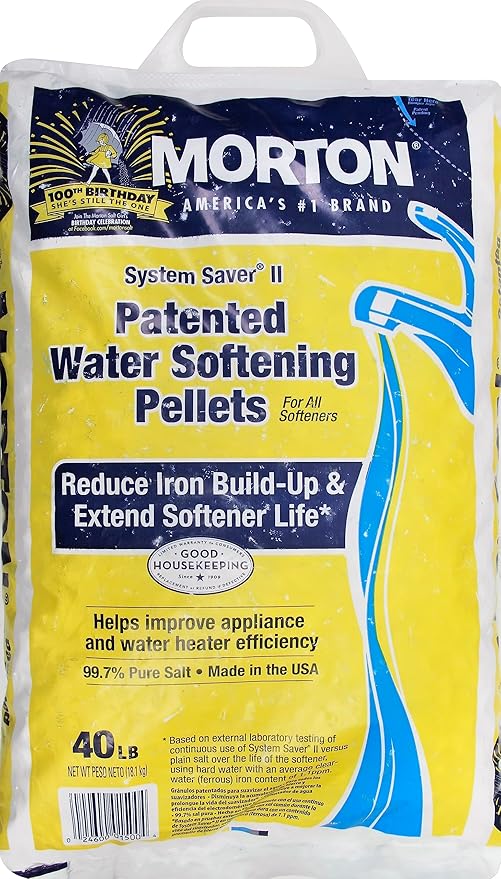
This 40-pound bag of USA-made System Saver pellets is designed to improve the taste of your water while helping extend the life of your appliances and water softener. Simple to use, just add the pellets directly to your softener's brine tank as needed.
Check On AmazonIf you click this link and buy, we earn a commission at no additional cost to you.
FAQs
💧 How hard is Phoenix tap water exactly?
Phoenix tap water typically tests between 16 and 20 GPG depending on the part of the metro and the time of year. Scottsdale and Chandler tend toward the higher end of that range. Tucson draws from a mix of Colorado River water and local groundwater, with similar hardness levels. You can confirm your specific hardness by requesting a water quality report from your municipal water provider or using a basic hardness test kit.
📏 What size water softener do I need for a family of 4 in Arizona?
At 18 GPG, a family of 4 generates roughly 37,800 grains of demand per week. A 48,000-grain system technically covers that, but with very little margin for peak usage days, and real-world usable capacity at salt-efficient settings runs below the nominal grain number. An 80,000-grain system gives comfortable cycling headroom at Phoenix-level hardness. For 20 GPG or households of 5 or more, twin alternating is worth looking at seriously.
🔁 What does twin alternating mean and do I need it in Arizona?
Twin alternating systems use two resin tanks. When one exhausts and regenerates, the second takes over automatically, so there is never a window of unsoftened water reaching your fixtures. For households of 4 or more at Arizona hardness levels, where regen cycles are more frequent than average, twin alternating eliminates the risk of hard water during regen. It is not required for smaller households with predictable low-demand overnight schedules, but for larger Arizona households it is the more reliable setup.
🧪 Does Arizona city water have iron in it?
Arizona municipal water from Colorado River sources is treated before distribution, and iron levels in most Phoenix-area tap water are low enough that they do not affect softener sizing or resin selection. Iron pre-treatment that is mandatory for well water is generally not needed for Arizona city water. Hardness is the primary problem to solve.
⚙️ Does crosslink percentage really matter for Arizona water softeners?
Yes, more than in lower-hardness markets. A system running on Arizona water at 18-20 GPG regenerates more frequently than the same system at 8 GPG, which means more cumulative chlorine contact with the resin over time. 10% crosslink resin holds up significantly better under that exposure than 8% crosslink. Most box store listings do not specify crosslink percentage. Check the manufacturer’s spec sheet before buying to confirm it.
🏙️ Is Scottsdale water harder than Phoenix water?
Scottsdale tends to test toward the higher end of the Phoenix metro range, commonly 18-20 GPG. The variation across the metro reflects distribution differences and seasonal blending of water sources. For sizing purposes, use your actual test result rather than a city average. Your municipal water quality report will give you the specific number you need.