What Happens Inside the Resin Tank
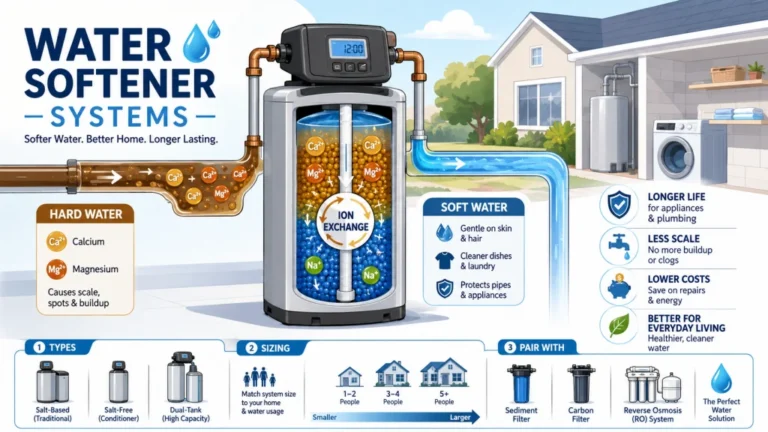
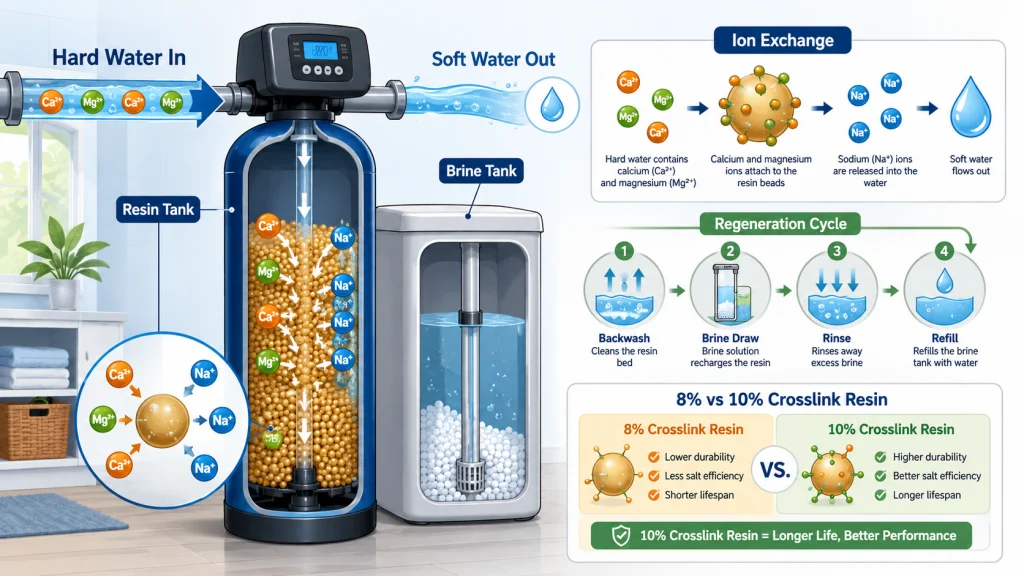
The resin tank is where softening actually takes place. Inside it are millions of tiny polystyrene beads carrying a negative electrical charge. Calcium and magnesium ions, which are both positively charged, get attracted to those beads as hard water passes through. The exchange happens fast. What flows out the other side is water where calcium and magnesium have been replaced by sodium ions, which do not form scale on your pipes, appliances, or fixtures.
The most common mistake I see homeowners make is thinking the resin is some kind of filter that physically traps particles. It is not. It is an exchange, not a strainer. Calcium and magnesium leave the water and bond to the resin. Sodium, which was already sitting on the resin from the last regeneration cycle, takes their place in the water. Your supply goes from 18 GPG to essentially zero without anything being physically captured or removed in the way a sediment filter works. That distinction matters when people ask whether a softener removes other contaminants. It does not. Ion exchange is specific to calcium and magnesium, with limited capacity for ferrous iron in low concentrations.
Resin does not last forever. Over time the beads physically degrade from mechanical stress, oxidation, and chlorine exposure if you are on city water. How fast depends entirely on a specification you will not find on most consumer product listings: the crosslink percentage. That is the last section of this article, and it is the part worth paying closest attention to before you buy anything.
The Brine Tank and What the Salt Actually Does
The brine tank sits beside the resin tank and holds your salt. Water fills the bottom of the brine tank to a set depth and dissolves the salt into a concentrated solution called brine. That brine is what recharges the resin during regeneration. Without it, the resin stays loaded with calcium and magnesium and the system stops softening.
Here is the chemistry in plain terms. Once the resin beads are fully loaded, you need to knock those minerals off so the beads can work again. Flooding the resin with a concentrated sodium solution does exactly that. Sodium ions, present in overwhelming numbers, displace the calcium and magnesium back into solution. The system then flushes those displaced minerals down the drain along with the spent brine. The resin, recoated with sodium, is ready for another softening cycle. Salt is not the softening agent. It is the reset mechanism that makes continuous softening possible.
A certain amount of standing water in the brine tank is normal and expected. I have had homeowners call convinced their system is leaking because they see water sitting in the salt tank. That water needs to be there to form the brine solution. What you should not see is water rising above the salt line or overflowing the tank, which points to a float or valve issue. The other thing to check periodically is a salt bridge, a hardened crust of fused salt that forms across the tank and creates a hollow space underneath. The level looks fine from the top, there is visible salt, but there is no dissolved brine below it. The system regenerates and draws almost nothing. Water stays hard. Break up the bridge, let it dissolve, and the system returns to normal.
Field Note: Salt bridges are more common in humid environments or when using certain fine-grain salt types. I have found them in systems that looked completely normal from the outside, salt full, water in the tank, no visible problems. If a system is regenerating on schedule but water hardness is creeping back up, checking for a bridge is the first step before touching anything else.

This 3-pack delivers 75 pounds of Morton salt pellets in lighter 25-pound bags, each featuring a sturdy plastic handle and easy-tear opening for more manageable lifting and pouring. Regular use helps reduce mineral buildup inside pipes and appliances, softens water to protect skin and hair from dryness, and leaves glasses, dishes, and faucets virtually spot-free.
Check On AmazonIf you click this link and buy, we earn a commission at no additional cost to you.
The Control Valve: Timer-Based vs. Demand-Initiated
The control valve is the system’s brain. It manages when regeneration happens and sequences every stage of the cycle. There are two ways it can decide when to regenerate, and the difference has a measurable impact on how much salt and water your system consumes over its lifetime. Timer-based valves regenerate on a fixed schedule regardless of actual water use. Set it to regenerate every three days and it regenerates every three days, whether you had a full house of guests or spent the week traveling. Demand-initiated valves, also called metered controls, track actual water consumption through a meter on the outlet and trigger regeneration only when the resin is approaching capacity. Most residential installs today should use demand-initiated. Salt usage drops 30 to 50 percent on average compared to timer-based systems because the valve is not running cycles the resin does not need.
Timer-based controls still make sense in one specific situation: extremely hard water at high daily household volume where the system is running close to resin capacity every day regardless. At 20 GPG with a family of six, the gap between the two approaches narrows significantly. For anyone else, and especially for households with variable usage or those on a septic system where you want to minimize regeneration frequency, demand-initiated is the better choice. The broader picture of how this decision fits into choosing the right system overall is covered in the water softener systems overview, which routes through every major evaluation point from types to sizing to comparisons with other treatment options.

IAPMO certified to NSF/ANSI Standard 44, this system is sized for homes with up to 5 people and 4 bathrooms, using ion exchange to deliver soft, scale-free water from every tap with city or well water compatibility. The user-friendly LCD allows metered operation that uses up to 50% less salt and 28% less water compared to standard time-based softeners, helping lower long-term costs on appliances, soap, and cleaning products. The bundle includes a recommended pre-filter and installation kit, and is backed by a 5 to 10-year limited warranty with dedicated customer support.
Check On AmazonIf you click this link and buy, we earn a commission at no additional cost to you.
The Regeneration Cycle, Stage by Stage
Regeneration is the process that resets the resin back to working capacity. Most systems run it automatically overnight when water demand is low. The full cycle takes 90 to 120 minutes depending on system size and is divided into five distinct stages, each doing a specific job in sequence.
| Stage | Approximate Duration | What Happens |
|---|---|---|
| Backwash | 5 minutes | Water flows upward through the resin bed to loosen and flush out accumulated debris and fine particles |
| Brine Draw | 30 to 60 minutes | Brine is drawn slowly from the salt tank and through the resin, displacing calcium and magnesium off the beads |
| Slow Rinse | 30 minutes | Fresh water pushes remaining brine and displaced minerals through at a slow rate that completes the ion exchange process |
| Fast Rinse | 10 minutes | Higher-velocity rinse seats the resin bed and removes any remaining brine before returning to service |
| Brine Refill | Variable | Water refills the brine tank to the preset level so the salt can dissolve in preparation for the next cycle |
During regeneration, most systems default to a bypass position so household water is served directly from the main supply rather than through a tank mid-cycle. If your water feels noticeably hard during an overnight window, that is usually what is happening and it is normal behavior. The system returns to soft water service once the cycle completes.
Regeneration also uses water, typically 40 to 65 gallons per cycle depending on system size. That is a real operating cost worth factoring in. An oversized system on a small household regenerates less frequently, but when it does run, it consumes more water per cycle than the household actually requires. One size above the calculated minimum is fine as a buffer. Two sizes above introduces inefficiency that adds up over years of operation.
Note: Normal service and regeneration are two distinct modes. During normal service, hard water enters the resin tank, calcium and magnesium bind to the beads, and softened water flows to the house. During regeneration, the valve redirects flow: brine enters the resin tank, sodium displaces the captured minerals, and the waste goes to drain. The house may receive bypassed unsoftened water during the cycle. Once refill completes, the resin is reloaded with sodium and normal service resumes.
The Crosslink Percentage: The Spec That Determines How Long Your Resin Lasts
This is the part I want you to stop and read carefully, because it directly affects how long your system actually works at full capacity and it is absent from nearly every consumer-facing product listing you will find at home centers or on box store websites.
Resin beads are made from polystyrene crosslinked with divinylbenzene. The crosslink percentage describes how densely that molecular structure is woven together. Standard resin uses 8 percent crosslinking. Higher-quality resin uses 10 percent. The practical difference matters most for city water users, because municipal water contains chlorine and chloramines used in treatment. The more open 8 percent structure absorbs chlorine and degrades faster. The denser 10 percent structure resists that chlorine exposure significantly. On city water with typical chlorination, 8 percent crosslink resin commonly lasts 5 to 10 years before softening capacity drops noticeably. Ten percent crosslink resin on the same water supply commonly runs 10 to 20 years.
Replacing resin costs $100 to $300 depending on tank size, plus labor if you are not doing it yourself. The crosslink spec directly determines your service interval. A system that ships with 10 percent crosslink resin is not just a better product on paper. It is a system that costs less to own over its actual lifespan. The problem is that manufacturers using standard 8 percent resin rarely advertise the spec because it is not a selling point. Manufacturers using 10 percent crosslink resin tend to call it out explicitly because it is one of the few specifications that genuinely differentiates a better product from a cheaper one.
- 8 percent crosslink resin is standard on most home center softeners and entry-level online brands. Most product listings at major home centers do not specify crosslink percentage at all, which in practice means you should assume 8 percent.
- 10 percent crosslink resin appears in higher-quality direct-to-consumer systems and is worth seeking out specifically if you are on chlorinated city water, which covers most US households.
- If the product page does not state the crosslink percentage, treat it as 8 percent. The absence of the spec is itself informative.
- Well water users face different degradation risks, primarily from iron and oxidizing agents. Crosslink percentage still matters, but iron fouling often becomes the limiting factor before chlorine damage has time to accumulate.
Before grain capacity or warranty language, I look for one thing first: whether the resin grade is stated. Most listings leave it out, and that omission tells you something on its own. If you are on city water and expect to stay in the same house for more than a decade, it is worth asking about before committing to any particular system. If you are still working through the full picture of what makes a water softener worth buying in the first place, the complete water softener guide covers the full lifecycle from hard water identification through installation and long-term maintenance decisions.
Key point: For city water households with chlorinated supply, 10 percent crosslink resin extends service life significantly compared to standard 8 percent resin. The spec rarely appears on home center listings. Ask for it by name or verify it in the product documentation before buying.
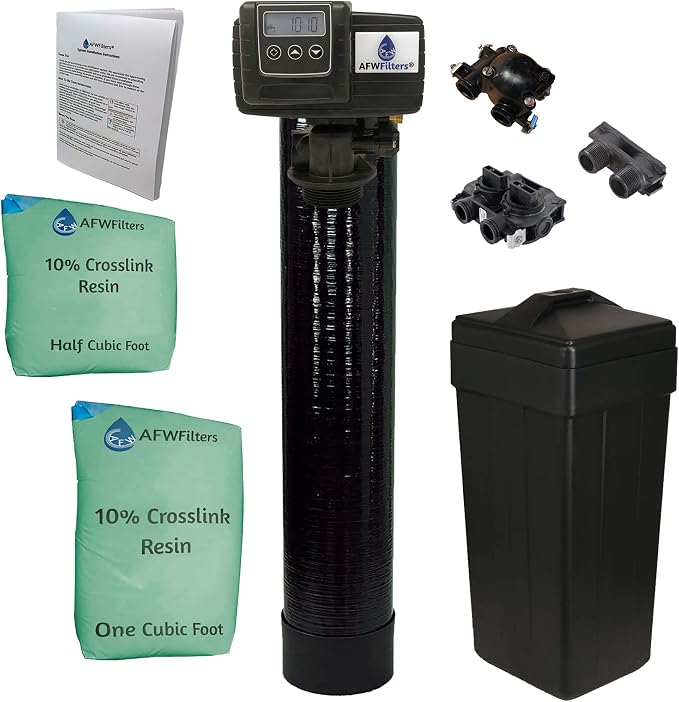
This high-capacity whole house water softener uses ion exchange to remove calcium and magnesium, eliminating hard water scale and restoring soap efficiency throughout your home. The Fleck 5600SXT digital on-demand control valve regenerates only when needed, saving salt and water, and features a backlit LCD display with 48-hour power backup. The poly-glass mineral tank carries a 10-year warranty while the control valve has been tested for up to 27 years of continuous use. The included Clack brine tank holds up to 250 pounds of salt and comes with a safety float to prevent overflow. Most homeowners can install this USA-made system themselves using the provided video instructions.
Check On AmazonIf you click this link and buy, we earn a commission at no additional cost to you.
Final Thoughts: What Knowing the Mechanism Changes
Once you understand how ion exchange actually works, a few things become clear that the shelf display does not make obvious. Softening removes specific minerals and nothing else. It adds trace sodium in exchange. It requires salt and water to regenerate on a regular cycle. Two systems with the same grain capacity can age completely differently depending on resin grade and water chemistry. That is why the mechanism matters as much as the spec sheet before you spend anything.
If you have your water hardness number and are ready to calculate what grain capacity you need, including the iron adjustment that changes the math significantly for well water, that is at what size water softener do I need. If you want to understand how salt-based ion exchange compares to salt-free conditioners, dual tank systems, and electronic descalers before making a type decision, including the honest case against one of those four options, that is at types of water softener systems.

This kit includes 150 dip-and-read test strips for quickly measuring water hardness across virtually any source, including home faucets, well water, softeners, dishwashers, showers, and aquariums. Results are instant and easy to read against a color chart, making it simple to verify whether your water softener, reverse osmosis, or water conditioning system is performing as expected. A bonus eBook is included to help you record, track, and interpret your results over time.
Check On AmazonIf you click this link and buy, we earn a commission at no additional cost to you.
FAQs
🧂 How much salt does a water softener use per month?
A typical residential softener uses 6 to 10 pounds of salt per regeneration cycle. Demand-initiated systems use 30 to 50 percent less salt overall compared to timer-based systems because they only regenerate when the resin actually needs it. For a family of four at 10 to 15 GPG, monthly salt use commonly falls somewhere in the 40 to 80 pound range, though actual numbers vary with water hardness and household consumption.
💧 Why does my water softener run at 2 a.m.?
Most control valves are programmed to regenerate during low-demand hours to avoid running a 90 to 120 minute cycle while people are showering or running appliances. Two to four in the morning is the standard default window. The timing is adjustable in the control valve settings if it causes any issues.
🔍 Why is my water still hard after regeneration?
If hardness persists throughout the day after a completed cycle, the most common causes are a salt bridge in the brine tank preventing proper brine formation, a valve malfunction interrupting the regeneration sequence, or resin that has degraded past effective capacity. Check for a bridge first. It is the most frequent culprit and the easiest to fix without calling a technician.
⚗️ Does a water softener remove chlorine?
No. Ion exchange resin is charged to attract calcium and magnesium specifically. Chlorine passes through unchanged. For city water households who want chlorine removed, whether for taste, skin sensitivity, or resin protection, a carbon pre-filter installed upstream of the softener handles chlorine before it reaches the resin tank.
🪣 Is it normal to have water sitting in the brine tank?
Yes, standing water in the brine tank is normal. The system needs water present to dissolve the salt into a brine solution between cycles. The concern is water rising above the expected level or overflowing the tank, which points to a float or injector issue that needs attention. Water sitting below the salt line is doing exactly what it is supposed to do.
🔩 What is 8% vs 10% crosslink resin and does it matter?
Crosslink percentage describes the density of the resin bead structure. Ten percent crosslink resin resists chlorine degradation significantly better than 8 percent. For city water with chlorination, this difference commonly extends resin service life from 5 to 10 years to 10 to 20 years. The spec is not listed on most home center products, so if the product page is silent on crosslink percentage, assume 8 percent.