The Naming Confusion That Costs Homeowners Thousands
A water conditioner is not a water softener. This confusion, deliberate in many cases, is one of the most expensive instances of mislabeling in residential water treatment. The buyer searches for a water softener, finds a salt-free system with the word “softener” somewhere in its product name or description, buys it expecting soft water, and calls months later wondering why nothing changed. The water still tests hard. The skin still feels dry. The shampoo still will not lather. Nothing is broken. The system is doing exactly what it was designed to do. It just was not designed to do what the buyer needed.
Both technologies address hard water. That is the extent of their overlap. What they do to your water chemistry, and what results you can expect afterward, are fundamentally different. Before spending anything on either system, you need to understand what each one actually does at the mineral level, because that is where the practical difference lives.
What a Salt-Based Water Softener Does to Your Water
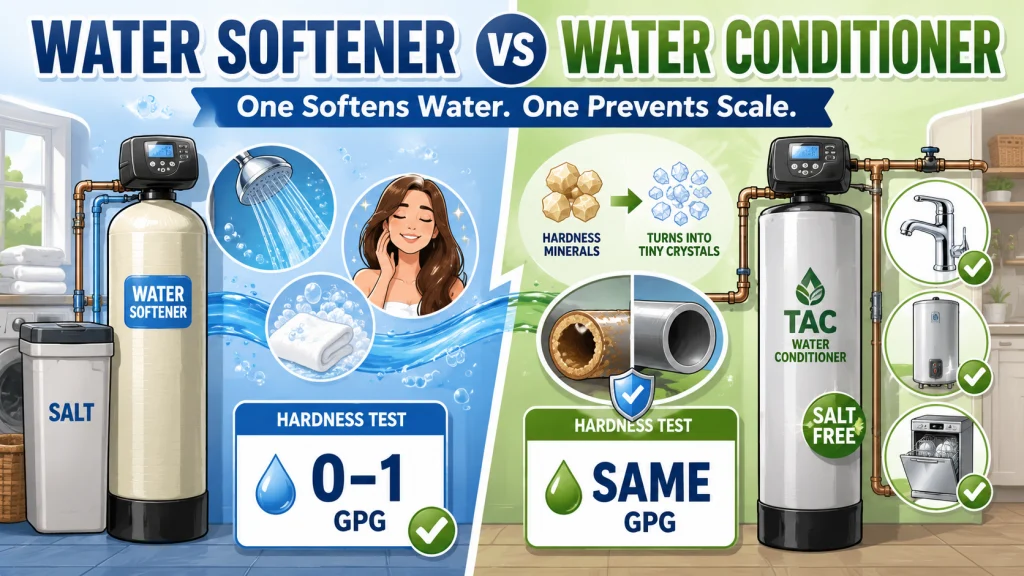
A salt-based softener works through ion exchange. Hard water enters a resin tank charged with sodium ions. Calcium and magnesium in the water have a stronger attraction to the resin beads than sodium does, so they bind to the resin and sodium is released in their place. By the time water exits the system, those hardness minerals are physically gone from the water. Test the output with a standard drop-count titration kit or test strips, and you will get a reading of 0 to 1 GPG regardless of what came in at the inlet.
I have tested the output on more installs than I can count. Incoming water at 22 GPG reads 0 GPG downstream of a properly sized and configured ion exchange system. At 14 GPG, same result. The minerals are not being masked or altered in structure. They are removed. That removal is what produces the soft feel in the shower, the improvement in soap and shampoo lather, and the difference in how laundry comes out. It is also what eliminates scale completely, because the calcium and magnesium responsible for scale buildup are no longer present.
Field Note: One of the most consistent reactions I see after a new ion exchange system goes live is homeowners telling me their skin stopped feeling dry. They had been using extra lotion for years and never connected it to the water. At 20-plus GPG, that is not a minor effect. Hard water minerals react with soap and leave a residue film on skin. Remove the minerals, the residue stops. The first shower after a softener goes live tends to be a convincing demonstration.

IAPMO certified to NSF/ANSI Standard 44, this system is sized for homes with up to 5 people and 4 bathrooms, using ion exchange to deliver soft, scale-free water from every tap with city or well water compatibility. The user-friendly LCD allows metered operation that uses up to 50% less salt and 28% less water compared to standard time-based softeners, helping lower long-term costs on appliances, soap, and cleaning products. The bundle includes a recommended pre-filter and installation kit, and is backed by a 5 to 10-year limited warranty with dedicated customer support.
Check On AmazonIf you click this link and buy, we earn a commission at no additional cost to you.
What a TAC Water Conditioner Does Instead
A water conditioner using TAC technology, which stands for Template Assisted Crystallization, takes a different approach entirely. Water passes through a media bed containing nucleation sites. Hardness minerals are encouraged to form microscopic crystals around those sites as they pass through. Once in crystal form, the minerals are far less likely to adhere to pipe walls, heating elements, and appliance surfaces. They pass through your plumbing without sticking, and scale formation is significantly reduced as a result.
Here is the part that surprises most buyers: test the water coming out of a TAC conditioner with a standard hardness test kit and you will get the same reading as your source water. If you went in at 18 GPG, you are coming out at 18 GPG. The calcium and magnesium are still present in the water. The conditioner did not remove them. It changed their structure so they behave differently when they contact surfaces, but a hardness measurement does not care about crystal structure. It measures the minerals themselves, and those are all still there.
That is not a defect. It is the expected result of the technology. The problem comes when a homeowner buys a system expecting a lower number on a water test and interprets the unchanged reading as evidence the system failed. It did not fail. It was sold inaccurately.
The Water Test That Tells You Everything
The simplest way to understand the difference between these two technologies is to look at a single outcome: what your hardness test reads after installation. With ion exchange, the number drops to near zero. With a TAC conditioner, the number stays the same as your incoming water. That one data point tells you which technology you actually purchased and whether it matches what you set out to accomplish.
| Salt-Based Softener | TAC Water Conditioner | |
|---|---|---|
| Core technology | Ion exchange | Template Assisted Crystallization (TAC) |
| Hardness minerals removed | Yes | No |
| GPG reading after treatment | 0 to 1 GPG | Same as source water |
| Scale prevention | Yes | Yes |
| Softer skin and hair feel | Yes | No |
| Improved soap lather | Yes | No |
| Uses salt for regeneration | Yes | No |
| Adds sodium to water | Yes, trace amounts | No |
| Effective range | Works across low to very high hardness when properly sized | Best at 7 to 15 GPG |
I have had to walk more than a few homeowners through this conversation after the fact. They ran a test strip on their conditioner output, got 14 GPG, and assumed something was wrong. The explanation is always the same: the system is working correctly. The test is measuring what it is supposed to measure. The harder part is explaining that the system may be working fine, but it was never the right tool for the problem they wanted solved.

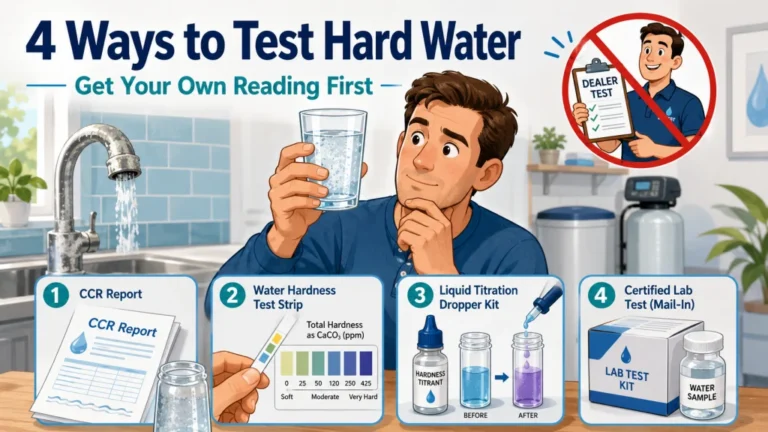
This kit lets you test drinking water, pool water, or any water source in seconds using a simple dip-and-read method with an oversized color chart ranging from red to green, covering 0 to 25 GPG and 0 to 425 PPM. All 100 strips are protected by FreshSeal technology across a ready-to-use bottle and two sealed pouches for long-term accuracy. Each purchase also funds a full year of clean water for someone in the Central African Republic.
Check On AmazonIf you click this link and buy, we earn a commission at no additional cost to you.
What the Difference Means for Skin, Hair, and Laundry
If the reason you are considering treatment is how hard water affects your skin, your hair, or the way your laundry comes out, a TAC conditioner will not fix any of those things. The softer feel after a shower comes from the absence of calcium and magnesium. The improvement in shampoo and soap lather comes from that same absence. Clothes that come out of the wash without a stiff or dingy quality come from removing the minerals that deposit in fabric fibers during the wash cycle. You need the minerals out of the water, not reorganized into a different structure while still present in the water.
One of the most common situations I run into is a homeowner who spent $1,200 to $2,500 on a salt-free system marketed as a water softener and called to report the same problem. The complaint is always similar: the test number has not moved, the shower does not feel any different, and the laundry still has that hard-water stiffness. Nothing changed because the system was never designed to produce those outcomes. This is not a product defect. It is a marketing problem that the buyer paid for.
A TAC conditioner can do real work on scale. Mineral buildup inside water heaters, on pipe walls, and on appliance heating elements can be significantly reduced because the conditioned minerals are less likely to stick to those surfaces. At 10 to 15 GPG on city water, that is a genuine and measurable benefit worth paying for. But scale prevention and water softening are two different outcomes, and treating them as interchangeable is how buyers end up with the wrong system.
Why Salt-Free Systems Get Marketed as Water Softeners
The reason TAC conditioners end up sold under softener branding is not complicated. Consumers search for water softeners. That is the category term that dominates search volume. Manufacturers who make conditioners have a direct commercial incentive to use that language on their product pages, even when their technology does not soften water by any standard hardness measurement. The result is a category where the label often promises the exact thing the product does not actually do.
Spend an hour reading home improvement forums on this topic and the pattern becomes clear. Post after post from buyers who installed a salt-free system labeled as a softener, ran a water test, got the same hard reading as before, and concluded the system was broken or fraudulent. In most of those threads, someone eventually explains that TAC does not change the hardness reading. Some homeowners take the answer in stride. Others are understandably frustrated, because nobody told them this upfront and they made a purchase decision based on terminology that did not accurately describe the product. The tractorbynet forum has a quote I keep coming back to on this: someone with direct experience in the field stating flatly that they had never encountered a no-salt product that actually softened water. That matches what I have seen.
The question to ask before buying any salt-free system is simple: will a standard water hardness test show a lower GPG reading after installation? If the answer from the manufacturer is anything other than a clear no, ask again. With ion exchange, the reading drops to near zero. With TAC, it stays the same as your source water. Both answers are honest. You just need to know which one you are getting.
When a Water Conditioner Is the Right Choice
Conditioners are not bad products. They are specific-purpose products, and in the right situation they are a reasonable and cost-effective tool. The issue is when they are sold into the wrong situation. Understanding where each system fits saves money and avoids the mismatch that produces most of the frustration I see from homeowners who feel like they got burned.
- Scale prevention is the only goal. If your water heater, dishwasher, and fixtures are accumulating mineral buildup and you have no interest in the feel of soft water or improved lather, a conditioner addresses that problem without the ongoing salt cost and maintenance of an ion exchange system.
- Hardness is in the moderate range, roughly 7 to 15 GPG. TAC performs most reliably at these levels. At 20 GPG and above, the mineral load increases to the point where ion exchange is the more dependable long-term solution for both scale control and full softening.
- Salt discharge restrictions apply. Several states and municipalities, particularly in parts of California, restrict or ban salt-based softeners due to concerns about sodium in wastewater. In those areas, a TAC conditioner may be the only compliant option available.
- Adding sodium to the water supply is a concern. A salt-based softener adds a small amount of sodium to treated water. For most households this is not a meaningful issue, but for anyone closely managing sodium intake, a conditioner removes that variable entirely.
- The source is municipal water with no iron. TAC handles calcium carbonate hardness well. It is not designed for iron, manganese, or hydrogen sulfide. City water with standard calcium and magnesium hardness and no iron is the environment where conditioners perform as intended. Well water with iron is a different problem that requires a different treatment approach.
If your situation falls outside these conditions, particularly if you have well water with iron, hardness above 18 to 20 GPG, or you are specifically looking for the feel of soft water, ion exchange is the better fit. For a detailed breakdown of how these and other system types compare, the article on types of water softener systems covers each option in full.

Designed for homes with 2 to 4 bathrooms, this maintenance-free Template Assisted Crystallization system prevents scale buildup and protects pipes and appliances without salt, chemicals, electricity, backwashing, or drainage. The TAC process converts hard water minerals into microscopic seed crystals that stay suspended in the water stream rather than attaching to surfaces, gradually dissolving existing scale over time. Installation is a simple pipe-in and pipe-out connection, and the complete system includes media, mineral tank, distributor assembly, tank head, and bypass valve.
Check On AmazonIf you click this link and buy, we earn a commission at no additional cost to you.
Quick Scenarios: Which System Actually Fits Your Situation
A lot of the confusion around these two technologies comes from reading about them in the abstract. It helps to anchor the decision to a specific water situation, because that is how the practical difference becomes obvious. The scenarios below are not exhaustive, but they cover the cases I see most often.
If you are on city water at 10 to 12 GPG, frustrated by scale buildup on fixtures and the inside of your water heater, but you have no particular complaint about how the shower feels or how laundry comes out, a TAC conditioner is a reasonable fit. You are solving a scale problem, not a softness problem, and a conditioner is designed for exactly that. A full ion exchange system would also work, but it would be more hardware and ongoing salt cost than your situation requires.
If you are at 18 to 25 GPG and the complaints include shampoo that will not lather, laundry that comes out stiff, skin that feels dry after showering, and scale on top of all that, you are describing someone who needs ion exchange. A conditioner will not produce any of those improvements. The mineral load is also getting high enough that TAC becomes less reliable for scale control anyway.
If you have well water with any iron or rust staining, conditioner is the wrong starting point regardless of hardness. Iron can foul the TAC media, and the treatment order for well water typically requires sediment filtration and iron removal upstream of any softening stage. Get the iron handled first, then revisit which softening approach fits what is left.
If you are in a region with salt discharge restrictions and your primary concern is scale rather than soft water feel, a conditioner may be your practical option. Just go in knowing your hardness test result will not change after installation, and set your expectations around scale prevention rather than softening. Those are different outcomes, and the conditioner delivers one of them.
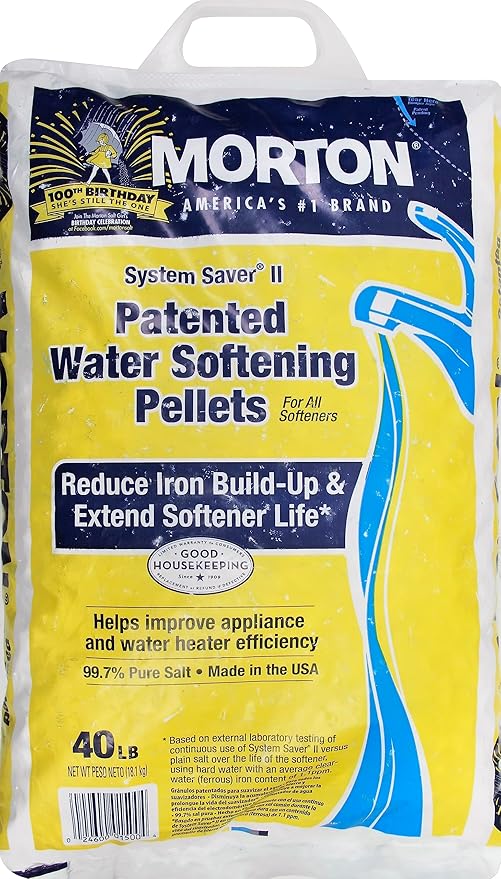
This 40-pound bag of USA-made System Saver pellets is designed to improve the taste of your water while helping extend the life of your appliances and water softener. Simple to use, just add the pellets directly to your softener's brine tank as needed.
Check On AmazonIf you click this link and buy, we earn a commission at no additional cost to you.
Final Thoughts: The Right Tool Starts With the Right Problem
The core issue here is not that water conditioners are ineffective. In the right situation, TAC does exactly what it is supposed to do, and it does it without salt, without a regeneration cycle, and without a drop in your hardness reading. The problem is a consistent mismatch between what buyers are led to expect and what the technology actually delivers, driven largely by product naming that borrows the wrong category.
Before you buy anything, get clear on the outcome you are actually after. If you want a lower number on a water test, softer skin in the shower, better soap performance, and laundry that comes out without a stiff or dingy quality, you need ion exchange. If you want to reduce scale formation in your pipes and appliances without adding salt to your water supply, a TAC conditioner is a legitimate and lower-maintenance tool for that specific problem. The two technologies are not interchangeable, and the marketing will not always make that clear to you.
If you are still in the early stages of sorting out which type of system makes sense for your water and your home, the water softener systems hub is a good place to get oriented on the full range of options before committing to a direction. And if you are further back in the process and want the full picture from hard water identification through treatment and beyond, the complete water softener guide covers the entire lifecycle in one place.
FAQs
💧 Is a water conditioner the same as a water softener?
No. A water softener uses ion exchange to physically remove calcium and magnesium from the water, dropping the hardness reading to 0 to 1 GPG. A water conditioner uses TAC technology to change the crystal structure of those minerals so they resist scale, but leaves them present in the water. Your hardness test will still show the same GPG reading after a conditioner is installed.
🧪 Why does my salt-free system still test hard after installation?
Because most salt-free systems use TAC technology, which does not remove dissolved minerals. It prevents them from forming scale deposits on surfaces. The system is working correctly. If you need a lower hardness reading on a water test, you need an ion exchange softener, not a conditioner.
🚿 Will a water conditioner make my skin feel softer in the shower?
No. The soft feel after showering comes from the absence of calcium and magnesium in the water. A conditioner leaves those minerals present in the water. Any benefit related to skin feel, hair texture, or soap lather requires ion exchange, not conditioning.
🔬 What does TAC stand for and how does it work?
TAC stands for Template Assisted Crystallization. Water passes through a media bed with nucleation sites that cause dissolved hardness minerals to form into microscopic crystals. In crystal form, the minerals pass through pipes and appliances without sticking to surfaces. No salt is used, there is no regeneration cycle, and the hardness reading on a standard test does not change.
🏡 When does a conditioner make more sense than a softener?
City water in the 7 to 15 GPG range where the goal is scale prevention rather than fully soft water. Also in states with salt discharge restrictions, or in households where adding trace sodium to the water supply is a concern. TAC is not well-suited to well water with iron, or to hardness above 18 to 20 GPG.
📏 Does a water conditioner work at high hardness levels, like 25 GPG?
TAC conditioners are most reliable in the moderate hardness range, roughly 7 to 15 GPG. At 25 GPG the mineral load is high enough that ion exchange is the more dependable solution for both scale control and full softening. A conditioner at that level may not keep pace with the scale-forming potential of the incoming water.
⚙️ Can I use a water conditioner if I have well water?
In most cases, no. Well water often contains iron, manganese, or other contaminants alongside hardness, and TAC is not designed to address those. Iron in particular can foul the conditioner media. Well water with hardness typically calls for a sediment pre-filter, iron treatment if needed, and then an ion exchange softener downstream.