The Fear That Sent Rural Homeowners Back to Hard Water
The concern follows a simple and plausible-sounding logic. When a water softener regenerates, it flushes concentrated salt brine through the resin tank to recharge it. That backwash drains into the household plumbing and eventually reaches the septic tank. The worry is that the sodium concentration kills the beneficial bacteria responsible for breaking down waste inside the tank. If the bacterial ecosystem collapses, the septic system stops working. That chain of reasoning gets repeated often enough online that many homeowners treat it as settled fact before they ever look for a source.
From what I have seen, this concern comes up most in rural areas where hard water is genuinely severe. Homeowners dealing with 20, 25, sometimes north of 30 GPG are watching scale build on everything: appliances dying ahead of schedule, shower heads losing flow, water heaters failing years early. They have every practical reason to soften their water. But the septic fear stops them. What the research actually found reverses the assumption almost completely, and it is worth reading the findings carefully rather than taking the online consensus at face value.
Three Research Institutions Studied This. Here Is What They Found.
The University of Wisconsin conducted direct research on water softener discharge and septic system performance. Their finding: increased sodium levels in the septic tank were not just tolerated by the beneficial bacteria doing the biological work, the research recorded a net positive effect on those organisms. The study also examined soil absorption in the drain field and found no negative effect there either. The Missouri Extension Service, which publishes guidance for rural landowners without a commercial interest in any particular answer, later published a PDF citing the UW research and affirming its findings as applicable guidance for homeowners on private septic systems. Two institutions, same conclusion, from opposite ends of the research process.
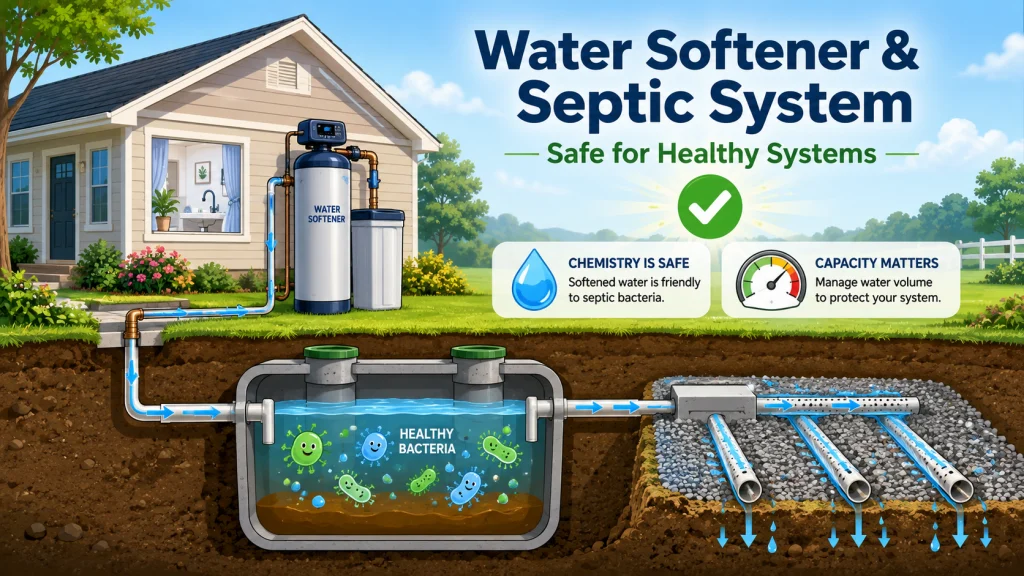
The National Sanitation Foundation came at the question from a different angle: volume rather than chemistry. A standard softener regeneration cycle uses roughly 50 gallons of water. The NSF found that this volume is well within what a healthy, properly sized septic system handles routinely. To put it in terms that are easier to picture: 50 gallons per regeneration cycle is less than one full load in a top-loading washing machine, which uses 40 to 55 gallons per cycle. A septic system that processes laundry without strain processes one regeneration cycle the same way.
Virginia Polytechnic Institute, through research funded by the Water Quality Research Foundation, addressed the bacterial harm question most directly. The researchers looked at what actually happens to beneficial bacteria at the dilution concentrations that softener brine reaches inside a real, operating septic tank. The conclusion: by the time the discharge mixes with the existing tank volume, the concentration is low enough that it does not harm the bacterial ecosystem. The numbers that sound alarming when you picture concentrated salt solution entering the system are not the numbers the bacteria actually encounter.
| The Common Concern | What the Research Found | Source |
|---|---|---|
| Sodium kills beneficial septic bacteria | Not supported. UW research recorded a positive effect on bacterial organisms, not just no harm. | University of Wisconsin, cited by Missouri Extension Service |
| Brine damages drain field soil absorption | Not supported. No negative effect on soil absorption found. | University of Wisconsin |
| Diluted brine still destroys bacterial ecosystem | Not supported. Actual dilution inside a real tank is too low to cause bacterial harm. | Virginia Polytechnic Institute (Water Quality Research Foundation) |
| 50-gallon regeneration volume overloads the system | Not a concern for healthy, properly sized systems. Comparable to one washing machine load. | National Sanitation Foundation |
What is worth noting about these studies is where they came from. The Missouri Extension Service is a land-grant university outreach program. It publishes guidance for rural landowners, not for softener manufacturers. When an institution like that cites research and recommends it to homeowners, it is because the evidence supports the recommendation. Three institutions, from different research angles, arrived at the same place.

This kit lets you test drinking water, pool water, or any water source in seconds using a simple dip-and-read method with an oversized color chart ranging from red to green, covering 0 to 25 GPG and 0 to 425 PPM. All 100 strips are protected by FreshSeal technology across a ready-to-use bottle and two sealed pouches for long-term accuracy. Each purchase also funds a full year of clean water for someone in the Central African Republic.
Check On AmazonIf you click this link and buy, we earn a commission at no additional cost to you.
What the Backwash Carries That Almost Nobody Mentions
There is a detail in the research that rarely surfaces in the typical online discussion about softeners and septic systems. When a water softener regenerates, the backwash does not carry only sodium. It also carries the calcium and magnesium that were stripped from the water during the softening process. Those minerals flow down the drain alongside the salt brine and eventually reach the septic tank and drain field.
Calcium behaves in soil similarly to gypsum. Gypsum is applied to compacted or clay-heavy soils specifically to improve drainage and percolation. It breaks up dense soil structure and helps water move through more efficiently. If your drain field sits in heavy clay, the calcium coming off your softener’s regeneration cycles over time may actually benefit soil structure rather than harm it. The research notes this. Most of the content online covering the softener-and-septic question does not. For homeowners in rural areas with notoriously tight soils and drain field performance concerns already on their radar, this is worth knowing before assuming the worst about discharge.
Field Note: The question I hear most often is some version of whether the salt will “poison” or “sour” the drain field soil over time. What homeowners are picturing is agricultural salt accumulation at very high concentrations, the kind that renders land infertile. That is not what happens here. The concentration that reaches the drain field from a household softener on a normal regeneration schedule is far below any threshold that affects soil biology or plant life in a meaningful way. The two situations are not comparable, and treating them as equivalent is where the fear comes from.
When There Is a Legitimate Reason to Be Careful
None of the above means every septic system handles a water softener without any consideration. There is a real concern. It is just not the one most homeowners are focused on. The risk is hydraulic. A water softener adds roughly 50 gallons to your septic system each time it regenerates. If that happens every two or three days on a meter-based system, or even more frequently on a timer-based unit that runs on a fixed schedule regardless of actual water use, you are adding a meaningful volume of extra water to a system that was originally sized for a specific daily flow based on your household occupancy.
A system in good condition with adequate capacity absorbs that volume without strain. An undersized system, or one where the drain field is already showing signs of deterioration, may not have the margin for it. That is the actual concern, and it is a sizing and condition question, not a salt question. A healthy, properly sized system is not at risk from the chemistry. A marginal or failing system may be pushed further toward hydraulic overload by any additional consistent water input, softener discharge included.
The pattern I have watched repeat across the installs and consultations I have done is homeowners who inherited an older system or have simply not thought about it in a long time. They do not know when it was last pumped. They are not sure of the rated capacity. They want to add a softener on top of an unknown situation. In those cases, the softener is not the variable that concerns me. The unexamined condition of the system underneath it is.
- Get the system inspected and pumped before you install a softener. Know what you are working with. A current inspection tells you tank condition, drain field performance, and whether the system has capacity to absorb additional water volume without strain.
- Check the rated daily flow capacity. This is typically documented in your original permits or your most recent inspection report. If your household water use is already near that limit, the conversation about adding a softener changes.
- Choose demand-initiated regeneration. A meter-based system only triggers a cycle when the resin is actually depleted, not on a fixed timer. This keeps the number of monthly cycles, and the extra water added to the septic system, to the minimum your actual water use requires.
- Know what 50 gallons means in context. One regeneration cycle is roughly the same water volume as one top-loading washing machine load. Your septic system already handles that range on laundry days. Whether it is a problem depends on sizing and condition, not on the presence of salt in the discharge.
Septic system inspected and pumped within the last few years, no signs of slow drainage or backup, household water use is normal for the system’s rated capacity, and you are planning to use demand-initiated regeneration. In this case, the chemistry concern is not a real barrier.
You are not sure when the septic was last pumped, do not know the rated daily flow capacity, recently increased household occupancy, or have well water with high iron that will cause the softener to regenerate more frequently. Get a professional inspection before installing anything.
Once you know your septic is in good shape, the next question shifts from “will this damage my system?” to “how often will this unit regenerate and how is that cycle triggered?” The article on how a water softener works and what triggers the regeneration cycle covers that in detail. Understanding what demand-initiated regeneration actually means, and how it differs from a fixed-timer setup, is the right thing to know before you decide on a unit for a home on septic.

Designed for smaller homes, this system treats up to 32,000 grains of hardness while tackling iron levels up to 10 ppm, removing red staining and preventing scale and spot buildup throughout your entire home. The Aquatrol Advanced Digital On-Demand meter control head features time-delayed, metered, and manual double backwash for thorough regeneration and long-term performance. Built with a high-strength fiberglass-lined polyethylene tank and corrosion-resistant bypass valve, it arrives pre-filled with premium fine mesh resin and includes a 1 inch NPT male adapter for straightforward installation. The system is backed by a 5-year manufacturer warranty.
Check On AmazonIf you click this link and buy, we earn a commission at no additional cost to you.
What Homeowners Found After Years of Actual Use
Research findings matter. So does what happens in real homes over time. On TractorByNet, a forum where rural homeowners and landowners discuss practical property questions without a product to promote, a thread on this exact topic collected observations from multiple homeowners who had been running water softeners on private septic systems for years. Several of them had their tanks professionally pumped and inspected during that period. The consistent report: the tanks were in good shape. In multiple cases, the inspector described the tank as being in near-new condition despite years of softener discharge running through the system.
That kind of independent confirmation is worth weighing alongside the university research. These are property owners who hired a professional, had the system looked at with no expectation of a particular answer, and reported what they were told. The pattern matches what the studies predicted. A well-maintained, properly sized system handles water softener discharge without detectable harm over time. The fear was not confirmed by the evidence, either in the lab or in the field.
If you are still working through whether softening makes financial sense for your household before getting into the specifics of septic compatibility, the breakdown of whether a water softener is worth the cost at your hardness level works through the math directly. The septic question is one piece of the decision. Whether the long-term savings on appliances and energy justify the upfront investment at your specific GPG is another, and that calculation is worth doing before anything else.

Built for 1 to 2 bathroom homes, this professional-grade water softener treats up to 32,000 grains of hardness by removing calcium and magnesium that irritate skin and clog pores, while eliminating scale buildup that damages plumbing and appliances. The fully programmable backlit digital control head lets you customize auto-flush intervals based on your water quality and usage for effortless, ongoing maintenance. Constructed with a fiberglass-lined polyethylene tank, corrosion-resistant bypass valve, and pre-filled premium resin, it is backed by a 30-day money-back guarantee, a 5-year warranty, and lifetime U.S.-based tech support.
Check On AmazonIf you click this link and buy, we earn a commission at no additional cost to you.
Final Thoughts: The Fear Was Chemistry. The Only Real Question Is Condition.
If your septic system is healthy, inspected, and sized correctly for your household, the research is clear: the chemistry concern is not a barrier. The sodium does not harm the bacteria. The volume of one regeneration cycle is not beyond what a working system handles. The calcium in the backwash may actually help a dense drain field over time. The fear that stopped a lot of rural homeowners from acting on their hard water problem is not supported by what three independent institutions found when they went looking.
The decision then is not “is a softener safe for septic?” but “is my septic in good enough shape to take on additional water volume, and am I choosing a unit that regenerates only when it needs to?” Those are answerable questions. Get the system inspected if there is any doubt. Choose demand-initiated regeneration. Then make the call based on what hard water has been costing you, not on a concern the evidence does not back. For a broader look at how residential softening systems differ from each other, the overview at residential water softener systems and how they compare is a useful next step.

IAPMO certified to NSF/ANSI Standard 44, this system is sized for homes with up to 5 people and 4 bathrooms, using ion exchange to deliver soft, scale-free water from every tap with city or well water compatibility. The user-friendly LCD allows metered operation that uses up to 50% less salt and 28% less water compared to standard time-based softeners, helping lower long-term costs on appliances, soap, and cleaning products. The bundle includes a recommended pre-filter and installation kit, and is backed by a 5 to 10-year limited warranty with dedicated customer support.
Check On AmazonIf you click this link and buy, we earn a commission at no additional cost to you.
FAQs
🧪 Will water softener salt kill the bacteria in my septic tank?
No. The University of Wisconsin studied this directly and found that sodium from softener regeneration does not harm beneficial septic bacteria. Virginia Tech confirmed separately that by the time brine reaches the bacterial ecosystem inside a real tank, it is diluted to a concentration well below any harmful threshold.
💧 Can you have a water softener with a septic system?
Yes, in most cases. Research from the University of Wisconsin, the National Sanitation Foundation, and Virginia Tech all found no meaningful harm to healthy, properly sized septic systems from normal softener discharge. The one caveat is hydraulic capacity: if your system is undersized or already deteriorating, the extra water volume from regeneration cycles may add strain. A current inspection tells you which situation you are in.
🔁 How much extra water does a water softener add to the septic system?
Roughly 50 gallons per regeneration cycle, which is comparable to one top-loading washing machine load. How often that happens depends on your water hardness and household usage. A demand-initiated system only regenerates when the resin is depleted, keeping cycle frequency lower than a fixed-timer unit would on the same household.
🌱 Does softener discharge damage drain field soil?
The University of Wisconsin found no negative effect on drain field soil absorption. The calcium and magnesium carried in the backwash may actually improve percolation in dense or clay-heavy soils, similar to how agricultural gypsum is used to loosen compacted ground and improve drainage.
⚠️ When should I actually be concerned about a softener on septic?
When the system is undersized for your household or already showing drain field stress. The concern is volume, not chemistry. Adding 50 gallons per cycle to a system that is already at or near hydraulic capacity can push it further toward failure. Have the system professionally inspected before installing a softener if it has not been serviced recently.
🏡 What is demand-initiated regeneration and why does it matter for a home on septic?
Demand-initiated regeneration, also called meter-based or on-demand, means the system only runs a cycle when the resin is actually depleted rather than on a fixed timer. For homes on septic, this reduces the total number of regeneration cycles per month and keeps the extra water volume added to the system at the minimum your actual water use requires. Timer-based units may regenerate whether they need to or not.
🔬 Which research institutions studied water softeners and septic systems?
The University of Wisconsin, the National Sanitation Foundation, and Virginia Polytechnic Institute, with the Virginia Tech research funded by the Water Quality Research Foundation. The Missouri Extension Service also published guidance for rural homeowners specifically citing and affirming the University of Wisconsin findings.
🪣 Should I get my septic tank pumped before installing a water softener?
Yes, especially if you do not know when it was last done. Pumping and inspection before you add any new consistent water load tells you the current condition of the tank and drain field, and whether the system has the capacity to handle regular regeneration cycles without strain. It is the one practical step that removes the uncertainty from the decision.