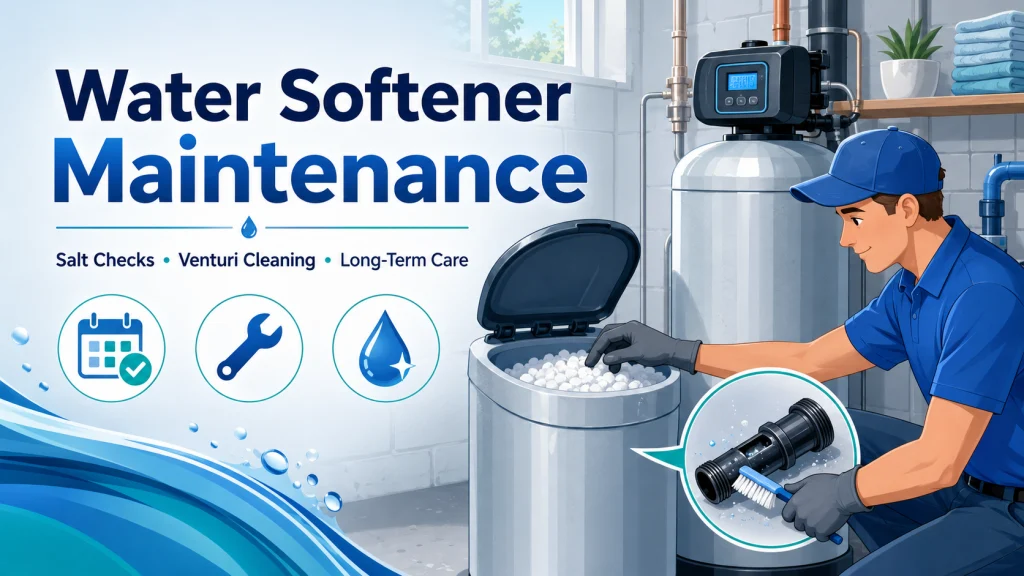
What Water Softener Maintenance Actually Requires
Water softener maintenance is not complicated. It is five tasks spread across five different time horizons, and only one of them gets any meaningful attention in most owner’s manuals. Monthly, you check the salt level. Quarterly, you check for a salt bridge. Once a year, you clean the venturi valve and inspect the brine tank. Every three to five years, you run a resin cleaner treatment. Every ten to fifteen years, depending on your water conditions, you assess the resin itself. That is the complete water softener upkeep picture for a standard residential ion exchange system.
What separates a softener that runs cleanly for twenty years from one that develops chronic problems at twelve is almost always whether the owner followed that schedule, not the quality of the equipment. I have seen well-regarded systems fail early because of neglected venturi valves, and I have seen older, budget units still performing because someone took fifteen minutes once a year to clean the injector. The equipment matters. The maintenance matters more. If you want the full context on how installation decisions connect to long-term upkeep, the practical guide to water softener installation and maintenance covers both phases together.
The sections below break down each task by what it involves, why it matters, and what you are actually looking for when you do it.
Monthly and Quarterly: The Short Checks
The monthly task is simple: look at the salt level in the brine tank. The salt should sit at least one-third full, with the salt visibly above the water line. A household of four with hard water, somewhere in the 15 to 20 GPG range, typically goes through a 40-pound bag every three to four weeks. At 25 GPG or higher, that pace increases noticeably. You do not have to calculate anything precisely; the tank tells you when it is getting low.
Note: Do not fill the brine tank to the top. Halfway to two-thirds is the practical target. A fully packed, compressed salt column is more likely to bridge, which is exactly the next problem this section covers.
Every quarter, check for a salt bridge. A salt bridge forms when salt clumps together into a solid crust above the water line, usually bridging across the walls of the tank. From the outside, the tank appears full. But none of that salt is dissolving into brine because the crust is suspending it above the water below. The softener keeps cycling through its regeneration schedule, draws nothing, recharges nothing, and sends hard water through your pipes. This is one of the most common causes of “my softener stopped working” calls, and the fix costs nothing: push a broom handle firmly down through the salt. Solid resistance above the water level means a bridge. Break it up, then confirm the salt below is actually in contact with the water at the bottom of the tank.
Both of these tasks connect directly to how you manage salt selection, pellet size, and storage conditions. The type of salt you use affects bridging frequency, brine concentration, and how much sludge accumulates in the tank over time. A fuller look at those tradeoffs is in the guide on water softener salt types and usage.
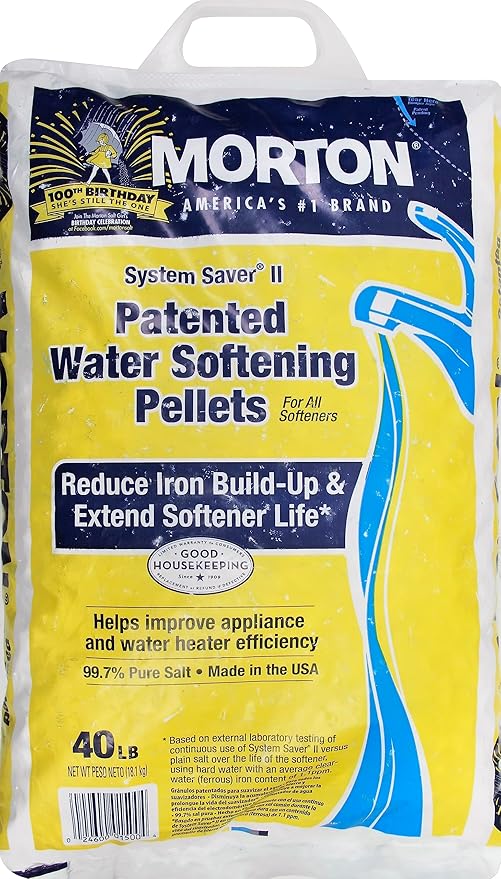
This 40-pound bag of USA-made System Saver pellets is designed to improve the taste of your water while helping extend the life of your appliances and water softener. Simple to use, just add the pellets directly to your softener's brine tank as needed.
Check On AmazonIf you click this link and buy, we earn a commission at no additional cost to you.
The Annual Task Most Owner’s Manuals Don’t Mention
The venturi valve, sometimes called the injector or brine injector, is a small plastic assembly mounted on the side of the control head. Its job is to create the suction that draws brine from the salt tank into the resin tank during each regeneration cycle. When it clogs with mineral deposits or fine sediment, that suction disappears. The softener keeps running through its programmed cycles and looks normal from the outside. But it is drawing no brine, recharging no resin, and producing no soft water. The salt level stops dropping. Hard water comes out of every tap.
Field Note: The pattern repeats constantly. Homeowner calls because the salt level is not dropping. Dealer sends a technician. The tech arrives, pulls out the injector assembly, cleans it with warm water and a small brush, charges $150 to $300, and leaves. When the homeowner asks what was wrong, the answer is a venturi clog. The homeowner has never heard of a venturi valve. It was not in the manual, not in any setup guide, not mentioned at installation. What I have watched play out across hundreds of service calls is that this one $0, fifteen-minute task gets skipped universally, and it is the single most preventable service call I know of.
Cleaning the venturi varies slightly between control head designs, but the process is consistent. Put the softener in bypass mode. Locate the injector cover on the side of the control head, usually a quarter-turn cap or a small plate with two screws. Remove the cover and pull out the injector assembly, which is typically two or three small plastic pieces: a nozzle, a throat, and the injector body. Rinse everything in warm water, use a toothbrush or small brush to clear any visible buildup from the tiny holes and passages, and reassemble. Run a manual regeneration cycle afterward. If the brine tank water level drops during that cycle, the venturi is drawing correctly.
Well water with any iron content, say anything above 1 to 2 PPM, fouls the venturi faster than city water. On those installations, checking the injector twice a year is worth the extra fifteen minutes. City water systems with no iron can typically go a full year between cleanings without issue. The water tells you the schedule, not the calendar.
Annual maintenance also includes a look inside the brine tank itself. If there is more than an inch or two of accumulated sludge at the bottom, the tank is worth cleaning out. The sludge is a mix of undissolved salt residue and mineral deposits. It will not cause immediate failure, but heavy buildup can affect the float valve that controls the water level inside the tank, and a stuck or fouled float valve creates its own category of problems. If your installation includes a pre-filter upstream of the softener, check and replace that cartridge at the annual mark as well, more frequently if you are on well water with visible sediment. A plugged pre-filter creates flow restriction that mimics softener performance issues but has nothing to do with the softener.

This BPA-free, food-grade sediment filter uses a three-layer density design with an absolute 5 micron inner core, nominal 7 micron middle layer, and nominal 10 micron outer layer to capture particles and sediment with 30% longer service life than standard filters. Each filter handles up to 13,000 gallons and fits any standard 20 by 2.5 inch heavy-duty housing, including popular models from Aqua Pure, Pentair, Aquasana, and Hydronix. It is recommended for tap and municipal water sources and should be replaced every 3 to 6 months for optimal performance.
Check On AmazonIf you click this link and buy, we earn a commission at no additional cost to you.
The 3, 10, and 15-Year Marks
Resin beads are the core of a salt-based softener. They are the media that exchanges calcium and magnesium ions for sodium, and they have a finite service life. Under typical city water conditions with no iron, well-maintained resin lasts fifteen to twenty years or longer. Under well water conditions with meaningful iron content, or in municipal supplies with higher chloramine concentrations, degradation happens faster. The beads lose exchange capacity gradually, so the symptoms build slowly: water that stops getting fully soft despite correct regeneration settings, more frequent regen cycles triggered by demand meters, and soft water quality that stops responding to adjustments that used to help.
The three to five year task is a resin cleaner treatment. This is a chemical treatment poured into the brine tank before a regeneration cycle that clears accumulated iron, manganese, and organic compounds off the surface of the resin beads, restoring exchange capacity. For systems dealing with meaningful iron, the treatment interval drops considerably. In my experience, systems installed on well water with iron above 3 or 4 PPM sometimes need a resin cleaner treatment every six to twelve months to maintain full softening performance. The difference in output before and after a proper treatment on a heavily fouled resin bed is not subtle; a hardness test will confirm it clearly.
At the 10 to 15-year mark, resin replacement becomes a realistic consideration rather than a distant one. The symptom is progressive softening decline that cleaning no longer reverses. The resin is simply exhausted. What matters here is that the control valve on a well-maintained residential softener typically lasts twenty years or more. Replacing just the resin inside a valve that is otherwise in good condition is almost always a better financial decision than replacing the entire unit. Resin replacement itself requires specialized equipment and is worth calling a technician for, but knowing that the valve is likely still salvageable changes how you approach that conversation.
| Frequency | Task | Approximate Time |
|---|---|---|
| Monthly | Check and refill salt level | 5 minutes |
| Quarterly | Check for salt bridge | 5 to 10 minutes |
| Annually | Clean venturi valve and injector | 15 to 30 minutes |
| Annually | Inspect brine tank for sludge buildup | 15 minutes inspection, 60 to 90 if cleaning needed |
| Annually | Check and replace pre-filter cartridges | 10 to 15 minutes |
| Every 3 to 5 years | Resin cleaner treatment | 15 minutes to set up, one full regen cycle to complete |
| Every 10 to 15 years | Assess resin condition, replace if exhausted | Professional job, 2 to 4 hours on-site |
City water installations with moderate hardness land toward the longer end of every interval in that table. Well water with iron, or any installation running hardness above 30 GPG, lands toward the shorter end. Think of the schedule as a starting framework that your actual water conditions push in one direction or the other.

This professional-grade liquid cleanser removes iron, manganese, silt, metal particles, and other contaminants that salt leaves behind in your resin bed, valve parts, and beads. Regular use helps extend appliance life, reduce maintenance calls, and maintain consistent water quality across any water softener brand. It is NSF certified to NSF/ANSI/CAN Standard 60 for drinking water additives and is made in the USA, making it safe for families and pets. Apply 4 oz before each regeneration or use with the Pro Products Easy Feeder kit for daily low-dose treatment.
Check On AmazonIf you click this link and buy, we earn a commission at no additional cost to you.
What You Can Handle Yourself and When to Actually Call Someone
The most common reason homeowners call a service technician is a problem they could have fixed in fifteen minutes at no cost. That is not the technician’s fault; it is the result of almost no maintenance education reaching end users after installation. The list of tasks a homeowner can handle without any professional involvement is longer than most people assume:
- Salt check and refill
- Breaking up a salt bridge
- Venturi valve and injector cleaning
- Brine tank cleaning
- Resin cleaner treatment
- Pre-filter cartridge replacement
- Manually initiating a regeneration cycle
- Reprogramming the control head after a power outage
A few basic items cover most of what you will need to handle these tasks without a service call. A small brush or an old toothbrush handles the venturi cleaning. A bucket and a couple of towels are enough for brine tank work. Basic hardness test strips let you confirm whether soft water is actually coming through after a cleaning or regeneration adjustment. A spare pre-filter cartridge is worth keeping on hand if your installation includes a sediment filter upstream of the softener. Resin cleaner is not a standing supply item; use it when your water conditions or softening performance indicate it is needed, not on a fixed calendar.
Where you actually need a professional is a narrower category. Resin replacement requires specialized equipment. Distributor tube failure, the condition where resin beads escape into your home’s plumbing through a broken internal tube, needs immediate action and is not something to troubleshoot slowly. Persistent leaking that O-ring replacement does not resolve, or a control valve motor failure on an older system, are both situations where a trained eye saves time and avoids making things worse. The boundary is roughly this: anything involving salt, brine, and regeneration cycle behavior is homeowner territory. Anything involving the pressurized resin tank structure or internal valve components beyond the injector is worth getting help for.
If you are seeing symptoms that do not match any of the maintenance scenarios in this guide, the water softener troubleshooting guide covers specific failure modes in detail, with diagnostic steps for each.

This kit includes 150 dip-and-read test strips for quickly measuring water hardness across virtually any source, including home faucets, well water, softeners, dishwashers, showers, and aquariums. Results are instant and easy to read against a color chart, making it simple to verify whether your water softener, reverse osmosis, or water conditioning system is performing as expected. A bonus eBook is included to help you record, track, and interpret your results over time.
Check On AmazonIf you click this link and buy, we earn a commission at no additional cost to you.
Final Thoughts: The Fifteen-Minute Job That Pays for Itself Every Year
Most of what goes wrong with a water softener over its lifetime is preventable. The venturi cleaning alone eliminates the most common failure mode. The quarterly salt bridge check prevents a frustrating category of “it just stopped working” calls that look like major repairs but are not. The resin cleaner treatment at the three to five year mark extends the life of the media doing all the actual softening work.
From what I have seen, the homeowners who get twenty or more years out of a softener are not the ones who bought the most expensive equipment on the market. They are the ones who looked inside the brine tank once a year and kept the injector clean. That is most of the maintenance story, and it costs nothing but a bit of time.
FAQs
🧂 How often should I add salt to my water softener?
Check the brine tank every four to six weeks and refill when the salt drops below one-third full. A household of four with moderately hard water typically goes through a 40-pound bag every three to four weeks. Higher hardness levels mean faster salt consumption.
🔧 What does the venturi valve do in a water softener?
The venturi valve creates the suction that draws brine from the salt tank into the resin tank during each regeneration cycle. When it clogs with sediment or mineral deposits, the softener continues cycling but cannot draw brine, so the resin never gets recharged and the water stays hard.
💧 How do I know if my water softener needs maintenance?
The most reliable signs are a salt level that is not dropping despite normal use, water that feels hard again, and scale returning on fixtures and shower glass. A basic hardness test strip will confirm whether soft water is actually coming through the system.
⏳ How long does water softener resin last?
On city water with no iron, well-maintained resin typically lasts fifteen to twenty years or more. Well water with iron, or municipal water with higher chloramine levels, shortens that range. Regular resin cleaner treatments at the three to five year mark help extend service life.
🛠️ Can I do water softener maintenance myself?
Most of it, yes. Salt checks, salt bridge clearing, venturi cleaning, brine tank cleaning, resin cleaner treatments, and pre-filter replacement are all homeowner tasks that require no special tools. Resin replacement and significant control valve failures are the main situations worth calling a technician for.
❓ What happens if you never clean the venturi valve?
The venturi gradually clogs until the softener can no longer draw brine during regeneration. The system appears to run normally, but it uses no salt and produces no soft water. This is the most common cause of softeners that get written off as broken when they are actually just dirty.