
The Formula First, the Brand Name Second
The most common water softener sizing mistake I see is buying based on price without ever running the calculation. Someone sees a 48,000 grain system on sale, it looks like plenty, and they buy it. Maybe it is enough. Maybe it is not. They will not know for six months, at which point either the salt consumption is higher than expected or hardness breakthrough shows up during peak morning use. By then, the return window is long gone.
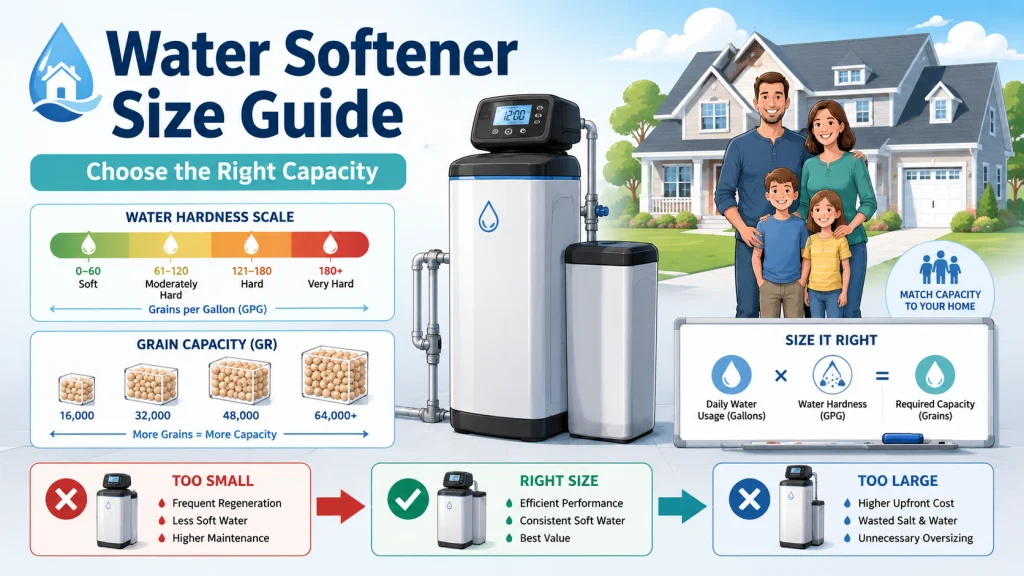
The calculation is not complicated. Multiply your household size by 75, which is a conservative average for daily water use per person in gallons. Multiply that by your water hardness in grains per gallon. Multiply that by seven, because a properly sized system should complete one full regeneration cycle per week. The result is your minimum weekly grain requirement. The tank you choose should meet or comfortably exceed that number after a real-world efficiency adjustment, which is covered in the next section.
To run the calculation, you need three inputs. For city water buyers, the third one usually does not apply, but it is worth confirming before you skip it.
- Your household size, meaning the number of people actively using water in the home on a typical day
- Your water hardness in grains per gallon (GPG), available from your utility’s annual quality report or a water test kit
- Your dissolved iron level in PPM, from a water test, if you are on well water or have any reason to suspect iron
Your GPG number comes from one of two places: your water utility’s annual quality report, which is available free on most utility websites, or a mail-in test kit if you are on well water. Municipal reports sometimes list hardness in mg/L or ppm rather than GPG. Divide that number by 17.1 to convert. A report showing 170 mg/L puts you at 10 GPG. A report showing 306 mg/L puts you at 18 GPG. Those two hardness levels lead to very different sizing outcomes for the same household, which is exactly why this number matters before anything else.
To put the formula in practical terms: a family of four at 10 GPG works out to 4 × 75 × 10 × 7 = 21,000 grains per week. That is a manageable number that a 32,000 grain system can handle comfortably with room to spare. The same family at 18 GPG works out to 4 × 75 × 18 × 7 = 37,800 grains per week. After adding the real-world capacity buffer, the adjusted target lands around 43,500 to 45,500 grains. A 48,000 grain unit technically covers that, but it is running close to its practical ceiling with very little margin. A 64,000 grain system is usually the more comfortable choice at 18 GPG, because the buffer actually exists rather than existing only on paper. If you are in Arizona, Nevada, or parts of Texas where city water regularly runs 16 to 20 GPG, the 48,000 grain tank sitting on the store shelf is often the wrong answer for a family of four, and the right answer depends on which column of the size chart your hardness falls into. The regional picture for city water buyers is covered in the guide to water softeners for hard city water by region.

This kit lets you test drinking water, pool water, or any water source in seconds using a simple dip-and-read method with an oversized color chart ranging from red to green, covering 0 to 25 GPG and 0 to 425 PPM. All 100 strips are protected by FreshSeal technology across a ready-to-use bottle and two sealed pouches for long-term accuracy. Each purchase also funds a full year of clean water for someone in the Central African Republic.
Check On AmazonIf you click this link and buy, we earn a commission at no additional cost to you.
Why the Grain Number on the Box Is Not the Number You Should Use
A 48,000 grain softener does not actually deliver 48,000 grains of capacity under real operating conditions. That rated number is tested at a maximum salt dose that manufacturers do not actually recommend for everyday use, because it is inefficient and expensive to run. At a sensible operating salt dose, real-world capacity runs 15 to 30 percent below the number printed on the box. In practice, a 48,000 grain unit delivers closer to 34,000 to 40,000 grains before it needs to regenerate. That gap matters when you are trying to hit a specific weekly grain target.
Field Note: I have watched this play out repeatedly on installs where the homeowner did everything right except account for the gap between box rating and real-world output. The homeowner buys based on the grain number on the box, runs the system, and notices salt disappearing faster than they planned. We pull the logs and find it regenerating every four days instead of weekly. The rated capacity was technically correct. The real-world operating capacity was not. Nobody closed that gap before the purchase was made.
The practical adjustment is to take your calculated weekly grain requirement and add 15 to 20 percent on top before shopping. If your household needs 21,000 grains per week, you are looking for a rated capacity of at least 25,000 to 26,000 grains as your floor, not your ceiling. For the family at 18 GPG who needs 37,800 grains per week, adding 15 to 20 percent brings the adjusted target to around 43,500 to 45,500 grains. That falls within a 48,000 grain system’s rated range, but leaves almost no practical buffer under real operating conditions. A 64,000 grain unit gives you the actual margin the calculation is supposed to build in. Twin alternating enters the picture when the household is larger, the hardness is higher, or both, not at 18 GPG for a family of four.
The other variable that affects real-world efficiency is how the system decides when to regenerate. Timer-based systems run on a fixed schedule regardless of actual water use. During a week with less activity, the system regenerates anyway, wasting 30 to 50 percent of the salt used in that cycle on capacity it did not actually exhaust. Demand-initiated systems track water use in real time and regenerate only when the resin is close to capacity. At moderate hardness, this is a meaningful efficiency feature. At 15 GPG or higher, it is not optional. A timer-based system at high hardness burns through salt at a rate that will surprise most homeowners after the first full month of use.

Refined to 99.8% purity, these pellets minimize tank residue and are specifically formulated to resist clumping and salt bridges that can cause system malfunctions. By removing hard minerals like calcium and magnesium, they help extend the life of your dishwasher, washing machine, and water heater while preventing scale buildup in pipes. Compatible with all major water softening systems, the 50-pound bag features a patented dual-handle design for easier and safer lifting and pouring.
Check On AmazonIf you click this link and buy, we earn a commission at no additional cost to you.
The Iron Adjustment Most Buyers Miss
Hardness alone does not tell the full story if your water contains dissolved iron. Iron occupies exchange sites on the resin in the same way calcium and magnesium do, which means a system is working against a heavier combined load than the hardness test shows. The standard adjustment is to add 4 to 5 GPG to your hardness number for every 1 PPM of dissolved iron before you run the sizing calculation.
Here is what that looks like in practice. Well water testing at 10 GPG hardness with 2 PPM dissolved iron should be sized as if it were 18 to 20 GPG. For a family of four, that shifts the weekly grain requirement from 21,000 grains to somewhere between 37,800 and 42,000 grains. The system that handles the first number comfortably is completely undersized for the second. This is one of the most consistent errors I see in well water installations, and it almost always shows up as excessive regeneration frequency within the first few months, long after the installation is done and the service window has closed.
The iron situation for well water goes beyond just this sizing adjustment, because dissolved iron and particulate iron behave differently and require different treatment upstream of any softener. The full picture on how iron affects both equipment selection and installation order is covered in the guide to water softeners for well water. Sizing is one part of that decision. Pre-treatment is another, and getting the order wrong is expensive to undo.
For city water buyers, this adjustment almost never applies. Municipal treatment keeps iron well below 0.3 PPM in most US water systems, which is low enough to ignore for sizing purposes. Your utility’s annual report will list iron if it is present. If it does not appear in the report at all, you can treat it as negligible and size from hardness alone.
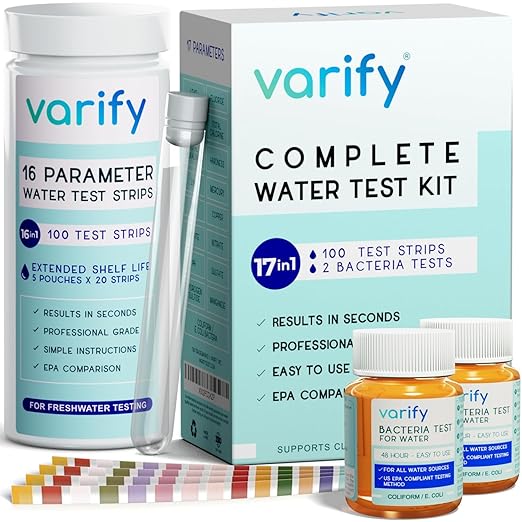
This comprehensive kit tests for 17 parameters including chlorine, fluoride, lead, iron, and bacteria, giving you a full picture of your water's safety in minutes. The 100 color-coded test strips come in 5 individually sealed pouches of 20 for extended freshness, while 2 included bacteria tests deliver results within 48 hours. Every purchase contributes a portion of proceeds to Water For Good, supporting clean water access in Central Africa.
Check On AmazonIf you click this link and buy, we earn a commission at no additional cost to you.
The Oversizing Problem Nobody Mentions
Every conversation about water softener sizing focuses on going too small, and the reasons are obvious. An undersized system regenerates constantly, wears through the control valve faster, and costs more to run every month. But there is a real risk on the other end that almost no buying guide addresses directly: going too large creates its own set of problems, and they are less visible until they become serious.
One size up from your calculated requirement is not a concern. It builds in useful buffer for guests, high-demand weeks, and the occasional anomaly. Two sizes up is where the math breaks down. A system that is significantly oversized for the household regenerates infrequently, sometimes every two to three weeks instead of weekly. Resin that sits between regeneration cycles for extended periods without being flushed can develop bacterial growth conditions. Salt in a brine tank that cycles rarely is also more prone to bridging and mushing than in a system that cycles consistently. These are not theoretical risks. They are patterns that show up in service calls.
This matters most for small households. A two-person household at 7 GPG needs around 7,350 grains per week. A 48,000 grain tank serving that household is not a comfortable buffer. It is a system that regenerates roughly every six to seven weeks under normal use conditions. That is not a good operating state for ion exchange resin. The right capacity range for that situation is 16,000 to 24,000 grains, not whatever happens to be available on the store shelf.
Note: If you are sizing for a vacation property, a seasonal residence, or a part-time rental, the oversizing risk applies directly. A system that already cycles infrequently for a household of two becomes a resin management problem at a property that sits empty for months at a stretch. Demand-initiated regeneration mitigates some of this, but sizing appropriately for actual use is still the better starting point.
The oversizing risk also applies in the other direction for high-demand households. A family of five or six at 15 GPG or higher will notice single-tank limitations faster, especially if regeneration overlaps with household demand or the tank is forced to cycle too frequently to keep up. A twin alternating setup eliminates that gap by keeping one tank in active service while the other regenerates on standby. One size up is a margin of safety. Twin alternating is the right mechanical answer when continuous coverage matters and the numbers support it.
Size Chart by Household and GPG
The table below uses the standard formula and applies the real-world capacity adjustment discussed above. These are minimum recommended rated capacities, not bare-floor numbers. If your situation falls between two cells, use the larger figure. If you have any dissolved iron in your water, apply the iron adjustment to your GPG before reading from the table. If you are on a timer-based system rather than demand-initiated, move up one column across the board.
| Household Size | 7 GPG | 10 GPG | 15 GPG | 20 GPG | 25+ GPG |
|---|---|---|---|---|---|
| 1-2 people | 16k-24k | 24k | 32k | 40k-48k | 48k-64k |
| 3-4 people | 32k | 40k-48k | 64k | 80k | Twin alternating |
| 5-6 people | 40k-48k | 48k-64k | 80k | Twin alternating | Twin alternating |
| 6+ people | 64k | 64k-80k | Twin alternating | Twin alternating | Twin alternating |
A few notes on reading this table. The 20 GPG and 25+ GPG columns apply to parts of Arizona, Nevada, Texas, and California where Colorado River-sourced municipal water concentrates minerals well above the national average of 7 to 10 GPG. If you are on well water in those regions and have confirmed dissolved iron, apply the iron adjustment first, then read from the table. The result will often be one to two columns to the right of where a hardness-only number would place you, and that is the column that actually reflects your softening load.
For a true one-person household, use the lower end of the 1-2 people range and avoid jumping two sizes up unless peak flow demand or a confirmed iron adjustment justifies it. The oversizing risk discussed earlier applies most directly here.
For a complete walkthrough of the formula with every variable explained, the companion article on how to calculate the right water softener size for your home goes through the math in detail, including the conversion from mg/L to GPG, the iron adjustment, and how to confirm your number against your utility report.

IAPMO certified to NSF/ANSI Standard 44, this system is sized for homes with up to 5 people and 4 bathrooms, using ion exchange to deliver soft, scale-free water from every tap with city or well water compatibility. The user-friendly LCD allows metered operation that uses up to 50% less salt and 28% less water compared to standard time-based softeners, helping lower long-term costs on appliances, soap, and cleaning products. The bundle includes a recommended pre-filter and installation kit, and is backed by a 5 to 10-year limited warranty with dedicated customer support.
Check On AmazonIf you click this link and buy, we earn a commission at no additional cost to you.
Before You Buy: Three Things to Confirm Against Your Size
Once you have a capacity range from the chart, there are three things worth checking before settling on a specific system. None of them require reading a technical manual. They are the points where buyers with the right grain number still end up with the wrong system.
First, confirm the rated grain capacity meets your adjusted number, the one after adding the 15 to 20 percent real-world buffer, not just the raw weekly calculation. Systems are often marketed with the rated number prominently and the operating number nowhere in the listing. If a manufacturer does not publish their recommended salt dose and the capacity at that dose, assume the gap exists and build your own buffer accordingly.
Second, verify the system uses demand-initiated regeneration, not a fixed timer. This point was covered in the box ratings section, but it is worth repeating here because some systems in the $300 to $500 range still default to timer-based regen without making that obvious in the product listing. At 10 GPG or below for a small household, this is a cost and efficiency issue. At 15 GPG or higher, it affects whether the system actually keeps up with your water use week to week.
Third, check the service flow rate in gallons per minute against your household’s peak demand. Grain capacity determines how long a system runs between regenerations. Service flow rate determines whether it can keep up when multiple showers, a dishwasher, and a washing machine are all running at the same time. A system sized correctly for your grain load but rated for 6 GPM service flow will cause noticeable pressure drop in a household that routinely pulls 8 to 10 GPM at peak. The flow rate spec is usually in the technical documentation, not the product headline, so it requires one extra click to find.

This professional-grade liquid cleanser removes iron, manganese, silt, metal particles, and other contaminants that salt leaves behind in your resin bed, valve parts, and beads. Regular use helps extend appliance life, reduce maintenance calls, and maintain consistent water quality across any water softener brand. It is NSF certified to NSF/ANSI/CAN Standard 60 for drinking water additives and is made in the USA, making it safe for families and pets. Apply 4 oz before each regeneration or use with the Pro Products Easy Feeder kit for daily low-dose treatment.
Check On AmazonIf you click this link and buy, we earn a commission at no additional cost to you.
Final Thoughts: Size Right, Then Shop
The sequence matters here. Calculate your grain requirement first. Apply the iron adjustment if it is relevant to your water. Add the real-world efficiency buffer. Then, with a specific capacity range in hand, look for systems that meet it at your budget and fit your installation setup. Doing it in the other order, picking a system and hoping the sizing works out, is how most buyers end up with a system that either regenerates every three days or sits long enough between cycles to cause problems they do not immediately connect to the sizing decision they made at purchase.
Every article linked below applies this framework to a specific household size or constraint, with the calculation worked through for that situation and the tradeoffs made explicit. If you are still sorting out which type of system fits your overall water situation, whether a salt-based softener makes sense versus a salt-free conditioner, or whether well water complications change the answer entirely, the broader overview on choosing the right water softener system by situation covers that framework before you get into the sizing numbers.
Find Your Specific Scenario
Each article below applies the sizing framework to a specific household configuration or budget range. The recommendations are worked through for that situation, not adapted from generic advice. Start with the one that matches your household size or primary constraint.
| Article | What It Covers |
|---|---|
| Best water softener for a family of four | Tiered sizing recommendations at different GPG levels for the most common household configuration in the US |
| Best water softener for a household of two | Why oversizing is the primary risk for small households, what capacity range avoids it, and why demand-initiated regen matters here more than anywhere else |
| Best water softener for a large family of five or more | When twin alternating tanks become the practical answer for continuous soft water, with sizing worked through at different GPG levels |
| Best whole house water softener | What whole-house coverage actually requires in practice, including the outdoor hose bib installation detail that most buying guides completely skip |
| Best water softener for apartment renters | Real options for renters who cannot cut into a main water line or make permanent plumbing changes, including what portable ion exchange can and cannot do |
| Best water softener under $500 | What budget systems actually deliver versus where they cut corners, with real-world community evidence on longevity at this price point |
| Best water softener under $1,000 | Where mid-range performance peaks, which specs to prioritize in the $600 to $1,000 range, and why the community consensus at this price is what it is |
FAQs
🧮 How do I calculate what size water softener I need?
Multiply your household size by 75 gallons per day, multiply that by your GPG hardness number, then multiply by 7 days. The result is your weekly grain requirement. Add 15 to 20 percent to account for real-world efficiency, then find a system with a rated capacity that meets or exceeds that adjusted number.
📦 Is a 48,000 grain water softener enough for a family of four?
At 7 to 10 GPG, a 48,000 grain system handles most families of four adequately. Around 15 GPG, it can work but leaves less practical buffer under real operating conditions. At 18 to 20 GPG, a 64,000 grain system is usually the safer choice, especially if the household has high peak demand. Run the calculation for your specific hardness number before deciding.
⚗️ How does iron in my water affect what size I need?
Add 4 to 5 GPG to your hardness number for every 1 PPM of dissolved iron before running the sizing calculation. Two PPM iron at 10 GPG means sizing as though you have 18 to 20 GPG hardness. Skipping this adjustment is the most consistent sizing error I see in well water installations.
⚠️ Can a water softener be too big for my household?
Yes. A significantly oversized system regenerates infrequently, sometimes every three to six weeks for a small household, which creates conditions for bacterial growth in the resin bed and increases salt bridging in the brine tank. One size up from your calculated number is a useful buffer. Two sizes up is a genuine problem, especially for households of one or two people.
🔁 What is a twin alternating water softener and when do I need one?
A twin alternating system uses two tanks. While one actively softens water, the other regenerates on standby. When the first tank is exhausted, they switch automatically, ensuring continuous soft water with no hardness breakthrough during regen. It makes the most sense when the size chart moves you beyond comfortable single-tank capacity, usually households of five or more at 20 GPG or higher, very large households at 15 GPG or higher, or any setup where continuous soft water during regeneration matters.
📋 Where do I find my water hardness GPG number?
Your city water utility publishes an annual quality report with hardness included. If hardness is listed in mg/L or ppm, divide that number by 17.1 to convert to GPG. Well water owners need a water test kit, since utility reports only apply to municipal systems. Many county extension offices and local water treatment dealers offer free or low-cost basic water tests.


