

What “Whole House” Actually Covers
A whole-house water softener installs on the main supply line coming into the home, upstream of the water heater, bathrooms, kitchen, and laundry. Every cold and hot water fixture in the house receives treated water. That is the correct position for protecting appliances and plumbing from scale buildup, and it is what separates a whole-house system from a point-of-use filter installed under a sink or on a single showerhead.
The water heater is often the appliance that benefits most from this setup. Scale accumulates inside tank water heaters faster than most people realize, and it is one of the main reasons heaters fail before their rated lifespan. A whole-house softener addresses that directly, before the water ever reaches the tank. The same applies to dishwashers, washing machines, and any appliance with a heating element or water flow path. That is the practical case for whole-house coverage, as opposed to treating water at just one point of use.
What the label does not automatically clarify is where your outdoor hose bibs and irrigation lines connect. That single plumbing detail is responsible for one of the most common mistakes I see on whole-house installs, and almost no one brings it up before the system goes in.
The Outdoor Hose Bib Problem Nobody Warns You About
Softened water contains sodium. That is the chemistry of ion exchange: the resin pulls calcium and magnesium ions out of the water and releases sodium ions in their place. For bathing, laundry, and most household use, the sodium level is low enough that it is not a practical concern. For irrigation, it is a different situation entirely. Sodium accumulates in soil over time, degrading the soil’s ability to absorb water and affecting plants that are sensitive to sodium levels. The USGS has confirmed that softened water is not suitable for regular garden or lawn irrigation.
Field Note: One of the most common callbacks I dealt with after a whole-house install was the garden dying slowly over two or three years. The homeowner was happy with the indoor water quality, had no complaints about the system, and had no idea the outdoor spigots were positioned downstream of the softener. The contractor who did the original install followed the most common plumbing path without thinking about irrigation. The fix to replumb the hose bibs upstream is straightforward once you know to do it, but the plants in the meantime were gone.
The correct approach is to position any outdoor hose bibs, garden spigots, and irrigation feed lines upstream of the softener, drawing from untreated supply water. This is a planning decision that happens before the install, not after. If you are hiring a plumber or water treatment dealer for the installation, confirm this point explicitly. Most installers who have done many residential softener jobs know to ask about outdoor irrigation, but it is not a universal standard, and I have seen enough installs where it was missed to know it is worth raising yourself.
If the hose bibs are already plumbed downstream and replumbing is not practical, a three-way bypass valve provides a workaround. More on that in the section on bypass valves below.
Flow Rate: The Spec That Determines Whether Coverage Is Real
A whole-house softener needs to handle peak demand without creating a pressure drop at fixtures. Peak residential water demand typically falls between 6 and 10 gallons per minute, depending on how many fixtures are running simultaneously. A family of 4 with two showers running at the same time, a dishwasher, and a faucet in use is drawing 7 to 8 GPM without much effort. The system needs to keep up with that without causing a noticeable drop at the showerhead or faucet.
The two main factors that determine flow capacity are the control valve and the port size on the tank. Most quality residential systems handle 6 to 8 GPM comfortably. Larger homes, or homes with high-flow showerheads and multiple bathrooms regularly running at the same time, benefit from systems rated for 10 to 12 GPM. This is the spec most worth verifying when evaluating systems in the lower price range. Budget softeners sometimes use smaller valve components that become the flow restriction point. The grain capacity number on the box tells you how much hardness the system can remove before regenerating. It does not tell you whether the valve can handle your home’s peak demand.
Note: If a product listing shows grain capacity but omits a flow rate specification in GPM, that is worth asking about before purchasing. A 48,000-grain system with a valve rated for 5 GPM will create noticeable pressure drop in a home with 4 or more people during peak morning use.
A quick way to estimate your own peak demand: add up the fixtures that could realistically run simultaneously during a busy morning in your household. Each standard shower runs roughly 2 to 2.5 GPM. A dishwasher draws 1 to 2 GPM. A washing machine adds another 2 to 3 GPM. A faucet running while someone brushes teeth is another 1 GPM. That adds up to 7 to 9 GPM for a typical household of 4, before accounting for any high-flow fixtures or a second shower.

This kit lets you test drinking water, pool water, or any water source in seconds using a simple dip-and-read method with an oversized color chart ranging from red to green, covering 0 to 25 GPG and 0 to 425 PPM. All 100 strips are protected by FreshSeal technology across a ready-to-use bottle and two sealed pouches for long-term accuracy. Each purchase also funds a full year of clean water for someone in the Central African Republic.
Check On AmazonIf you click this link and buy, we earn a commission at no additional cost to you.
Bypass Valves: Not Optional on a Whole-House System
Every whole-house softener installation should include a bypass valve. A bypass valve reroutes water around the softener without shutting off the home’s supply. There are three situations where this matters in practice, and at least one of them will come up within the first year or two of ownership.
- Outdoor watering: If the hose bibs were not plumbed upstream of the softener, a bypass valve is the practical alternative. You open the bypass before outdoor watering so the irrigation draws from untreated supply water, then return to normal operation afterward. It requires discipline to do consistently, but it works.
- Service and maintenance: Resin cleaning, control valve repairs, and routine inspections require taking the softener offline. A bypass valve keeps water flowing to the rest of the house during any service work, without shutting down the whole supply line.
- Regeneration management: Most demand-initiated systems regenerate at night to stay out of peak usage hours. If you ever need to force a manual regeneration during the day, a bypass keeps water available to the house. That water will be untreated while the regen cycle runs, since the resin is offline. The exception is a twin alternating setup, where the second tank continues softening while the first one regenerates.
Most quality systems include a bypass valve as part of the installation kit. If one is not listed in the package contents, it is a straightforward addition at any plumbing supply store, typically in the $30 to $60 range. I have never worked on a professional installation where it was left out. If a dealer or installer suggests skipping it to save time or cost, that is a flag worth paying attention to.
Sizing a Whole-House System for Your Household and GPG
Correct sizing is where whole-house softener purchases most often go wrong when someone buys online without local guidance. The calculation is straightforward once you have the two numbers you need: household size and water hardness in grains per gallon.
The standard formula: number of people times 75 gallons per day times hardness in GPG times 7 days equals weekly grain demand. A family of 4 at 12 GPG works out to 4 times 75 times 12 times 7, which equals 25,200 grains per week. A 32,000-grain system can handle that, though a 48,000-grain system gives a more efficient regeneration schedule, cycling roughly every 10 to 13 days instead of every 6 to 8 days. Longer regen intervals are generally better for resin longevity and salt efficiency.
The same family at 18 GPG produces a weekly demand of 37,800 grains. A 48,000-grain system still covers that, regenerating about every 9 days. But push that household to 5 people at 18 GPG and the weekly demand reaches 47,250 grains. A 48,000-grain system is now regenerating every 7 days, which is functional but leaves no buffer. A 64,000-grain system becomes the more practical choice.
Standard online sizing guides are almost universally calibrated for the national average of 7 to 10 GPG. If you are in Arizona, Nevada, Texas, or any other high-hardness region, those guides will point you toward an undersized system. The table below shows minimum recommended capacity by household size and hardness level. These are minimums, not ideals. Sizing up one tier almost always makes sense for efficiency.
| Household Size | 7-10 GPG | 11-15 GPG | 16-20 GPG | 20+ GPG |
|---|---|---|---|---|
| 1-2 people | 24k min | 32k min | 48k min | 48k-64k |
| 3-4 people | 32k-48k | 48k min | 64k-80k | 80k or twin alternating |
| 5-6 people | 48k | 64k | 80k or twin alternating | Twin alternating |
| 6+ people | 64k or twin | 80k or twin | Twin alternating | Twin alternating |
Twin alternating systems run two tanks in parallel and switch which one is active during the regen cycle, so one tank is always on duty. For large households at high GPG, this is the only reliable way to guarantee continuous soft water. A single-tank system produces hardness breakthrough during the 90-minute to 2-hour regen window. At moderate hardness and average household size, most people do not notice. At 20+ GPG with a family of 5 or more, breakthrough during regen is something people notice and complain about immediately. If you are in that category, twin alternating is worth the additional cost. For a detailed look at capacity recommendations matched to household configuration, the sizing guide for water softeners by household covers each scenario with full calculations.

This whole-home water softener comes pre-loaded with 1.5 cubic feet of high capacity resin in a black USA-made mineral tank, paired with a USA brine tank featuring a safety float. The on-demand digital metered system ensures efficient water treatment, and the included 1-inch Noryl plastic bypass valve makes installation straightforward. Toll-free customer support is available whenever you need help.
Check On AmazonIf you click this link and buy, we earn a commission at no additional cost to you.
Specs That Actually Matter for Whole-House Selection
Once you have your grain capacity target, there are a handful of additional specs worth evaluating before committing to a system. These are the things I look at first, and the ones that separate a system that holds up over 10 to 15 years from one that creates service headaches within the first five.
- Demand-initiated regeneration: The system regenerates based on actual water use, not a fixed timer. Timer-based regeneration runs on a fixed schedule regardless of how much capacity has been consumed, which wastes salt on cycles that are not needed. Demand-initiated is the minimum standard for any whole-house system worth buying.
- 10% crosslink resin for city water: Municipal water contains chlorine, and chlorine degrades standard ion exchange resin over time. The crosslink percentage of the resin determines how resistant it is to chlorine degradation. Standard 8% crosslink resin works fine but shortens the resin lifespan in chlorinated water. 10% crosslink extends it significantly. The crosslink specification is not always listed on retail product pages, which means you may need to ask the supplier directly.
- Control valve brand and parts availability: The control valve is the mechanical heart of the system. Fleck and Clack valves have been in residential and commercial use long enough that parts are widely available from multiple distributors, and most water treatment technicians know how to service them. Proprietary control valves with no aftermarket parts availability mean the only option when the valve eventually fails is a full system replacement.
- Bypass valve included: Should come standard. Verify before ordering.
- Flow rate rating in GPM: Match to your household’s realistic peak demand. Most 3-4 person households are covered at 8 GPM. Larger homes or configurations with multiple high-flow fixtures warrant looking at systems rated for 10 to 12 GPM.
- Warranty structure: Look at the control valve warranty separately from the tank and resin warranty. They are often different terms. A 10-year tank warranty with a 1-year valve warranty is not a 10-year warranty in any meaningful sense, because the valve is almost always the first component to need attention.
The broader decision framework, including how to evaluate dealer-installed systems versus direct-to-consumer options and what the markup reality looks like, is laid out in the guide to choosing a water softener matched to your situation. The valve and resin points above come up in detail there because they apply across every situation, not just whole-house applications.
Which Whole-House Setup Fits Your Situation
The specs in the previous section apply to any whole-house purchase. But the right configuration depends on your specific combination of household size, water hardness, and property setup. Here is how I think about it by situation, without naming specific systems.
Average city water, 3-4 people, 7-12 GPG: A 48,000-grain system with demand-initiated regeneration, an 8 GPM or higher service flow rating, and an included bypass valve covers this situation comfortably. The main spec worth confirming is the resin crosslink percentage if your municipal water is chlorinated, which it almost certainly is. A system that does not publish this spec is not necessarily a bad system, but it is worth asking before committing.
High-hardness region, 16-20 GPG, 3-4 people: Move to the 64,000 to 80,000-grain range and prioritize a system with a confirmed 10 GPM or higher service flow. At this hardness level, undersizing is the most common and most avoidable mistake. Be skeptical of any product listing that does not include a service flow rating in GPM alongside the grain capacity. Those two numbers together tell you what the system can actually do; one without the other is incomplete information.
Large household, 5 or more people, or any household at 20+ GPG: This is where twin alternating becomes worth the additional cost. A single-tank system at this demand level regenerates frequently enough that hardness breakthrough becomes a regular event rather than an occasional one. Twin alternating eliminates that. If a 20+ GPG household of 4 is asking whether twin alternating is necessary, the honest answer is that it depends on how much the breakthrough during overnight regen bothers them. For a household of 5 at that hardness, it is the practical standard.
House with lawn, garden, or irrigation: Confirm the hose bib and irrigation routing before the system is ordered, not after. If the property has a dedicated irrigation system fed from the supply line, that connection point needs to be upstream of the softener. This is a plumbing conversation to have with whoever is doing the install. If replumbing is genuinely not possible, a bypass valve with a clear operating plan is the fallback. Either way, it is not something to figure out after the system is already in the wall.
Budget-constrained buyer: Do not evaluate by grain capacity alone. A system that lists 48,000 grains without specifying the service flow rating, bypass valve inclusion, or valve brand is missing the information that actually predicts long-term performance. The questions worth asking before buying on price: What is the GPM service flow rating? Is a bypass valve included? What is the control valve brand and what is the parts availability? What is the specific warranty term on the control valve, separate from the tank? If those questions get vague answers, that tells you something about the system.
Pro Tips: Before signing off on any whole-house installation, I check three things in this order: hose bib and irrigation routing relative to the softener inlet, bypass valve included and accessible, and whether the service flow rating in GPM matches the household’s peak demand. Everything else is secondary to those three.

This whole house water softener uses fine mesh resin to eliminate rust stains from ferrous iron while also tackling scale, water spots, and soap scum throughout your home. The Fleck 5600SXT digital metered control head measures actual water usage and regenerates only when needed, letting you easily adjust settings to maximize capacity or minimize salt consumption. Most homeowners can install the system themselves using the provided instructions and available video tips, with friendly and knowledgeable U.S.-based support staff available whenever you need assistance.
Check On AmazonIf you click this link and buy, we earn a commission at no additional cost to you.
Final Thoughts: Two Questions Before You Order
Most whole-house softener purchases go wrong in one of two places: the outdoor plumbing position and the grain capacity calculation. Everything else, valve brand, crosslink percentage, smart monitoring, flow rate, is secondary to getting those two things right first.
Before placing an order, answer these: Where do your outdoor hose bibs and irrigation lines connect relative to the planned softener inlet? If the answer is downstream, either plan to replumb them upstream during installation, or confirm you have a bypass valve and a clear plan for using it every time irrigation runs. Second, have you calculated your weekly grain demand using your actual GPG and your actual household size? Not the number from a sizing guide written for the national average, and not the grain capacity that a product description says is “ideal for a family of 4” without specifying what GPG that assumes. Do the math for your water and your household.
Get those two things right, and the rest of the selection comes down to the specs covered above. The system that matches your flow rate, uses demand-initiated regeneration, and is built around a serviceable control valve will do the job without the callbacks I have spent too many afternoons dealing with.
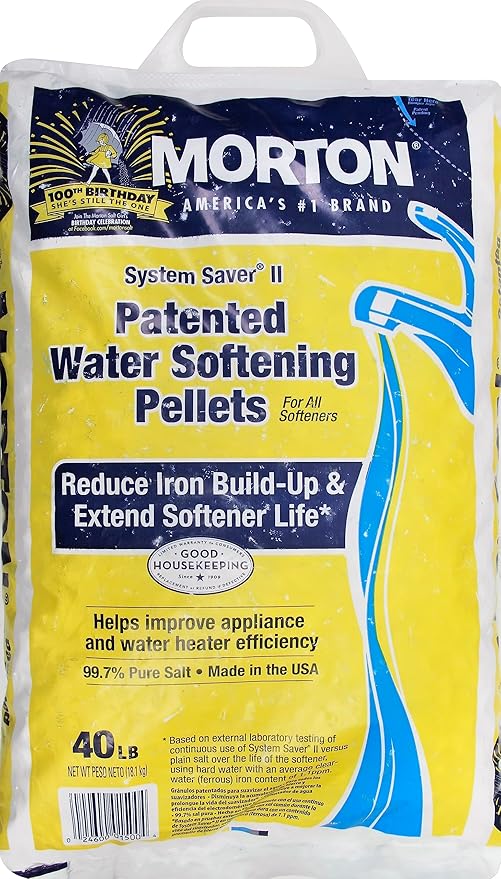
This 40-pound bag of USA-made System Saver pellets is designed to improve the taste of your water while helping extend the life of your appliances and water softener. Simple to use, just add the pellets directly to your softener's brine tank as needed.
Check On AmazonIf you click this link and buy, we earn a commission at no additional cost to you.
FAQs
🌿 Can I water my garden with softened water?
Not regularly. Softened water contains sodium from the ion exchange process, and sodium accumulates in soil over time, reducing its ability to absorb water and affecting salt-sensitive plants. Outdoor hose bibs and irrigation lines should be plumbed upstream of the softener so they draw from untreated supply water.
💧 What flow rate do I need for whole-house coverage?
For most 3-4 person households, a system rated for 7 to 8 GPM handles peak demand without noticeable pressure drop. Homes with 5 or more people, multiple high-flow showers, or simultaneous appliance use benefit from systems rated for 10 to 12 GPM. Check the valve’s GPM specification, not just the grain capacity.
🔧 Do whole-house softeners need a bypass valve?
Yes. A bypass valve lets you route water around the softener for outdoor irrigation, during service and maintenance, or when running a manual regen cycle. Most quality systems include one. Confirm it is part of the installation kit before ordering.
📐 How do I calculate what size whole-house softener I need?
Multiply: number of people in the household times 75 gallons per day times your water hardness in GPG times 7 days. The result is your weekly grain demand. Size the system so it can cover that demand while regenerating no more frequently than every 5 to 7 days for efficiency and resin longevity.
⚠️ What happens if I undersize a whole-house softener?
The system regenerates too frequently, uses more salt per week, and produces hardness breakthrough during regen cycles when the resin capacity is depleted before the next regeneration. At high GPG, this is noticeable immediately at fixtures. Sizing up by one tier almost always pays for itself in salt savings and extended resin life.
🔄 What is a twin alternating system and when do I need one?
A twin alternating system uses two tanks that switch active duty during regen cycles, so one tank is always treating water. This guarantees continuous soft water with no breakthrough window. It is worth considering for households of 5 or more at 15 GPG or higher, and is often the practical requirement for large families at 20+ GPG.