
The Sizing Mistake That Catches Most Families of 4
Finding the right water softener for a family of 4 is simpler than most buying guides make it look, and more specific than they usually get. Family of 4 is the most common household size in the US, and the most common sizing mistake follows: buying a 32,000-grain system because it was on sale, or because a store associate said it would work for four people. Technically, it can. Whether it actually handles your household without regenerating every two days is a different question, and the answer depends on your water hardness reading, not on what was featured on the endcap.
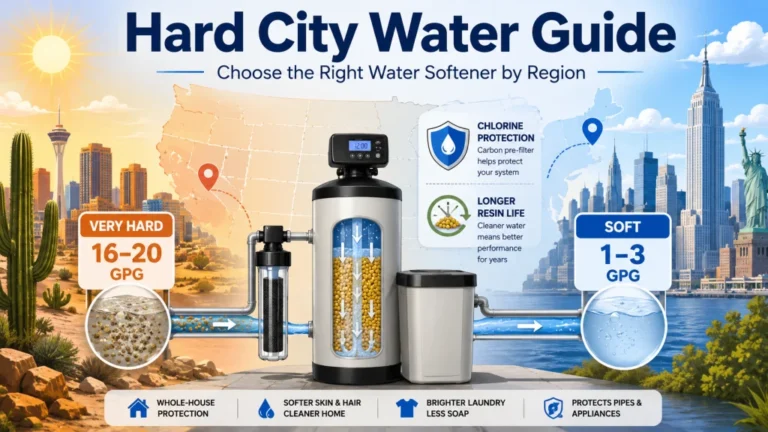
I have been on enough service calls to know how this plays out. A household in a Phoenix suburb buys the same 48,000-grain system a family in Ohio at 8 GPG would buy, then calls because it is regenerating every three to four days and using twice the salt the settings say it should. Nothing is wrong with the equipment. The system is undersized for the water it is treating. Running the calculation before buying would have changed the decision. If you want to understand how this sizing logic applies across different household configurations, the complete household sizing guide covers every scenario. For a family of 4 specifically, the math below is the starting point.
The good news is the formula is not complicated. You need your GPG from a water test, your household count, and two minutes. That is it.
The Calculation at Each GPG Level
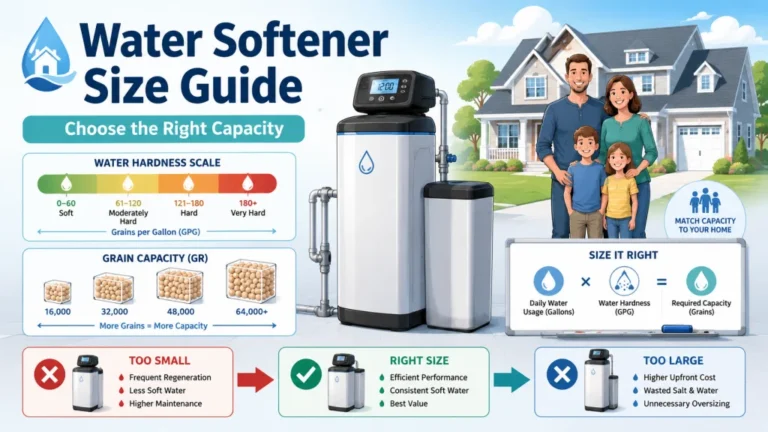
The formula is: people times 75 gallons per day times GPG times 7 days. That gives you weekly grain load. Your system’s capacity needs to cover that number with roughly one regeneration per week as the target. A family of 4 starts with 300 gallons per day (4 times 75). From there, GPG determines the capacity tier.
The table below runs that math at four hardness levels. These are not estimates or rounded figures. They are the actual results, and they show clearly why a single-capacity recommendation breaks down once you apply your real hardness number.
| Water Hardness (GPG) | Weekly Grain Load | Minimum Capacity | Comfortable Capacity | Where This Level Is Common |
|---|---|---|---|---|
| 7 GPG | 14,700 grains | 24,000 | 24,000 to 32,000 | Pacific Northwest, Upper Midwest |
| 10 GPG | 21,000 grains | 32,000 | 40,000 | Mid-Atlantic, parts of Southeast |
| 15 GPG | 31,500 grains | 48,000 | 64,000 | San Antonio, Inland Southeast, rural Midwest |
| 20 GPG | 42,000 grains | 64,000 | 80,000 | Phoenix, Las Vegas, West Texas |
The jump between 7 GPG and 20 GPG is not incremental. Minimum grain capacity goes from 24,000 to 64,000, a difference that makes the standard 48k recommendation look reasonable in some zip codes and badly undersized in others. At 10 GPG, 32,000 is the minimum and it holds up fine. At 15 GPG, 32,000 means the system is regenerating two to three times a week, which shortens resin life and burns through salt faster than any dial setting will fix.
The “comfortable capacity” column is worth paying attention to. Going one tier above minimum is not wasted capacity. Resin that gets pushed to its limit before every regeneration wears faster than resin with a reasonable buffer. At 15 GPG, the difference in daily salt use between a 48,000-grain and 64,000-grain system is small. The difference in how hard the resin works shows up in year 6 or year 8, not in the first season.
Key point: The formula is: 4 people x 75 gallons x your GPG x 7 days = weekly grain load. Match your system’s capacity to that number. Do not match it to whatever is most popular or most prominently featured in search results.
Once you know which tier you land in, that number also points toward what type of system fits. In the 24,000 to 32,000 range, the priority is a compact demand-initiated unit, and buying oversized to catch a sale creates its own problem: resin that rarely gets used sits stagnant and is more prone to bacterial growth over time. In the 48,000 to 64,000 range, metered regeneration and resin quality matter more because you are running the system harder week over week. At 80,000 or above, or anywhere above 20 GPG with consistent daily demand, a twin-tank alternating configuration moves from upgrade to practical necessity. If iron is part of your situation, do not size from the hardness-only number. Adjust for iron first, then find your tier.

This kit lets you test drinking water, pool water, or any water source in seconds using a simple dip-and-read method with an oversized color chart ranging from red to green, covering 0 to 25 GPG and 0 to 425 PPM. All 100 strips are protected by FreshSeal technology across a ready-to-use bottle and two sealed pouches for long-term accuracy. Each purchase also funds a full year of clean water for someone in the Central African Republic.
Check On AmazonIf you click this link and buy, we earn a commission at no additional cost to you.
Iron in Your Water Changes the Numbers More Than Most People Expect
If your water test shows any ferrous iron, you have to factor it in before settling on a capacity. Ion exchange resin removes dissolved ferrous iron alongside calcium and magnesium, but iron takes up more space in the resin bed per unit. The standard adjustment is to add 4 GPG to your effective hardness for every 1 PPM of ferrous iron. Skip this and you will be undersized even if the hardness-only calculation looked right on paper.
Field Note: One situation I run into regularly on well water is a homeowner who tested at 10 GPG and bought a 32,000-grain system because the formula said it would work. What they did not catch was the 2 PPM of iron in the water. Apply the adjustment: 10 GPG plus (2 PPM times 4) equals 18 adjusted GPG. At 18 GPG, a family of 4 needs 48,000 grains at minimum, and 64,000 is the practical choice. The 32,000-grain system they bought starts regenerating every two days, the resin fouls faster than it should, and the homeowner concludes the system is defective. Nothing is defective. It was sized to the wrong input number from the start.
If any iron shows up on your test, apply the adjustment before settling on a capacity. The calculation adds thirty seconds. The repair bill for fouled resin does not.
One clarification worth stating plainly: the iron ratings on most water softener product listings refer to dissolved ferrous iron, the clear kind. If your water runs orange when it sits in a glass, or leaves rust stains without sitting long, that is ferric (oxidized) iron. A standard softener does not handle ferric iron regardless of what its iron-removal rating says. Ferric iron requires upstream filtration before the softener. On city water, ferrous-only is typical. On well water, both can show up, and a lab test tells you which you have.
When You Are Above 15 GPG
At 15 GPG and above, sizing decisions become less forgiving. A family of 4 at 15 GPG is running 31,500 grains through the resin per week. A 48,000-grain system covers that math, but without much buffer. A houseguest for a week, an extra load of laundry every day before a trip, and the system is pushing toward back-to-back regenerations. At 15 GPG, 64,000 is the practical capacity, not an oversized choice.
At 20 GPG, 64,000 is the floor and 80,000 is where you want to land. Some households in high-hardness areas also consider twin-tank alternating systems at this level. A twin-tank setup keeps one tank in service while the other regenerates, which means no hardness breakthrough during a regen cycle. For a family of 4 in an area where a single-tank system regenerates three or four times a week, the continuous soft water a twin-tank provides is a practical benefit, not a luxury. If your water is in this range, the article on water softeners for extremely hard city water covers the 15+ GPG case in detail, including when twin-tank makes the most sense.
Demand-initiated regeneration also matters more at higher GPG. A timer-based system regenerates on a fixed schedule regardless of how much water was actually used. At 20 GPG, a family of 4 running the system on a timer wastes salt on low-use days and may fall short on high-demand weeks. Metered regeneration, which triggers based on actual water processed, is not a premium feature at this hardness level. It is what the situation calls for.

This complete high-flow system comes equipped with a digital metered 5600SXT control head, 2 cubic feet of resin in a 12 by 48-inch tank, and a larger 18 by 33-inch round brine tank with bypass valve included and ready to install. On-demand metered regeneration treats up to 16 GPM and only cycles when needed, conserving salt and water while protecting plumbing, appliances, and fixtures from scale buildup. The system is backed by a 5-year warranty on the control head and a 10-year warranty on the tank.
Check On AmazonIf you click this link and buy, we earn a commission at no additional cost to you.
Capacity Is Weekly Load. Flow Rate Is Real-Time Demand.
Grain capacity tells you how many grains the resin can remove before it needs to regenerate. Flow rate tells you whether the system keeps up when your household is pulling water from multiple points at the same time. For a family of 4, both numbers matter, and a system sized correctly for weekly grain load can still underperform if its service flow rate drops when two showers, the dishwasher, and a washing machine are all running during the same hour.
Most residential water softeners list a service flow rate in GPM. A single shower draws about 2 GPM. A washing machine draws 2 to 3 GPM. Add a dishwasher and a second shower and you are at 6 to 8 GPM of simultaneous demand, which is a realistic morning scenario for a family of 4. A softener with a service flow rate below that threshold delivers a pressure drop at peak use, and at higher GPG, softening performance can become less consistent during that peak demand window.
| Use Pattern (Family of 4) | Peak Demand (approx.) | What to Confirm Before Buying |
|---|---|---|
| 1 shower, normal faucet use | 2 to 4 GPM | Standard residential service flow rate is adequate |
| 2 showers running at the same time | 4 to 6 GPM | Verify service flow rate spec before buying |
| Shower plus laundry plus dishwasher | 6 to 8 GPM | Prioritize systems rated 10 GPM or higher at service flow |
| 15+ GPG with heavy daily overlap | 6 to 10 GPM | Confirm both capacity and flow rate, do not assume one covers the other |
Flow rate is a spec that rarely gets highlighted in buying guides, but it is the difference between consistent soft water at the showerhead and a pressure dip at the worst moment of the morning. Grain capacity and service flow rate are separate numbers. Verify both before you decide, not just the one featured on the front of the box.
What to Evaluate Once You Know Your Target Capacity
Grain capacity gets you to the right size. After that, a handful of specific specs separate a system that holds up over time from one that needs attention two years in. Most of these do not appear prominently in retail listings, which is a large part of why they get overlooked. Here is what I check once the capacity question is settled.
- Resin crosslink percentage. Standard resin is 8% crosslinked. Higher-crosslink resin at 10% holds up significantly better in municipal water with chlorine and lasts longer before it needs replacing. This spec is frequently missing from product listings. If a manufacturer does not publish it, that tends to be the answer.
- Demand-initiated regeneration. A timer-based system regenerates on a fixed schedule and wastes salt on low-use periods. A metered system regenerates based on actual water processed. For a family of 4 where usage varies week to week, metered regeneration reduces salt consumption and is easier on the resin.
- Control valve quality and parts availability. The control valve is the component most likely to need service over the life of the system. A valve with documented reliability, available replacement parts, and a meaningful warranty is worth prioritizing. Proprietary valves from brands with thin parts networks are a future inconvenience that is easy to overlook during the buying decision.
- Brine tank capacity and safety float. A brine tank without a safety float is one stuck valve away from an overflow. At the usage level of a family of 4 at higher GPG, you are also refilling salt more often, so tank capacity affects how frequently you need to manage it.
- NSF/ANSI 44 certification. This confirms independent testing of softening performance claims. Its absence on a system making specific efficiency numbers is worth noting, though it is not the only relevant quality signal.
These are the questions worth asking before you commit to a system. Two systems rated at the same grain capacity can behave quite differently depending on resin crosslink, valve quality, and regeneration control. The full picture on what separates a reliable system from one that causes problems long-term is covered in the guide on what actually makes a water softener worth buying, including valve types, resin specs, and the questions worth asking before you decide.
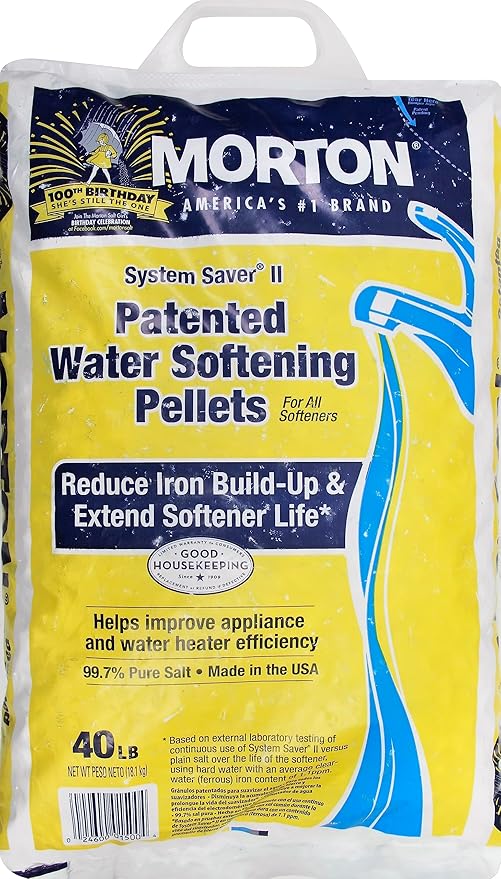
This 40-pound bag of USA-made System Saver pellets is designed to improve the taste of your water while helping extend the life of your appliances and water softener. Simple to use, just add the pellets directly to your softener's brine tank as needed.
Check On AmazonIf you click this link and buy, we earn a commission at no additional cost to you.
Final Thoughts: Run the Numbers Before You Buy
The 48,000-grain recommendation you see everywhere for a family of 4 is right for a specific slice of the hardness range and wrong for everything above or below it. At 7 GPG, it is more capacity than the math calls for. At 20 GPG, it is undersized by a significant margin. The calculation that closes that gap is not complicated, and it costs nothing to run before you make a purchase decision.
Get your water tested first if you have not. City water utilities publish annual quality reports that include hardness data. Well water hardness is not published anywhere, so a mail-in lab test is the reliable option. Once you have the GPG number, and your iron level if the water comes from a well, plug the numbers into the formula. Size to your actual weekly grain load, go one tier above minimum if your GPG is at 15 or higher, and then evaluate specs from there. That sequence avoids most of the sizing mistakes I see show up on service calls, usually at the worst possible time.

This whole-home water softener comes pre-loaded with 1.5 cubic feet of high capacity resin in a black USA-made mineral tank, paired with a USA brine tank featuring a safety float. The on-demand digital metered system ensures efficient water treatment, and the included 1-inch Noryl plastic bypass valve makes installation straightforward. Toll-free customer support is available whenever you need help.
Check On AmazonIf you click this link and buy, we earn a commission at no additional cost to you.
FAQs
📐 What size water softener do I need for a family of 4?
It depends on your water hardness. At 7 GPG, a 24,000-grain system is sufficient. At 10 GPG, the minimum is 32,000. At 15 GPG, you need 48,000 at minimum with 64,000 as the comfortable choice. At 20 GPG, go to 64,000 or higher. Use the formula: 4 x 75 x your GPG x 7 = your weekly grain requirement, then match your system to that number.
🧮 How do I calculate water softener capacity for 4 people?
Multiply 4 people by 75 gallons per person per day, then by your GPG, then by 7 days. At 10 GPG: 4 x 75 x 10 x 7 = 21,000 grains per week. Choose a system rated above that number, with one regeneration per week as the target. If your water has any iron, add 4 GPG per 1 PPM of ferrous iron before you calculate.
🔩 Is a 32,000-grain softener enough for a family of 4?
At 7 to 10 GPG, yes. At 15 GPG or above, a 32,000-grain system is undersized for a family of 4 and will regenerate too frequently. If your water tests above 10 GPG or if you have any iron in the water, size up rather than down.
💧 Does iron in my water change the water softener size I need for a family of 4?
Yes, significantly. Add 4 GPG for every 1 PPM of ferrous iron before calculating. At 10 GPG with 2 PPM iron, your effective hardness for sizing purposes is 18 GPG. That changes the required capacity from 32,000 to 48,000 minimum, with 64,000 as the practical choice.
🏜️ What size water softener does a family of 4 need in Arizona, Nevada, or Texas?
Most of those areas run 16 to 22 GPG. At 20 GPG, a family of 4 needs 64,000 grains at minimum, with 80,000 as the practical target. Twin-tank alternating systems are worth considering at this hardness level if your household runs water throughout the day and you want continuous soft water during regeneration cycles.
⏱️ How often should a water softener regenerate for a family of 4?
About once per week is the target. Regenerating every one to two days usually means the system is undersized for your hardness level. Going two or more weeks without regenerating is not automatically a problem with demand-initiated controls, but on a timer-based system it may mean the settings need adjustment to ensure regular resin refresh.