
Where Standard Sizing Guides Break Down
The sizing formula is not complicated: people in the household multiplied by 75 gallons per day, multiplied by your GPG reading, multiplied by 7 days. That gives you the weekly grain removal requirement your system needs to meet before it regenerates. What most buying guides skip is running this math at real hardness levels instead of the national average, and then explaining what to do with the number once you have it.
A family of 4 at 10 GPG produces 21,000 grains per week. That same family at 20 GPG produces 42,000 grains per week. More than double. The problem is that 42,000 grains per week is only the starting point for a sizing decision, not the end of it. Picking a system rated at exactly that number and calling it done is where buyers at extreme hardness get into trouble. What comes next matters as much as the formula.
Field Note: What I run into most often is a household in Arizona or Texas that came home with a 48k grain system because that is what the box store recommended. Two months in they are refilling the brine tank every three weeks and the water still feels slightly off on heavy-use days. In most of these cases the system is not defective, it is under-configured for the actual hardness level. The recommendation never accounted for 16 to 20 GPG Colorado River water, and no one explained the gap between the number on the box and the number the system actually delivers in day-to-day operation.
Rated Capacity vs. Usable Capacity: The Number on the Box Is Not Your Operating Number
Water softener grain capacity ratings are measured under ideal lab conditions using a specific salt dose per regeneration cycle. In practice, many systems are set to regenerate at a lower salt dose for better salt efficiency, which reduces usable capacity below the rated number. A system nominally rated at 48k grains typically delivers somewhere between 30,000 and 38,000 grains of actual softening capacity per cycle when set for efficient salt use. The rated number on the label is a ceiling, not the operating figure to plan around.
At 7 to 10 GPG this gap between rated and usable capacity is manageable. A 48k system serving a family of 4 at 10 GPG needs 21,000 grains per week. Even at 70% usable efficiency, the system clears that weekly load comfortably. At 20 GPG the math changes significantly. A family of 4 at 20 GPG needs 42,000 grains per week. A 48k system operating at realistic efficiency delivers roughly 30,000 to 38,000 usable grains per cycle. The shortfall forces regeneration every 5 to 6 days instead of every 7, and sometimes closer to 4 to 5 days in higher-use weeks. This is why sizing recommendations for extreme hardness should not be derived from the weekly grain number alone, and why building in a 20 to 30 percent buffer above the calculated requirement is not conservative, it is necessary.
Key point: The sizing formula tells you your minimum weekly grain requirement. To size correctly, add a 20 to 30 percent buffer to that number, then select a system whose usable capacity, not rated capacity, meets that adjusted figure. At 15 GPG and above, this distinction between rated and usable is the difference between a system that works well and one that regenerates constantly.
The Sizing Math at 15, 20, and 25 GPG
The table below shows minimum and recommended grain capacity targets at extreme hardness levels for common household sizes, calculated at 75 gallons per person per day with a 7-day regeneration interval as the target. These figures already account for a practical usable capacity buffer. If your household uses more water than average, or if your test shows any iron content on top of the hardness reading, size up from the numbers here before making a decision.
| Hardness (GPG) | 2-person household | 4-person household | 6-person household |
|---|---|---|---|
| 10 GPG | 16k to 24k | 32k to 48k | 48k to 64k |
| 15 GPG | 24k to 32k | 48k to 64k | 64k to 80k |
| 20 GPG | 32k to 48k | 64k to 80k | 80k or twin alternating |
| 25 GPG | 48k minimum | Twin alternating preferred | Twin alternating |
A few notes on reading this table. At 15 GPG, 48k for a family of 4 is the minimum, not a comfortable operating number. Any week with guests or elevated water use pushes the system closer to breakthrough before it catches up. The 64k figure provides the buffer that makes weekly regeneration reliable. At 20 GPG, 64k is the practical floor for a family of 4 and 80k is the range where the system performs well without pushing its usable capacity limits regularly. At 25 GPG for a household of 4 or more, a single-tank system starts to become less practical on a standard regeneration cycle, and twin alternating becomes the configuration worth comparing seriously.
If you are in the Phoenix area testing 16 to 20 GPG, or in San Antonio where city water regularly runs 15 to 20 GPG from the Edwards Aquifer, these numbers replace the generic 48k advice you will find on most comparison sites. The Arizona hard water sizing guide goes deeper on Colorado River mineral concentration and city-by-city hardness readings across the Valley. For Texas households in high-hardness regions, city-by-city detail is in the Texas water softener guide.

This kit lets you test drinking water, pool water, or any water source in seconds using a simple dip-and-read method with an oversized color chart ranging from red to green, covering 0 to 25 GPG and 0 to 425 PPM. All 100 strips are protected by FreshSeal technology across a ready-to-use bottle and two sealed pouches for long-term accuracy. Each purchase also funds a full year of clean water for someone in the Central African Republic.
Check On AmazonIf you click this link and buy, we earn a commission at no additional cost to you.
Demand-Initiated Regeneration: Not Optional Above 15 GPG
Timer-based regeneration runs on a fixed schedule regardless of how much water the household actually used. At 7 to 10 GPG the waste from an early regeneration cycle is minor. At 15 GPG and above, a timer-controlled system calibrated for worst-case daily use can waste 30 to 50 percent of the salt you buy because it regenerates before the resin is close to exhausted. The higher your GPG, the more salt and valve cycles that wasted regeneration costs you over a year.
Demand-initiated regeneration, sometimes called metered regeneration, tracks actual water use through a flow meter and triggers a cycle only when the system has processed enough water to justify it. When you hit the setpoint volume, the system regenerates. Nothing more. At extreme hardness levels, this switch from timer to metered control meaningfully reduces annual salt consumption and unnecessary wear on the control valve. In my experience, this spec gets overlooked when buyers compare systems in the 15 GPG and above range, partly because it is not always prominent on big-box store listings. Look for it specifically before committing to any system at these hardness levels. If a system is timer-only, the ongoing operating cost will offset whatever you saved at purchase.

This whole-home water softener comes pre-loaded with 1.5 cubic feet of high capacity resin in a black USA-made mineral tank, paired with a USA brine tank featuring a safety float. The on-demand digital metered system ensures efficient water treatment, and the included 1-inch Noryl plastic bypass valve makes installation straightforward. Toll-free customer support is available whenever you need help.
Check On AmazonIf you click this link and buy, we earn a commission at no additional cost to you.
When Two Tanks Make More Sense Than One Large Tank
Twin alternating uses two resin tanks connected to a single control valve. While one tank handles incoming water, the other sits in standby or regenerates. When the active tank reaches capacity, the valve switches automatically. The result is continuous soft water with no gap during the regeneration cycle. For a single-tank system, the 60 to 90 minutes of a regeneration cycle is a window where hard water enters the home. At 7 GPG with a small household and an overnight schedule, nobody notices. At 20 GPG or above with a busy household moving through a morning peak, the difference is noticeable.
The threshold where this configuration becomes worth the additional cost, from what I have seen, falls around 20 GPG for households of 3 or more people. Below that, a properly sized single tank with demand-initiated regeneration scheduled for low-use hours handles the demand without breakthrough issues. Above 20 GPG with a larger household and predictable peak demand, it eliminates the timing risk entirely. An AnandTech forum discussion captures the operational reality plainly: “A twin tank softener does not require a clock. When regenerating on one tank, the other provides soft water.” That is the core advantage.
Twin alternating systems cost more upfront and are typically sourced through a water treatment dealer or online specialist rather than a big-box store. The control valve handles the switching automatically. For households where the hardness level and daily demand justify the configuration, the alternative is a single tank large enough to carry the full weekly load without needing to regenerate during peak hours, which sometimes means an 80k tank where a twin alternating setup would have handled the same demand more consistently over the system’s life.
Choosing by Situation at 15, 20, and 25 GPG
Once you have your weekly grain requirement and understand the usable capacity buffer, the decision becomes about which system configuration fits your situation. No product names needed at this stage. The configuration comes first.
- 15 to 17 GPG, 2 to 4 people: A high-capacity single-tank system with demand-initiated regeneration is the right approach. Prioritize usable capacity over rated capacity. Size for at least 25 percent above your calculated weekly requirement and avoid anything with timer-only regeneration.
- 18 to 20 GPG, 3 to 4 people: 64k is the practical floor and 80k is the range where the system handles normal weekly variation without pushing its limits. Demand-initiated is mandatory here. If peak demand in your home is predictable and high, such as morning showers for a family of 4 or 5 on a school day, compare a single-tank 80k setup against twin alternating before deciding.
- 20 GPG and above, household of 4 or more: Twin alternating is worth evaluating seriously. The continuous soft water advantage becomes real at this hardness level and household size. If the upfront cost of twin alternating is a constraint, an 80k single-tank system with demand-initiated control and a regeneration window set for low-use hours is the fallback, not a generic 48k recommendation.
- Any hardness above 15 GPG with iron present: Add 4 to 5 GPG per 1 PPM of iron to your hardness reading before sizing. Iron at 1 PPM on top of 18 GPG hardness means sizing decisions for 22 to 23 GPG, which changes the bracket.
- Timer-only systems: Avoid at any hardness level above 15 GPG. The salt waste over a year consistently outweighs any savings at purchase.
These are configuration decisions, not brand decisions. Once you know which configuration fits your situation, narrowing to a specific system is the next step. The hard water softener guide covers the full regional and situational framework that feeds into this decision.

This twin-tank system uses two 14 by 65-inch polyglass resin tanks loaded with 6 cubic feet of high-capacity resin total, delivering 96,000 grains of hardness removal and a continuous 20 GPM service flow with soft water available 24/7 as tanks alternate cycles. The digital metered 9100SXT control head regenerates based on actual water use rather than a timer, conserving both salt and water. The 18 by 40-inch brine tank holds up to 350 pounds of salt, and the system is backed by a 5-year control head and 10-year tank warranty with a 30-day satisfaction guarantee.
Check On AmazonIf you click this link and buy, we earn a commission at no additional cost to you.
City Water at Extreme Hardness With Iron
Most city water above 15 GPG does not carry iron at levels that significantly affect softener performance. Municipal treatment handles dissolved iron before it reaches the distribution system in most cases. Where it shows up is in older distribution infrastructure or in specific source water situations where trace iron slips through. If your test shows any iron, the adjustment is straightforward: add 4 to 5 GPG per 1 PPM of iron to your hardness number before running the sizing calculation. At 18 GPG with 1 PPM iron, you are sizing for 22 to 23 GPG effective hardness. That difference can push a 4-person household from a 64k single tank into 80k or twin alternating territory.
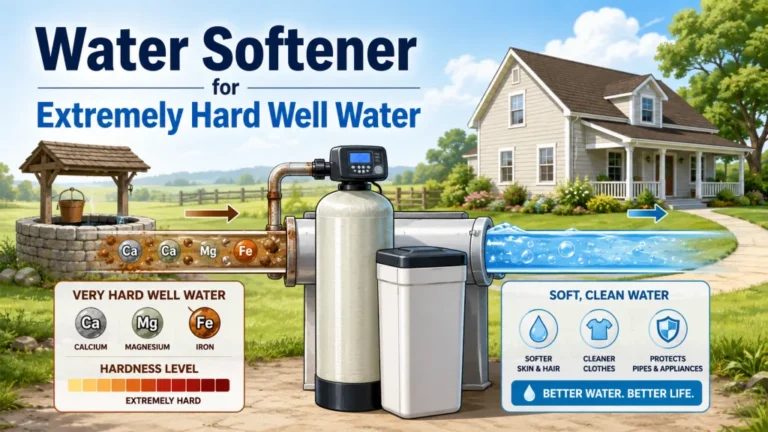
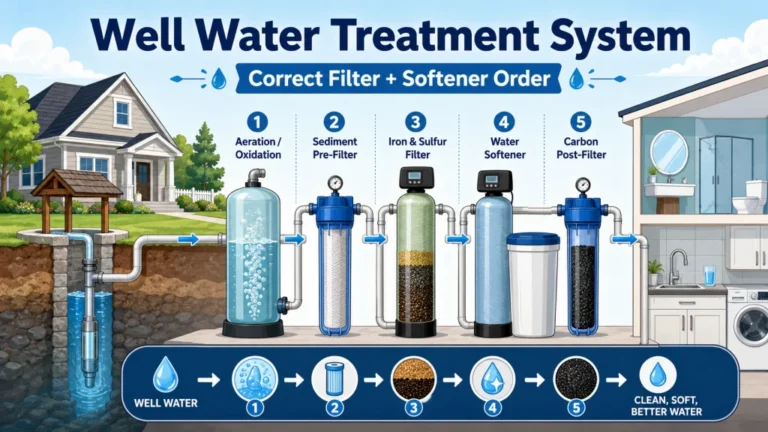
If your situation involves well water rather than city water at extreme hardness, the equipment considerations are different enough to warrant a separate read. Well water at 15 GPG and above commonly combines iron, sediment, and sometimes sulfur in combinations that city water does not produce. The guide to extremely hard well water systems covers those decisions separately.
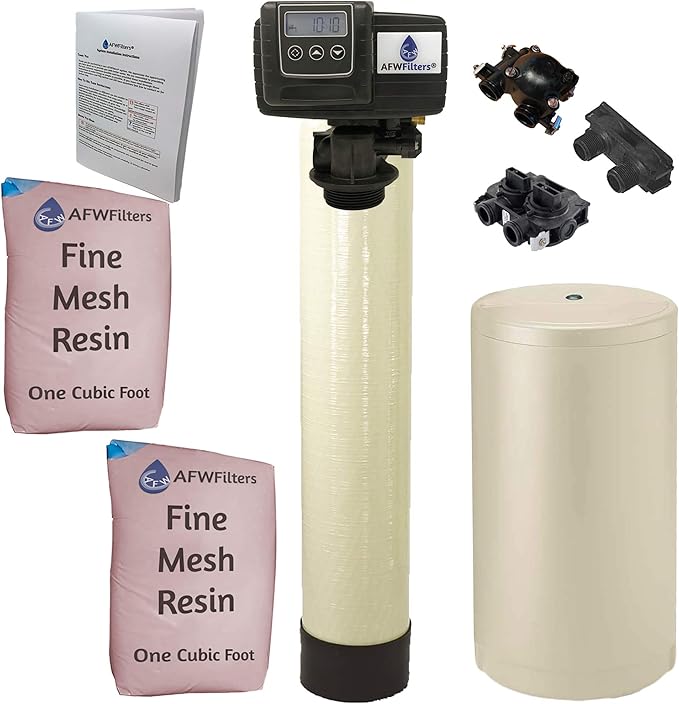
This all-in-one whole house system tackles hard water, iron up to 6 ppm, manganese up to 6 ppm, and rust in a single unit, eliminating the need for separate treatment systems. Powered by the Fleck 5600SXT digital metered valve, it operates efficiently by regenerating only based on actual water usage, making it both reliable and cost-effective. The high flow rate design ensures every tap in your home receives a consistent supply of clean, treated water. The Fleck control valve is backed by a 5-year warranty for added confidence.
Check On AmazonIf you click this link and buy, we earn a commission at no additional cost to you.
Final: Size for Usable Capacity, Not the Number on the Box
The most common mistake at extreme hardness levels is treating the grain rating on the label as the operating number to plan around. It is not. Rated capacity is a ceiling measured under ideal conditions. Usable capacity in efficient day-to-day operation sits below that number, and the gap matters more at 15 GPG and above than it ever does at average hardness. A system that looks correctly sized on paper runs short in practice if the sizing did not account for this.
Run the formula from the sizing section above to get your weekly grain requirement. Add 20 to 30 percent to account for realistic usable capacity. Then match that adjusted number to the right system configuration, single-tank with demand-initiated regeneration or twin alternating, based on your hardness level and household demand pattern. The configuration decision comes before the brand decision.
For the broader framework on how city water hardness varies by region and how that shapes which configuration makes sense for different situations, the hard water softener guide covers the full picture. If you are working through the entire decision from the beginning, the overview of water softener selection by situation is the right starting point before narrowing to extreme hardness specifically.
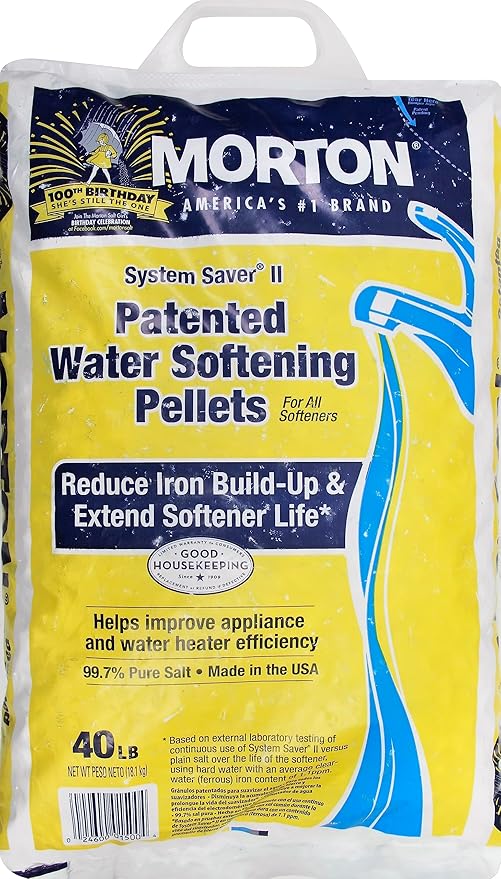
This 40-pound bag of USA-made System Saver pellets is designed to improve the taste of your water while helping extend the life of your appliances and water softener. Simple to use, just add the pellets directly to your softener's brine tank as needed.
Check On AmazonIf you click this link and buy, we earn a commission at no additional cost to you.
FAQs
💧 What GPG is considered extremely hard water for sizing purposes?
For buying and sizing decisions, 15 GPG and above is the range where standard advice stops being reliable. The calculations and configuration choices change meaningfully compared to average hardness. Phoenix, San Antonio, and Las Vegas regularly test in the 15 to 25 GPG range, making them among the hardest city water markets in the US.
🔢 How do I calculate what size water softener I need at high hardness?
Multiply people in your household by 75 gallons per day, then by your GPG, then by 7 days. That gives you your minimum weekly grain requirement. Add 20 to 30 percent to account for the gap between rated capacity and real-world usable capacity. If your water shows any iron, add 4 to 5 GPG per 1 PPM of iron to your hardness number before calculating.
⚠️ Why does my water softener regenerate so often even though it is rated large enough?
Rated grain capacity is measured under ideal conditions. In practical salt-efficient operation, most systems deliver 60 to 80 percent of that rated number as usable capacity. At high hardness, this gap between rated and usable capacity causes regeneration to happen more frequently than expected. Sizing to the rated number alone without adding a usable-capacity buffer is the most common cause of this problem.
🔄 When does twin alternating actually make sense vs a larger single tank?
Twin alternating becomes a practical consideration at 20 GPG and above for households of 3 or more people. At that hardness level and household size, a single-tank system risks hardness breakthrough during its regeneration window. Twin alternating eliminates that gap by keeping one tank in service at all times. Below 20 GPG, a properly sized single tank with demand-initiated regeneration and an overnight schedule handles the demand without that problem.
🧂 Does higher hardness mean significantly more salt use?
Yes. Higher GPG means more hardness minerals to remove on each cycle, which requires more salt. The compounding issue is that an undersized system regenerates more frequently than a properly sized one, multiplying the salt use further. Demand-initiated regeneration reduces waste by cycling only when actual water use warrants it, which makes a meaningful difference in annual salt cost at 15 GPG and above.
🏙️ Which US cities commonly have extremely hard water?
Phoenix and the broader Valley of the Sun typically test 15 to 25 GPG from Colorado River source water concentrated through arid terrain. San Antonio commonly runs 15 to 20 GPG from the Edwards Aquifer. Las Vegas comes in at 16 GPG and above from Lake Mead. Parts of El Paso, Dallas, and the Florida Panhandle also see hardness above 15 GPG depending on local source water and distribution system.