Two Systems, Two Completely Different Problems
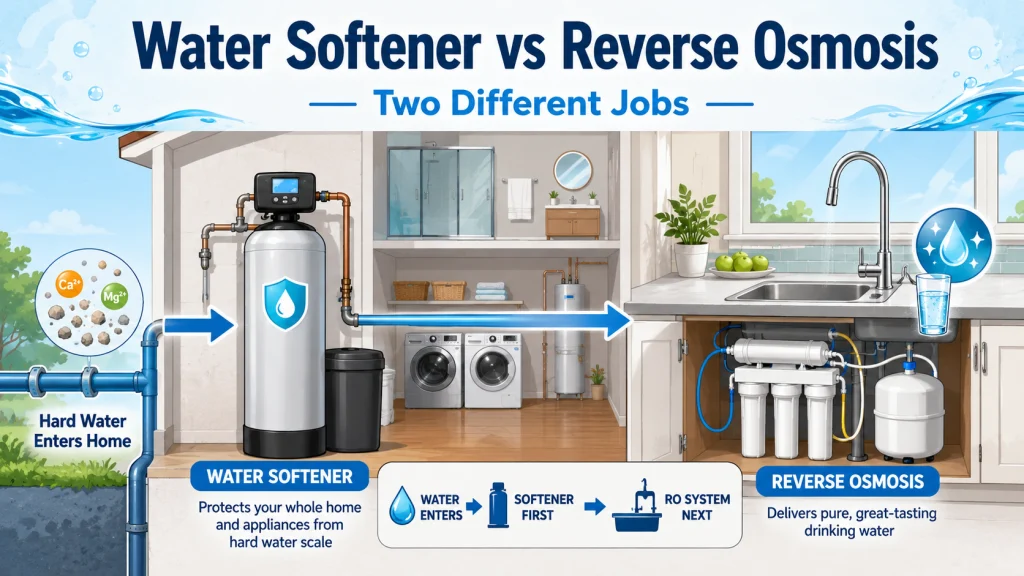
Reverse osmosis produces some of the cleanest drinking water you can get at home. The membrane removes bacteria, heavy metals, dissolved solids, and yes, hardness minerals too. What it cannot do is supply that water to your whole house. A standard under-sink RO system produces somewhere between 50 and 75 gallons per day, which sounds like a lot until you remember a household of four can use 250 to 400 gallons daily for showers, laundry, dishwashers, and faucets. The math does not work for whole-house use. RO is a point-of-use technology, full stop.
A water softener works the opposite way. It treats every drop of water entering your home through ion exchange, swapping calcium and magnesium ions for sodium ions. The result is soft water at every tap, every appliance, every fixture. It does not remove chlorine, sediment, bacteria, or heavy metals. Those are different problems that require different equipment. What it does exceptionally well is protect your plumbing, water heater, washing machine, and dishwasher from the scale buildup that hard water produces over time. If your water tests at 10 GPG or above, that protection adds up fast.
Most of the confusion I run into comes from homeowners who looked up “water softener vs RO” and read three vendor articles in a row. Every vendor has something to sell, so the comparison inevitably drifts toward whichever product they make. The practical reality is simpler: if you have hard water and want to protect your home, you need a softener. If you want excellent drinking water with contaminants removed beyond what a softener handles, you need an RO. Those are not competing conclusions.
The Installation Order Question: Why It Matters More Than Most Articles Say
Here is the part that costs people money when they get it wrong. Hard water is particularly rough on RO membranes. Calcium and magnesium are among the hardest minerals for a membrane to handle, and running water above roughly 7 GPG through an untreated RO system shortens membrane life measurably. The harder your water, the faster that membrane degrades. One RO equipment manual I have referenced on installs states it plainly: water hardness should not exceed 10 GPG at the membrane inlet, or the lifespan shortens. Most of the US Midwest and Southwest runs between 10 and 25 GPG. That is not a marginal risk.
The fix is to install the water softener upstream, before the RO. Softened water swaps calcium and magnesium for sodium ions, and sodium is considerably easier on the membrane. Around 98% of the sodium the softener adds to the water gets removed by the RO membrane anyway, which also addresses the one legitimate concern people have about drinking softened water directly. Run the softener first, then run that softened water to the RO under the kitchen sink, and the membrane lasts significantly longer than it would on raw hard water.
Field Note: I have been on installs where a homeowner had already bought and mounted an RO system before calling anyone about their 18 GPG well water. The membrane they replaced after 14 months should have lasted three to five years. They were replacing it on hard well water with no pre-treatment. The softener that went in afterward was the right call, just two years and two membranes later than it should have been.
The other thing worth mentioning is that this order resolves the sodium concern for good. Some homeowners on low-sodium diets are correctly cautious about drinking softened water directly. Softened water at high hardness levels does contain more sodium than untreated water. With an RO after the softener, that sodium is stripped out before it reaches the drinking tap. You get soft water throughout the house and very low-sodium drinking water at the kitchen sink. Both problems handled.

NSF/ANSI 58 certified and trusted by American families for over 15 years, this compact RO system removes up to 99% of more than 1,000 contaminants including PFAS, fluoride, arsenic, and up to 98% of lead, while reducing TDS by 80 to 90%. Filtration reaches down to 0.0001 microns, with a final GAC polishing stage for exceptional taste, and the system includes a 100% lead-free designer faucet and food-grade tubing. The transparent first-stage housing makes filter checks effortless, and the system requires no power source, fits under most kitchen sinks, and is backed by a 1-year warranty with lifetime support from Georgia, USA.
Check On AmazonIf you click this link and buy, we earn a commission at no additional cost to you.
What Each System Actually Removes
This is worth laying out directly, because marketing materials from both types of equipment tend to blur the lines. A water softener removes calcium and magnesium, and to a limited degree ferrous (clear water) iron. It does not remove chlorine, sediment, sulfur, bacteria, nitrates, heavy metals, or other dissolved contaminants. It is not a filtration system. If your city water has a chlorine taste or your well has sulfur, a softener will not fix either of those things.
| What You’re Trying to Remove | Water Softener | Reverse Osmosis |
|---|---|---|
| Calcium and magnesium (hardness) | Yes, ion exchange, whole house | Yes, at point of use only |
| Chlorine and chloramines | No | Usually reduced by carbon pre-filter stage; chloramine removal depends on the system specs |
| Sediment | No | Pre-filter stage removes sediment before membrane |
| Bacteria and viruses | No | Can reduce many microorganisms, but not a substitute for disinfecting unsafe water |
| Heavy metals (lead, arsenic) | No | Yes, significantly reduced |
| Sodium added by softener | N/A, softener adds it | Yes, approximately 98% removed |
| Scale protection (whole house) | Yes | No, point of use only |
An RO system removes a much broader range of contaminants, but only at the tap it is installed at. If your concern is drinking water quality, that is ideal. If your concern is scale destroying your water heater or mineral deposits clogging your shower head, RO does nothing for those because it is not treating the water reaching those fixtures. This is the core distinction that determines which system you need, and in most hard water households, the answer is that both serve a real purpose.
When One System Alone Makes Sense
There are situations where only one system is the right call, and I want to be honest about both sides of that. An RO system on its own makes sense if your water is genuinely soft, you are in a low-hardness area, and your primary concern is drinking water quality, removing chlorine taste, or reducing other contaminants. If your water tests below 3 GPG, there is no meaningful scale problem to solve. Adding a softener in that situation is unnecessary. The RO handles your drinking water, and the rest of the house is fine without treatment.
A softener on its own makes sense if your hardness is the primary problem and you have no other water quality concerns. Most households in hard water regions fall into this category. The softener protects the appliances, eliminates scale, and delivers noticeably different results for laundry, showering, and soap lathering. For many households, that is the full picture and nothing else is needed. Where the softener alone starts to feel incomplete is when the homeowner also wants excellent drinking water, when there is a sodium concern, or when the source water has chlorine, sulfur, or other contaminants beyond hardness. That is where the combination comes in.
One thing I see homeowners get wrong: buying an RO system alone to handle 20 GPG well water and expecting it to solve their scale problem. The RO produces clean drinking water. Meanwhile, the dishwasher, water heater, and shower head are still running on 20 GPG and showing the same deposits as before. One of the most common things I hear on a service call is “I have a filter, but I still have buildup everywhere.” They had an RO. An RO and a softener are not the same product doing similar things with different branding. They are two different tools addressing two different problems.
- Softener only: Hard water is the primary concern, no other contaminants, homeowner comfortable drinking softened water directly, or budget limits to one system.
- RO only: Source water is already soft or near-soft (under 5 GPG), primary concern is drinking water quality, chlorine taste, or contaminant removal at one tap.
- Both systems: Hard water above 7 GPG combined with desire for excellent drinking water, sodium concern from softening, or well water with multiple issues beyond hardness.
- Neither, yet: Water tests below 3 GPG with no contaminant concerns and no taste issues. No treatment is the right call until the water profile changes.
The Combination Setup: What It Looks Like in Practice
The setup I see most often in hard water homes that want both appliance protection and excellent drinking water is a whole-house softener on the main supply line, with an under-sink RO tapped from the cold water line in the kitchen. The softener handles every fixture in the house. The RO draws from the softened line and removes the sodium along with any remaining contaminants, delivering clean, essentially mineral-free water at a dedicated drinking tap. Most under-sink RO units include a small tank that holds 2 to 4 gallons, so you are not waiting on production when you need a glass of water.
The economics of this setup are reasonable. The softener is the larger investment and requires ongoing salt. The RO is a modest addition, and its primary consumable is filter replacement every 6 to 12 months, plus a membrane replacement every 3 to 5 years, assuming it is running on softened water. Running that same membrane on untreated 20 GPG water, that replacement interval shortens considerably. The softener upstream is not just an add-on convenience. It is what keeps the RO maintenance cost manageable over time.
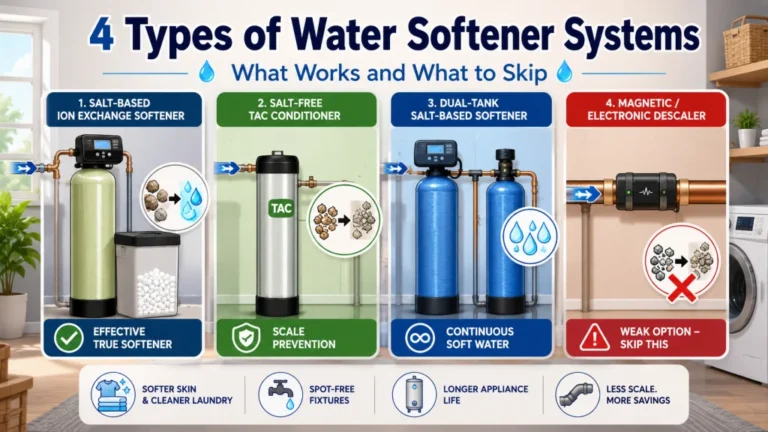
For well water households with multiple water quality issues, the treatment order typically extends further. Sediment pre-filter first, then any iron or sulfur treatment if needed, then the softener, then the rest of the house and the RO at the kitchen sink. If you want to understand how the full range of water softener system types fits into a treatment plan for different water conditions, that is worth reviewing before you commit to any equipment sequence. The specific issues in your source water determine what goes in front of the softener, but the softener before the RO order does not change.
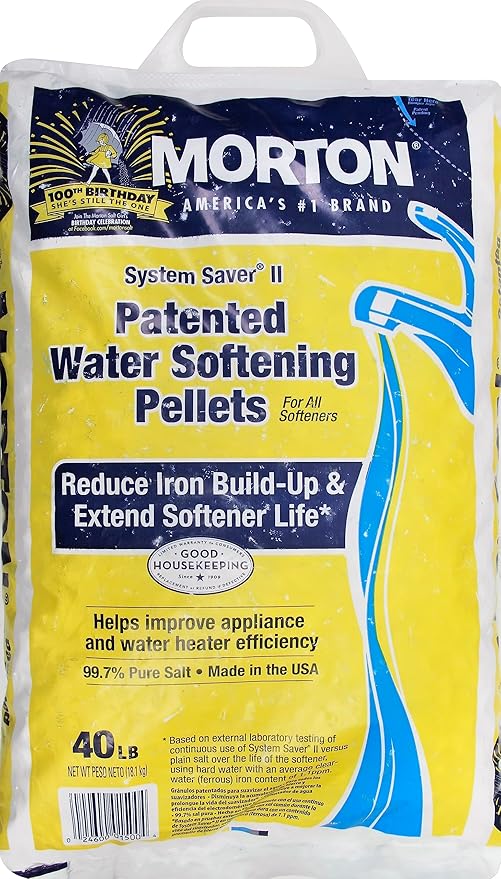
This 40-pound bag of USA-made System Saver pellets is designed to improve the taste of your water while helping extend the life of your appliances and water softener. Simple to use, just add the pellets directly to your softener's brine tank as needed.
Check On AmazonIf you click this link and buy, we earn a commission at no additional cost to you.
Questions I Hear Most Often on This
One that comes up frequently: does softened water taste salty? It should not, unless the system is malfunctioning or grossly oversalted. What some people describe as a slightly different taste compared to untreated well water is real, but it is not sodium flavor at any properly functioning hardness level. If you are on a low-sodium diet and concerned, the RO downstream removes that sodium entirely, which addresses the concern more directly than worrying about softener salt dosing.
Another question: can RO replace a softener entirely? Technically, an RO system does remove hardness minerals from the water it treats. The problem is it only treats water at one tap, at 50 to 75 gallons per day. Your water heater runs on several hundred gallons a day. Your washing machine and dishwasher run on the same untreated supply line. An RO under the sink does nothing for scale accumulation in any appliance that draws from the main supply. So the answer is no, not practically, not in a way that protects the house. For an overview of how the full water softener decision process works, that context is worth having before you start shopping.
A third one: whole-house RO. It exists, and some very high-end custom homes have it. The practical problems are cost, water waste (RO rejects 3 to 4 gallons for every gallon of treated water it produces), flow rate, and maintenance complexity at whole-house scale. Most water treatment professionals I know do not recommend it for residential use unless there is a specific contaminant situation that justifies it. For hardness alone, a softener is a far more practical solution.
Before You Buy: 5 Numbers and Facts to Have Ready
Most of the homeowners I have seen buy the wrong system, or buy in the wrong order, did not have these answers when they started shopping. Getting them first takes about 15 minutes and prevents the kind of mistake that costs several hundred dollars to undo.
- Your actual hardness in GPG. Not a guess. Not what a dealer told you. A utility CCR for city water, a test strip, or a lab result for well water. Everything else in this decision flows from this number.
- City water or well water. Well water households often have iron, sulfur, or sediment on top of hardness, and each of those requires different treatment upstream of both the softener and the RO.
- Whether sodium is a concern. If someone in the household is on a medically restricted low-sodium diet, that changes the calculus. A softener plus an RO resolves it. A softener alone may not be appropriate depending on the hardness level and sodium load.
- What your drinking water concern actually is. Taste from chlorine, lead from old pipes, arsenic from well water, nitrates, and hardness are all different problems. Knowing which one you are trying to fix determines whether you need the RO at all and what RO system specs matter for your situation.
- Your under-sink space and willingness to change filters. An RO system needs filter replacements every 6 to 12 months and a membrane replacement every 3 to 5 years. If neither of those is practical for your situation, factor that into the decision.
None of these require a dealer visit. They are things you can find or figure out in an afternoon. Having them ready makes the equipment choice straightforward instead of a guessing game.

This kit lets you test drinking water, pool water, or any water source in seconds using a simple dip-and-read method with an oversized color chart ranging from red to green, covering 0 to 25 GPG and 0 to 425 PPM. All 100 strips are protected by FreshSeal technology across a ready-to-use bottle and two sealed pouches for long-term accuracy. Each purchase also funds a full year of clean water for someone in the Central African Republic.
Check On AmazonIf you click this link and buy, we earn a commission at no additional cost to you.
Final Thoughts: Different Tools, Different Problems
Get the hardness number, figure out whether your concern is appliance protection, drinking water quality, or both, then match the system to the actual problem. If you install both, softener before RO. That single detail saves the membrane and keeps long-term maintenance costs reasonable. Everything else follows from there.

This 50-micron flushable and reusable filter serves as an ideal first stage in any whole house filtration system, capturing sediment, rust, dirt, and sand before water reaches finer filters downstream. A built-in Siliphos additive helps soften water, prevent scale buildup, and reduce pipe corrosion, with filter replacement recommended every 3 to 6 months for best results. The see-through housing allows easy visual monitoring, and dual threads with 1-inch MNPT and 3 to 4-inch FNPT connections make installation straightforward for indoor use within a pressure range of 20 to 100 PSI.
Check On AmazonIf you click this link and buy, we earn a commission at no additional cost to you.
FAQs
🔄 Do I need both a water softener and reverse osmosis?
Not always. If your water is hard and your main concern is appliance protection and scale, a softener alone may be enough. If you also want contaminant-free drinking water or are on a low-sodium diet, adding an RO under the kitchen sink handles both issues well. The two systems solve different problems and work better together than either does alone in a hard water household.
💧 Can I use reverse osmosis instead of a water softener?
Not practically for whole-house hard water. An RO system produces 50 to 75 gallons per day at one tap. Your water heater, washing machine, and dishwasher all run on the untreated supply line and still accumulate scale. RO handles drinking water. A softener protects the house.
🔧 Should the water softener go before or after the RO system?
Always before. Hard water shortens RO membrane life. Calcium and magnesium are among the hardest minerals for a membrane to handle. Softened water upstream means the RO membrane deals with sodium instead, which is much easier on it. Membrane life extends significantly when it is fed softened rather than raw hard water.
🧂 Does RO remove the sodium added by a water softener?
Yes. An RO membrane removes approximately 98% of the sodium added during ion exchange. If you are on a sodium-restricted diet and concerned about drinking softened water, this combination solves that problem directly. The water at the RO tap will be essentially sodium-free.
📊 At what hardness level should I consider adding an RO system?
Hardness level does not directly determine whether you need an RO. That decision depends on whether you want contaminants beyond hardness removed from your drinking water, or whether sodium from the softener is a concern. The hardness level matters for whether you need a softener at all, typically above 7 GPG. RO is a separate question about drinking water quality.
🏠 Can you get a whole-house reverse osmosis system instead of a softener?
It exists, but it is rarely practical for residential use. Whole-house RO wastes 3 to 4 gallons of water for every gallon it produces, requires significant pressure and flow infrastructure, and costs far more than a softener. For hardness alone, a softener is the right tool. Whole-house RO is a solution to a different category of water quality problem.