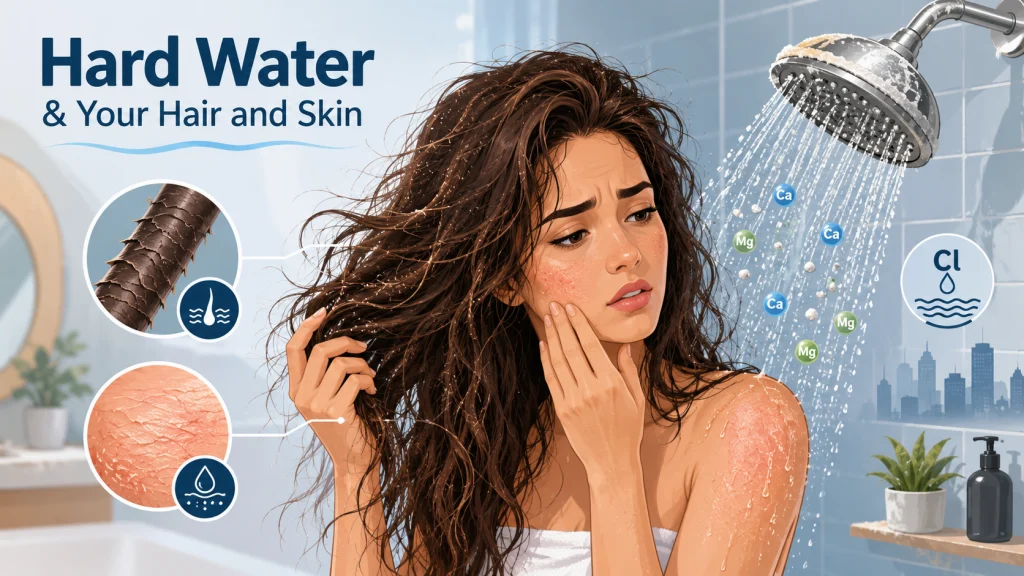
What Hard Water Does to Your Hair (and What It Cannot)
Hard water damages hair. Hard water does not cause hair loss. These two statements are both true, and the difference between them matters before you spend $1,500 on a whole-house system for a hair complaint.
Calcium and magnesium dissolved in hard water coat the hair shaft during washing. Over time, that mineral layer increases friction along the cuticle, dulls shine, and leaves hair feeling rough and difficult to manage. A study published in the International Journal of Trichology tested hair samples washed in hard water against samples washed in distilled water over a controlled period. The hard water group showed measurably lower tensile strength. The hair broke more easily under stress. That is real, peer-reviewed evidence. It also measures something specific: mechanical damage to the shaft, not damage to the follicle.
Permanent follicle damage and androgenic hair loss are entirely different biological processes. No peer-reviewed research connects hard water mineral exposure to alopecia or receding hairlines. Temporary shedding caused by structurally weakened hair breaking off can look like hair loss. It is not. The moment I started explaining that distinction clearly on installs, I stopped hearing “my neighbor said soft water would fix my thinning hair.” Setting that frame early saves everyone a frustrating conversation later.
First-time buyers in hard water areas tend to arrive with two concerns bundled together: the scale on the faucets and the hair in the drain. The scale concern is valid and the softener addresses it directly. The hair-loss concern is a different question, and conflating the two leads to mismatched expectations. A household at 15 GPG with scale on every fixture and a water heater working harder than it should has a strong case for a softener on appliance grounds alone. The hair benefits are real but secondary, and hair loss was never on the list.
Field Note: I have walked into more than a few homes where the homeowner had already decided on a softener specifically to stop hair loss, not because of appliances or scale. The water tested genuinely hard in most of those cases, so the softener made sense on other grounds. But the expectation that it would reverse an actively receding hairline was not something any water treatment was going to meet. That conversation is easier to have before the install than after it.
Hard Water and Skin: What Actually Happens
The skin picture follows a similar structure. There is a genuine effect, it is worth understanding, and the research has limits that are worth being honest about before drawing conclusions about what treatment will help.
When you shower in hard water, a thin film of calcium and magnesium remains on the skin after rinsing. This is not some unusual sensitivity. It is basic mineral chemistry. The same minerals that build up on your shower head and faucets are depositing on your skin during every shower. They also interfere with soap rinsing, so the clean-feeling finish most people expect never quite arrives. If your skin is already dry or prone to irritation, that mineral film adds to the problem. Most people living with hard water describe skin that feels tight or faintly filmy after a shower, and they are describing something real.
The more clinically discussed connection is with eczema. The National Eczema Association acknowledges that hard water may disrupt the skin barrier, and epidemiological studies have found higher rates of eczema diagnosis in hard water regions. That association is real and worth taking seriously. What the research does not establish is direct causation. Hard water areas and eczema rates overlap, but hard water has not been confirmed as a direct trigger in controlled trials. If you have eczema and you soften your water, your skin may improve noticeably. It may also not change much. I have seen both outcomes across installs, and I would rather set that expectation clearly than have someone install a $1,400 system expecting eczema relief and feel let down.
What does hold up consistently: people with generally dry or reactive skin reporting a real, if modest, improvement after softening. Skin feels less stripped after a shower. Moisturizer seems to absorb and hold better. The changes are not dramatic in most cases, but they are genuine. If your skin complaint is dryness and tightness after showering at 12 GPG or above, softening your water is a reasonable thing to try with realistic expectations of moderate improvement.
What the Research Supports and What Gets Overstated
Most articles on this topic take one of two positions: hard water is destroying your hair, or the whole thing is overblown. The actual research picture is more specific than either. What the evidence supports and what it does not support are worth laying out clearly so you can make a decision based on what is actually true.
| Claim | Evidence | What It Means |
|---|---|---|
| Hard water reduces hair tensile strength | Peer-reviewed (IJT study) | Supported. Real mechanical damage to the hair shaft. |
| Hard water causes hair loss | None | Overstated. Breakage from a weakened shaft is not alopecia. |
| Hard water leaves mineral film on skin | Chemistry, widely confirmed | Supported. Measurable and consistent across hard water households. |
| Hard water worsens eczema | Epidemiological association | Associated, not proven causal. Individual outcomes vary significantly. |
| Softening water cures eczema | None | Not supported. Possible improvement for some, no change for others. |
The IJT study is the most legitimate piece of evidence in this space, and it holds up to scrutiny. The problem is how broadly it gets applied. Hair breaking at lower tension because of mineral coating is a real finding. Using that study as evidence that hard water causes hair loss is a stretch the study itself does not support. The measurement was about shaft integrity under mechanical stress, not follicle function, and those are different things.
On the eczema side, the epidemiological association is worth acknowledging without overstating it. Population-level correlations carry real signal alongside real confounding variables. Softening is a reasonable thing to try if you have reactive skin, but it is not a guaranteed treatment and should not be framed as one.

This advanced shower filter uses a multi-stage system combining sediment filters, redox media, calcium sulfite, activated carbon, and ceramic beads to reduce chlorine, pesticides, pharmaceuticals, dirt, and odors while infusing beneficial minerals into your water. Designed to visibly improve skin, hair, and nails within 2 to 4 weeks, it works with fixed, rain, combo, dual, and handheld showers via a standard half-inch connection with no tools required. Replacement cartridges last 6 months at under 9 cents per day, making it one of the more affordable long-term shower filtration options available.
Check On AmazonIf you click this link and buy, we earn a commission at no additional cost to you.
If You Are on City Water, Chlorine May Be the Bigger Problem
This is the finding absent from every hard water hair article I have come across, and for city water households it changes the entire decision about what to spend and where to spend it.
Municipal water is chlorinated, and that is the right call for public health. Residual chlorine keeps bacterial contamination out of distribution lines all the way to the tap. The problem is that the same chlorine you are drinking at safe concentrations is stripping natural oils from your scalp and skin every time you shower. The mechanism is different from what hard water does: hardness minerals coat and leave deposits, while chlorine oxidizes and strips. Both are happening at the same time for most city water users, and in my experience the chlorine side of that equation gets far less credit for the damage than it deserves.
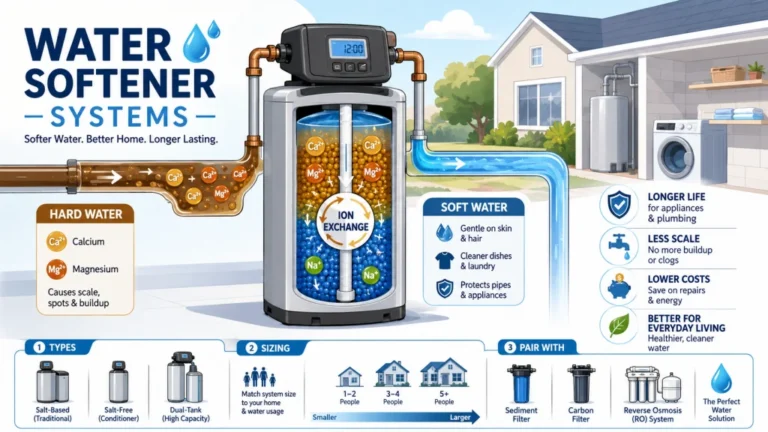
A chlorine-reducing shower filter typically costs between $40 and $80. It addresses the problem directly, at the point of use, before the water touches your hair and skin. A whole-house ion exchange softener addresses the hardness problem throughout the entire home, at $1,000 to $1,500 before installation. Both solve different problems. Neither solves the other’s problem.
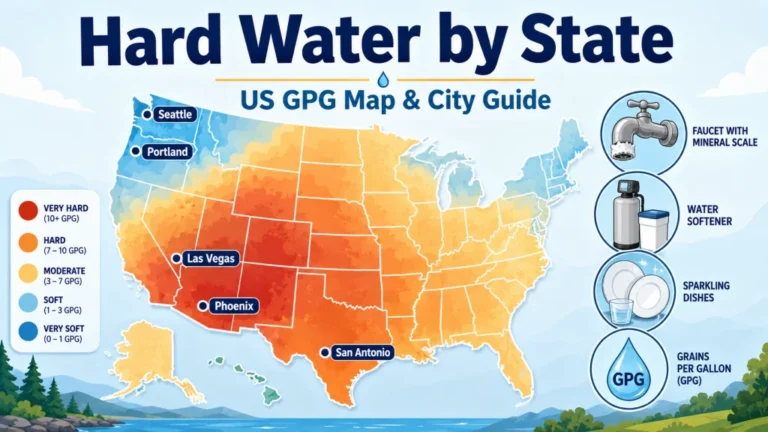
For someone on city water at moderate hardness, say 7 to 12 GPG, whose primary complaint is dry hair and irritated skin with no major appliance symptoms, a shower filter is a reasonable first step. It costs less than a tenth of a whole-house system, it addresses the chlorine variable directly, and if the complaint improves, you have identified chlorine as a meaningful contributor. If it does not improve, or if scale symptoms start appearing on appliances, you have ruled out the cheaper fix and have better information for the larger decision. The full picture of what hard water contains, how severity levels differ by region, and what each level typically requires covers the wider context if you want to understand where your situation fits before spending anything.
At 15 GPG or above with scale on fixtures and a water heater that is running less efficiently than it should, the case for a whole-house softener is strong on appliance grounds, and the hair and skin benefits follow alongside. That is a different decision than treating water at 8 GPG primarily to improve shampoo results. Matching the solution to the actual problem is what keeps the math sensible.
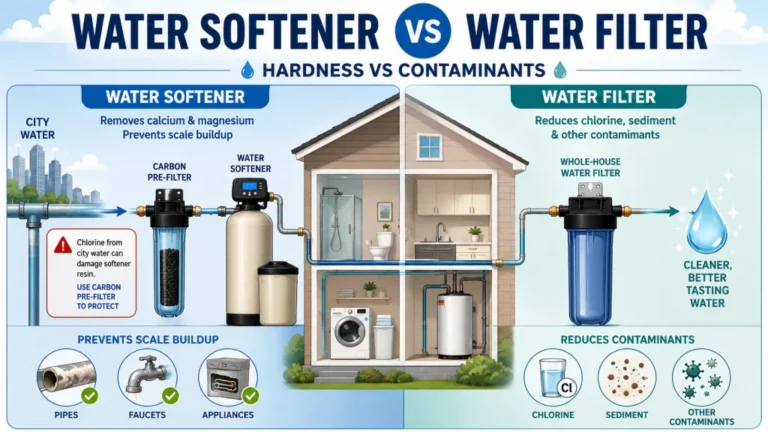
Note: For city water households, pairing a carbon pre-filter with a whole-house softener addresses both variables: the carbon pre-filter reduces chlorine before it reaches the system, while the softener handles hardness. Building that combination in from the start is significantly easier than adding it later.
What to Realistically Expect From a Water Softener
If your baseline hardness was at 10 GPG or above and you switch to soft water, you will likely notice a real change in how your hair and skin feel. Hair becomes easier to comb when wet, feels less rough and brittle when dry, and shampoo rinses out more completely. Skin feels less tight after a shower and tends to hold moisture better. These are genuine changes that show up consistently in households where the water was genuinely hard. They are usually not dramatic, and most people do not notice the full difference after the first shower.
Most people I have talked to after an install notice the hair and skin difference within two to four weeks of consistent use. The mineral buildup in hair does not reverse overnight. If you are expecting a transformation in the first few days and nothing feels different, that does not mean the system is not working. It means the timeline for this particular benefit is measured in weeks, not days.
What does not change with softening alone, for city water households, is chlorine exposure. If your complaints span both scale symptoms and hair or skin sensitivity, a softener addresses the hardness while a carbon pre-filter addresses the chlorine. The complete guide to the full water treatment system, from identifying the problem through installation and maintenance, covers how those components fit together if you want to understand the full picture before making a decision.
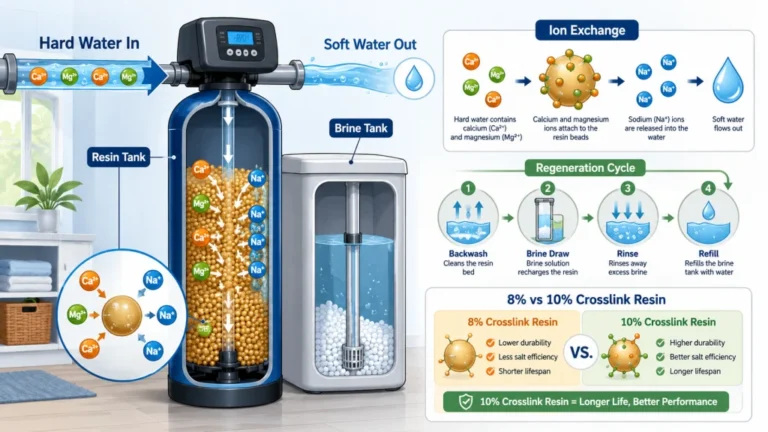
One pattern worth watching for: if you have been softening your water for a while and the hair and skin complaints have returned, the softener may be the source. A resin bed that has degraded or a brine tank that is not cycling correctly produces water that tests hard again. The same symptoms that originally pointed you toward softening come back, and homeowners often assume it is the municipal supply that has changed when the system is the actual variable. A quick hardness test on the post-softener water tells you immediately.
- Hair changes you can expect from soft water: less breakage, easier to detangle when wet, improved shine, shampoo and conditioner rinse out more completely
- Skin changes you can expect: less mineral film after showering, skin stays moisturized longer, reduced tightness after bathing
- What soft water does not fix: androgenic hair loss, active eczema flares, chlorine-related damage on city water without a pre-filter
- Realistic timeframe: most households notice hair and skin changes within two to four weeks of consistent use
- Watch for regression: returning symptoms after months of good performance often point to a softener maintenance issue, not the source water

This kit includes 150 dip-and-read test strips for quickly measuring water hardness across virtually any source, including home faucets, well water, softeners, dishwashers, showers, and aquariums. Results are instant and easy to read against a color chart, making it simple to verify whether your water softener, reverse osmosis, or water conditioning system is performing as expected. A bonus eBook is included to help you record, track, and interpret your results over time.
Check On AmazonIf you click this link and buy, we earn a commission at no additional cost to you.
Before You Spend Anything, Identify the Real Problem
The most common mistake in this category is pricing the solution before confirming the problem. Hair and skin complaints have at least three possible contributors: water hardness, chlorine, and factors unrelated to water at all. Matching the treatment to what you actually have keeps the cost proportionate and the expectations accurate. Four questions help narrow it down quickly.
Assume hard water is the cause, buy a whole-house softener based on a hair complaint, then find out the water was at 6 GPG and the shower head filter would have handled it for $50.
Confirm your hardness number, identify your water source, match symptoms to likely cause, then choose the treatment sized to the actual problem.
The four questions worth answering before spending anything:
- Water source: city water or private well? City water has chlorine. Well water typically does not, but may have iron, sulfur, or other variables.
- Hardness number: under 7 GPG, 7 to 12 GPG, 12 to 15 GPG, or 15 plus? The treatment threshold changes meaningfully between these bands.
- Symptom profile: only hair and skin complaints, or also scale on fixtures, reduced appliance efficiency, and spots on dishes? Hair and skin alone points toward chlorine as a likely contributor. Scale symptoms plus hair and skin points toward hardness as the main variable.
- Current setup: no treatment at all, shower filter only, softener without pre-filter, or both? If you already have a softener and symptoms returned, test the post-softener water before buying anything else.
A city water household at 7 to 12 GPG with only hair and skin complaints is a strong candidate for trying a shower filter first. A household at 12 GPG or above with visible scale and appliance symptoms has a stronger case for softening, with hair and skin improvement as a secondary benefit. At 15 GPG or above, the softener case is clear regardless of the hair situation. Eczema and active hair loss are separate medical questions that water treatment may help at the margins but will not resolve on its own.

IAPMO certified to NSF/ANSI Standard 44, this system is sized for homes with up to 5 people and 4 bathrooms, using ion exchange to deliver soft, scale-free water from every tap with city or well water compatibility. The user-friendly LCD allows metered operation that uses up to 50% less salt and 28% less water compared to standard time-based softeners, helping lower long-term costs on appliances, soap, and cleaning products. The bundle includes a recommended pre-filter and installation kit, and is backed by a 5 to 10-year limited warranty with dedicated customer support.
Check On AmazonIf you click this link and buy, we earn a commission at no additional cost to you.
Final Thoughts: Get the Problem Right Before You Price the Solution
Hard water is a real contributor to hair and skin problems. For most city water households, it is not the only contributor, and in many cases it is not even the primary one. Chlorine is doing meaningful damage to hair and skin that a water softener will not fix, and that fact is missing from almost every hard water hair article online. Knowing it changes how you think about what to spend.
The practical approach before spending anything: know your hardness number. If you are on city water, treat chlorine as a factor in the equation, not an afterthought. At 5 to 8 GPG with no appliance symptoms, a shower filter is a reasonable first test. At 12 GPG with scale on fixtures and a water heater that is running harder than it used to, the softener case is solid on multiple grounds and the hair and skin benefits follow. At 15 GPG or above, the appliance math makes the decision straightforward regardless of what your hair looks like. If you are not sure where your water actually falls, getting an accurate hardness reading is the right first step before spending on any treatment.

Designed for homes with 4 to 6 bathrooms, this California-built system combines a reusable 30-micron washable sediment filter with GAC-KDF media to reduce dirt, rust, iron, scale, heavy metals, chlorine taste and odor, and VOCs across up to 1,000,000 gallons. Large 1-inch inlet and outlet ports maintain strong water pressure throughout the entire home, and the reusable pre-filter requires no tools to clean, keeping long-term maintenance costs low. All components are built with NSF-certified materials for dependable, lasting performance.
Check On AmazonIf you click this link and buy, we earn a commission at no additional cost to you.
FAQs
💇 Does hard water cause hair loss?
No. Hard water can weaken the hair shaft and cause breakage, which looks like shedding, but it does not damage hair follicles or trigger androgenic hair loss. If your hairline is receding, hard water is not the cause. A water softener will not stop that process.
🔬 What did the IJT study actually find about hard water and hair?
The International Journal of Trichology study found that hair samples washed in hard water showed lower tensile strength than samples washed in distilled water over the same period. The hair broke more easily under mechanical stress. The study measured shaft damage, not follicle function, which is a meaningful distinction when you are trying to figure out whether a softener will help your specific problem.
🚿 Will a shower filter actually help dry hair on city water?
Often more than people expect. Municipal chlorine strips scalp oils and is frequently a larger contributor to dry hair than minerals are. A chlorine-reducing shower filter at $40 to $80 is worth testing before committing to a whole-house softener if your main complaint is dry hair and irritated skin. If it helps significantly, you have identified chlorine as the main variable. If it does not, you have eliminated the cheaper fix.
🩺 Can hard water cause or worsen eczema?
There is a documented epidemiological association between hard water regions and higher eczema rates, and the National Eczema Association acknowledges that hard water may disrupt the skin barrier. Hard water has not been established as a direct cause in controlled trials. Softening may noticeably help some people with reactive skin and have no measurable effect on others.
⏱️ How long does it take to see hair and skin improvement after installing a softener?
Most households notice changes within two to four weeks. Hair gradually becomes easier to manage and less prone to breakage as mineral buildup leaves the shaft. The first shower in soft water rarely produces a dramatic result, so do not judge the system in the first few days.
🌿 Does a water softener remove chlorine from city water?
No. Ion exchange softeners remove calcium and magnesium. Chlorine passes through the resin bed unchanged. For city water households with both scale symptoms and hair or skin sensitivity, the better setup is usually a softener for hardness plus a carbon pre-filter for chlorine. It is significantly easier to build that combination in from the start than to add it later.
💧 What GPG level is bad enough to actually affect hair and skin?
Most people on city water start noticing hair and skin effects at 10 GPG and above. Below 7 GPG, the mineral load is low enough that chlorine is likely the more significant factor for most city water households. At 15 GPG or above, both the mineral and the appliance case for softening are strong.