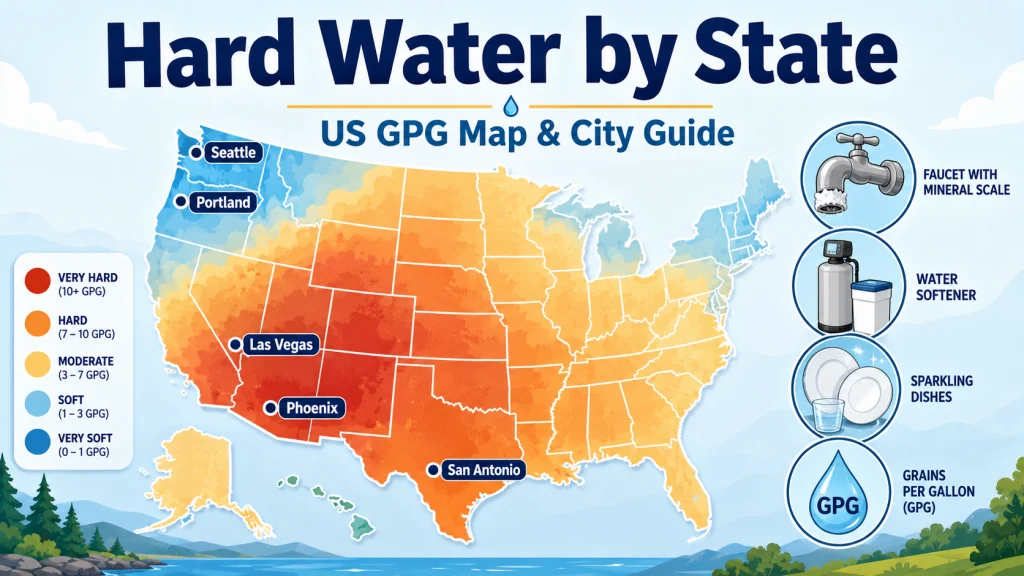
Hard Water by State: Why Location Changes the Entire Conversation
Hard water is not distributed evenly across the US. The USGS National Water-Quality Assessment data shows it concentrated in the east-central and western United States, driven almost entirely by geology. Rain falls with essentially no dissolved minerals. As it percolates through limestone, chalk, and gypsum formations, it picks up calcium and magnesium before it ever reaches a tap. Regions underlaid by those rock formations have hard water. Regions fed by snowmelt or underlaid by different geology tend to be soft.
That matters because your GPG number shapes every decision that follows. Whether to treat at all, what system type makes sense, and what grain capacity you need are not universal answers. What is correct for a household in Las Vegas is the wrong answer in Portland. If you are still working through the foundational questions about what your GPG number means and what path makes sense, the complete guide to water softeners walks through the full decision process from problem identification to system selection without skipping steps.
The Hardest States: Where Treatment Is Essentially Required
Arizona and Nevada lead the country by a significant margin. Most of Arizona’s municipal supply draws from the Colorado River basin and high-mineral desert aquifers. Phoenix and Las Vegas are not outliers in their states at 16 to 20 GPG. That is simply what the geology produces. Texas follows closely at 15 to 20 GPG across most of the state, with San Antonio and the Hill Country region regularly at the high end of that range. New Mexico and Kansas are not far behind, with most municipalities measuring above 15 GPG. At those levels, scale builds on faucets and fixtures within weeks of a new installation. That is not an exaggeration.
The interior Midwest is softer than the Southwest but still well into hard water territory. Indianapolis municipal supply often hits 15 to 20 GPG, driven by the limestone formations beneath the city. Minneapolis regularly measures around 15 GPG. Chicago’s supply runs 8 to 12 GPG depending on source blending and season. These levels do not present the same urgency as Phoenix, but they are not a non-issue either. At 10 GPG, scale accumulates steadily on heating elements and in pipe fittings. The impact takes longer to become visible, but it is happening. What I notice at those hardness levels is that homeowners often dismiss the problem for two or three years until the water heater starts losing recovery speed or the dishwasher spray arms start blocking. By then the damage is already done.
The Softest Regions: Where a Softener Is Hard to Justify
The Pacific Northwest is a different story. Oregon and Washington draw primarily from snowmelt-fed surface reservoirs in the Cascades. Seattle’s municipal supply typically measures under 1 GPG. Portland comes in around 1 to 3 GPG. At those levels, scale is not a practical concern and appliance protection is not a convincing argument for a softener purchase. New England and Hawaii are similarly soft in most areas. The common thread is source water that bypasses the calcium and magnesium-laden geology that defines the Southwest and interior plains.
New York City sits in an interesting middle position at 3 to 7 GPG. The city draws from the Catskill-Delaware watershed, which produces relatively low hardness compared to most of the country. Light spotting on dishes and minor soap residue are possible at that level, but the appliance damage that motivates most softener purchases develops much more slowly than it would at 15 GPG. Understanding how these hardness levels translate into practical outcomes at home, and what the full path from problem to treatment looks like, is what the hard water guide walks through before pointing you to the right next steps.
Key US Cities and Their GPG Levels
City-level data is more useful than state averages because hardness varies within states based on local source water, aquifer depth, and utility blending practices. The figures below are drawn from USGS National Water-Quality Assessment data and published Consumer Confidence Reports. Well water users should treat these figures as directional estimates only. Private well hardness depends on the specific aquifer and can differ substantially from municipal supply in the same area.
| City | Typical GPG Range | Treatment Outlook |
|---|---|---|
| Las Vegas, NV | 16 to 20+ GPG | Essentially required |
| Phoenix, AZ | 16 to 20 GPG | Essentially required |
| San Antonio, TX | 15 to 20 GPG | Essentially required |
| Indianapolis, IN | 15 to 20 GPG | Essentially required |
| Minneapolis, MN | 15 to 18 GPG | Essentially required |
| Dallas, TX | 10 to 15 GPG | Recommended |
| Chicago, IL | 8 to 12 GPG | Recommended |
| Denver, CO | 5 to 10 GPG | Optional to recommended |
| New York City, NY | 3 to 7 GPG | Optional |
| Boston, MA | 2 to 5 GPG | Optional to not needed |
| Portland, OR | 1 to 3 GPG | Not needed |
| Seattle, WA | Under 3 GPG | Not needed |
Field Note: One of the patterns I watch repeat most consistently is homeowners relocating from Seattle or Boston into Phoenix or San Antonio. They have never owned a softener, never needed one, and have no frame of reference for what 18 GPG does to a home. Within two years they are calling about a shower head running at half pressure, a dishwasher leaving white film on everything, and a water heater that already sounds like someone dropped gravel into it. Nothing went wrong with the appliances. The water chemistry just changed by about 15 GPG and the equipment had no way to adapt.
These ranges reflect typical municipal supply at the city level. Suburbs and smaller communities within a metro area may draw from different source water and see different hardness levels. The only reliable number for your specific service area is the one in your utility’s annual report.

This complete high-flow system comes equipped with a digital metered 5600SXT control head, 2 cubic feet of resin in a 12 by 48-inch tank, and a larger 18 by 33-inch round brine tank with bypass valve included and ready to install. On-demand metered regeneration treats up to 16 GPM and only cycles when needed, conserving salt and water while protecting plumbing, appliances, and fixtures from scale buildup. The system is backed by a 5-year warranty on the control head and a 10-year warranty on the tank.
Check On AmazonIf you click this link and buy, we earn a commission at no additional cost to you.
US Hard Water by State: Quick Reference
The table below covers approximately 30 states grouped by hardness range, using USGS data and published utility reports. All figures reflect typical municipal supply. Private well hardness varies independently of these figures and requires a direct test. The sizing column assumes a four-person household on city water without iron. Well water with iron shifts both the required treatment approach and the grain capacity higher.
| State | Typical GPG (Municipal) | Key Cities | Minimum System Size (4-person household) |
|---|---|---|---|
| 12 to 20+ GPG: Treatment often required | |||
| Arizona | 16 to 20+ | Phoenix, Tucson, Scottsdale | 64k to 80k grains |
| Nevada | 16 to 20+ | Las Vegas, Henderson | 64k to 80k grains |
| Texas | 15 to 20 | San Antonio, El Paso, Dallas | 48k to 64k grains |
| New Mexico | 14 to 20 | Albuquerque, Santa Fe, Las Cruces | 48k to 64k grains |
| Indiana | 15 to 20 | Indianapolis, Fort Wayne | 48k to 64k grains |
| Minnesota | 14 to 18 | Minneapolis, St. Paul | 48k grains minimum |
| Kansas | 13 to 18 | Wichita, Topeka | 48k grains minimum |
| Nebraska | 12 to 17 | Omaha, Lincoln | 48k grains minimum |
| 8 to 15 GPG: Treatment recommended | |||
| Utah | 10 to 16 | Salt Lake City, Provo | 32k to 48k grains |
| Iowa | 10 to 14 | Des Moines, Cedar Rapids | 32k to 48k grains |
| Oklahoma | 8 to 14 | Oklahoma City, Tulsa | 32k to 48k grains |
| Ohio | 8 to 14 | Columbus, Cleveland, Cincinnati | 32k to 48k grains |
| Illinois | 8 to 12 | Chicago, Springfield | 32k grains |
| Michigan | 8 to 13 | Detroit, Grand Rapids | 32k grains |
| Missouri | 8 to 13 | Kansas City, St. Louis | 32k grains |
| Wisconsin | 8 to 13 | Milwaukee, Madison | 32k grains |
| Wyoming | 8 to 14 | Cheyenne, Casper | 32k to 48k grains |
| 3 to 7 GPG: Treatment optional | |||
| Colorado | 5 to 10 | Denver, Colorado Springs | 24k to 32k grains |
| Pennsylvania | 4 to 9 | Philadelphia soft, rural areas harder | 24k to 32k if treating |
| Virginia | 4 to 9 | Northern VA, Richmond varies by region | 24k if treating |
| North Carolina | 3 to 8 | Charlotte, Raleigh | 24k if treating |
| Georgia | 3 to 7 | Atlanta | 24k if treating |
| New York | 3 to 7 in NYC, higher upstate | NYC, Albany, Buffalo | 24k if treating |
| California | 1 to 3 in the Bay Area, 8 to 15 in Southern CA | San Francisco soft, Los Angeles and San Diego much harder | Not needed to 48k depending on area |
| Under 3 GPG: Treatment generally not needed | |||
| Washington | Under 2 | Seattle, Tacoma, Olympia | Not needed |
| Oregon | 1 to 3 | Portland, Eugene, Salem | Not needed |
| Hawaii | Under 2 | Honolulu, Maui | Not needed |
| Maine | 1 to 3 | Portland, Bangor | Not needed |
| Vermont | 1 to 3 | Burlington, Montpelier | Not needed |
| New Hampshire | 1 to 3 | Concord, Manchester | Not needed |
| Massachusetts | 1 to 4 | Boston, Worcester | Not needed to 24k |
Note: California hardness varies more than any other state. The Bay Area and most of Northern California draw from soft mountain reservoirs and typically measure under 3 GPG. Southern California, including the Los Angeles and San Diego metro areas, draws heavily from the Colorado River and ranges from 8 to 15 GPG in many municipalities. If you are in California, check your specific utility’s report before assuming soft or hard.
A few states are absent from this table because hardness varies too much by region to give a single useful range. Tennessee, for example, runs soft in the eastern mountains and notably harder in the central basin around Nashville. Mississippi and Alabama follow a similar pattern. For those states, your utility’s Consumer Confidence Report is the only reliable starting point.

IAPMO certified to NSF/ANSI Standard 44, this system is sized for homes with up to 5 people and 4 bathrooms, using ion exchange to deliver soft, scale-free water from every tap with city or well water compatibility. The user-friendly LCD allows metered operation that uses up to 50% less salt and 28% less water compared to standard time-based softeners, helping lower long-term costs on appliances, soap, and cleaning products. The bundle includes a recommended pre-filter and installation kit, and is backed by a 5 to 10-year limited warranty with dedicated customer support.
Check On AmazonIf you click this link and buy, we earn a commission at no additional cost to you.
What Your GPG Means for the Treatment Decision
Your GPG number determines whether treatment makes practical sense and at what urgency. The thresholds below are based on what I have watched play out across many installations at different hardness levels. They are not marketing ranges designed to push everyone into buying something. At the low end, the honest answer is often that a softener is not worth the cost.
- Under 3 GPG: Soft water. No treatment needed. Scale is not a functional concern at this level. If you are in Portland or Seattle, a softener purchase is difficult to justify on any appliance protection basis.
- 3 to 7 GPG: Mildly hard. Treatment is a comfort upgrade, not a requirement. Light spotting on dishes and minor soap residue are possible. Appliance impact is real but slow. A softener in this range is a quality-of-life decision, not a financial necessity.
- 7 to 15 GPG: Hard to very hard. Treatment is recommended for households with water heaters, dishwashers, and washing machines in regular use. The Battelle Memorial Institute study found measurable efficiency loss and shortened appliance lifespan at sustained hardness levels in this range. At 10 GPG a properly sized system commonly breaks even on appliance savings within a few years.
- 15+ GPG: Extremely hard. Treatment is essentially required if you want appliances running at expected efficiency and lifespan. At this level scale accumulates on every surface the water contacts, and it does so quickly. A gas water heater operating without treatment at 18 to 20 GPG shows measurable efficiency loss within the first year of operation.
These thresholds apply to city water with standard household use. Well water carrying iron content shifts the effective hardness demand higher, because iron fouls softener resin and must be factored into both the treatment approach and the sizing calculation separately from the hardness number.
What It Means When Sizing a System
Geography does not just determine whether to treat. It determines what size system you need, and the difference between a Phoenix household and a Chicago household at the same family size is not a rounding error. The basic sizing formula multiplies household size by estimated daily water use per person by GPG by seven days to get the minimum weekly grain demand. That formula produces very different outputs depending on where you live.
A family of four in Phoenix at 20 GPG works out to 4 x 75 x 20 x 7, which lands at 42,000 grains of weekly demand before any iron adjustment. That puts the correct system at 64,000 to 80,000 grains. A standard 48,000-grain unit at that demand level regenerates every two to three days instead of the normal weekly interval. Short-cycle regeneration wastes salt, adds unnecessary wear to the control valve, and in a large high-hardness household often cannot keep up with peak demand. The 48,000-grain unit that looks like a reasonable middle-ground choice is actually undersized for Phoenix conditions.
The same family of four in Chicago at 10 GPG has weekly demand closer to 21,000 grains. A 32,000-grain unit handles that load comfortably on a standard weekly regeneration cycle. Same household, completely different sizing requirement. The 32,000-grain system that is undersized in Phoenix is the correct answer in Chicago. The 64,000-grain system Phoenix requires would be significantly oversized there, sitting between regeneration cycles long enough to raise bacterial growth concerns in stagnant resin.

This whole-home water softener comes pre-loaded with 1.5 cubic feet of high capacity resin in a black USA-made mineral tank, paired with a USA brine tank featuring a safety float. The on-demand digital metered system ensures efficient water treatment, and the included 1-inch Noryl plastic bypass valve makes installation straightforward. Toll-free customer support is available whenever you need help.
Check On AmazonIf you click this link and buy, we earn a commission at no additional cost to you.
How to Find Your Exact Hardness Number
State and city averages tell you whether you are likely in hard water territory. They are not precise enough to base a purchase on. For city water users, the most reliable free source is your utility’s Consumer Confidence Report. The EPA requires every public water supplier to publish this annually. Most utilities post it online. Search your city name plus “Consumer Confidence Report” or “annual water quality report.” The hardness value is typically listed in grains per gallon, milligrams per liter, or parts per million. To convert from mg/L or PPM to GPG, divide by 17.1.
If you cannot locate the report online, a call to your utility’s customer service line gets you the hardness figure directly. In my experience, most utility representatives can give you the current hardness reading for your service area in about two minutes. It is public information and they answer the question regularly. The number they provide is the one that matters for every decision that follows.
Well water is a different situation entirely. The Consumer Confidence Report covers only municipal supply, not private wells. Aquifer hardness varies enough by depth and local geology that a neighbor’s test result is not a reliable guide for your own. Test strips from a hardware or pool supply store give a usable approximation for under $15. A liquid titration kit gets you closer to accurate for around $20. If you are also dealing with iron, manganese, or sulfur, a state-certified lab test at $30 to $50 covers all of those in a single report. That full picture matters because iron content changes both the sizing formula and the treatment configuration you will need upstream of the softener.

This kit lets you test drinking water, pool water, or any water source in seconds using a simple dip-and-read method with an oversized color chart ranging from red to green, covering 0 to 25 GPG and 0 to 425 PPM. All 100 strips are protected by FreshSeal technology across a ready-to-use bottle and two sealed pouches for long-term accuracy. Each purchase also funds a full year of clean water for someone in the Central African Republic.
Check On AmazonIf you click this link and buy, we earn a commission at no additional cost to you.
Final Thoughts: Get the Number, Then Pick the Size
The regional data in this article tells you whether you have a hard water problem. It does not tell you how to size a solution. A state table showing 16 to 20 GPG for Arizona confirms that treatment makes sense. It does not tell you whether your specific utility is at 16 or 20 GPG today, and that difference moves the sizing calculation by thousands of grains. Buying based on state reputation rather than a confirmed number is how households end up with a 32,000-grain unit in Phoenix regenerating constantly, or a 64,000-grain unit in Chicago sitting stagnant between cycles.
Confirm your GPG from your utility’s annual report or a direct test, then size based on that number and your household size. Those two inputs are all the sizing formula needs. Everything in this article points toward that same five-minute step before any purchase decision gets made.
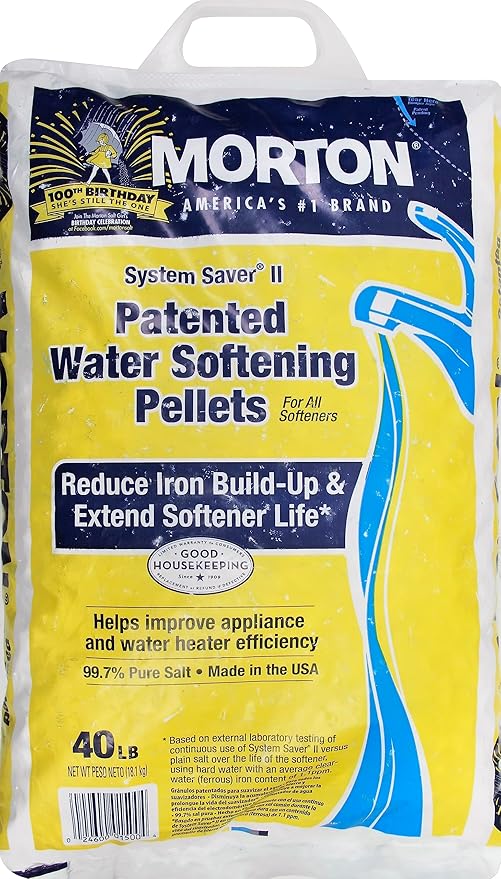
This 40-pound bag of USA-made System Saver pellets is designed to improve the taste of your water while helping extend the life of your appliances and water softener. Simple to use, just add the pellets directly to your softener's brine tank as needed.
Check On AmazonIf you click this link and buy, we earn a commission at no additional cost to you.
FAQs
🗺️ Which US states have the hardest water?
Arizona, Nevada, and Texas consistently rank at the top, with most municipalities measuring 15 to 20+ GPG. New Mexico, Indiana, Kansas, and Nebraska are close behind. The common factor is limestone-rich geology and high-mineral groundwater that heavily mineralizes supply before it reaches the tap.
💧 What is considered a normal GPG level for US tap water?
The USGS reports that hard water is prevalent across most of the country. A rough national average lands somewhere between 10 and 13 GPG, but that figure covers an enormous range, from under 1 GPG in Seattle to over 20 GPG in Las Vegas. Where you fall in that range matters more than the average.
📊 Is 7 GPG hard enough to need a water softener?
At 7 GPG you are at the lower end of hard water. Treatment is recommended rather than essential. Appliance impact is real but develops slowly. For a household with a water heater, dishwasher, and washing machine in regular use, a softener is worth considering. For a smaller household without heavy appliance use, it is more optional than urgent.
🔬 Does well water hardness differ from city water in the same area?
Often significantly. Private well hardness depends on which aquifer the well draws from and at what depth. Two neighboring properties on private wells can show different hardness results. City averages and Consumer Confidence Reports do not apply to private wells. A direct test with strips, a titration kit, or a certified lab is the only reliable way to know your well’s hardness level.
🏠 Do I need a water softener if I live in the Pacific Northwest?
In most cases, no. Seattle, Portland, and most of western Oregon and Washington draw from snowmelt-fed reservoirs that produce water well under 3 GPG. At that level, scale is not a practical problem and appliance protection is not a strong justification for softener installation. Verify your specific utility’s annual report to confirm, since supply sources can vary within the region.
📋 How do I look up my city’s exact water hardness?
Search your city name plus “Consumer Confidence Report” or “annual water quality report.” The EPA requires public utilities to publish this data each year and most post it online. If you cannot find it, a call to the utility’s customer service line will get you the current hardness reading directly. Well water users need a physical test since the Consumer Confidence Report covers only municipal supply.