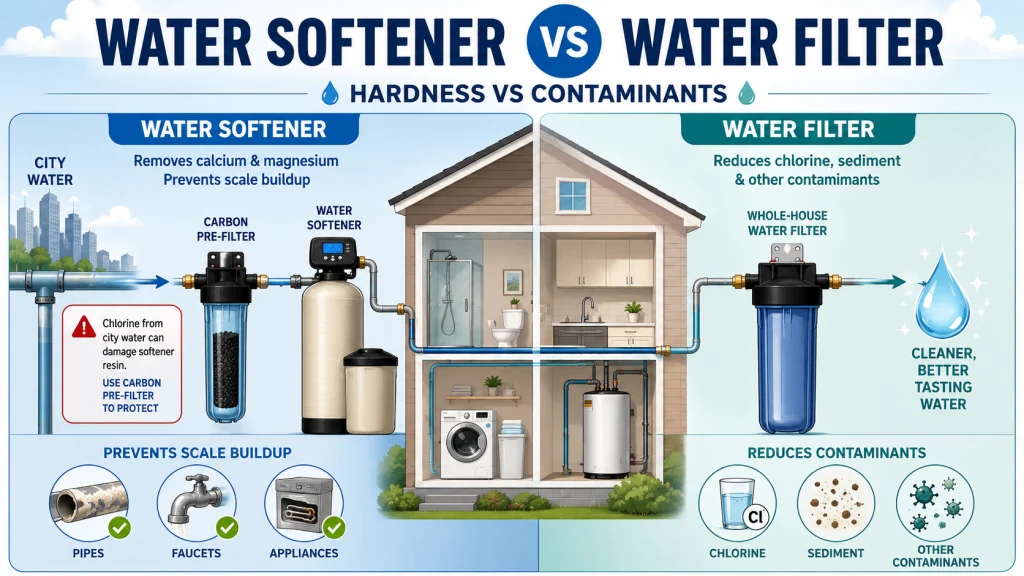
Two Systems, Two Completely Different Jobs
The confusion here is understandable. Both systems connect to your main water line. Both improve your water in some way. The marketing around them overlaps constantly, and some vendors deliberately blur the line to make a sale. But at the core, they address entirely different problems and you cannot substitute one for the other.
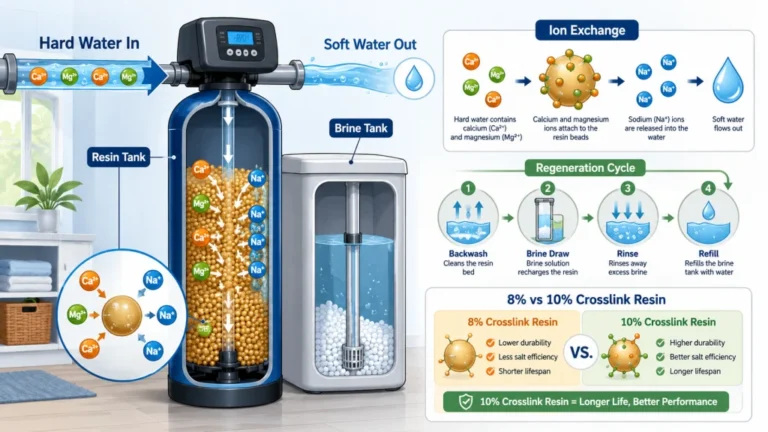
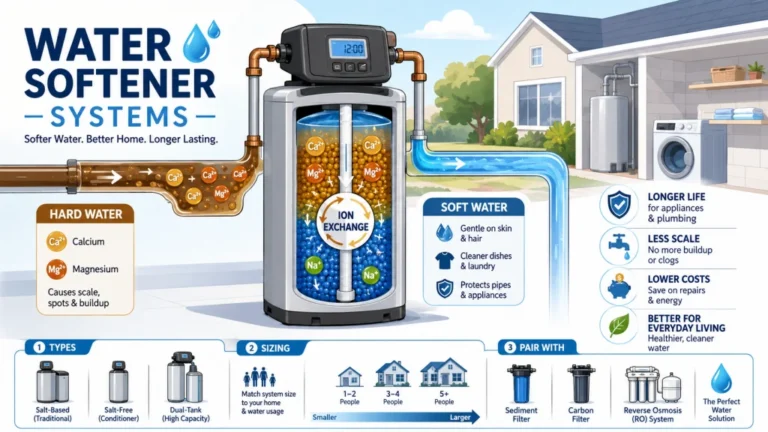
A water softener is a single-purpose system. It uses ion exchange resin to pull calcium and magnesium out of your water and replace them with sodium. That is it. The result is water that does not form scale, does not bond with soap to create scum, and does not coat your appliances with mineral deposits. What it does not do is remove chlorine, sediment, bacteria, heavy metals, VOCs, or any other contaminant. The resin targets hardness minerals specifically. Run chlorinated city water through a softener without any pre-treatment, and the chlorine passes straight through into your household supply unchanged.
A whole-house water filter is the opposite profile. Depending on the media inside (sediment, carbon, KDF), it can remove chlorine, chloramines, sediment, some heavy metals, and VOCs. What it cannot do is soften your water. The hardness minerals that form scale in your pipes and coat your water heater element pass right through a filter unchanged. Your test result stays exactly where it started. If you came in at 18 GPG and you install a filter, you still have 18 GPG water coming out the other side.
The clearest way I have found to explain this to homeowners: a softener fixes what shows up on a hardness test, and a filter fixes what shows up on a contamination test. If you have both problems, you need both systems.
What Each System Actually Removes and What It Leaves Behind
Getting specific here matters, because the gaps are where homeowners get burned. Someone with sulfur odor in their well water installs a softener expecting it to fix the smell. It will not. Someone with city water and chlorine taste installs a carbon filter expecting softer water. Still hard. The mismatch between expectation and result comes from not knowing which contaminant each system is designed to target.
| What’s in your water | Water softener removes it? | Whole-house filter removes it? |
|---|---|---|
| Calcium and magnesium (hardness) | Yes | No |
| Ferrous (clear) iron at low levels | Partially, up to about 2 to 3 ppm | Not with standard sediment or carbon filtration. Needs a dedicated iron or oxidizing filter. |
| Chlorine and chloramines | No | Yes, with carbon media (catalytic carbon for chloramines) |
| Sediment and particulates | No | Yes, with sediment filter |
| Sulfur odor | No | Yes, with KDF or carbon media |
| Heavy metals such as lead or copper | No | Depends on filter media |
| Bacteria and pathogens | No | Only with a UV stage added |
| Scale in pipes and appliances | Yes | No |
The iron row is worth a moment of attention. A softener can handle low levels of clear (ferrous) iron, typically up to about 2 to 3 ppm. Beyond that, the iron fouls the resin bed. I have seen softeners pulled out of service inside a year because nobody caught the iron level before installation. If your water test comes back with significant iron, a dedicated iron or oxidizing filter needs to go upstream of the softener, not around it.
Field Note: One of the more frustrating service calls I walk into is a softener installed on well water without any pre-treatment. The resin is orange, clogged, and the system is regenerating twice as often as it should trying to keep up. The hardness was the presenting problem. The iron was the problem that killed the system. The homeowner’s water report had iron listed right there in it. Nobody read it before the system went in.
The City Water Problem Nobody Mentions: Chlorine and Your Resin
This is the detail that almost never appears in water softener versus filter comparison articles, and it is the one that costs city water homeowners the most money over time. Municipal water is disinfected with chlorine or chloramines. That is standard practice and generally fine for drinking. What it is not fine for is the ion exchange resin inside your softener, and the mechanism is worth understanding.
Softener resin is manufactured from styrene cross-linked with divinylbenzene (DVB). The DVB cross-links are what hold the resin structure together. Chlorine is an oxidizing agent, and it attacks those cross-links directly. Standard residential resin is 8% cross-linked. At typical municipal chlorine concentrations, that 8% resin degrades over time. The cross-links break down, the resin beads swell and become fragile, and eventually the system loses capacity and starts pushing fine resin particles downstream. Higher-grade resin at 10% cross-link handles chlorine better, but continuous exposure at city water chlorine levels degrades it too over a long enough timeline.
The reliable fix is to remove the chlorine before it reaches the resin. A carbon pre-filter installed upstream of the softener does exactly that. Standard activated carbon adsorbs chlorine well. For chloramines, which some municipalities use instead of or alongside chlorine, catalytic carbon is more effective and worth specifying when you know chloramines are present. Either way, the resin never sees the oxidizing agent, and resin life extends significantly. In my experience, the difference between a softener that lasts eight years and one that needs a resin replacement at four often comes down to whether a carbon pre-filter was installed upfront, because chlorine exposure starts degrading resin from day one.
The technical data backs this up. Purolite, a major resin manufacturer, documents that for every 1 ppm of free chlorine in the incoming water supply, a standard softening resin loses roughly half its service life. Most city water runs between 0.5 and 2 ppm at the tap. Those numbers compound. A carbon pre-filter is not an optional upgrade on city water; it is the correct installation practice, and skipping it is a decision that shows up later as a service call.
Key point: A whole-house carbon pre-filter does not soften your water. It protects the resin that does the softening. On chlorinated city water, these two systems serve different functions and work better together than either does alone.

Installed at the main water supply line, this system removes up to 99% of chlorine and up to 95% of sediment, rust, herbicides, industrial solvents, and other contaminants from every tap in your home. With 1-inch NPT connections and 20 by 4.5-inch cartridges supporting up to 15 GPM, it delivers strong whole-house flow with minimal pressure drop and straightforward DIY installation. Unlike reverse osmosis systems, it retains healthy minerals in your water and is backed by a lifetime personalized support warranty with online product registration.
Check On AmazonIf you click this link and buy, we earn a commission at no additional cost to you.
Well Water: Why a Softener Alone Is Usually the Wrong Starting Point
If you are on a private well, the calculus is different from city water and more complicated. City water arrives at your meter with consistent chemistry the municipality monitors and reports. Well water arrives with whatever your local geology, the well casing condition, and the pump depth dictate. That can mean hardness plus iron plus manganese plus sediment plus sulfur odor, all at the same time. A softener is not designed to handle that combination on its own.
The installation order on well water matters as much as the equipment selected. The standard sequence that holds up across most well water situations is: sediment pre-filter first, then any iron or sulfur treatment if your water test calls for it, then the softener. Running unfiltered well water directly into a softener compresses what should be a multi-year service life into something much shorter. Sediment physically clogs resin beds. Iron fouls them. A softener trying to handle all of that upstream load will exhaust faster, regenerate more frequently, and lose capacity early.
- Sediment pre-filter (5 to 25 micron): removes particulates before they reach the softener or any downstream equipment. Spin-down style filters are easy to flush and maintain for most homeowners.
- Iron treatment: if your water test shows iron above 2 to 3 ppm, a dedicated iron filter or oxidizing filter needs to precede the softener. The softener alone will foul and lose capacity well ahead of schedule.
- Sulfur (hydrogen sulfide): a KDF or aeration-based treatment stage before the softener handles this. Standard carbon alone is not always sufficient for high sulfur concentrations.
- UV disinfection: if bacterial contamination is a concern (common with older wells or wells near agricultural land), a UV stage belongs downstream of filtration once the water is clear so the UV light can reach pathogens effectively.
- Water softener: last in the pre-treatment chain, treating the hardness that remains after each upstream stage has done its job.
The Minnesota Department of Health notes in its well water guidance that excessive iron can foul softener systems, which is consistent with what I see in the field on heavily iron-loaded well water. The system fails faster than expected and the homeowner assumes the softener was defective. In most of those cases, the problem was the installation sequence, not the equipment.

This 50-micron flushable and reusable filter serves as an ideal first stage in any whole house filtration system, capturing sediment, rust, dirt, and sand before water reaches finer filters downstream. A built-in Siliphos additive helps soften water, prevent scale buildup, and reduce pipe corrosion, with filter replacement recommended every 3 to 6 months for best results. The see-through housing allows easy visual monitoring, and dual threads with 1-inch MNPT and 3 to 4-inch FNPT connections make installation straightforward for indoor use within a pressure range of 20 to 100 PSI.
Check On AmazonIf you click this link and buy, we earn a commission at no additional cost to you.
If Budget Forces You to Choose One First
Sometimes a homeowner has to prioritize where money goes first. The answer depends on which problem is doing more damage. On city water, if your hardness is above 10 GPG and you have visible scale on fixtures or appliances aging faster than they should, the softener addresses the higher-cost problem. For more on the long-term financial case for treating hard water, the complete water softener guide covers the appliance degradation data in detail. A carbon pre-filter can be staged in later if budget genuinely forces the choice, though installing it from the start is better because resin damage begins from the first day of chlorine exposure.
If the main concern is chlorine taste, skin irritation, or odor and your water is not particularly hard, a filter addresses the more immediate problem and the softener can wait. On well water, I would not recommend installing a softener without at minimum a sediment pre-filter in front of it. That pre-filter is low cost and prevents a more expensive problem downstream. If the water test shows iron above 2 to 3 ppm, the iron treatment stage goes in before the softener as well.
Installing a softener on unfiltered well water with high iron because the hardness is the visible problem. The resin fouls within months, regeneration frequency doubles, and the system underperforms well ahead of its rated life.
Running a full water test before selecting any equipment. Hardness, iron, sediment, pH, and bacteria if applicable. Building the treatment sequence around what the test shows, in the correct order: pre-treatment first, softener last.
The most common first-time buyer mistake I see is treating the hardness number as the only number worth looking at. It is the most obvious one because it shows up on dishes, on faucets, and on the showerhead. But on well water especially, it is rarely the only thing in the water. A full test at a state-certified lab costs $30 to $50 and is worth every dollar before any treatment dollar is spent.
Installation Order: The Sequence That Protects Everything Downstream
Whether you are on city or well water, the order in which treatment equipment is installed determines how well each piece performs and how long it lasts. This is where I see homeowners make expensive mistakes, often based on advice from someone selling one piece of equipment without thinking about the overall system.
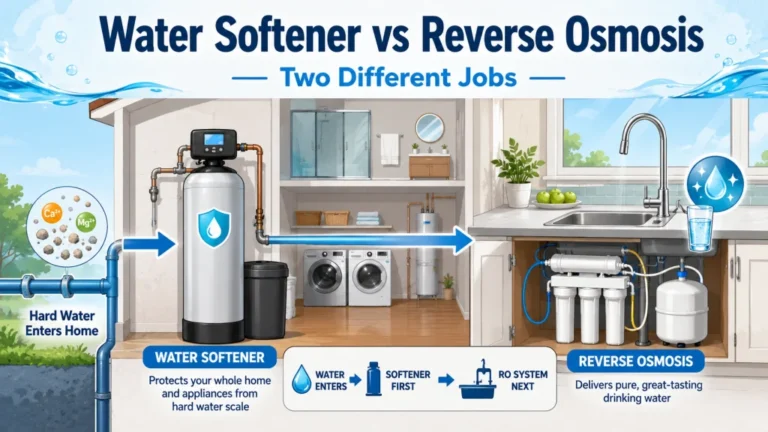
The correct sequence for most situations is: sediment pre-filter first, then a carbon filter if chlorine removal is needed, then the softener, then any point-of-use treatment for drinking water quality. The logic behind this order is protective layering. Each upstream stage removes something that would otherwise shorten the life or reduce the performance of the stage that follows.
Point-of-use systems such as reverse osmosis go after the softener, not before it. Hard water shortens reverse osmosis membrane life considerably. With a softener upstream, the membrane handles sodium-softened water instead of calcium-heavy water, which significantly extends its service life. If you are weighing whether to add reverse osmosis to an existing or planned softener setup, the water softener systems overview covers how these systems fit together and what to evaluate before committing to a configuration.
Note: The protective sequencing runs in one direction. Pre-treatment protects the softener. The softener protects the reverse osmosis membrane. Reversing any stage in that chain adds load where the equipment was not designed to carry it.

IAPMO certified to NSF/ANSI Standard 44, this system is sized for homes with up to 5 people and 4 bathrooms, using ion exchange to deliver soft, scale-free water from every tap with city or well water compatibility. The user-friendly LCD allows metered operation that uses up to 50% less salt and 28% less water compared to standard time-based softeners, helping lower long-term costs on appliances, soap, and cleaning products. The bundle includes a recommended pre-filter and installation kit, and is backed by a 5 to 10-year limited warranty with dedicated customer support.
Check On AmazonIf you click this link and buy, we earn a commission at no additional cost to you.
Before You Buy: Five Questions Worth Answering First
Most buyers skip these and end up with the wrong equipment or the right equipment in the wrong order. These are the questions I would want answered before recommending any setup.
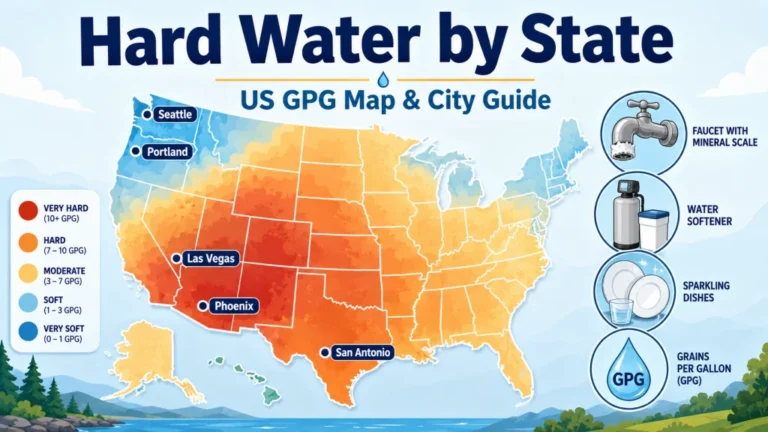
- What is your water hardness in GPG? Under 5 GPG and softening is often optional. Above 10 GPG and the appliance case for treatment is strong. Above 15 GPG and treatment is essentially required for normal appliance life.
- Are you on city water or a private well? City water brings chlorine. Well water brings whatever the geology and casing deliver. The treatment sequence differs significantly between the two.
- What else does your water report show? Iron, manganese, sediment, sulfur, bacteria. Each one affects which pre-treatment stages go upstream of the softener and in what order.
- What is the primary problem you are trying to solve? Scale damaging appliances points to a softener. Chlorine taste or odor points to a filter. Iron staining or sediment points to pre-treatment. Some homes need all of it.
- What goes upstream before the softener? Based on the test results, identify every pre-treatment stage the softener needs in order to be protected. That list is your equipment sequence, not just a shopping list.
Working through these five questions with a water test in hand usually makes the equipment decision obvious. The cases where people end up with the wrong system are almost always cases where one or more of these questions went unanswered before the purchase.

This kit lets you test drinking water, pool water, or any water source in seconds using a simple dip-and-read method with an oversized color chart ranging from red to green, covering 0 to 25 GPG and 0 to 425 PPM. All 100 strips are protected by FreshSeal technology across a ready-to-use bottle and two sealed pouches for long-term accuracy. Each purchase also funds a full year of clean water for someone in the Central African Republic.
Check On AmazonIf you click this link and buy, we earn a commission at no additional cost to you.
Final Thoughts: Match the System to the Problem, Not the Other Way Around
The softener versus filter question only has a clear answer once you know what your water actually contains. On chlorinated city water with hardness, you almost certainly need both a softener and a carbon pre-filter, with the pre-filter protecting the resin from day one. On well water with iron and hardness, the softener comes last in the sequence, after every pre-treatment stage has done its job. And if your water is genuinely soft but you have contamination concerns, a filter alone may be what the situation calls for and a softener is unnecessary spending.
Get a water test first. Match the equipment to what the test shows. Build the sequence in the right order. Those three steps cover the majority of the expensive mistakes I have watched happen in this category.
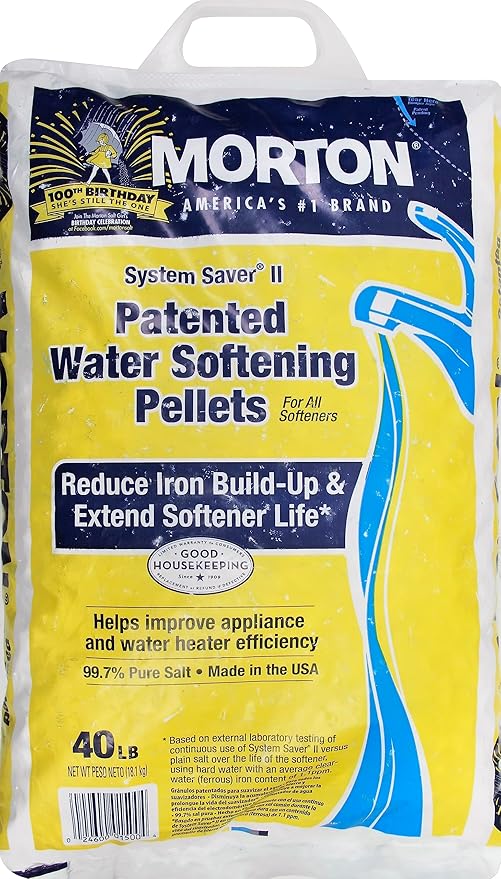
This 40-pound bag of USA-made System Saver pellets is designed to improve the taste of your water while helping extend the life of your appliances and water softener. Simple to use, just add the pellets directly to your softener's brine tank as needed.
Check On AmazonIf you click this link and buy, we earn a commission at no additional cost to you.
FAQs
🧪 Can a water softener also filter my water?
Not in any meaningful sense. A softener removes hardness minerals through ion exchange but does not filter chlorine, sediment, bacteria, or other contaminants. If you need both functions, you need both types of systems installed in the correct sequence.
💧 Does a whole-house water filter reduce water hardness?
No. Standard filtration media including sediment, carbon, and KDF do not remove calcium or magnesium. Your hardness reading will be unchanged after a filter. Only ion exchange removes hardness minerals from your water supply.
🔧 What order should a water softener and filter be installed?
Sediment pre-filter first, then carbon filter if chlorine removal is needed, then the water softener. Each upstream stage protects the resin from damage. On well water with iron, add a dedicated iron filter before the softener as well.
☠️ Does chlorine in city water damage a water softener?
Yes. Chlorine oxidizes ion exchange resin over time, breaking down the DVB cross-links that hold the resin structure together. Standard 8% cross-linked resin is particularly vulnerable at typical municipal chlorine concentrations. A carbon pre-filter installed before the softener removes chlorine before it reaches the resin and significantly extends resin life.
🌊 Do I need a filter if I have a water softener on well water?
Almost always, yes. Well water typically contains sediment, iron, and sometimes sulfur or bacteria alongside hardness. Sediment and iron foul the resin bed when a softener runs without pre-treatment. At minimum, a sediment pre-filter should go upstream of the softener. A full water test tells you what else the sequence needs.
🏠 Should I get a water softener or water filter first if budget is limited?
It depends on your primary problem. If scale is visibly damaging appliances and your hardness is above 10 GPG, start with the softener. If your main concern is chlorine taste, odor, or contamination and your water is not particularly hard, a filter addresses the more immediate issue. Test your water first so the decision is based on your actual numbers.