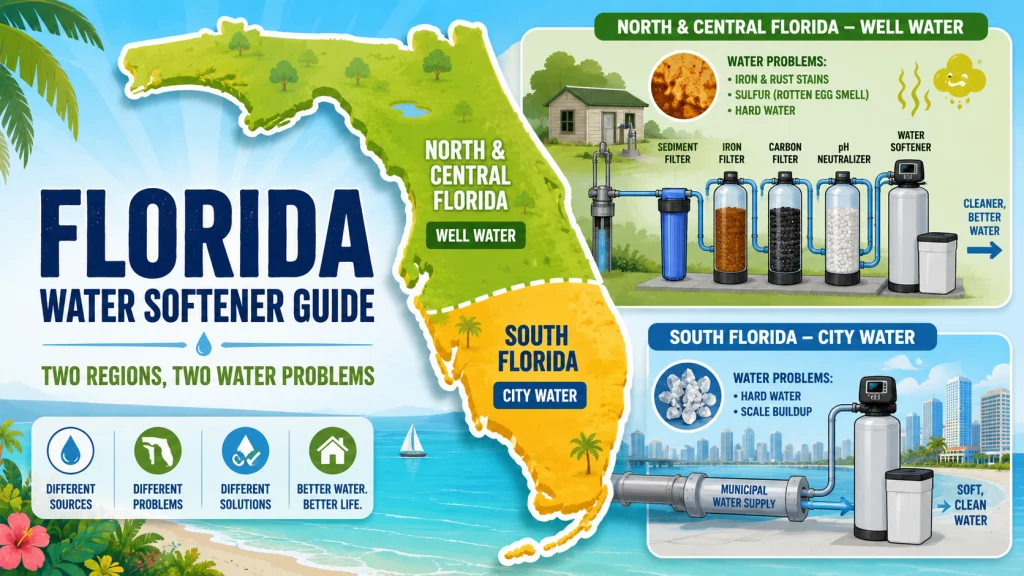
Florida Has Two Water Problems, and They Need Different Answers
Most water softener guides treat Florida as a single market with a single problem. From what I’ve seen, that leads homeowners on wells in Ocala or Gainesville to buy the same system as someone on Miami city water, then wonder why it’s staining orange within a year. The difference matters a lot.
South Florida city water, including Miami-Dade, Broward, and Palm Beach County, pulls from the Biscayne Aquifer. It’s shallow limestone, which means it picks up calcium and magnesium, but it’s less deep and less mineral-heavy than the aquifer systems farther north. You’re typically looking at 8 to 12 GPG. Hard, but a straightforward softening problem: standard ion exchange handles it without pre-treatment complications, because city treatment removes most of what would otherwise damage resin. Central Florida is harder. Tampa and Orlando draw from the deepest, most mineral-saturated zones of the Floridan Aquifer, and test results from those areas consistently run 10 to 15 GPG. Jacksonville city water sits at roughly 15 GPG, which puts it in the same sizing territory as San Antonio or Phoenix, and most buyers have no idea until a scale ring shows up inside their water heater after a year.
North and Central Florida well water is a different category altogether. Not just harder water. It’s a combination of hardness, dissolved iron, and hydrogen sulfide that the Floridan Aquifer produces in higher concentrations than almost anywhere else in the country. What follows covers each situation and what it actually requires.
South Florida City Water: Hard but Predictable
If you’re on municipal water in Miami-Dade, Broward, or Palm Beach County, you’re dealing with water that’s been treated and stabilized before it reaches your tap. No iron. No hydrogen sulfide. No sulfur smell. The hardness is real: 8 to 12 GPG puts you solidly in the hard to very hard range, but it’s predictable, consistent, and the chemistry doesn’t change on you. The main concern for your softener resin is the chlorine that city utilities add for disinfection. Chlorine degrades 8% crosslink resin noticeably faster than 10% crosslink over time. That resin spec is the thing worth confirming before buying, because it’s not on most box store labels.
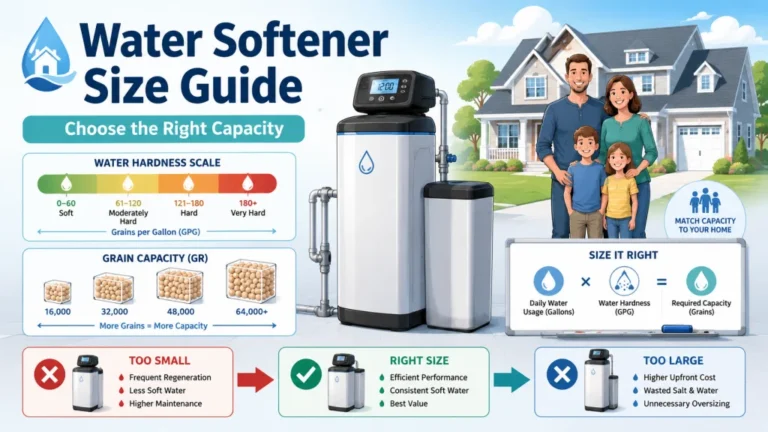
Sizing for South Florida city water follows the standard calculation. For a family of 4 at 10 GPG: 4 people times 75 gallons per day times 10 GPG times 7 days equals 21,000 grains per week. A 32k softener handles that comfortably. At 12 GPG the same family needs about 25,200 grains per week. A 32k system still works, though a 48k gives you longer cycles and regenerates less frequently. I generally recommend sizing up when the budget allows, because less frequent regeneration means less salt use and less wear on the control valve over the system’s life.
One thing South Florida buyers often skip past: demand-initiated regeneration matters here more than in lower-hardness states. At 10 to 12 GPG, a timer-based softener that regenerates on a fixed schedule regardless of actual water use wastes more salt per year than one that regenerates based on actual volume processed. Over a 10-year system life, that difference adds up. It’s a spec worth confirming before purchasing. Demand-initiated control valves are standard in most decent softeners above the entry level, but not all.
| Household Size | South Florida City (10 GPG) | Central Florida City (13 GPG) | North and Central Florida Well (15+ GPG, iron adjusted) |
|---|---|---|---|
| 1 to 2 people | 24k minimum | 32k minimum | 48k minimum (after pre-treatment) |
| 3 to 4 people | 32k to 48k | 48k minimum | 64k to 80k |
| 5 or more | 48k minimum | 64k minimum | 80k or twin alternating |
Well water figures in the right column assume iron has been adjusted into the effective hardness number and that iron and sulfur pre-treatment is already in place upstream of the softener. More on that calculation below.

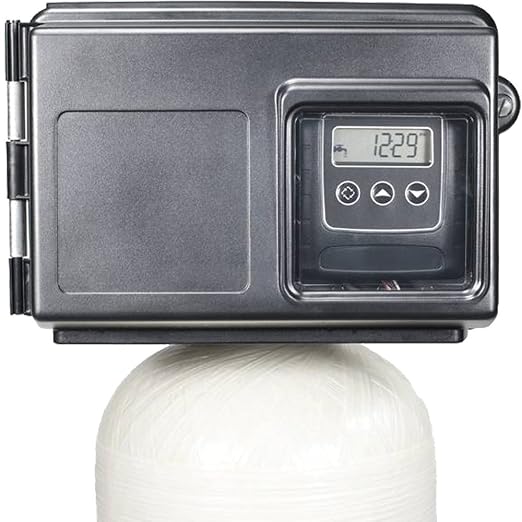
This whole-home water softener comes pre-loaded with 1.5 cubic feet of high capacity resin in a black USA-made mineral tank, paired with a USA brine tank featuring a safety float. The on-demand digital metered system ensures efficient water treatment, and the included 1-inch Noryl plastic bypass valve makes installation straightforward. Toll-free customer support is available whenever you need help.
Check On AmazonIf you click this link and buy, we earn a commission at no additional cost to you.
Central Florida City Water: Harder Than Most Buyers Expect
Tampa and Orlando buyers often come to this process assuming they have a standard hard water problem. At 10 to 15 GPG from a municipal source, they’re not wrong, but they’re in the harder half of that range, and standard online sizing calculators are written for the national average of 7 to 10 GPG. What those calculators return is usually undersized for Tampa or Orlando. This is the same pattern I’ve seen play out in Arizona and Texas, where local hardness is well above the national mean and the national guides miss it entirely.
Jacksonville is worth calling out specifically, because it surprises buyers. City water there consistently comes in around 15 GPG, which most people don’t expect from a coastal Florida city. A family of 4 at 15 GPG needs roughly 31,500 grains per week for 7-day cycles. A 32k system handles that but regenerates every 5 days, which is more frequent than ideal and accelerates wear on the control valve over time. At 15 GPG I’d size to 48k minimum, not to squeeze out more capacity, but because the longer cycles are easier on the equipment and salt use drops noticeably.
The Floridan Aquifer’s mineral content is carbonate-heavy: calcium and magnesium from limestone, predictable chemistry, no iron in most city supplies. That’s good news for resin longevity. The chlorine from city treatment is still the main long-term threat to your resin, so the 10% crosslink question still applies here. For a full breakdown of how Central Florida fits into the broader picture of city water hardness by region and what it means for softener selection, Jacksonville and Tampa both land in the high-hardness category alongside Arizona and Nevada.
North and Central Florida Well Water: The Triple Problem
This is where the real complexity lives. North and Central Florida well water, including Gainesville, Ocala, Tallahassee, The Villages, and the inland Space Coast corridor, draws from a part of the Floridan Aquifer that produces one of the highest concentrations of simultaneous hardness, iron, and hydrogen sulfide problems anywhere in the country. Understanding why it happens makes the treatment logic easier to follow.
The Floridan Aquifer is porous limestone, and in the inland areas it’s relatively shallow and untreated by anyone before it enters your pump. Iron concentrations in North and Central Florida wells commonly run from 1 to 5 PPM, sometimes higher depending on the geology directly around the well. USGS data on the upper Floridan Aquifer in northwest-central counties documents sulfate concentrations in some zones that exceed 250 mg/L, the drinking water secondary standard for sulfate. The hydrogen sulfide comes from sulfur-reducing bacteria living in the oxygen-depleted aquifer environment. Those bacteria metabolize naturally occurring sulfate compounds and produce the gas as a byproduct. When you open a tap and the rotten-egg smell hits you before the water even fills the glass, that’s H2S releasing the moment it’s exposed to air pressure change.
Field Note: One of the most common things I run into with Florida well water situations is homeowners who bought a softener first, installed it, and called for service 18 months later wondering why their fixtures were staining orange. The resin bed was saturated with iron. A fine mesh resin softener can handle ferrous iron up to about 3 PPM under favorable pH conditions, but that’s the ceiling, and even within that range it’s working harder than it should when there’s no pre-treatment upstream. Get the iron test done before buying a softener, not after.
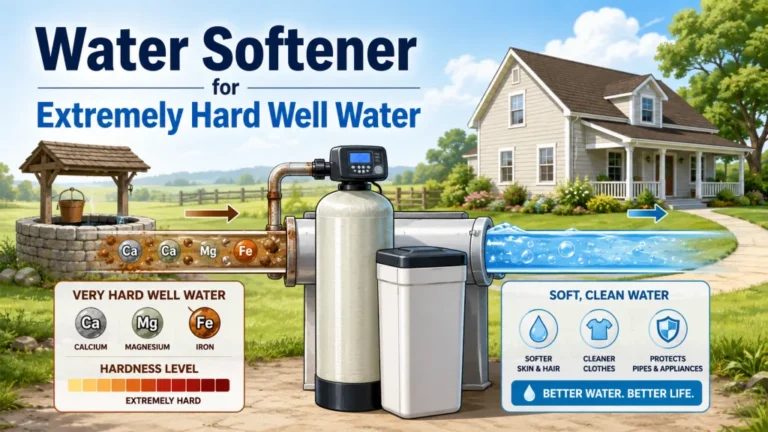
The iron compounds the hardness problem in a way most buyers don’t know about. For every 1 PPM of ferrous iron in your water, you add 4 to 5 GPG to your effective hardness when sizing a softener. If your well tests at 15 GPG hardness and 2 PPM iron, you size the softener as if the hardness is 23 to 25 GPG. For a family of 4, that’s the difference between a 48k system and a 64k to 80k system. Most product pages and buying guides don’t include this adjustment, which is part of why undersized softeners are so common in this region.
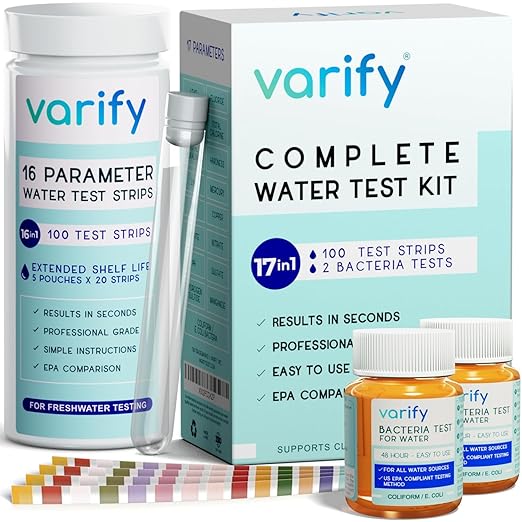
This comprehensive kit tests for 17 parameters including chlorine, fluoride, lead, iron, and bacteria, giving you a full picture of your water's safety in minutes. The 100 color-coded test strips come in 5 individually sealed pouches of 20 for extended freshness, while 2 included bacteria tests deliver results within 48 hours. Every purchase contributes a portion of proceeds to Water For Good, supporting clean water access in Central Africa.
Check On AmazonIf you click this link and buy, we earn a commission at no additional cost to you.
Treatment Order for North and Central Florida Well Water
Getting the order right matters as much as getting the right equipment. The principle is simple: treat whatever damages resin before the water ever reaches the resin. Installing a softener in the first position on well water with iron and sulfur present is the single most common installation mistake I see in complex well water situations, and Florida produces a lot of that scenario.
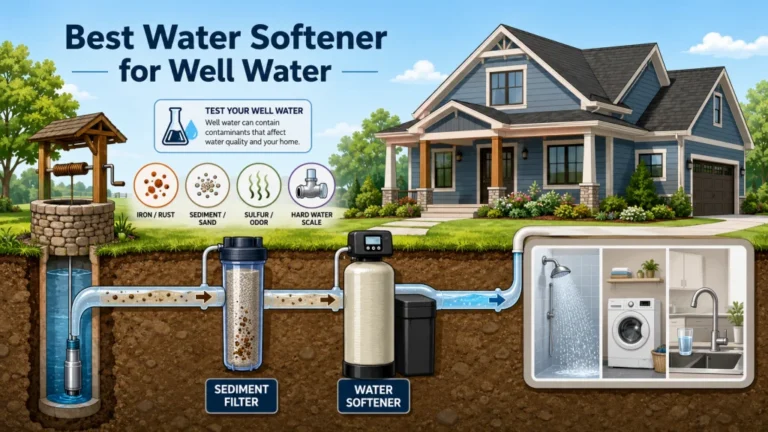
For North and Central Florida well water with all three problems (hardness, iron, and hydrogen sulfide), the correct treatment sequence is:
- AIO (Air Injection Oxidation) or aeration system, first in line. This handles hydrogen sulfide by oxidizing it and venting it out, and simultaneously oxidizes dissolved ferrous iron into ferric iron particles that can be filtered downstream. For wells with both sulfur smell and iron, an AIO unit in the first position is typically the most efficient single-stage solution for those two problems.
- Sediment pre-filter (20 to 50 micron), second. The Floridan Aquifer’s porous limestone sends fine particles along with the water, and your well pump adds its own particulate load. Without a sediment pre-filter, resin beds and every other downstream component take on particulate wear that shortens their service life. This is not optional on Florida well water: it is mandatory.
- Iron filter, third. Removes the oxidized ferric iron particles that the AIO converted upstream. If your AIO system has sufficient capacity and iron levels are under 3 PPM, this stage may be integrated into the AIO unit. At iron levels above 3 PPM, a dedicated iron removal stage is the safer approach.
- Water softener, last. Once iron and sulfur are handled upstream, the softener works on a clean resin bed with only hardness to exchange. This is where the system performs as the manufacturer designed it to, and where the service life projections in the warranty actually apply.
The sulfur issue catches buyers off guard more than the iron does, probably because the iron staining is visible and the sulfur smell is something you stop noticing after a while. But H2S doesn’t just smell bad. It corrodes copper plumbing, attacks the seals in control valves, and accelerates degradation of anything downstream if left in the water. Treating it first protects the entire system. For a deeper look at how to spec each component in this kind of multi-stage setup, the guide on building a complete filter and softener system for well water covers the component choices and sizing in detail.
If your iron is confirmed under 1 PPM and you have no sulfur smell, the decision gets simpler. A fine mesh resin softener after a sediment pre-filter is often sufficient, and you skip the cost of a full treatment train. This is exactly why testing before buying is the correct first step regardless of which part of Florida you’re in.
Key point: Hardness and iron together are not two problems a single box solves well. They require different removal mechanisms, and the order in which you install equipment determines whether your softener lasts 15 years or needs a resin replacement in three.
This chemical-free whole house system uses air injection and oxidation to remove iron, sulfur, and manganese from your water without the need for added chemicals or separate chemical tanks. A patented piston keeps the entire oxidation process contained within one tank, creating a pressurized air bubble during backwash to trap impurities and minimize maintenance costs and downtime. The system arrives fully equipped with a tank riser tube, deflector, control head, media, and stainless steel bypass valve for straightforward installation in an average-sized home.
Check On AmazonIf you click this link and buy, we earn a commission at no additional cost to you.
What to Test Before You Buy Anything
Florida water varies enough within the state, and within individual wells on the same street, that buying a softener based on regional averages alone is a starting point, not a complete decision. A lab test covering hardness, total iron and ferrous iron, pH, and hydrogen sulfide gives you the numbers the sizing calculation actually needs. The Florida Department of Health certifies water testing labs statewide, and tests covering these parameters typically cost $50 to $100 from a certified lab. That’s cheap relative to the cost of buying the wrong equipment.
What the results tell you:
- Hardness in GPG or mg/L: the base number for grain capacity sizing. Confirm it against what your city utility reports if you’re on city water, since municipal source blending can cause variation between the annual report and your actual tap.
- Total iron vs. ferrous iron in PPM: if total iron is significantly higher than ferrous iron, you have ferric iron (the red water kind) already precipitating in the pipes. That requires oxidation and filtration upstream, not just a softener.
- pH: below 6.8 makes ferrous iron harder for resin to exchange and may require pH correction before the softener. Above 7.5, ferrous iron starts oxidizing on its own, which can cause fouling without pre-treatment to filter it out first.
- Hydrogen sulfide in PPM: if you can smell it, it’s present. The test tells you how much, which determines what treatment capacity you need at the AIO or aeration stage.
City water buyers in South Florida or Central Florida can often skip the lab test and use their utility’s publicly available annual water quality report. It covers hardness, and city water chemistry is consistent enough to size from. Well water buyers have no equivalent resource. There’s no treated source, no municipal report, and the aquifer chemistry under your specific parcel may differ from the neighbor two lots over. Test first. Everything else follows from those numbers.
What to Prioritize by Florida Water Situation
Once you know your water situation, the choice of system type becomes more straightforward. The following is not a product list. It’s a set of specs and priorities to look for based on which Florida scenario applies to you.
| Your Florida Situation | What to Prioritize | What to Avoid |
|---|---|---|
| South Florida city water, 8 to 12 GPG | Demand-initiated regeneration, 10% crosslink resin if available, 32k to 48k for a family of 3 to 4 | Timer-based regeneration, 8% crosslink resin for city chlorine exposure |
| Central Florida city water, 10 to 15 GPG | 48k minimum for family of 3 to 4, demand-initiated control, 10% crosslink resin | Standard 32k systems sized for national averages, timer regeneration |
| Jacksonville or other 15 GPG city water | 48k to 64k for family of 4, longer cycle capacity, demand-initiated | Undersized systems. Frequent regeneration cycles at 15 GPG accelerate valve wear |
| North or Central Florida well water with iron and sulfur | AIO or aeration system first, sediment pre-filter, iron filter, then softener last. Fine mesh resin in the softener | Buying a softener before testing. Installing the softener before any upstream treatment |
| Florida well water, iron under 1 PPM, no sulfur smell | Sediment pre-filter plus fine mesh resin softener. Simpler setup is often sufficient | Paying for a full AIO treatment train before confirming iron and sulfur levels with a test |
The common thread across every Florida situation: match the grain capacity to your actual hardness, confirm the resin spec for city water applications, and do not install any softener on well water before you know what’s in the well. The table above gives you the framework. The test gives you the numbers to fill it in.
For the broader framework on matching a system to your specific water situation, the full guide on how to choose the right water softener by situation covers the decision logic in detail alongside the Florida-specific guidance here.

This 50-micron flushable and reusable filter serves as an ideal first stage in any whole house filtration system, capturing sediment, rust, dirt, and sand before water reaches finer filters downstream. A built-in Siliphos additive helps soften water, prevent scale buildup, and reduce pipe corrosion, with filter replacement recommended every 3 to 6 months for best results. The see-through housing allows easy visual monitoring, and dual threads with 1-inch MNPT and 3 to 4-inch FNPT connections make installation straightforward for indoor use within a pressure range of 20 to 100 PSI.
Check On AmazonIf you click this link and buy, we earn a commission at no additional cost to you.
Final Thoughts: Know Your Florida Before You Buy
The reason most Florida buyers get into trouble isn’t the hardness itself. It’s the assumption that hardness is the only issue. South Florida city water buyers can act on a number from their utility report and be fine. North and Central Florida well water buyers who do the same thing frequently end up with a softener working against chemistry it was never designed to handle alone.
Get the test done first. Let the numbers tell you what’s actually in the water. Then build the system around what’s there, not around what the box says it can handle in ideal conditions. Florida’s water problems are well-documented and very fixable. They just require knowing which Florida you’re in.

These salt pellets help prevent rust stains on fixtures and clothing, reduce mineral buildup inside pipes and appliances, and soften water to protect skin and hair from the drying effects of hard water. Soft water also leaves glasses, dishes, and faucets virtually spot-free for easier cleaning throughout your home. The 40-pound bag features a sturdy plastic handle and easy-tear opening for comfortable lifting and hassle-free pouring.
Check On AmazonIf you click this link and buy, we earn a commission at no additional cost to you.
FAQs
💧 Is Florida water hard enough to need a softener?
In most of Florida, yes. South Florida city water typically runs 8 to 12 GPG. Central Florida municipal water commonly reaches 10 to 15 GPG, with Jacksonville around 15 GPG. Those levels are high enough to cause meaningful scale buildup in water heaters, on fixtures, and inside appliances over time.
🔬 Does Florida well water need more than just a softener?
Usually yes. North and Central Florida wells commonly have iron, hydrogen sulfide, and hardness together. A standard softener should not be treated as your primary iron or sulfur solution. Even a fine mesh resin softener, which can handle ferrous iron up to about 3 PPM under favorable conditions, works harder without upstream pre-treatment and does nothing for hydrogen sulfide. Get a lab test first to confirm what’s in your specific well.
🗺️ Does the same softener work for all parts of Florida?
No. South Florida city water buyers can use a standard ion exchange softener sized for their GPG level. North and Central Florida well water buyers typically need a multi-stage system with iron and sulfur treatment before the softener. The region and water source determine the right approach.
🧮 How do I calculate softener size for Florida well water with iron?
Add 4 to 5 GPG per 1 PPM of ferrous iron to your measured hardness before running the sizing calculation. If your well tests at 15 GPG and 2 PPM iron, size the softener as if the hardness is 23 to 25 GPG. Most online calculators skip this adjustment entirely.
🏠 What grain capacity do I need for a family of 4 in Florida?
South Florida city water at 10 GPG: 32k to 48k. Central Florida city water at 13 GPG: 48k minimum. North or Central Florida well water at 15 GPG with 2 PPM iron (effective 23 to 25 GPG after adjustment): 64k to 80k. These assume demand-initiated regeneration and 7-day cycles.
💨 Why does my Florida well water smell like rotten eggs?
That’s hydrogen sulfide gas produced by sulfur-reducing bacteria living in the Floridan Aquifer. It releases when pressure drops as water leaves the tap. A water softener does not remove it. You need an AIO system or aeration upstream of your softener to handle sulfur before it reaches any downstream equipment.