
Hard Water: What It Is and What It Costs You
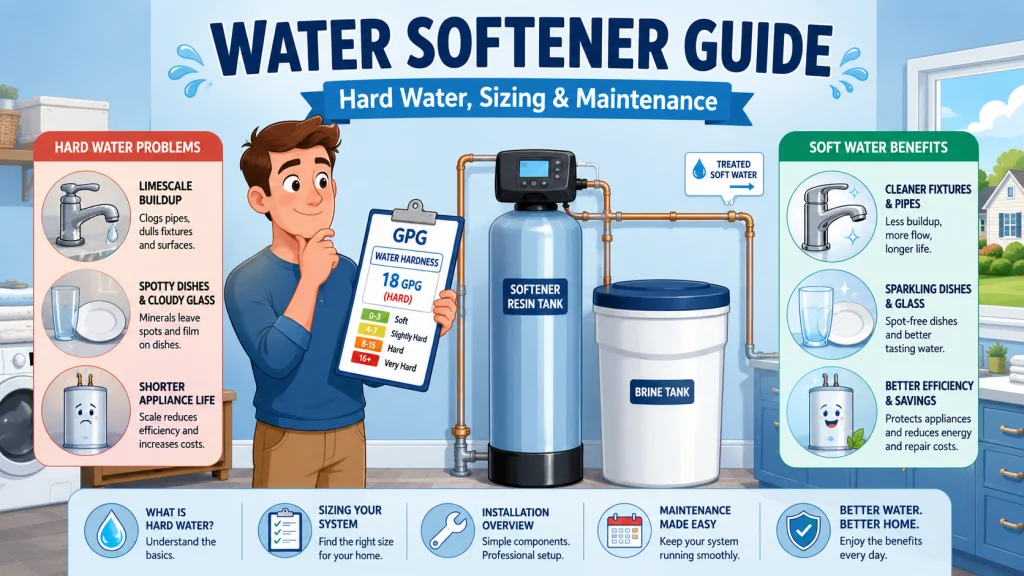
If this water softener guide is your starting point, start here. Hard water is water carrying a high concentration of dissolved calcium and magnesium, picked up as it travels through limestone and chalk on its way to your tap. That sounds benign. What it does over time is not. The white crust forming around your faucets, the shower head losing flow, the water heater the technician says needs replacing at year 8, the dishwasher leaving film on every glass regardless of the detergent, these are all the same problem showing up in different places at different times.
The Battelle Memorial Institute studied what hard water does to appliances at measurable hardness levels. The headline finding: at 26 GPG, a gas water heater consumes roughly 22% more energy than it would running on soft water, with efficiency losses compounding over the appliance’s service life. At 15 GPG or above, most households running full appliance use will see a softener pay for itself in under three years on energy and replacement costs alone. That math changes below 10 GPG, which is worth knowing before spending anything. For the full picture, including testing methods, regional data, and what symptoms look like across different areas of the home: understanding hard water from your GPG number to what it looks like in your home.
| Hardness Level | GPG Range | What You Typically Notice |
|---|---|---|
| Soft | 0 to 3 | No visible scale, no mineral-related skin dryness |
| Moderately hard | 4 to 7 | Light spotting on fixtures, occasional scale on heating elements |
| Hard | 8 to 12 | Regular scale buildup, reduced appliance efficiency over time |
| Very hard | 13 to 18 | Heavy scale, shortened appliance life, dry skin and hair |
| Extremely hard | 18+ | Rapid scale accumulation, serious appliance efficiency loss |
Your GPG number is not just a label for a category. It determines the size system you need, whether iron is complicating the picture, and whether the investment makes financial sense at all. That number is where every sensible water softener decision begins.

This kit lets you test drinking water, pool water, or any water source in seconds using a simple dip-and-read method with an oversized color chart ranging from red to green, covering 0 to 25 GPG and 0 to 425 PPM. All 100 strips are protected by FreshSeal technology across a ready-to-use bottle and two sealed pouches for long-term accuracy. Each purchase also funds a full year of clean water for someone in the Central African Republic.
Check On AmazonIf you click this link and buy, we earn a commission at no additional cost to you.
How a Water Softener Works
The mechanism is called ion exchange. Incoming hard water passes through a resin bed inside the mineral tank, where calcium and magnesium ions swap places with sodium ions bound to the resin beads. What comes out the other side is chemically soft water, with the hardness minerals gone rather than just altered. The resin eventually saturates with calcium and magnesium and needs to be flushed, which is what the regeneration cycle does using a concentrated brine solution drawn from the salt tank.
That is the two-sentence version, and it is accurate as far as it goes. What it leaves out is everything that separates a well-designed system from a mediocre one: resin quality and crosslink percentage, control valve design, how regeneration frequency is calculated, and why some systems underperform even when the specs look right on paper. For the full mechanism and what to look for when evaluating systems: how water softener systems work and what separates good design from bad.
Field Note: The most common thing I walk into on a service call is a softener where the resin has never been checked. Resin is not permanent. Chlorinated municipal water degrades it over time, and iron degrades it faster. I have pulled tanks out of service that looked like the inside of a neglected coffee machine, at 6 or 7 years, with the homeowner convinced the system was still working because nobody ever told them to check it. Nobody profits from telling them, so nobody does.
The Three Types: Salt-Based, Salt-Free, and Dual-Tank
A salt-based ion exchange softener removes calcium and magnesium from the water entirely, which is what produces genuinely soft water. A salt-free conditioner uses template-assisted crystallization (TAC) technology to change the structure of hardness minerals so they are less likely to adhere to surfaces, but the minerals remain in the water and a standard hardness test will still show your original GPG reading after treatment. A dual-tank system uses two resin tanks that alternate so one is always in service while the other regenerates, which matters for households that cannot tolerate any interruption in soft water supply.
The distinction between salt-based and salt-free matters more than most marketing acknowledges. I run into homeowners regularly who bought a salt-free conditioner expecting the same results as a traditional softener and are puzzled when their skin still feels dry, their water still tests hard, and the scale has only partially improved. The minerals did not go anywhere. Scale prevention and mineral removal are different outcomes. Which type suits your water conditions, your household, and your treatment goals is covered in detail here: water softener system types compared by what they actually deliver.

This whole-home water softener comes pre-loaded with 1.5 cubic feet of high capacity resin in a black USA-made mineral tank, paired with a USA brine tank featuring a safety float. The on-demand digital metered system ensures efficient water treatment, and the included 1-inch Noryl plastic bypass valve makes installation straightforward. Toll-free customer support is available whenever you need help.
Check On AmazonIf you click this link and buy, we earn a commission at no additional cost to you.
Before You Compare Systems, Know These Five Things
Most people start comparing water softeners before they have the information that would actually make the comparison useful. The type, size, and configuration that fits one household can be completely wrong for another. Before looking at a single product, have answers to these five things.
- Your actual GPG number. Not an estimate, not a strip test, not what a dealer told you. A utility report or a third-party lab result.
- City water or private well. Well water often carries iron, manganese, or sulfur that city water does not. This changes both the type of system you need and how it needs to be configured.
- Whether iron is present. Even low iron levels affect sizing and resin selection. You need this number before you can size correctly.
- Household size and daily water use. The number of people and bathrooms in the house directly determines the capacity range you are shopping in.
- DIY installation or professional install. Some systems are straightforward to install. Others require more complex plumbing work. Knowing this up front narrows your options before cost becomes a factor.
With those five answered, most wrong choices eliminate themselves before you spend a dollar on anything.
Sizing: The Formula Exists, but Iron Changes Everything
A sizing formula exists, and for straightforward cases it works. You put in household size, daily water use, and GPG level, and you get a weekly grain removal requirement that tells you what capacity range to shop in. That part is not hard. Iron is where it breaks. If your water contains iron, even at low levels, it competes with calcium and magnesium for the same resin sites and accelerates fouling in ways that a GPG-only calculation will not catch. A system sized correctly on hardness alone will underperform significantly when iron is present, often within the first couple of years. This is one of the most consistent first-purchase mistakes I see.
The practical implication is that you need a complete water test before sizing anything, not just a hardness reading. Strips measure hardness. They do not tell you about iron, manganese, or pH, all of which affect sizing decisions. The full sizing guide, including how to account for iron and what the formula actually looks like in practice, is in the system section: how to size a water softener for your household and water conditions.
Note: Municipal water customers can usually request a free annual Consumer Confidence Report from their utility provider. This gives a reliable hardness baseline. Well water homeowners need a state-certified third-party lab test, since the CCR does not cover private wells. Do not make a sizing decision on strip tests alone if iron, manganese, or sulfur is a possibility.
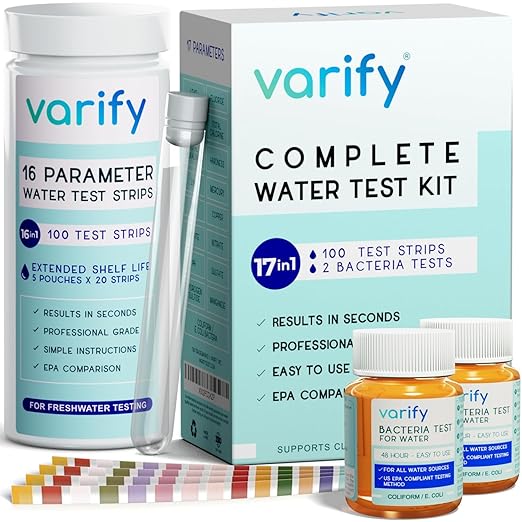
This comprehensive kit tests for 17 parameters including chlorine, fluoride, lead, iron, and bacteria, giving you a full picture of your water's safety in minutes. The 100 color-coded test strips come in 5 individually sealed pouches of 20 for extended freshness, while 2 included bacteria tests deliver results within 48 hours. Every purchase contributes a portion of proceeds to Water For Good, supporting clean water access in Central Africa.
Check On AmazonIf you click this link and buy, we earn a commission at no additional cost to you.
Installation: What Is Actually Involved
A water softener installs on the main supply line, positioned after the pressure tank if you are on a well and before the water heater. It needs a drain connection for the regeneration discharge, access to a standard electrical outlet for the control valve, and enough floor space for the mineral tank and brine tank side by side. Most residential systems take two to four hours to install when the location is already plumbed and accessible.
DIY installation is doable for anyone comfortable with basic plumbing. The connections are straightforward and most systems include installation instructions that cover the essentials. What goes wrong is rarely the plumbing itself. The common failure points are the bypass valve setup, the drain line air gap, and the brine line connection. Getting any of these wrong can cause a regeneration cycle to flood the drain continuously or fail to draw brine at all, which means the system runs but never actually softens the water. The bypass valve is the part most often skipped because it looks optional. It is not: without one in place, any future service call requires shutting off water to the entire house. For a full installation walkthrough including permit considerations and bypass configurations: water softener installation from location selection to first regeneration.
Maintenance: What Needs Doing and How Often
A salt-based softener has a short maintenance list that most homeowners handle without professional service calls. Salt needs to be added to the brine tank on a schedule that depends on household size and water hardness, typically every four to eight weeks for an average household. The brine tank should be cleaned out once a year or every two years to prevent salt bridging or mushing, both of which can block regeneration without triggering any visible error on the control panel.
Resin replacement is the maintenance task most homeowners do not know about until the system has already been underperforming for a while. Resin is not permanent. Its lifespan depends on water quality: chlorinated municipal water degrades it over time, and iron exposure accelerates that significantly. If soft water output drops and the control valve is functioning correctly, the resin is the first thing to check, not the last. Resin quality varies between systems and it affects how long a softener stays effective. For a full maintenance schedule, salt type comparison, and what to check when a system underperforms: how to maintain a water softener and troubleshoot common problems.

This 2-pack delivers 80 pounds of Morton salt pellets in an easy-to-handle pellet form, designed to keep your water softener running efficiently. The formula is free from surfactants, enzymes, bleach, dyes, and fragrances, making it a clean and straightforward choice for maintaining soft water in your home.
Check On AmazonIf you click this link and buy, we earn a commission at no additional cost to you.
The Dealer Test Warning
Do not let anyone selling equipment test your water. This is not a blanket criticism of every water treatment dealer. It is a structural problem. The person testing your water has a direct financial stake in the result, and the result will almost always support the sale of whatever they are carrying. I have watched this play out enough times that I do not find it surprising anymore. A dealer runs a quick test, announces an alarming hardness number or a vague concern about contaminants, and recommends the system that happens to be in their truck. The test itself can be real. The interpretation and the urgency attached to it frequently are not.
Get your water tested by a source with no financial interest in what you buy. Municipal water customers can request an annual Consumer Confidence Report from their utility. For well water, use a state-certified third-party lab. A comprehensive water chemistry test runs between $30 and $150 depending on what parameters are included, and it is the most useful piece of information you can have before any purchasing conversation. Know your GPG, your iron level, and your pH before you talk to anyone trying to sell you equipment. Hard water is not dangerous. Anyone telling you otherwise to motivate a purchase is using a sales tactic, not giving you information.
Warning: If a dealer characterizes your water as “toxic” or a health hazard based on hardness alone, that is a red flag. Hard water causes scale and efficiency loss. It does not cause illness. Anyone attaching health scare language to a hardness reading is using pressure, not facts.
Final Thoughts: Where to Go Next
This overview exists to give you the frame. The goal was not to go deep on every topic but to make sure you understand what questions to ask and why they matter, before you spend anything. From here, the right next step depends on where you are in the process. If you are still figuring out whether hard water is actually your problem and how severe it is, start with the hard water section: understanding hard water from your GPG number to symptoms by area of the home. It covers testing methods, what different hardness levels mean in practice, and how your state and region factor into the picture.
If you already know your number and are evaluating system types, sizing options, and what differentiates a well-built softener from a mediocre one, the system guide is the next stop: how water softener systems work and which type fits your situation. For specific recommendations organized by water condition, household size, and budget, the picks section covers that ground: best water softener options evaluated by situation. And if you are ready to install, or already own a system that is not performing the way it should, the installation and maintenance reference has the practical detail: water softener installation, maintenance, and troubleshooting.

This professional-grade liquid cleanser removes iron, manganese, silt, metal particles, and other contaminants that salt leaves behind in your resin bed, valve parts, and beads. Regular use helps extend appliance life, reduce maintenance calls, and maintain consistent water quality across any water softener brand. It is NSF certified to NSF/ANSI/CAN Standard 60 for drinking water additives and is made in the USA, making it safe for families and pets. Apply 4 oz before each regeneration or use with the Pro Products Easy Feeder kit for daily low-dose treatment.
Check On AmazonIf you click this link and buy, we earn a commission at no additional cost to you.
Start With These Core Resources
This site is organized around two main areas of the water softener decision. Each one goes deep on the topics this overview only touched.
| Section | What It Covers |
|---|---|
| Understanding Hard Water | GPG levels explained, how to test your water, hard water symptoms by area of the home, effects on hair and skin, water hardness by state and region |
| Water Softener Systems | How ion exchange works in full detail, all system types compared, the complete sizing guide including iron, control valve design, resin quality and lifespan |
FAQs
💧 What does a water softener actually do to your water?
A salt-based water softener removes calcium and magnesium from incoming water through ion exchange. Those hardness minerals swap places with sodium ions held in a resin bed, and the water that comes out has the minerals gone, not just altered. The result is chemically soft water that does not leave scale on surfaces or heating elements.
🧪 How do I know whether I actually need one?
Start with a water test and get your GPG number. Below 5 GPG, the practical benefits are mostly cosmetic and the investment rarely makes sense. Above 7 GPG with visible scale or appliance issues, it is worth evaluating. Above 15 GPG, the financial case based on appliance efficiency and replacement cycles alone tends to make treatment clearly worthwhile.
📏 What is GPG and why does everyone keep using it?
GPG stands for grains per gallon, the standard US unit for measuring water hardness. One grain equals roughly 17.1 milligrams per liter of calcium carbonate. The reason it matters is that it determines system sizing, regeneration frequency, and whether the math on a softener works out for your situation. It is the number everything else is calculated from.
🚿 Will soft water make my drinking water safer?
Hard water is not a health hazard. A water softener addresses hardness minerals, not contaminants. If your concern is drinking water taste, chlorine, or specific contaminants like lead or nitrates, a filter or reverse osmosis system is the right tool. A softener is not a filter and is not designed to do what a filter does.
⏳ How long should a water softener last?
A well-maintained salt-based softener typically runs 15 to 20 years. The control valve and resin are the components most likely to need attention first. Resin lasts roughly 10 to 15 years under good conditions but degrades faster with high iron or chlorine exposure. Regular maintenance, particularly keeping salt clean and checking the brine tank, extends service life significantly.
🔧 Is DIY installation realistic?
Yes, for anyone comfortable with basic plumbing. The connections are not complicated, and most systems include clear instructions. The parts most often done wrong are the bypass valve setup, the drain line air gap, and the brine line connection. Take your time on those three points and most of what goes wrong on a DIY install is avoided.