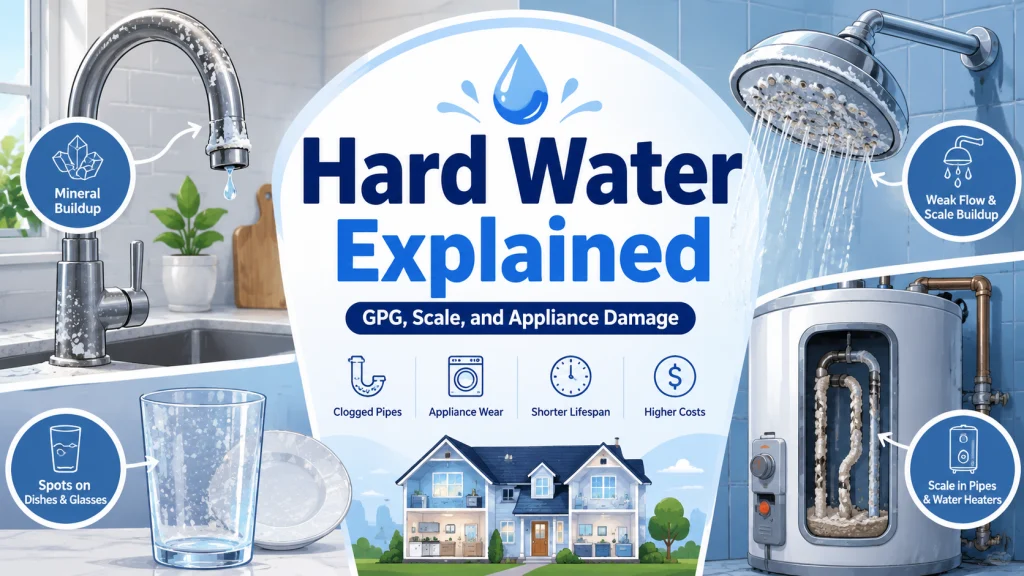
The White Crust, the Weak Shower, the Water Heater That Died Too Young
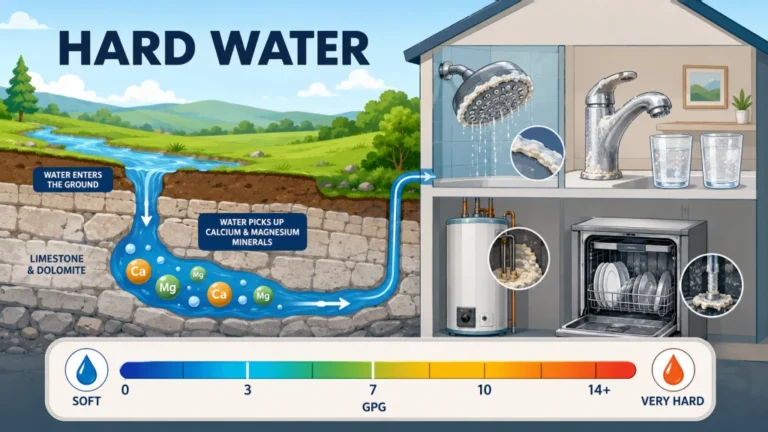
The white crust building up around your faucet base, the shower head that loses half its pressure within a year of installation, the water heater that gave out at year 8 instead of year 12: these are not separate problems. They are the same problem showing up in different places. Dissolved calcium and magnesium in your water supply leave mineral deposits everywhere the water sits, heats, or evaporates. Most homeowners spend years treating each symptom separately without ever tracing them back to a single source.
What I have watched repeat itself across more homes than I can count is this: by the time someone starts looking for answers, scale has already been accumulating for years. The dishwasher runs through more detergent and still leaves spots. The plumber gets called twice for the same shower head. Laundry comes out stiff on a normal cycle. None of it gets connected to the water supply. The fixes add up quietly, and nobody does the math until something major fails.
Field Note: The most common call I used to get was not “I think I have hard water.” It was “my water heater is 8 years old and already dying.” By the time they reached me, the scale damage was done. In most of those cases, a $15 water test years earlier would have changed the entire cost picture.
The good news is that once you understand what is actually happening, the decisions become straightforward. Hard water is not complicated. It is minerals, measured by a number, and the number tells you what you are actually dealing with. Start there, and everything else follows logically.

This kit lets you test drinking water, pool water, or any water source in seconds using a simple dip-and-read method with an oversized color chart ranging from red to green, covering 0 to 25 GPG and 0 to 425 PPM. All 100 strips are protected by FreshSeal technology across a ready-to-use bottle and two sealed pouches for long-term accuracy. Each purchase also funds a full year of clean water for someone in the Central African Republic.
Check On AmazonIf you click this link and buy, we earn a commission at no additional cost to you.
Why the GPG Number Matters More Than the Hard or Soft Label
Water gets described as hard or soft as if there are two settings. There are not. Hardness is a continuous scale, measured in grains per gallon (GPG), and where your water sits on that scale makes an enormous practical difference. Water at 4 GPG and water at 22 GPG are both technically classified as hard. The experience of living with them, and the right response to each, is completely different.
At 4 GPG, you might notice minor scale buildup around fixtures over time. A reasonable person could live with that without treating it. At 22 GPG, scale accumulates inside pipes and heating elements fast enough to meaningfully shorten appliance life within a few years. A Battelle Memorial Institute study, commissioned to measure scale impact on household appliances, found that water heaters at 26 GPG lost up to 48% efficiency over the test period compared to units running on soft water. That is why I take GPG seriously as a number rather than just a label.
| GPG Range | Classification | Practical Impact |
|---|---|---|
| 0 to 1 | Soft | No mineral issues, no treatment needed |
| 1 to 3.5 | Slightly hard | Minor scale possible, low priority for most households |
| 3.5 to 7 | Moderately hard | Visible deposits over time, some appliance wear |
| 7 to 10.5 | Hard | Noticeable scale, reduced appliance lifespan |
| 10.5 and above | Very hard | Active scale damage, shorter appliance and fixture cycles |
The table above is a quick reference, not the full story. Iron content and water temperature both affect how the same GPG level behaves in practice. Your number is the starting point. For the complete breakdown of what each tier means, how GPG converts to PPM and mg/L, and what the different ranges imply for your specific appliances, the article on what hard water is and what each GPG level means in practice goes through all of it.
How to Find Your Actual Number
Most homeowners are in one of two situations: they have no idea what their water hardness is, or they got a number from someone who was also selling them a treatment system. Those are different problems, but both lead to the same outcome: a decision made without reliable data. Knowing your GPG before you do anything else is the single most useful step in this entire process.
If you are on city water, your utility is required to publish an annual water quality report. Hardness is typically listed, and it is the fastest zero-cost starting point. Well water is a different situation entirely. No utility report exists for private wells, and hardness can shift significantly based on local geology, depth, and seasonal variation. For well water, or for anyone who wants a verified independent number before spending on treatment, there are mail-in lab tests and in-home test kits that work completely outside of any sales process. There are also four distinct testing methods, each with real differences in accuracy and appropriate use cases.
Warning: Never rely on a water hardness test performed by someone who is also selling you a treatment system. Bring your own independently confirmed number to that conversation. The guide on how to test your water hardness accurately covers all four methods, when each is appropriate, and exactly why dealer tests cannot be trusted.
Key point: Before you spend anything, write down three things: your actual GPG number, your water source (city supply or private well), and your main goal, whether that is stopping appliance scale, improving hair and skin, dealing with iron, or general prevention. That combination determines what type of system makes sense and gives you a real filter when you start evaluating options.

At just 4 cents per test, this kit offers the most strips available at the lowest cost per test, with each strip featuring two identical color pads that cross-verify results for added reliability. The 200 strips are packed in sealed foils of 50 to minimize air exposure, and dual desiccants in both the cap and bottom of the container help maintain freshness and extend shelf life. A sample cup is included to ensure consistent, accurate readings every time.
Check On AmazonIf you click this link and buy, we earn a commission at no additional cost to you.
What Hard Water Looks Like in Your Home
Before running any test, your home has likely already been showing you signs. White mineral deposits around faucet bases, shower heads that clog and lose pressure within a year or two, and spotted or filmy glassware out of the dishwasher are the three I see most consistently in homes with meaningful hardness. Soap that will not lather cleanly tends to show up at lower GPG levels than the fixture buildup does, so it can be an earlier indicator than most people expect.
One thing worth separating out early: orange or rust-colored staining around drains is a different problem from calcium scale. That points to iron in the water, which has a different cause and a different solution. They can occur together in well water, but treating one does not automatically address the other. If you want the full list of physical signs, how to calibrate their severity, and how to tell what each one is pointing to, the guide to reading hard water signs in your home covers all nine.
What Hard Water Does to Hair and Skin
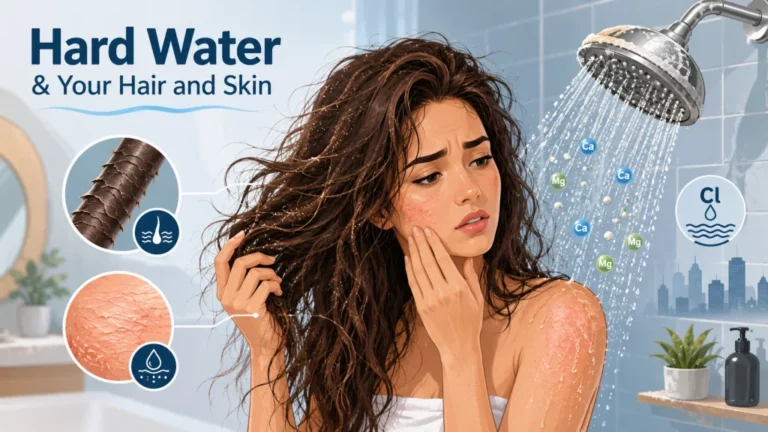
The effects on hair and skin are real, but they are also the most frequently overstated complaint in this category. Dissolved calcium and magnesium interfere with how soap and shampoo rinse away from skin and hair. At moderate hardness levels, most people notice nothing beyond a slight change in how soap feels. At higher levels, particularly with magnesium-heavy water, the impact on hair texture and scalp condition can be significant enough that people cycle through shampoos and conditioners trying to solve what is actually a water problem.
What I find more interesting than the cosmetic side of it is how often hair and skin complaints are the thing that finally gets someone to test their water, only for them to discover a GPG level that has also been quietly degrading their water heater and appliances for the past several years. The skin and hair symptoms are the visible ones. The appliance damage is invisible until something fails. The full picture of what the research actually shows, what genuinely helps versus what is marketing, and when treatment makes a measurable cosmetic difference is covered in the article on how hard water affects hair and skin.

This advanced shower filter uses a multi-stage system combining sediment filters, redox media, calcium sulfite, activated carbon, and ceramic beads to reduce chlorine, pesticides, pharmaceuticals, dirt, and odors while infusing beneficial minerals into your water. Designed to visibly improve skin, hair, and nails within 2 to 4 weeks, it works with fixed, rain, combo, dual, and handheld showers via a standard half-inch connection with no tools required. Replacement cartridges last 6 months at under 9 cents per day, making it one of the more affordable long-term shower filtration options available.
Check On AmazonIf you click this link and buy, we earn a commission at no additional cost to you.
Your State and City Make a Difference
Hardness levels vary dramatically across the country, and not always in the direction people expect. Much of the American West and Midwest runs significantly hard, including some areas that exceed 20 GPG in the water supply. Parts of the Pacific Northwest and certain areas of New England are routinely soft without any treatment at all. But state-level averages can mislead in both directions: a state with an average hardness of 12 GPG might have individual municipalities well above and well below that figure.
If you want to understand where your region typically falls before pulling your utility report, the state-by-state breakdown of water hardness across the US maps out regional patterns and identifies which areas are consistently hard, which are reliably soft, and how to find city-level data for your specific supply.
What Actually Changes When Your Water Is Soft
Most people who have lived their entire lives with hard water do not have a reference point for what treated water feels like in daily use. The differences are practical rather than dramatic: soap lathers more readily and rinses away completely instead of leaving a film, dishes and glassware come out of the dishwasher clear, and the slick feeling on skin after showering is not residue, it is the absence of mineral film. That last one surprises people every time. They think the slippery feeling is something added. It is actually something removed.
Whether those differences are worth the cost of a treatment system depends entirely on your current hardness level and what you are actually trying to fix. The side-by-side comparison of hard and soft water in daily use covers the practical differences across categories including appliances, cleaning, laundry, and personal care, without overstating what treatment will and will not change.

Refined to 99.8% purity, these pellets minimize tank residue and are specifically formulated to resist clumping and salt bridges that can cause system malfunctions. By removing hard minerals like calcium and magnesium, they help extend the life of your dishwasher, washing machine, and water heater while preventing scale buildup in pipes. Compatible with all major water softening systems, the 50-pound bag features a patented dual-handle design for easier and safer lifting and pouring.
Check On AmazonIf you click this link and buy, we earn a commission at no additional cost to you.
Is Hard Water Safe to Drink?
Hard water is not a safety problem. The minerals responsible for scale, calcium and magnesium, are not harmful at the concentrations found in typical household water. The EPA does not classify water hardness as a health concern, and most health guidance frames the minerals in hard water as a minor dietary contribution rather than a risk. This is worth stating plainly because it sometimes gets lost in the conversation about treatment.
That said, the question has some legitimate nuance. Softened water contains a small amount of additional sodium introduced through the ion exchange process, and some people on sodium-restricted diets want to understand what that means for water coming directly out of the kitchen tap. There are practical ways to address that concern without compromising the rest of the system. The full picture, including what the health guidance actually says and when the softened water sodium addition is worth factoring into a decision, is in the article on whether hard water is safe to drink.
Once You Know Your Number, Choose System Type Before Brand
The pattern I have watched repeat itself more often than any other in this business is homeowners who spend money first and understand later. They buy a system based on a dealer’s recommendation or a neighbor’s experience, and only afterward learn that their water was 5 GPG and the expensive setup was largely unnecessary. Or the opposite: they skipped treatment at 18 GPG for years and paid for that decision through a string of appliance replacements they never connected back to the water.
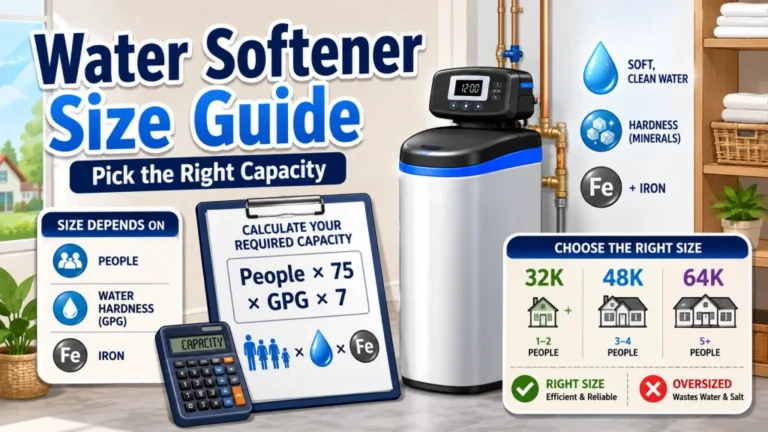
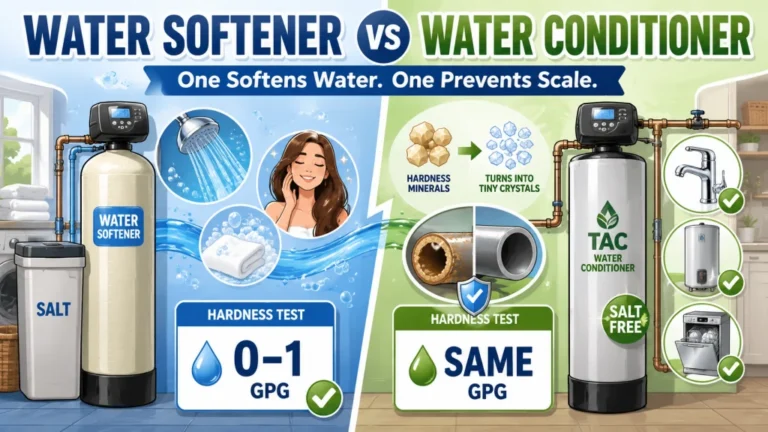
Hard water becomes manageable once you have your GPG number. That number tells you whether treatment is worth it, what kind of system fits your situation, and what the realistic outcomes look like. One thing I tell people at this point: once you have that number, your next decision is system type first, not brand first. The type of system determines what your water will actually test out as afterward. The brand determines price and support. Mixing that order up is where most buying mistakes happen. If you have worked through the topics above and are ready to look at system options, the full guide to water softener systems and how to choose between them is the right next step. For the broader context of how softening fits into your home, from first purchase through installation and maintenance, the complete water softener guide covers the full lifecycle. And once you are ready to evaluate specific options by situation, the overview of top-performing water softeners by situation is a useful reference to have in hand.

This whole-home water softener comes pre-loaded with 1.5 cubic feet of high capacity resin in a black USA-made mineral tank, paired with a USA brine tank featuring a safety float. The on-demand digital metered system ensures efficient water treatment, and the included 1-inch Noryl plastic bypass valve makes installation straightforward. Toll-free customer support is available whenever you need help.
Check On AmazonIf you click this link and buy, we earn a commission at no additional cost to you.
Articles in This Series
Hard water is not one question with one answer. It is a set of connected topics, each with its own depth. The articles below cover each piece in full detail. If you know which part of the picture you need, go directly to that article. If you are still building the full picture, work through them in order.
| Article | What It Covers |
|---|---|
| What Is Hard Water | The full GPG scale explained by tier, where hard water comes from geologically, and what calcium and magnesium actually do inside pipes and heating elements |
| How to Test for Hard Water | All four testing methods ranked by accuracy, when a utility report is enough, when to use a mail-in lab, and why dealer-conducted tests cannot be trusted |
| Signs of Hard Water | Nine physical symptoms your home may already be showing, how to calibrate their severity, and how to tell calcium scale from iron staining |
| Hard Water Effects on Hair and Skin | What the research actually shows about mineral buildup on hair, which remedies help versus which are marketing, and at what hardness levels the impact becomes measurable |
| Hard Water by State | Regional hardness patterns across the US, which states consistently run hard, and how to find city-level data for your specific municipal supply |
| Hard Water vs Soft Water | The practical differences in daily life across appliances, cleaning, laundry, and personal care, including what the transition actually feels like |
| Is Hard Water Safe to Drink | The health question answered directly, including what the EPA says and when softened water sodium is a factor worth thinking about |
FAQs
💧 What exactly is hard water?
Hard water is water containing elevated concentrations of dissolved calcium and magnesium, picked up as water moves through rock and soil. It is not polluted or unsafe. It is a mineral concentration issue measured in grains per gallon (GPG), and the GPG number tells you how significant the problem is in your specific home.
📊 What GPG level counts as hard water?
Water above 7 GPG is classified as hard. Above 10.5 GPG is very hard. Below 3.5 GPG, the practical impact on appliances and daily use is minor for most households. The label matters less than the number. Your actual GPG tells you whether treatment is worth pursuing and at what scale.
🏠 How do I know if my home has hard water without testing?
White mineral deposits around faucets, shower heads that clog regularly, spotted glassware from the dishwasher, and soap that will not lather properly are the most reliable visual indicators. The more of these that show up together, the more likely you have meaningful hardness. A test confirms the number; the symptoms tell you where to look first.
🚿 Does hard water actually damage hair and skin?
It can, particularly at higher GPG levels. Mineral deposits interfere with how soap and shampoo rinse, leaving residue on skin and buildup on hair over time. At moderate hardness, many people notice little. At high hardness, especially with magnesium-heavy water, the effect on hair texture can be significant enough to get misattributed to product problems.
🔬 Is hard water safe to drink?
Yes. The EPA does not classify water hardness as a health concern, and the calcium and magnesium in hard water are not harmful at household concentrations. People on sodium-restricted diets may want to consider a dedicated drinking water source if they install a salt-based softener, since ion exchange adds a small amount of sodium to the treated water.
💰 Does hard water actually shorten appliance life?
Yes, and the effect is documented. A Battelle Memorial Institute study measured scale impact on household appliances and found that water heaters operating at high hardness levels lost significant efficiency and failed earlier than units running on soft water. Dishwashers and appliances that use water show similar patterns. The higher the GPG, the faster scale accumulates on heating elements and inside pipes.
🌎 How do I know how hard the water is where I live?
For city water, start with your utility’s annual Consumer Confidence Report (CCR), which is publicly available and typically includes hardness data. For well water, you need an independent test since no utility report exists for private wells. Regional patterns by state are a useful starting reference, but your actual municipal or well number is what matters for any real decision.