Four Ways to Test, Ranked by Accuracy and Cost
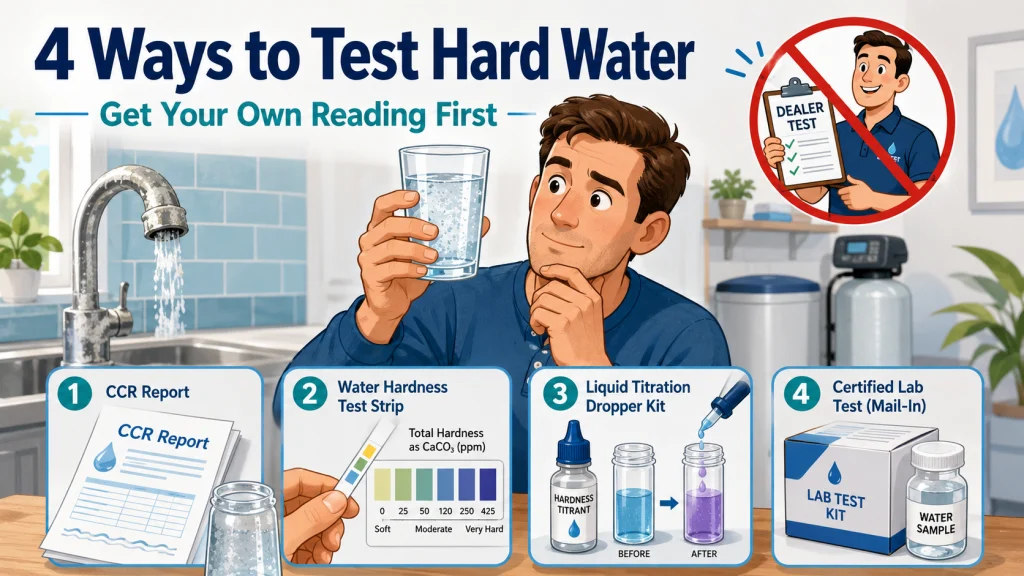
Most homeowners I talk to have no idea a free option even exists. Before you order a test kit or schedule anything, pull up your water utility’s Consumer Confidence Report. The EPA requires every public water system to publish one annually, and it often includes hardness, sometimes listed as calcium carbonate, total hardness, or just hardness under secondary contaminants. Search your utility name plus “CCR” or “water quality report,” or go directly to the EPA’s CCR search tool at epa.gov/ccr. If you cannot find it listed, call your utility and ask for the hardness reading in grains per gallon. The number will usually come back in milligrams per liter or parts per million. Divide by 17.1 to convert to grains per gallon, which is the unit most softener sizing charts use. That only helps if you are on city water. If you are on a private well, the CCR tells you nothing about your water, and you will need to skip ahead to methods two or four.
For a fast at-home number, test strips are the right call. Brands like JNW Direct and API Aquarium offer strips designed specifically for water hardness measurement. Drop a strip into a fresh water sample, wait the indicated time, and compare the color change against the provided chart. Accuracy runs roughly 10 to 15 percent, which works out to about 1 to 2 GPG on most household readings, close enough to guide a treatment decision in most cases. They cost $10 to $15 for enough strips to test multiple taps or retest after installing a softener. One practical note: run your cold tap for 30 seconds before collecting the sample. Water that has been sitting in the pipes picks up minerals from the lines and will read higher than what is actually coming in from the source.
If you want more precision than strips can give you, a liquid titration kit closes the gap considerably. These work by adding a reagent to a measured water sample until a color change occurs. Each drop typically equals 1 GPG. In the field, drop-count titration kits are standard for this reason: they give you a number, not a color band to interpret. The Hach-style kits are common because the chemistry is reliable and the result is unambiguous. These run $15 to $20 and are worth the slight increase in complexity if you are at the point of buying equipment.
The most accurate option is a certified lab test. For $30 to $50, you send a water sample to a state-certified laboratory and get back a full panel, including hardness, iron, manganese, and other parameters that the strip methods cannot detect. This is the one to use if you have a private well, if you are seeing rust-colored staining that suggests iron, or if your hardness reading seems inconsistent with what your home is showing you. The Water Quality Association maintains a directory of certified labs, and your state health department can also refer you to one. Results typically take a few days to a week.
| Method | Cost | Accuracy | Best For | Well Water? |
|---|---|---|---|---|
| Consumer Confidence Report (CCR) | Free | Good | City water, first check | No |
| Test strips | $10-$15 | Good (±1-2 GPG) | Quick confirmation, city or well | Yes |
| Liquid titration kit | $15-$20 | Better | Pre-softener sizing | Yes |
| Certified lab test | $30-$50 | Best | Well water, iron suspected, full panel | Yes |
If you are on city water and just want a quick confirmation before deciding anything, start with the CCR and follow up with strips at the tap. If you are sizing a softener and want a reliable number going into that purchase, use a titration kit. If you are on a well or you are seeing rust-colored staining, skip the at-home options and go straight to a lab panel. The methods are not equally useful for every situation, and choosing the right one saves both time and money.
The soap bottle test gets mentioned in a lot of places as a fifth option. Fill a clear bottle a third of the way with tap water, add ten drops of pure liquid soap (not detergent), cap it and shake for 15 seconds. Minimal foam and cloudy water point to hard water. Lots of suds with clear water below suggests soft. It is a rough indicator, not a measurement. You will not get a GPG number from it, only a binary signal. It is useful if you are trying to confirm a suspicion before spending anything at all, but if you are moving toward a treatment decision, you need an actual number.

This kit includes 150 dip-and-read test strips for quickly measuring water hardness across virtually any source, including home faucets, well water, softeners, dishwashers, showers, and aquariums. Results are instant and easy to read against a color chart, making it simple to verify whether your water softener, reverse osmosis, or water conditioning system is performing as expected. A bonus eBook is included to help you record, track, and interpret your results over time.
Check On AmazonIf you click this link and buy, we earn a commission at no additional cost to you.
Well Water Is a Different Situation
Private well users are working without a safety net that city water customers take for granted. There is no utility report. There is no annual disclosure. Your water has never been tested by anyone unless you tested it yourself. I have been on plenty of installs where well water was the culprit and the homeowner had no baseline reading at all, just a vague sense that something was wrong because of the staining or the scale buildup they had been seeing for years. You can learn more about what those physical signs actually indicate in the article on recognizing hard water symptoms in your home.
For well water, I recommend skipping the CCR and the test strips and going straight to a certified lab test, especially if you have any suspicion of iron or sulfur. Well water hardness can swing significantly depending on the aquifer, seasonal conditions, and your pump depth. A lab panel gives you the full picture in one shot rather than testing in pieces. If cost is a concern, test strips are fine as a starting point, but if you find hardness above 10 GPG, follow up with a lab test before you buy anything. Iron above 0.3 parts per million changes the sizing calculation for a softener, and you cannot see that with a strip.
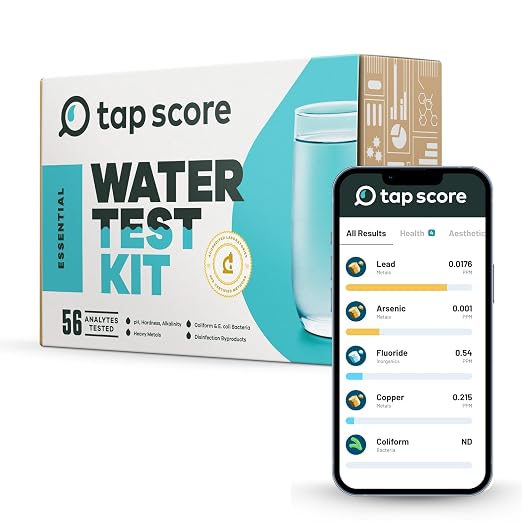
Used by millions of American homes and businesses, this certified lab test analyzes 56 parameters including heavy metals, coliform bacteria, nitrates, fluoride, hardness, turbidity, and TDS, making it ideal for both city tap and private well water. Every kit includes sampling materials, clear instructions, and pre-paid return shipping, with results delivered in an award-winning lab report featuring health guidance, taste evaluation, and unbiased filtration recommendations. EPA, NELAC, ISO, and state certified labs handle all testing, and PhD scientists and engineers are available for direct support throughout the process.
Check On AmazonIf you click this link and buy, we earn a commission at no additional cost to you.
Why You Cannot Trust a Dealer to Test Your Water
Most hard water testing guides stop at the test methods. The part they usually skip is the sales test itself, and that is where homeowners can lose the most money. Do not let anyone who sells water treatment equipment test your water. This is not a general caution. It is a specific, documented pattern that plays out in predictable ways across the country.
Field Note: The call pattern I have seen repeat itself goes like this: homeowner gets a mailer offering a free water test, fills out the form, gets a callback, schedules an appointment. The rep arrives, runs a few drops of reagent into a cup of tap water, the water changes color, and suddenly the homeowner is looking at a system quote between $4,000 and $9,000. The test is designed to show a problem. That is its function. In some cases, it would show the same result with distilled water. Understanding this is the single most valuable thing you can take from this article.
This is not speculation. The Town of Selbyville, Delaware issued an official public notice warning residents that fake water testing kits were being mailed to homeowners. After submitting the kits, residents received calls warning them about poor water quality, followed by offers for a free in-home assessment. The in-home visit was a sales call. The notice was from the town government, not a competitor or a consumer advocacy blog.
The CBC News investigation out of Ottawa documented a 74-year-old homeowner who answered his door to a salesperson from an organization called Ontario Safety Standards. The rep pointed to brown sediment at the bottom of his water tank and told him he needed a purifier. The man signed a contract for what he believed was a free, government-supplied system, then discovered ten days later, when the first bill arrived, that he had committed to $65 a month for the next ten years. The system was not even a purifier. It was a water softener.
On the TractorByNet forum, a user flagged the same pattern plainly: the companies that install water softeners will test your water for you, although they will always tell you it is really bad even when it is not. That is not a cynical read on the industry. It is an accurate description of the incentive structure. The rep’s income depends on what the test shows. In documented cases, homeowners who pushed back during demos watched the sales rep’s own tests produce results that did not match third-party readings from the same tap. A class-action lawsuit against a major home improvement retailer and its water treatment partner alleged that free in-store water tests were misleading homeowners into believing they were getting a safety assessment when the tests only measured mineral content and were designed as a lead generation tool. The companies acknowledged the tests were not intended as comprehensive health analyses.
The right way to get your number is one of the four methods above, completed before anyone from a treatment company sets foot in your home.
Key point: If a company offering to sell or install water softeners also offers to test your water for free, that test is a sales tool. Get your own independent reading first from your CCR, a strip kit, a titration kit, or a certified lab. Then, if you want a professional assessment, you will have a baseline to verify any claims against.
What to Do with Your Number
Once you have a GPG reading, here is what it means practically. For a full breakdown of what hard water actually is and where the GPG scale comes from, the article on what hard water means and how GPG levels are defined covers that in detail. The short version for decision-making purposes:
- Under 3 GPG: Soft water. No treatment needed. If you are experiencing scale or skin issues, look at other causes first.
- 3 to 7 GPG: Moderately hard. Treatment is optional depending on your water use and tolerance for the effects. Most people in this range manage fine without a softener.
- 7 to 10 GPG: Hard. Scale buildup will be noticeable on fixtures and in appliances. Treatment is worth considering, especially if you have a water heater showing age.
- 10 to 15 GPG: Very hard. Appliance efficiency takes a measurable hit at this level. Treatment is recommended if you plan to stay in the home long enough to see the return on cost.
- Above 15 GPG: Extremely hard. Treatment is not a luxury at this level. Water heater efficiency loss, soap performance, scale on every fixture, and laundry stiffness are all going to be significant ongoing issues.
If your number falls above 7 GPG and you are seriously considering treatment, your next step is confirming what the cost-benefit math actually looks like for your household. The break-even analysis on whether a water softener is financially worth it at your hardness level works through that math using real appliance data. Also worth knowing: hardness varies by region, and your result may be higher or lower than your neighbors depending on water source. If you want to see typical readings for your state before interpreting your own number, the breakdown of hard water levels by state gives regional context. For a broader orientation on what hard water causes and how this testing piece fits into the larger picture, the complete guide to understanding hard water covers the full scope before you move toward any treatment decision.

The original professional-grade hardness test kit trusted across water treatment, food and beverage, textile, and manufacturing industries, this kit measures total hardness as CaCO3 using a simple drop count titration method with a range of 1 to 30 GPG. Each kit contains approximately 100 tests and includes two reagents, a measuring tube, square bottle, and measuring scoop for both field and lab use. Instructions are provided in English, Spanish, French, and Portuguese.
Check On AmazonIf you click this link and buy, we earn a commission at no additional cost to you.
Testing Mistakes That Give You the Wrong Number
Getting a GPG reading is straightforward, but a handful of simple errors show up repeatedly and produce results that do not reflect what your water actually is. I have seen homeowners make treatment decisions based on numbers that were off because of one of these:
- Testing hot water instead of cold. Hot water releases dissolved minerals faster, which means a hot tap sample will read higher than cold. Always test from the cold supply line only.
- Testing from a softened tap without realizing it. Some homes have certain taps plumbed outside the softener loop, while others send softened water to places homeowners do not expect, like a laundry sink. Know which taps in your home are softened before you choose where to sample.
- Reading a strip too early or too late. Each strip brand has a specific development window. Reading at 30 seconds on a strip that calls for 60 seconds produces a different color than the chart assumes. Follow the included instructions exactly, not the general instructions you remember from a different brand.
- Using strips that have been exposed to humidity. Old strips stored in a bathroom cabinet, or strips left open near the sink, degrade and read inconsistently. Check the expiration date and store them sealed away from moisture.
- Comparing a CCR number directly to a tap strip reading and assuming they should match. The CCR reflects hardness at the treatment plant. By the time water travels through distribution lines and your home’s service line, the number at your tap can be 2 to 4 GPG higher. These are two different measurement points, and the gap between them is normal.
None of these are unusual errors. They come up often enough that if your test result seems surprisingly low or inconsistently high, one of the above is usually the reason. Retest with cold water from an unsoftened tap, a fresh strip, and proper timing, and the number will settle.

This kit lets you test drinking water, pool water, or any water source in seconds using a simple dip-and-read method with an oversized color chart ranging from red to green, covering 0 to 25 GPG and 0 to 425 PPM. All 100 strips are protected by FreshSeal technology across a ready-to-use bottle and two sealed pouches for long-term accuracy. Each purchase also funds a full year of clean water for someone in the Central African Republic.
Check On AmazonIf you click this link and buy, we earn a commission at no additional cost to you.
Final Thoughts: Get Your Number Before Anyone Else Does
The most important thing I have told you in this article is not which test kit to buy. It is to get your own reading before you talk to anyone trying to sell you a system. That one step changes the entire dynamic of every conversation that follows. You are no longer relying on their number. You have yours.
If you are on city water, start with your Consumer Confidence Report tonight. It is free and it takes three minutes to find. If you are on a well, order a certified lab test before you do anything else. Test strips are fine for a quick read, but a well without a full panel is a well you do not really know. Once you have your GPG number, the decisions downstream get a lot simpler.
FAQs
💧 How do I find my Consumer Confidence Report?
Search your water utility’s name along with “CCR” or “Consumer Confidence Report,” or use the EPA’s search tool at epa.gov/ccr. Hardness is usually listed under secondary or aesthetic contaminants, sometimes as calcium carbonate. If you cannot find it listed as hardness, call your utility directly and ask for the reading in grains per gallon.
🧪 Are test strips accurate enough to size a water softener?
They are close enough for most situations, with an accuracy range of roughly 1 to 2 GPG. If your reading comes back near a threshold, say 9 or 10 GPG, a titration kit or lab test will give you more confidence before committing to a system size. For well water with possible iron, skip strips and go straight to a lab.
🚿 Why does my water feel hard even though my city report says it is moderate?
The CCR reflects hardness at the treatment plant, not at your tap. Water picks up additional minerals from distribution pipes and service lines between the plant and your home. Test your tap directly with strips or a titration kit and compare. A gap of 2 to 4 GPG between the report number and your tap reading is not unusual in older municipal systems.
🔬 What does a lab water test include that strips do not?
A certified lab panel covers iron, manganese, pH, hardness, and other parameters that standard test strips cannot detect. Iron in particular matters for softener selection and sizing. Above 0.3 parts per million, iron requires specific handling that changes the system you need. Strips will tell you your hardness number, not your full water profile.
📬 Is it safe to mail in a water sample to a lab?
Yes, certified labs provide collection bottles and instructions for proper sampling. The key is to run the tap for two minutes before collecting to flush the lines, and to mail the sample within the time frame the lab specifies. Most labs list these instructions clearly on their order forms. Refrigerating the sample before shipping is standard practice for accuracy.
🏠 Can I use the soap bottle test to check if my softener is working?
You can use it as a rough indicator, but test strips from the softened water line are more reliable. A working softener should bring your output reading to 0 to 1 GPG. If strips from the softened tap still show hardness above 1 GPG, the system may need a resin bed check, a salt bridge inspection, or a valve service.