The Rotten Egg Problem Your Softener Cannot Fix
Most homeowners with well water and a sulfur smell find out the hard way. They install a softener because a dealer or a forum post suggested it, and six weeks later the water still smells. The scale is gone. The soap lathers better. The rotten egg odor is still there. What happened is that they treated the wrong problem with the wrong tool.
A water softener operates through ion exchange. Calcium and magnesium ions are swapped for sodium as water passes through a resin bed. The resin bed has nothing meaningful to exchange with hydrogen sulfide, which is a dissolved gas, not a mineral. Some softeners can actually make things worse by trapping small amounts of gas in the resin and releasing it intermittently, which gives you an inconsistent smell that is harder to trace. I have walked into homes where the homeowner was convinced their softener was defective because the odor came and went unpredictably, when the sulfur problem was never something the softener could solve.
Field Note: One of the most consistent patterns I run into on well water calls is someone who has owned a softener for years and never connected it to the sulfur smell. They have shock-chlorinated the well, replaced filter cartridges, had the dealer out twice. The softener is still there. The smell is still there. The two problems were never related, and treating one was never going to affect the other. Buying a second softener will not change that math.
What Is Actually Causing the Smell
Hydrogen sulfide is produced by sulfur-reducing bacteria that live in anaerobic environments: oxygen-depleted groundwater, the lower zones of wells, and stagnant sections of a water system. These bacteria feed on sulfur compounds naturally present in soil and rock and release H2S gas as a byproduct. In most residential well water situations the concentration falls somewhere between 0.1 and 5 milligrams per liter. Even at 0.1 mg/L, most people detect the odor clearly.
Two diagnostic details are worth checking before you spend money on equipment. First, if the smell only appears in hot water and not cold water, the source is almost certainly the magnesium anode rod in your water heater, not your well. Magnesium reacts with sulfur-reducing bacteria in warm water and amplifies the odor significantly. Replacing the magnesium rod with an aluminum-zinc alternative often resolves hot-water-only odor without touching the well treatment system at all. Second, if your water tests show low hydrogen sulfide but the smell persists, check manganese levels. Elevated manganese produces an odor many homeowners mistake for sulfur, and it requires a different treatment approach. Rule those two out before you spend money on a whole-house sulfur system.
If the smell is present in both hot and cold water consistently throughout the house, you have a groundwater source issue. That means a treatment train problem, and it needs to be addressed before the water reaches your softener, not alongside it.

Designed to eliminate rotten egg odors caused by factory-installed magnesium anode rods, this kit uses a proprietary aluminum/zinc alloy rod that neutralizes hydrogen sulfide gas at the source. The 44-inch rod is hinged into four segments of under 12 inches each, connected with 304 stainless steel crimped hinges that resist rust and allow installation even in tight spaces. A lifetime chrome vanadium 6-point removal tool, brass drain cap, and step-by-step instructions written by licensed fifth-generation plumbers are all included for a complete and confident installation.
Check On AmazonIf you click this link and buy, we earn a commission at no additional cost to you.
What Actually Works for Hydrogen Sulfide
There are three established approaches, each suited to different concentration ranges and installation constraints.
Aeration
Aeration is the most effective method for high sulfur concentrations. Hydrogen sulfide is a gas, and if you expose the water to air with enough surface area and contact time, the gas escapes. Florida, which has some of the highest H2S concentrations found in any residential well water in the country due to its limestone aquifer geology, has used open-tank aeration as standard practice for decades. Water from the well is introduced into a vented tank, the gas dissipates to the atmosphere, and a second pump pressurizes the treated water into the house. A certified water treatment technician I came across in a forum discussion put it plainly: for any sulfur smell, a bubbler to force air through the water and vent it outdoors is the most reliable fix available. The limitation is real: aeration requires a second pump, occupies meaningful space, and produces noticeable odor around the aerator itself. For concentrations above 5 mg/L, it is often the only approach that achieves complete removal.
Oxidizing Filter Media
For moderate sulfur levels, filter media such as greensand, birm, or catalytic carbon handle H2S by converting it to solid elemental sulfur that the filter bed captures and backwashes away. Greensand requires periodic regeneration with potassium permanganate. Catalytic carbon is lower maintenance but exhausts faster at higher concentrations and needs regular cartridge replacement. These filters are more compact than open aeration setups and do not require a second pump, making them the practical choice for most residential installs where hydrogen sulfide falls between 1 and 5 mg/L.
Air Injection Oxidation Systems
An AIO system injects a pocket of air into the treatment tank before each backwash cycle. Incoming water passes through the air pocket, which oxidizes both hydrogen sulfide and dissolved iron. The backwash cycle then flushes the oxidized material out. A properly rated AIO system handles H2S up to around 5 mg/L and ferrous iron up to 7-10 PPM in a single unit. That combination covers the majority of residential well water scenarios where sulfur and iron are present together, which is common. If your water test shows both, an AIO upstream of your softener is usually the most practical single-unit solution within those concentration limits.
| H2S Level (mg/L) | Smell Character | Recommended Approach |
|---|---|---|
| Under 0.5 | Faint, intermittent | Catalytic carbon pre-filter or entry-level AIO |
| 0.5 to 2 | Consistent, clearly noticeable | AIO system upstream of softener |
| 2 to 5 | Strong, persistent throughout house | Greensand filter + sediment filter + softener |
| Above 5 | Intense, present at every fixture | Dedicated aeration required before any filtration |
These ranges are practical guides, not manufacturer cutoffs. Actual performance depends on your pH, iron levels, flow rate, and how consistent the H2S concentration is through seasonal changes. A water test before purchasing is not optional here. You need your number before you can match it to a system.
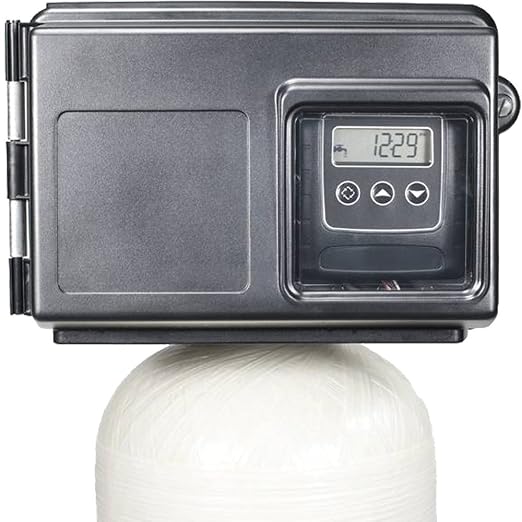
This chemical-free whole house system uses air injection and oxidation to remove iron, sulfur, and manganese from your water without the need for added chemicals or separate chemical tanks. A patented piston keeps the entire oxidation process contained within one tank, creating a pressurized air bubble during backwash to trap impurities and minimize maintenance costs and downtime. The system arrives fully equipped with a tank riser tube, deflector, control head, media, and stainless steel bypass valve for straightforward installation in an average-sized home.
Check On AmazonIf you click this link and buy, we earn a commission at no additional cost to you.
Treatment Order and Why It Matters for Your Softener
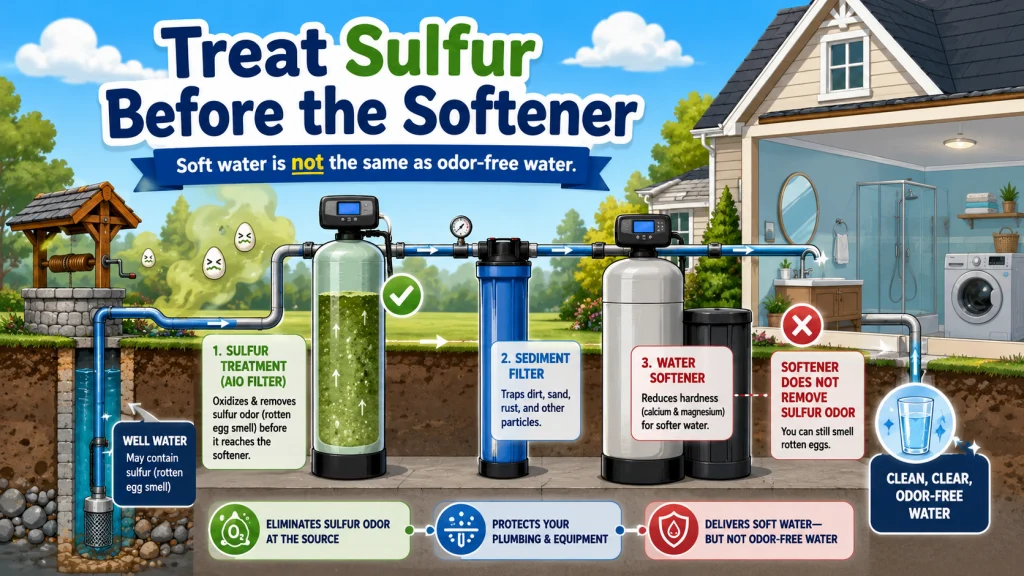
Whether you are adding sulfur treatment to an existing system or building from scratch, the sequence of equipment in the line is not flexible. Sulfur treatment goes first. A sediment filter follows. The softener is last.
The reason is resin life. Hydrogen sulfide damages ion exchange resin over time by coating the beads and reducing exchange capacity. Sulfur-reducing bacteria that travel with the gas can colonize a resin bed on untreated sulfur wells with no upstream oxidation and create ongoing contamination that is very difficult to clear. I have seen resin beds that needed full replacement after three years in that situation, when they should have lasted eight to ten. Once you price a resin replacement, the order of equipment stops looking optional.
The correct sequence for a well with both sulfur and hardness looks like this:
- AIO filter or greensand filter: removes hydrogen sulfide and oxidized iron, backwashes on a demand-initiated or timed cycle
- Sediment pre-filter (5 to 20 micron): catches oxidized particulate before it reaches the softener resin
- Water softener: handles hardness on clean, sulfur-free water, operating at full rated capacity
If you already own a softener, the answer is not to replace it. Add the right sulfur treatment upstream and the softener you have continues doing what it was designed to do. For understanding how iron levels affect softener sizing and what well water typically contains alongside sulfur, the well water softener guide walks through the full picture before you commit to a configuration.
Note: If the sulfur smell only appeared after your softener was installed, sulfur-reducing bacteria from untreated well water may have colonized the resin bed or brine tank. Sanitizing the system with a diluted bleach solution may reduce the symptom temporarily, but the upstream treatment problem still needs to be addressed or the smell returns.

This high-flow system features 1-inch inlet and outlet ports and a reusable 30-micron pleated filter that captures sediment, dirt, sand, silt, rust, and scale particles from well water throughout your entire home. The clear housing allows easy visual monitoring, and the washable filter design helps reduce long-term replacement costs. The complete kit includes a wrench, heavy-duty mounting bracket, and a built-in pressure relief button, all built from certified approved components designed in California.
Check On AmazonIf you click this link and buy, we earn a commission at no additional cost to you.
Which System Configuration to Choose
Once your water test results are in hand, the right configuration usually becomes clear. Here is how I think about it across the most common scenarios.
Best overall: AIO sulfur filter staged before a demand-initiated softener
For most well water with sulfur under 5 mg/L and iron under 7 PPM, a whole-house AIO filtration system staged ahead of a demand-initiated softener is the most complete solution. The AIO stage handles both sulfur and iron in a single tank through air injection oxidation and regular backwash. The softener downstream handles hardness on clean, pre-treated water and operates at full efficiency because it is not fighting contamination. This setup carries no ongoing chemical cost, requires minimal maintenance beyond salt and occasional media inspection, and covers the most common well water combination in a single treatment train. Look for an AIO unit rated at minimum 7 PPM iron and 5 mg/L H2S at your actual household flow rate, paired with a softener using a demand-initiated metered valve rather than a timed one. If your well has sulfur, iron, and hardness together, this is the configuration I would build first.
Best integrated option: modular well system with AIO and softener stages combined
Some manufacturers offer a well water system that integrates an AIO filter stage and a softener stage in a single connected package with a unified control setup. These work well for buyers who want one point of purchase, one manual, and one support line. In an integrated system, I want two things: a published H2S rating, not just an iron rating, and a control valve with parts and service availability outside the original vendor. The tradeoff versus a staged setup is that each component is slightly less individually configurable. For moderately challenging well water where sulfur and iron fall within AIO handling range, these integrated systems are a practical, lower-complexity choice for buyers who are not looking to piece together components from separate sources.
Best long-term value: greensand filter with a serviceable control valve, paired with a demand-initiated softener
For technically capable buyers comfortable with installation and periodic maintenance, a standalone greensand filter paired with a proven demand-initiated softener gives you the most control and the best long-term cost profile. You service each unit independently, swap a control valve without replacing the whole system, and size precisely to your water test numbers. The greensand filter handles sulfur and iron upstream, the sediment pre-filter catches oxidized particulate, and the softener works on clean water with a full-capacity resin bed. The key on the greensand side is choosing a control valve that has real-world local service availability. A Fleck or Clack valve can be worked on by any water treatment technician familiar with that platform. A proprietary valve on a budget unit works until it does not, and then you are dependent on the original vendor.
H2S above 5 mg/L: dedicated aeration first, everything else second
If your water test comes back above 5 mg/L hydrogen sulfide, neither a greensand filter nor an AIO system will reliably handle the load at full household flow. Budget for a dedicated open-tank or pressurized aeration system as the first stage. This means a second pump and additional tank space, but it is the only configuration that removes high-concentration H2S completely before the water touches any other equipment. Once the aeration stage brings H2S down to manageable levels, a sediment filter and softener downstream complete the train. Skipping the aeration step at this concentration range and trying to compensate with a larger AIO unit is a common mistake and an expensive one to undo.
| Situation | Best configuration | Why |
|---|---|---|
| H2S under 2 mg/L, low iron | Catalytic carbon or entry AIO before softener | Lower cost, adequate for mild odor at this range |
| H2S 2 to 5 mg/L, sulfur + iron | Rated AIO filter before demand-initiated softener | Handles both contaminants in one upstream stage |
| H2S above 5 mg/L | Dedicated aeration before filtration and softening | AIO cannot fully remove gas at high concentration |
| DIY-capable buyer | Greensand filter + serviceable-valve softener | Lower long-term cost, fully field-serviceable parts |
| Already owns a softener | Add sulfur treatment upstream, keep existing softener | Avoids replacing working equipment that was never the problem |
Key point: Whatever configuration you choose, verify the rated H2S limit at your actual household flow rate, not the peak spec on the product page. Many AIO systems rate performance at 5-6 GPM, and effectiveness drops meaningfully at 8-10 GPM. Size for your realistic peak demand, not ideal lab conditions.

This whole-home water softener comes pre-loaded with 1.5 cubic feet of high capacity resin in a black USA-made mineral tank, paired with a USA brine tank featuring a safety float. The on-demand digital metered system ensures efficient water treatment, and the included 1-inch Noryl plastic bypass valve makes installation straightforward. Toll-free customer support is available whenever you need help.
Check On AmazonIf you click this link and buy, we earn a commission at no additional cost to you.
Before You Buy: Quick Diagnostic Checklist
The number of buyers who spend $800 to $2,000 before doing a $35 water test is higher than it should be. A few questions first can prevent the wrong purchase entirely.
- Smell only in hot water? Check and replace the water heater anode rod before buying any whole-house treatment system.
- Smell only at one sink or fixture? Check the drain and the fixture itself. Biofilm in a drain can produce a sulfur-like odor that has nothing to do with your well.
- Smell in both hot and cold throughout the house? Test H2S, iron, hardness in GPG, and pH. Those four numbers define your equipment configuration.
- H2S under 2 mg/L? An AIO system or compact catalytic carbon pre-filter staged before your softener typically handles this range cleanly.
- H2S above 5 mg/L? Do not buy a softener-only setup or a small cartridge filter. Neither will make a meaningful dent. Budget for a dedicated aeration system as the first stage.
- Already have a softener with a sulfur smell? Do not replace it first. Add the right sulfur treatment upstream. The softener is likely fine.
The broader context of how different water source situations change the equipment decision from sizing through treatment train is covered in the guide to choosing the right water softener by situation.

This kit tests for six key parameters including coliform bacteria, nitrate, nitrite, hydrogen sulfide, total hardness, and total alkalinity, making it one of the more thorough consumer water test options available. Suitable for home tap water, private wells, boreholes, and marine or fresh water supplies, it includes 2 tests for each parameter except bacteria, which is a single-use test. A results chart is included to compare your findings directly against required UK water quality standards.
Check On AmazonIf you click this link and buy, we earn a commission at no additional cost to you.
Final Thoughts: Test First, Then Build
The sulfur smell in well water is fixable. It requires the right equipment in the right order, matched to your actual water test numbers. Get your results for H2S, iron, hardness, and pH before spending anything. Those four numbers tell you which of the configurations above applies to your situation and how to size each component.
If your H2S is under 2 mg/L and iron is moderate, a staged AIO ahead of your softener handles both cleanly. If H2S is above 5 mg/L, plan for dedicated aeration as your first stage. If it falls between those points, a greensand filter with a solid control valve covers most cases at a reasonable long-term cost. The homeowners who get this right test first and build accordingly. The ones who get it wrong bought based on what was in stock or what a dealer quoted without seeing the water test.
FAQs
💧 Will a water softener remove the sulfur smell from well water?
No. A water softener removes hardness minerals through ion exchange and cannot remove hydrogen sulfide gas. Adding a higher-capacity softener will not change the sulfur odor. You need an upstream system specifically designed for H2S removal, such as an AIO filter or greensand system, installed before the softener in the treatment line.
🌡️ Why does only my hot water smell like sulfur and not the cold?
Hot-water-only sulfur smell is usually caused by the magnesium anode rod in your water heater reacting with sulfur-reducing bacteria in warm water. Replace the magnesium rod with an aluminum-zinc anode. This resolves hot-water-only odor in most cases and is far simpler than a whole-house treatment system.
🔬 What is the correct treatment order for well water with sulfur and hardness?
Sulfur treatment must come before the softener. The correct sequence is: AIO or greensand filter first, then a sediment pre-filter, then the water softener. Running sulfur-contaminated water through a softener shortens resin life significantly and can allow sulfur bacteria to colonize the resin bed.
🛠️ Can one AIO system handle both sulfur and iron at the same time?
Yes, within limits. A properly rated AIO system handles hydrogen sulfide up to around 5 mg/L and ferrous iron up to 7-10 PPM in a single unit. Above those limits, a staged approach with dedicated equipment for each contaminant performs better and lasts longer between service intervals.
🧪 How do I test my well water for hydrogen sulfide?
Order a test kit from a state-certified lab or use a local water testing service. Standard well water panels do not always include H2S, so request it specifically along with iron, hardness, and pH. Those four results together define your treatment configuration. Testing typically costs $30 to $50 and is the most important step before any purchase decision.
🏠 My softener started smelling like sulfur after installation. What happened?
Sulfur-reducing bacteria from untreated well water can colonize a softener’s resin bed and brine tank when no upstream treatment is in place. Sanitizing the system with a diluted bleach solution may reduce the odor temporarily, but the underlying cause is an untreated sulfur source upstream. Address that first or the smell will return.
⚠️ What systems should I avoid buying for a sulfur problem?
Avoid buying a softener alone, a small activated carbon cartridge filter rated for taste and odor only, or any combo system that does not specify a rated H2S limit. If a product does not publish its hydrogen sulfide rating, it almost certainly cannot handle meaningful concentrations reliably. Look for a rated H2S capacity at your flow rate before committing.