City Water Makes Softening Straightforward, With One Exception
If you are on municipal water with a hardness reading somewhere between 7 and 15 GPG, you are in the most predictable softening scenario there is. No iron fouling the resin. No sulfur. No sediment working its way into the mineral tank. The hardness level is consistent, the mineral profile is stable, and sizing is basic arithmetic. Finding the best water softener for city water does not require building a multi-stage treatment train or worrying about pH swings.
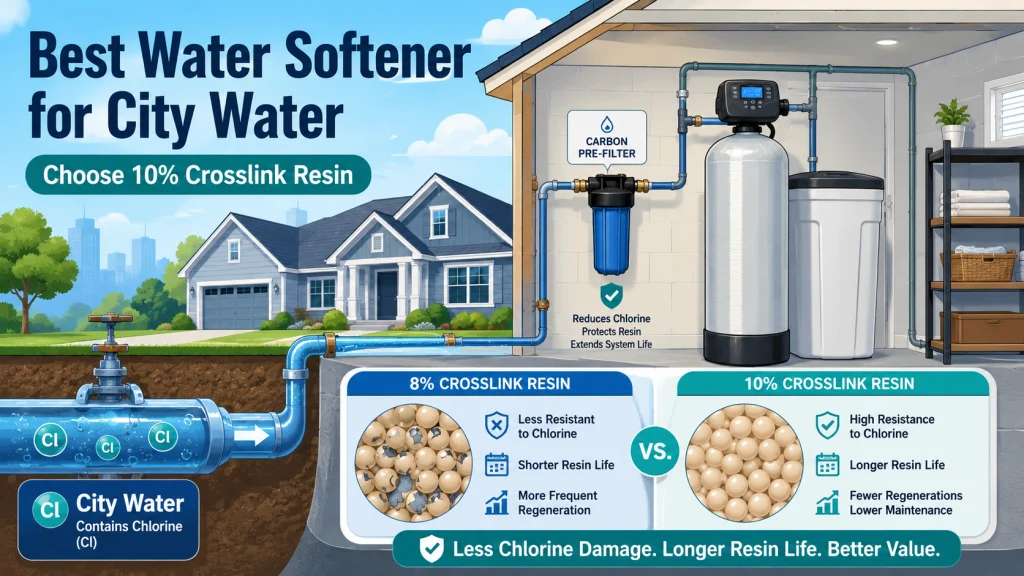
What it does require is paying attention to something most well water buyers never think about: chlorine. Municipal water is treated with chlorine before it reaches your tap, and that same chlorine that protects your water supply slowly attacks ion exchange resin over time. The rate at which it does that depends on a single spec. That spec is almost never published on box store product pages, and buyers routinely skip right past it on the way to comparing grain capacities and prices.
Field Note: I have seen city water installs where the resin looked visually degraded at the six or seven year mark. The homeowners were not doing anything wrong. They had sized correctly, they were using good salt, they had demand-initiated regeneration. The issue in every case was 8% crosslink resin taking a daily chlorine hit. A 10% crosslink system in the same home with the same water typically runs 15 to 20 years before showing that kind of breakdown.
The Crosslink Number Nobody Puts on the Box
Ion exchange resin is made of small polymer beads. The crosslink percentage describes how tightly those polymer chains are bonded to each other inside each bead. A higher crosslink means a denser internal structure that resists the oxidative process chlorine runs on it over time. Standard resin is 8% crosslink. High-durability resin is 10% crosslink. The difference in chlorinated city water is not marginal: 10% crosslink holds up significantly longer under continuous chlorine exposure, and that translates directly to how long the system lasts before the resin needs replacing.
The frustrating part is that this spec rarely appears on any box store listing. I have checked product pages for several common brands across major retailers, and the crosslink percentage simply is not there. You have to go to the manufacturer’s technical spec sheet, or contact their support and ask directly. Any manufacturer confident in their resin spec will state it plainly. If you cannot get a straight answer, treat that system as unconfirmed resin quality rather than assuming it is 10%. That one distinction, confirmed vs unconfirmed, is the most important filter to run before buying.
One thing worth noting for city water specifically: fine mesh resin is not necessary here. Fine mesh is designed to handle dissolved iron in well water. City water typically has negligible iron, so you would be paying for a capability you will not use. Standard 10% crosslink resin is the right specification for most municipal water applications.
Key point: Before buying any softener for city water, confirm the resin crosslink percentage. If the product page does not state it, contact the manufacturer directly. This is worth one email or phone call before spending several hundred dollars on a system you expect to run for 15 to 20 years.
The Carbon Pre-Filter Argument for City Water
If 10% crosslink resin is the long-term answer to chlorine from the resin side, a whole-house carbon pre-filter is the upstream answer. A carbon block or granular activated carbon filter installed before the softener removes most of the chlorine from the water before it ever reaches the resin bed. This extends resin life regardless of crosslink percentage, and it removes chlorine taste and odor throughout the house as a side benefit worth having.
The cost is reasonable. A whole-house carbon filter typically runs $100 to $300 depending on flow rate and housing quality, with filter media replacement once every six to twelve months. That ongoing cost is modest compared to replacing a resin bed years ahead of schedule. If your softener has confirmed 10% crosslink resin, a carbon pre-filter extends an already long lifespan further. If the resin spec is unconfirmed or you suspect it is 8% crosslink, a carbon pre-filter becomes a more important part of the setup rather than optional.

Installed at the main water supply line, this system removes up to 99% of chlorine and up to 95% of sediment, rust, herbicides, industrial solvents, and other contaminants from every tap in your home. With 1-inch NPT connections and 20 by 4.5-inch cartridges supporting up to 15 GPM, it delivers strong whole-house flow with minimal pressure drop and straightforward DIY installation. Unlike reverse osmosis systems, it retains healthy minerals in your water and is backed by a lifetime personalized support warranty with online product registration.
Check On AmazonIf you click this link and buy, we earn a commission at no additional cost to you.
How to Size for City Water Hardness
Sizing determines how often your system regenerates, how much salt it burns, and how long the resin holds up between cycles. The formula for city water is straightforward: daily grain requirement equals number of people multiplied by 75 gallons per day multiplied by your hardness in GPG. Multiply that by 7 and you have your weekly grain requirement, which is the minimum capacity your system needs to complete a full week between regenerations.
A mistake I see from first-time buyers is purchasing a 32k system for a family of four at 10 GPG. Running the math: 4 people times 75 gallons times 10 GPG equals 3,000 grains per day, times 7 is 21,000 grains per week. A 32k system can technically handle this, but it leaves almost no buffer if water use spikes, a guest stays for a stretch, or someone fills a large soaking tub. A 48k system gives the same household adequate headroom and regenerates less frequently, which is gentler on the valve over time. The general rule: size to the minimum and you are always one busy week away from breakthrough. Size up one step and you are not.
| Household Size | City Water Hardness | Weekly Grain Need | Recommended Capacity |
|---|---|---|---|
| 1-2 people | 7-10 GPG | 7,350-10,500 | 32k |
| 2-3 people | 7-12 GPG | 10,500-18,900 | 32k-48k |
| 3-4 people | 7-12 GPG | 15,750-25,200 | 48k |
| 4-5 people | 10-15 GPG | 21,000-39,375 | 48k-64k |
| 5+ people | 12-15 GPG | 31,500+ | 64k or dual tank |
City water above 15 GPG is less common but not rare, particularly in parts of the Southwest and Midwest. At those levels, sizing math for a family of four starts to look more like extreme hard water territory than standard city water, and the standard guidance will leave you regenerating more often than you should. The regional context for high-hardness city water and how the mineral profile varies by area is covered in more detail at the best water softener for hard water guide, which handles the regional GPG distinctions that a general city water article cannot fully address.

This kit lets you test drinking water, pool water, or any water source in seconds using a simple dip-and-read method with an oversized color chart ranging from red to green, covering 0 to 25 GPG and 0 to 425 PPM. All 100 strips are protected by FreshSeal technology across a ready-to-use bottle and two sealed pouches for long-term accuracy. Each purchase also funds a full year of clean water for someone in the Central African Republic.
Check On AmazonIf you click this link and buy, we earn a commission at no additional cost to you.
Demand-Initiated Regeneration vs Timer: Still Worth Getting Right
A timer-based softener regenerates on a fixed schedule regardless of how much water the household has actually used. If you go on vacation, it regenerates into an empty house. If you host a full household for a weekend and use twice your normal water volume, it waits until the scheduled day no matter what the resin capacity looks like. Demand-initiated regeneration, also called metered regeneration, tracks actual water usage through a flow meter and only triggers a cycle when the resin bed is approaching its capacity. This is the correct way to operate a softener and has been standard in properly built systems for a long time.
What surprises me is how many budget systems still ship with timer controls. The salt waste over a 10-year lifespan is real. A timer system regenerating twice a week when once every 10 days would suffice burns roughly 50 to 100 extra pounds of salt per year. Over a decade that is 500 to 1,000 pounds of unnecessary salt cost, not counting the water used in those extra cycles. Demand-initiated regeneration is not a premium feature at this point. It is the minimum standard any city water softener should meet.
Note: Some product listings use “automatic regeneration” as a feature descriptor, which can refer to either timer or demand-initiated depending on the model. Check the spec sheet specifically for “metered” or “demand-initiated” language. If the description says “regenerates every X days,” it is a timer.
The Short Checklist Before You Buy
Once you have the crosslink question, the sizing, and the regeneration type sorted, the rest of the evaluation is straightforward. Here is what I check when reviewing a system for standard city water use:
- 10% crosslink resin, confirmed in writing. Not implied, not labeled “premium,” not left unspecified. The manufacturer should state this on the product page or technical spec sheet. If it says 8% or nothing, factor in the shorter lifespan when comparing total cost over the life of the system.
- Demand-initiated metered regeneration. The system should track water volume and regenerate based on actual usage. This is standard in mid-range and above systems and should not require paying a significant premium.
- Control valve brand or source. Fleck and Clack are the industry-standard valve manufacturers, with parts available from dozens of suppliers and field-serviceable by any water treatment technician. A proprietary valve from a brand with limited distribution makes repairs harder once the warranty period ends.
- Warranty that distinguishes components. A warranty that specifies coverage for control valve electronics separately from the mineral tank is meaningfully different from a blanket “5-year warranty” with no breakdown. Ask what is covered on each component before buying.
- Smart monitoring if your setup benefits from it. Bluetooth or Wi-Fi monitoring lets you track salt levels and regeneration cycles without opening the cabinet. For systems installed in utility rooms or basements where nobody checks regularly, this prevents running dry without realizing it. It is a convenience feature, not a performance spec, but it matters for how well you actually manage the system over time.
With those five criteria in hand, the next step is applying them to actual systems. The broader context for how these specs play out across price ranges, including the dealer markup reality, is covered at the best water softener overview, which is worth reading if you are still forming a sense of the landscape before committing.
Best Water Softeners for City Water: Picks by Situation
The three systems I keep coming back to for standard city water use are the SpringWell SS1, the Rheem 42k RHW42 Wi-Fi, and the Aquasure Harmony 48k with the carbon pre-filter bundle. Each one fits a different buyer situation, and understanding which fits yours matters more than any ranking.
Best Overall for City Water: SpringWell SS1
The SS1 is the one I point to first for standard city water households, specifically because it is one of the few systems where 10% crosslink resin is confirmed directly on the product page without needing to ask. That confirmation alone is worth a lot when you are comparing against systems that leave the spec unspecified. It runs demand-initiated metered regeneration, includes Bluetooth monitoring through the SpringWell app, and is sized appropriately for a 3 to 5 person household at 7 to 12 GPG. For a buyer who wants to check the resin box definitively and move on, this is where I start.
Best Accessible Box Store Option: Rheem 42k RHW42 Wi-Fi
If buying from a local store or major retailer matters to your setup, the Rheem RHW42 is the most competent option at that tier. It runs demand-initiated regeneration, includes Wi-Fi monitoring with Salt Level Indicator, and comes with an extendable warranty that covers electronics separately. The one thing to do before buying: contact Rheem directly and confirm the crosslink percentage on the resin. The Home Depot listing does not specify it, and that is a gap worth closing given what we know about city water chlorine. If the answer confirms 10%, buy confidently. If not, factor in a carbon pre-filter as part of the setup.
Best Budget Setup: Aquasure Harmony 48k with Carbon Pre-Filter Bundle
The Aquasure Harmony 48k bundle pairs the softener with a whole-house carbon pre-filter, and for a budget city water setup, that combination makes sense for a specific reason: the carbon pre-filter addresses the chlorine exposure question before it reaches the resin, which buys additional resin life regardless of what the crosslink spec turns out to be. The Aquasure listing on Home Depot does not publish the crosslink percentage, same issue as the Rheem. The carbon pre-filter in the bundle is the mitigation for that uncertainty. If your household is 3 to 5 people at 7 to 12 GPG and you want a complete setup at lower upfront cost, this is the one to look at, with the understanding that confirming the resin spec directly with Aquasure is still worth doing.
Field Note: I have had homeowners buy a box store softener, never check the resin spec, run it fine for 8 years, and then hit resin failure earlier than they expected. When the replacement conversation comes up, the first question I ask is always the same: was the original system 10% crosslink? The answer is almost always “I don’t know.” The spec matters. Confirm it once before you buy and you probably never have to think about it again.
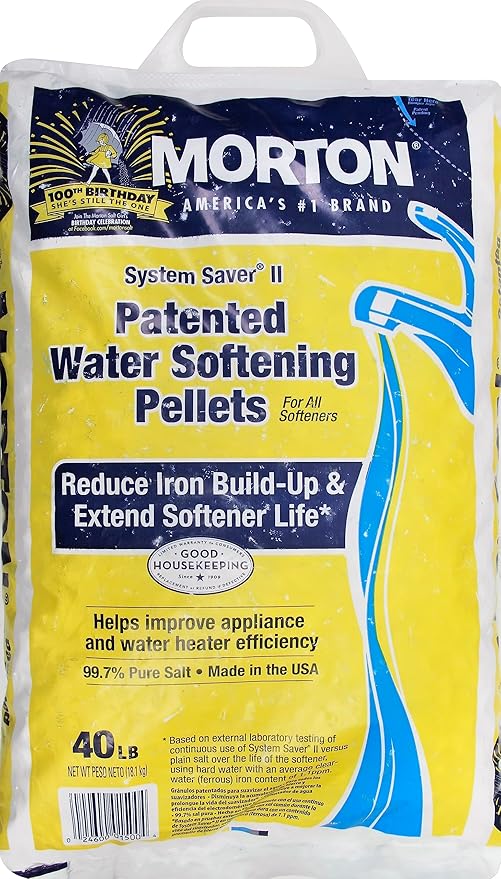
This 40-pound bag of USA-made System Saver pellets is designed to improve the taste of your water while helping extend the life of your appliances and water softener. Simple to use, just add the pellets directly to your softener's brine tank as needed.
Check On AmazonIf you click this link and buy, we earn a commission at no additional cost to you.
Final Thoughts: City Water Is Predictable, So Make One Good Decision Upfront
Standard city water at 7 to 12 GPG with a 3 to 5 person household is the easiest softening scenario there is to solve. The sizing math is simple, the water chemistry is consistent, and there is no treatment train to think about. What the whole thing hinges on is confirming the crosslink spec before buying, choosing demand-initiated regeneration, and sizing with a reasonable buffer rather than at the minimum. Those three decisions made once at purchase cover the next 15 to 20 years.
If you are above 15 GPG, the sizing adjustments and twin alternating question start to apply, and the regional hard water context matters more. If you have a straightforward city water situation and the resin spec checks out, you are in good shape. From what I have seen, the homeowners who get the most out of their city water softeners are the ones who asked one question the day they bought: what is the crosslink percentage on this resin?

This professional-grade liquid cleanser removes iron, manganese, silt, metal particles, and other contaminants that salt leaves behind in your resin bed, valve parts, and beads. Regular use helps extend appliance life, reduce maintenance calls, and maintain consistent water quality across any water softener brand. It is NSF certified to NSF/ANSI/CAN Standard 60 for drinking water additives and is made in the USA, making it safe for families and pets. Apply 4 oz before each regeneration or use with the Pro Products Easy Feeder kit for daily low-dose treatment.
Check On AmazonIf you click this link and buy, we earn a commission at no additional cost to you.
FAQs
💧 Do I need a water softener if I have city water?
It depends on your hardness level. Most US municipal water runs between 7 and 15 GPG, which is hard enough to cause scale on water heaters, appliances, and fixtures over time. If your utility’s annual water quality report shows above 7 GPG and you have visible scale buildup or soap scum, a softener is worth it. Below 7 GPG, the benefit is less clear-cut for most households.
🔬 What is crosslink percentage and why does it matter for city water?
Crosslink percentage describes how densely the polymer chains inside resin beads are bonded to each other. Standard is 8% crosslink. High-durability is 10% crosslink. For city water with chlorine, the difference is significant: 10% crosslink resists oxidative degradation far better and typically lasts 15 to 20 years instead of 7 to 10. It is the primary spec to confirm before buying any softener for municipal water.
📐 What size water softener do I need for city water?
Calculate your weekly grain requirement: number of people times 75 gallons per day times your GPG hardness times 7 days. For most 3 to 4 person households at 7 to 12 GPG city water, a 48k system is the right starting point. Size at the minimum and you have no buffer for high-use weeks. One size up typically costs $50 to $100 more and removes that problem entirely.
⏱️ Is demand-initiated regeneration worth paying more for?
Yes. A timer-based system regenerates on a fixed schedule regardless of actual water use, wasting salt when usage is low and occasionally falling short during high-use stretches. Demand-initiated regeneration tracks actual usage and only regenerates when the resin needs it. Over 10 years the salt savings alone offset any price difference at purchase.
🌊 Does city water need a pre-filter before a softener?
A sediment pre-filter is not required for most city water applications. A carbon pre-filter is not required but is a useful addition: it removes chlorine before it reaches the resin, extending resin life regardless of crosslink percentage. It becomes more important if your softener’s resin spec is unconfirmed or you suspect it is 8% crosslink rather than 10%.
🔧 How long should a water softener last on city water?
A well-built softener with 10% crosslink resin, properly sized and maintained, should last 15 to 20 years on city water. Systems with 8% crosslink resin on chlorinated municipal water commonly show resin degradation at 7 to 10 years. Control valve lifespan depends on brand: Fleck and Clack valves routinely outlast the resin they control.
🏷️ Why do box store listings not publish the resin crosslink percentage?
Box store product pages are written for general consumers and focus on features that translate to buying decisions at a glance: grain capacity, price, and brand. Crosslink percentage is a technical spec that does not appear in most consumer-facing descriptions, even though it is the most important long-term performance indicator for city water. You have to check the manufacturer’s technical spec sheet or contact their support directly to get the answer.