What Is Actually in Las Vegas Tap Water
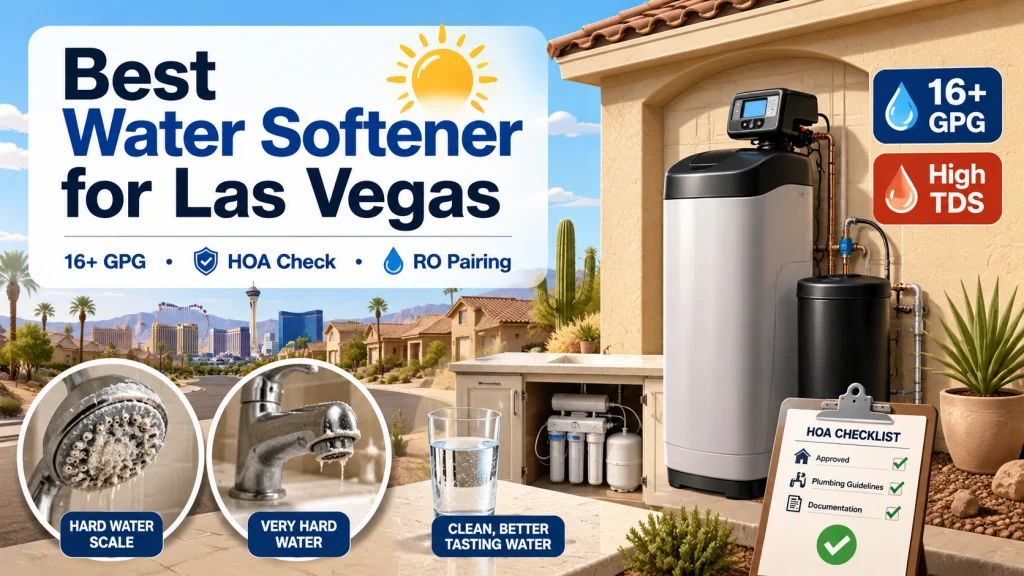
Las Vegas water originates from the Colorado River and is stored in Lake Mead before it reaches treatment and distribution. As Lake Mead levels drop, the remaining water concentrates. What you get at the tap is not just calcium and magnesium hardness in the 16+ GPG range. It carries elevated total dissolved solids running 600-800 mg/L, along with higher sodium and sulfate than you find in hard water cities drawing from different source types.
That combination matters beyond what the GPG number tells you on its own. From what I have seen, Las Vegas homes at 16-17 GPG accumulate scale on water heater elements and shower fixtures noticeably faster than homes at equivalent hardness in the Midwest, where source water TDS runs far lower. The mineral profile from a concentrated, arid-climate reservoir behaves differently on pipes and appliances than a limestone aquifer does. Las Vegas tap water is one of the more aggressive scaling sources I have encountered on city water, and most product guides do not account for that distinction.
The practical implication is simple: do not size or shop based on a guide calibrated for the 7-10 GPG national average. Las Vegas is more than double that. Applying standard recommendations here leads to a system regenerating far more often than it should, burning through salt faster than expected, and wearing out ahead of schedule.
Sizing Correctly for 16+ GPG
The sizing formula is the same regardless of city: number of people in the household multiplied by 75 gallons per day, multiplied by hardness in GPG, multiplied by 7 days. That gives your weekly grain load, which is the minimum your system needs to process between regenerations. At 16 GPG, a family of four generates roughly 33,600 grains per week. A family of five reaches 42,000.
I have run into this pattern in Henderson and the Northwest Valley more than once: a homeowner orders a 48k grain system because every buying guide they found said it covers a family of four. At 16 GPG, that system may end up regenerating closer to every 4-6 days in real use, once practical usable capacity and actual salt settings are factored in, instead of giving the comfortable weekly buffer most buyers expect. Not broken. Just undersized for local water. The frustration is predictable because the guides they trusted were not written with Las Vegas in mind.
| Household Size | Hardness (GPG) | Weekly Grain Load | Recommended Capacity |
|---|---|---|---|
| 1-2 people | 16 | ~16,800 grains | 48k minimum |
| 3 people | 16 | ~25,200 grains | 64k |
| 4 people | 16 | ~33,600 grains | 80k, or twin alternating |
| 5+ people | 16 | ~42,000 grains | Twin alternating |
| 4 people | 20 | ~42,000 grains | Twin alternating |
The twin alternating recommendation for a family of four may look like an overreach compared to what national guides say. It is not. A twin alternating system runs two resin tanks in rotation. One is always in service while the other regenerates. You never get a window of hard water passing through during a regen cycle. At 16+ GPG with a four-person household, that continuous coverage is worth having. The alternative is accepting occasional hardness breakthrough during regen, which you will notice on glass, on fixtures, and in the shower.
For a two-person household at 16 GPG, 48k provides a reasonable cycle. The weekly grain load of roughly 16,800 gives the system enough buffer to regenerate weekly rather than constantly. Still size at 48k rather than the 32k some guides suggest for a couple at lower hardness. Las Vegas does not leave much margin.
Beyond grain capacity, the specs that matter for Las Vegas city water are the same ones that matter anywhere with chlorinated municipal supply. Ten percent crosslink resin holds up to chlorine far better than eight percent. Demand-initiated regeneration fires only when the resin is depleted rather than on a fixed timer, which reduces salt waste meaningfully at high regeneration frequency. Those details, and the broader framework for evaluating any system by situation, are covered in the complete water softener guide at onlinewatersofteners.com.

Built for homes with 4 to 6 bathrooms, this whole-house system treats up to 64,000 grains of hardness by removing minerals such as calcium and magnesium. The included sediment, carbon, and zinc triple-purpose pre-filter helps reduce contaminants including chlorine, heavy metals, unpleasant tastes, odors, rust, and sediment. Its automatic digital metered control head manages backwashing and regeneration for efficient operation, while the system also helps reduce scale buildup throughout household plumbing and appliances.
Check On AmazonIf you click this link and buy, we earn a commission at no additional cost to you.
The HOA Consideration: Do This Before You Buy Anything
Many Las Vegas-area communities are HOA-governed, and some covenants restrict water softener installation, salt discharge to the municipal sewer, or both. This is not a Nevada state regulation. It is community-specific, and it varies more than most people expect from one development to the next.
Field Note: The HOA restriction question comes up more in Las Vegas than anywhere else I have worked. A lot of master-planned communities in Henderson and the Northwest Valley were built with covenants that predate current water softener technology, and the language is often vague. “No water treatment equipment” means something different than “no brine discharge.”
That distinction matters if you are evaluating potassium chloride as a regenerant, which discharges potassium rather than sodium and may be accepted in communities that restrict sodium-salt systems specifically. Read the actual document. A neighbor’s interpretation of the rules is not reliable enough to base a purchase on.
The check takes about twenty minutes. Pull your CC&Rs and search for the terms “water softener,” “brine discharge,” and “water treatment equipment.” If the language is ambiguous, send a written inquiry to your HOA management company and keep the response. You want documentation if there is ever a question later.
If your HOA does restrict sodium-based salt discharge specifically, potassium chloride regeneration is the first option to evaluate. The ion exchange mechanism is identical to sodium chloride. The system operates the same way. The main differences are cost per bag, slightly higher usage per regen cycle, and the discharge being potassium-based rather than sodium-based. For homeowners in communities with specific sodium-salt restrictions, potassium chloride systems can be a real solution that delivers actual soft water.
Salt-free TAC conditioners are the other route. At 16+ GPG, they work near the upper end of the hardness range where scale prevention is reliably effective. They do not soften water in the ion exchange sense, so your GPG reading will be unchanged after installation, and skin and hair benefits from soft water will not occur. They prevent scale on pipes and appliances, and for some Las Vegas homeowners with HOA constraints and scale prevention as the primary goal, that is a reasonable trade-off.

These 99% sodium-free pellets offer a healthier alternative to traditional salt for anyone monitoring sodium intake while still enjoying the benefits of softened water. The bag features a sturdy plastic handle for comfortable carrying and an easy-tear opening for hassle-free pouring.
Check On AmazonIf you click this link and buy, we earn a commission at no additional cost to you.
Softened Las Vegas Water and the RO Question
Ion exchange softening removes calcium and magnesium and replaces them with sodium ions. In a low-TDS water source, that sodium addition is minor relative to background dissolved solids and goes largely unnoticed. Las Vegas source water at 600-800 mg/L TDS already carries elevated sodium and sulfate before softening. After ion exchange at 16+ GPG, total dissolved solids increase further, and the result is softened water that tastes noticeably saltier than softened water from a lower-TDS city.
This is not a system malfunction. It is the chemistry of the source water. And it is why I recommend a point-of-use reverse osmosis system for drinking water in Las Vegas more consistently than I would in most other cities. Under-sink RO brings TDS at the drinking tap down to 50-100 mg/L. It removes post-softening sodium, improves taste significantly, and handles everything you drink and cook with. It does not affect how the water softener performs for laundry, the shower, or the dishwasher. It simply fixes the one place where the TDS elevation most directly affects daily experience.
The setup is compact. An under-sink RO system fits in a standard kitchen cabinet, requires no electrical connection in most configurations, and runs on water pressure alone. Filter replacement runs once or twice a year depending on the model and your usage. For a city where the source water TDS is what it is, that pairing is worth building into the budget alongside the softener.

This NSF/ANSI 58 certified reverse osmosis system reduces TDS by 93 to 98% and eliminates over 1,000 contaminants including PFAS, lead, fluoride, chlorine, and asbestos with impressive precision. A patent-pending mineral boost stage restores healthy pH and essential minerals, delivering clean water that tastes like natural spring water. The transparent first-stage filter housing lets you monitor buildup at a glance, and a patented top-mounted fastener makes countertop installation simple without reaching under the sink. Replacement filter sets are available on 6-month, 1-year, 2-year, and 3-year schedules, and the system is backed by lifetime technical support based in Atlanta, Georgia.
Check On AmazonIf you click this link and buy, we earn a commission at no additional cost to you.
How to Choose for a Las Vegas Home
The right system depends on your specific situation, not just your GPG. The hardness level, household size, HOA status, and whether taste is a priority all push toward different answers. Here is how to think through it before comparing models.
- No HOA restriction, goal is whole-house soft water: A salt-based ion exchange system is the right default. Size to the table above, prioritize 10% crosslink resin and demand-initiated regeneration, and plan for 80k or twin alternating if you have four or more people.
- HOA restricts sodium salt discharge: Potassium chloride is the direct swap. Same system hardware, same soft water result, higher salt cost. Confirm whether your covenant specifically restricts sodium discharge or all salt-based discharge before ordering.
- HOA restricts all brine discharge or budget is the main constraint: A salt-free TAC conditioner addresses scale on pipes and appliances but does not deliver soft water in the GPG sense. Understand what you are and are not getting before deciding this is the path.
- Four or more people at Las Vegas hardness: Twin alternating is the practical choice over a single large tank. Continuous soft water supply without hardness breakthrough during regen is worth the additional footprint once your grain load pushes a single tank into frequent regeneration.
- Taste is a priority: Budget for under-sink RO alongside the softener from the beginning. Plan for it rather than discovering the need after installation.
Most Las Vegas buyers fall into the first or fourth category. The HOA check is what determines whether potassium chloride or TAC becomes relevant. Do that step first and the rest of the decision tree follows logically.
Where to Install a Softener in Las Vegas Heat
Las Vegas summer days can push above 110°F, and that affects where a water softener can be placed safely. Control valves, resin, and brine tanks should not sit in direct outdoor sun at those temperatures without protection. Extended heat and direct UV exposure can degrade valve components and may affect resin performance over time, shortening the life of parts that are expensive to replace.
A garage installation is usually the safer choice for most Las Vegas homes, and it works well. Temperature in a closed garage climbs in peak summer but stays far below what direct sun on an exposed south-facing installation would reach. If the garage is unconditioned, position the system away from windows and direct sunlight where possible. That small adjustment makes a meaningful difference over years of summer heat cycles.
Outdoor installation is generally not recommended without adequate shading and a cover rated for the UV exposure and temperature range local conditions produce. If the only available space at your property is exterior, ask the installer specifically what enclosure or cover is appropriate for the control valve. That component is the most expensive part of the system to replace if it degrades early, and it is worth protecting correctly from the start.
One practical note on drain access: the brine discharge line needs to reach a floor drain, utility sink, or standpipe. In Las Vegas homes where the softener ends up near a utility closet or in the garage, confirm that a drain connection is reachable before finalizing the installation location. Running a longer drain line is workable, but planning for it before the system is delivered is easier than solving it on the day of install.
Las Vegas vs Arizona: Same River, Similar Problems
Phoenix and Las Vegas draw from the same Colorado River system. Phoenix runs 16-20 GPG, Las Vegas at 16+. The sizing requirements for equivalent household sizes are nearly identical, and the twin alternating logic for larger households applies in both cities. The main distinction is HOA density and how covenant language tends to be written. The Arizona buyer who skips the HOA check usually gets away with it. The Las Vegas buyer skipping that check takes on more risk. If you are also evaluating Arizona-specific sizing and water chemistry, the breakdown at onlinewatersofteners.com’s Arizona water softener guide covers the Phoenix and Scottsdale situation specifically.
One distinction worth noting is Lake Mead itself. As reservoir levels shift over drought cycles, Las Vegas TDS can trend upward in a way that Phoenix canal water, drawing at a different point in the Colorado system, does not mirror as directly. It is worth retesting your tap water every few years rather than assuming a single reading holds indefinitely.
What to Confirm Before Purchasing
Get a current water test from your tap. SNWA publishes an annual water quality report and 16 GPG is a common figure, but delivery lines, building age, and seasonal variation can produce readings that differ from the published average. A basic hardness test from a local water treatment dealer or a mail-in lab kit gives you an actual number to size against, not an estimate.
The five things worth confirming before anything else:
- Your confirmed hardness in GPG from an actual test, not a regional estimate from a buying guide
- Your HOA covenants, if applicable, specifically language around salt discharge and water treatment equipment installation
- Whether you have a floor drain or accessible drain line near the planned installation location (required for brine discharge on salt-based systems)
- Peak water demand in your household, meaning the number of bathrooms and appliances likely running simultaneously during high-use periods
- Whether you plan to pair with point-of-use RO for drinking water, and whether that cost is in your budget alongside the softener
None of those steps takes more than a day, and any one of them can save significant trouble after installation. The HOA check is worth doing first, before you spend time evaluating specific systems or grain capacities. If your covenants restrict salt discharge, that narrows your options before you get to sizing. Start there, then work through the rest.
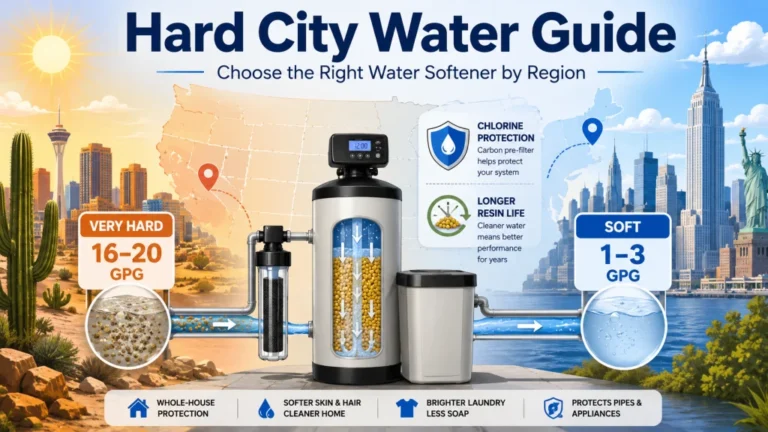
For a broader look at how hardness level, source water type, and regional factors affect which systems perform reliably in cities like Las Vegas, the guide to water softeners for hard city water covers the full range of situations and what differentiates them.

This kit lets you test drinking water, pool water, or any water source in seconds using a simple dip-and-read method with an oversized color chart ranging from red to green, covering 0 to 25 GPG and 0 to 425 PPM. All 100 strips are protected by FreshSeal technology across a ready-to-use bottle and two sealed pouches for long-term accuracy. Each purchase also funds a full year of clean water for someone in the Central African Republic.
Check On AmazonIf you click this link and buy, we earn a commission at no additional cost to you.
Final Thoughts: Las Vegas Requires More Than Standard Advice
Most of what is written about water softeners was calibrated for average conditions. Las Vegas is not an average water city. The combination of 16+ GPG, elevated TDS, many HOA-governed communities, extreme summer heat, and a water source that responds to drought conditions puts it in a category where following generic recommendations consistently falls short.
The core guidance is practical: size up from what national guides recommend, do the HOA check before ordering anything, think through your installation location before delivery day, and consider RO for the drinking tap if taste matters. When you are evaluating systems, focus on control valve quality, resin crosslink percentage, and regeneration mode. Those are the variables that determine whether a softener handles Las Vegas water reliably over years of use. The brand name on the cabinet is not.

Refined to 99.8% purity, these pellets minimize tank residue and are specifically formulated to resist clumping and salt bridges that can cause system malfunctions. By removing hard minerals like calcium and magnesium, they help extend the life of your dishwasher, washing machine, and water heater while preventing scale buildup in pipes. Compatible with all major water softening systems, the 50-pound bag features a patented dual-handle design for easier and safer lifting and pouring.
Check On AmazonIf you click this link and buy, we earn a commission at no additional cost to you.
FAQs
💧 How hard is the water in Las Vegas?
Las Vegas water typically runs 16+ GPG depending on location and time of year, placing it among the hardest municipal water sources in the US. It comes from Lake Mead via the Colorado River, and both hardness and total dissolved solids are consistently elevated compared to most cities. Check SNWA’s annual water quality report or test your tap directly for an accurate current figure.
🏠 Does my Las Vegas HOA allow a water softener?
It depends on your specific HOA covenants, not Nevada state law. Some Las Vegas communities restrict salt-based systems or brine discharge. Pull your CC&Rs and search for the terms “water softener” and “brine discharge” before purchasing. If the language is ambiguous, contact your HOA management company in writing and get a clear answer before ordering equipment.
📐 What size water softener do I need for Las Vegas?
At 16 GPG: 48k for a household of 1-2 people, 64k for three people, and 80k or twin alternating for four or more. A standard 48k system is undersized for most Las Vegas households and will regenerate far more frequently than buyers expect. Size up from whatever a general hard water guide recommends.
🤔 Why does my softened Las Vegas water taste salty?
Las Vegas source water already carries elevated TDS and sodium before softening. Ion exchange adds more sodium in exchange for calcium and magnesium, and the combined result tastes noticeably saltier than softened water from a lower-TDS city. A point-of-use reverse osmosis system under the kitchen sink removes this at the drinking tap without affecting the rest of the house.
🔄 Can I use potassium chloride in a Las Vegas water softener?
Yes, if your system supports it and your HOA language allows potassium-based discharge. Potassium chloride uses the same ion exchange mechanism as sodium chloride. It costs more per bag and requires slightly more per regen cycle, but it delivers actual soft water and can be a real option for households with sodium-specific restrictions.
🌵 Does Las Vegas water hardness change with drought?
It can. As Lake Mead levels shift during extended drought periods, both hardness and TDS can trend upward in ways that a single test reading will not capture. It is worth retesting your water every few years rather than relying on an older measurement, given how much the lake level has changed in recent years.
🌡️ Can I install a water softener outdoors in Las Vegas?
Not without proper protection. Las Vegas summer heat and UV exposure can degrade control valve components and shorten system life if the unit is installed without adequate shading and a rated cover. A garage installation is usually the safer choice for most homes. If only an exterior location is available, ask your installer what enclosure is appropriate before purchasing.