The Process Is Identical: What Changes Is the Ion
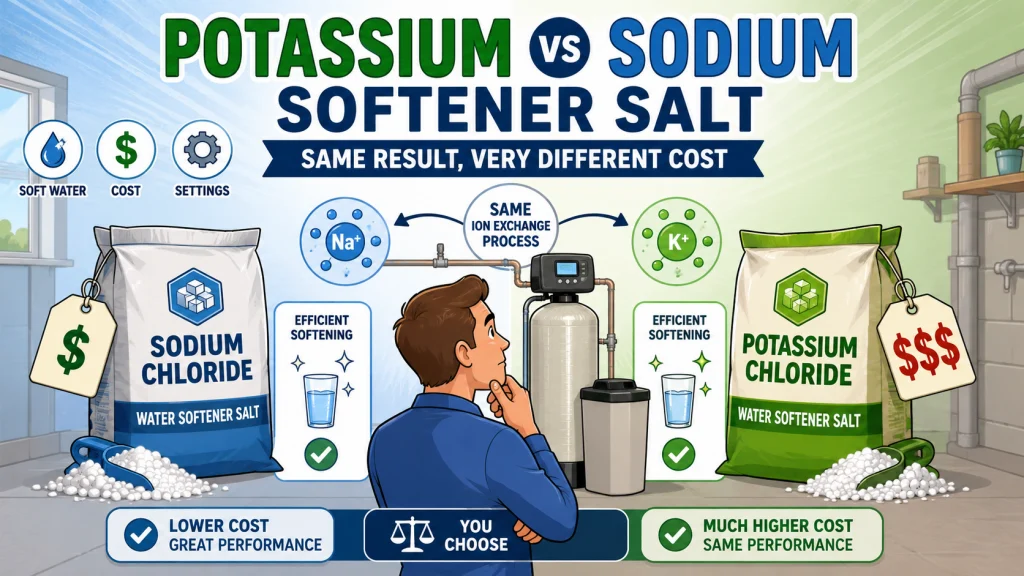
A water softener does not care whether you fill the brine tank with sodium chloride or potassium chloride. The resin beads do not care either. Both salts dissolve in the brine tank, both draw into the resin tank during regeneration, and both flush calcium and magnesium off the resin beads and down the drain. The ion exchange process is the same either way.
The difference shows up afterward. Sodium chloride leaves trace sodium in your softened water. Potassium chloride leaves trace potassium instead. For most households, neither amount is meaningful. A standard 8-ounce glass of sodium-softened water at 10 GPG contains roughly 28 milligrams of sodium, which is comparable to a single cracker. Potassium-softened water delivers a similarly small amount of potassium. Both are small compared with the sodium or potassium you typically get from food.
What is not the same is efficiency. Potassium chloride regenerates resin less effectively than sodium chloride does. You need about 25% more potassium chloride to achieve the same regeneration result. That difference matters, and I will come back to it in the cost section.
Who Actually Has a Reason to Use Potassium Chloride
I have had this conversation with enough homeowners to know that most people asking about potassium chloride fall into one of two groups: people who heard it was “healthier,” and people who were told they had to use it. The first group usually does not need it. The second group sometimes does.
The situations where potassium chloride genuinely makes sense are specific:
- Physician-ordered sodium restriction. Conditions like congestive heart failure or severe hypertension sometimes require patients to minimize sodium from every source, including water. If your doctor has explicitly told you to reduce dietary sodium at that level, potassium chloride is worth the premium. For a general low-sodium diet or mild hypertension, the trace sodium in softened water is not the problem. One important note here: if you have kidney disease, have been told to limit potassium, or take medication that affects potassium levels, ask your doctor before switching to potassium chloride. The switch adds potassium to your water rather than removing a concern.
- Irrigating directly with softened water. Sodium can build up in soil over time, making it harder for plants to take up water. If you are watering a vegetable garden or lawn directly from softened water (not the recommended setup, but it happens), potassium is a plant nutrient rather than a soil problem. This is a niche edge case, not a common one.
- Specific California water districts where sodium chloride is restricted but potassium is permitted. Some California districts regulate or prohibit sodium chloride specifically because of its impact on wastewater recycling. In those districts, potassium chloride is an option. I will explain an important nuance about this below.
What is not a good reason: general wellness preferences, vague concern about sodium, or recommendations from a water dealer who happens to also sell potassium chloride. I have seen all three used to push people toward a product that costs five to seven times as much for no practical benefit in their situation.
Field Note: One of the more common patterns I ran into was homeowners who switched to potassium chloride after a dealer told them it was “better for your health.” In nearly every case, there was no physician-level sodium concern involved. They were spending far more per month on salt and getting identical water softening results. Nobody had told them the difference was that small.

These 99% sodium-free pellets offer a healthier alternative to traditional salt for anyone monitoring sodium intake while still enjoying the benefits of softened water. The bag features a sturdy plastic handle for comfortable carrying and an easy-tear opening for hassle-free pouring.
Check On AmazonIf you click this link and buy, we earn a commission at no additional cost to you.
The Cost Math Nobody Works Out in Advance
The price difference between sodium chloride and potassium chloride is not subtle. A 40-pound bag of sodium chloride pellets runs $7 to $10 at most hardware stores and warehouse clubs. A 40-pound bag of potassium chloride runs $45 to $65 for the same size bag. That is five to seven times more per bag before you account for efficiency.
Now layer in the 25% efficiency gap. To achieve the same resin regeneration result, you need 1.25 bags of potassium chloride for every 1 bag of sodium chloride. The cost-per-unit-of-softening math gets worse the more carefully you work it out.
| Salt type | Cost per 40 lb bag | Bags needed per NaCl equivalent | Effective cost per equivalent |
|---|---|---|---|
| Sodium chloride pellets | $7 to $10 | 1.0 | $7 to $10 |
| Potassium chloride pellets | $45 to $65 | 1.25 | $56 to $81 |
For a household of four at 10 GPG using roughly one 40-pound bag of sodium chloride per month, the annual salt cost is about $84 to $120. Switching to potassium chloride, accounting for the additional quantity needed, puts that figure at $670 to $970 per year for the same household. That is a real number, not a rounding error. Over five years, the difference in salt cost alone ranges from $2,800 to $4,200 with no change in softening performance.
I am not saying potassium chloride is never worth it. The people with a genuine medical reason to avoid sodium are right to pay that difference. For everyone else, the math is hard to justify.
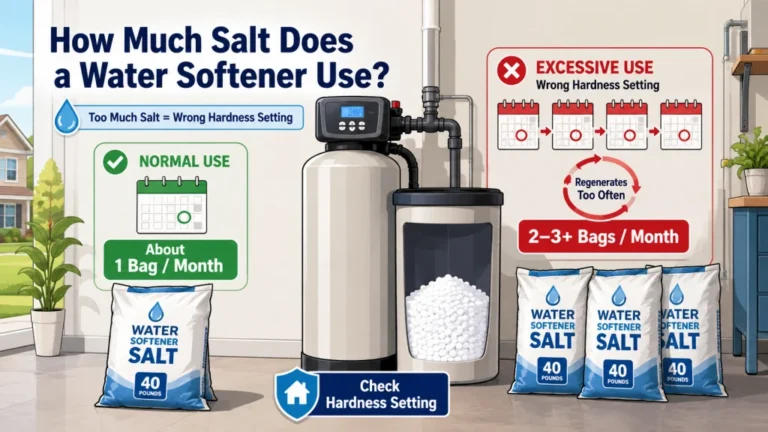
For a deeper look at what drives salt consumption and whether your system is using more than it should, the guide to how much salt a water softener actually uses covers the settings and variables that affect your monthly cost.
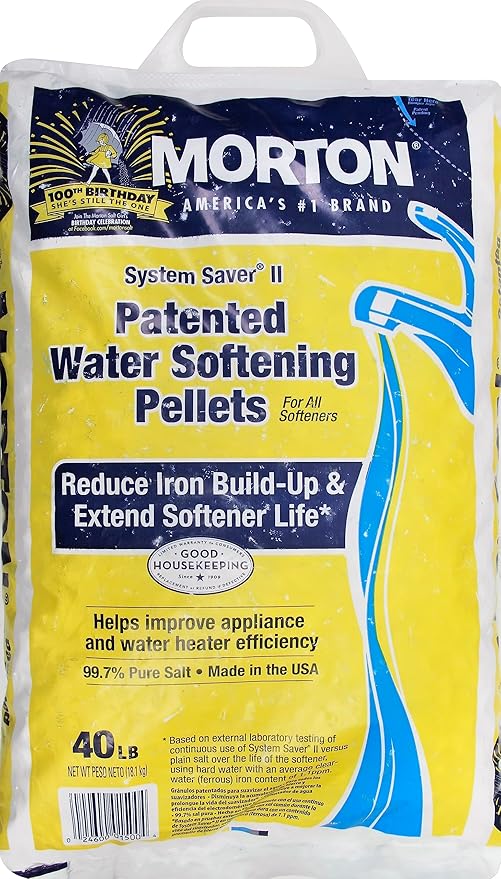
This 40-pound bag of USA-made System Saver pellets is designed to improve the taste of your water while helping extend the life of your appliances and water softener. Simple to use, just add the pellets directly to your softener's brine tank as needed.
Check On AmazonIf you click this link and buy, we earn a commission at no additional cost to you.
The California Misconception Worth Clearing Up
A lot of homeowners in California assume that switching to potassium chloride solves their regulatory problem. In some districts it does. In others, it does not, and that distinction is important to get right before you make any purchasing decision.
California’s salt-based softener restrictions are not uniformly about sodium. Many communities regulate brine discharge broadly, meaning chloride in general, not just sodium chloride. The Dixon Ordinance, the Discovery Bay Ordinance, and several other local rules cover both sodium and potassium-based systems discharging brine to the sewer. In those districts, switching from sodium pellets to potassium pellets in the same self-regenerating softener does not bring you into compliance. You are still discharging concentrated chloride brine during regeneration, just with potassium as the cation instead of sodium.
The districts where potassium chloride is specifically permitted as a compliant alternative to sodium chloride are fewer than most vendor articles suggest. If you are in California and trying to navigate local restrictions, check your specific water district’s ordinance language directly. The question to ask is whether the restriction covers chloride discharge generally or sodium chloride specifically. A general chloride restriction means potassium chloride does not solve the problem.
Note: California does not have a statewide ban on salt-based water softeners. Restrictions are local, based on individual water district rules. Dozens of communities have enacted them, and the list has grown over time. If you are in a hard water area of California, check with your local water district before assuming either salt type is permitted.
Adjusting Your Softener Settings When Switching to Potassium Chloride
If you are switching to potassium chloride, the control head setting for water hardness needs to be adjusted upward to compensate for the reduced regeneration efficiency. The standard guidance, confirmed in multiple manufacturer manuals, is to increase your hardness setting by 25% over your actual measured GPG.
The math is straightforward. If your water tests at 20 GPG, set the hardness to 25 GPG when running potassium chloride. This tells the control head to regenerate as if your water were harder than it is, which compensates for the lower regeneration capacity per unit of salt. Running potassium chloride at a sodium-calibrated hardness setting means your resin will not regenerate fully, and you will see soft water capacity drop off before the next scheduled cycle.
One thing I see people miss when they make this switch: the softener will appear to use more salt bags because the bags are physically heavier per unit of capacity and the system is calling for more product per regeneration. That is expected. If you are tracking salt consumption and see it increase after switching to potassium chloride, the system is working correctly, not malfunctioning.

This kit includes 150 dip-and-read test strips for quickly measuring water hardness across virtually any source, including home faucets, well water, softeners, dishwashers, showers, and aquariums. Results are instant and easy to read against a color chart, making it simple to verify whether your water softener, reverse osmosis, or water conditioning system is performing as expected. A bonus eBook is included to help you record, track, and interpret your results over time.
Check On AmazonIf you click this link and buy, we earn a commission at no additional cost to you.
Final Thoughts: A Simple Decision for Most People
For the majority of households, the answer is sodium chloride pellets. The softening result is identical, the efficiency is better, and the cost difference over several years is substantial. I have never met a homeowner whose water felt softer after switching to potassium chloride.
The cases where potassium chloride makes sense are real but narrow. A physician-ordered sodium restriction, a specific California district where sodium chloride is prohibited but potassium chloride is permitted, or direct irrigation with softened water are the legitimate use cases. General wellness concerns, water dealer recommendations without a specific medical or regulatory basis, and the assumption that potassium is naturally “better” do not hold up against the cost math.
Key point: Before buying potassium chloride, check these four things: your doctor has specifically said sodium in softened water is a concern for you; your local water district permits potassium chloride as a compliant option; your softener manual allows switching salt types; and you have not been told to limit potassium intake.
If you are working through the broader picture of what goes into running a salt-based system well, including salt type selection, salt consumption, and the maintenance that keeps a softener running for 15 to 20 years, the practical guide to water softener installation and maintenance covers that full scope in one place.

Refined to 99.8% purity, these pellets minimize tank residue and are specifically formulated to resist clumping and salt bridges that can cause system malfunctions. By removing hard minerals like calcium and magnesium, they help extend the life of your dishwasher, washing machine, and water heater while preventing scale buildup in pipes. Compatible with all major water softening systems, the 50-pound bag features a patented dual-handle design for easier and safer lifting and pouring.
Check On AmazonIf you click this link and buy, we earn a commission at no additional cost to you.
FAQs
🧂 Is potassium chloride better than sodium chloride for water softeners?
Not for most homes. Both salts produce identical softening results. Potassium chloride adds potassium ions to the water instead of sodium ions, which matters only if you have a physician-ordered sodium restriction or a local regulation requiring it. For general use, sodium chloride is more efficient and significantly cheaper.
💰 Why is potassium chloride so much more expensive?
Potassium chloride is more costly to extract and process than sodium chloride, and demand is lower, so production scale is smaller. At retail, a 40-pound bag of potassium chloride typically runs $45 to $65 compared to $7 to $10 for sodium chloride pellets of the same size.
⚙️ Do I need to adjust my softener settings when using potassium chloride?
Yes. Set your hardness level about 25% higher than your actual measured GPG to compensate for potassium chloride’s lower regeneration efficiency. If your water tests at 20 GPG, program the control head for 25 GPG. Running it at the standard sodium-calibrated setting will result in incomplete regeneration.
🌿 Does potassium chloride solve California water softener restrictions?
Sometimes, but not always. Some California districts restrict sodium chloride specifically and allow potassium chloride. Others regulate all brine-discharging softeners, which includes potassium-based systems. Check your specific water district’s ordinance language before assuming potassium chloride is compliant in your area.
🩺 Should I use potassium chloride if I am on a low-sodium diet?
For most low-sodium diets, the trace sodium in softened water is not a meaningful contributor. An 8-ounce glass of sodium-softened water at 10 GPG contains roughly 28 milligrams of sodium. If your doctor has prescribed a strict sodium restriction due to a cardiac or kidney condition, ask specifically whether water sodium is a concern. General dietary sodium reduction rarely requires potassium chloride in the softener. Also ask whether added potassium is safe for you, especially if you have kidney disease, have been told to limit potassium, or take medication that affects potassium levels.
🔄 Can I switch back and forth between sodium and potassium chloride?
Yes, most softeners handle both without issue. When switching from potassium back to sodium chloride, lower your hardness setting back to your actual measured GPG. Check your owner’s manual to confirm your specific model supports both, as a small number of older units specify one type only.