The Gap Between Dealer Quotes and What Installation Actually Costs
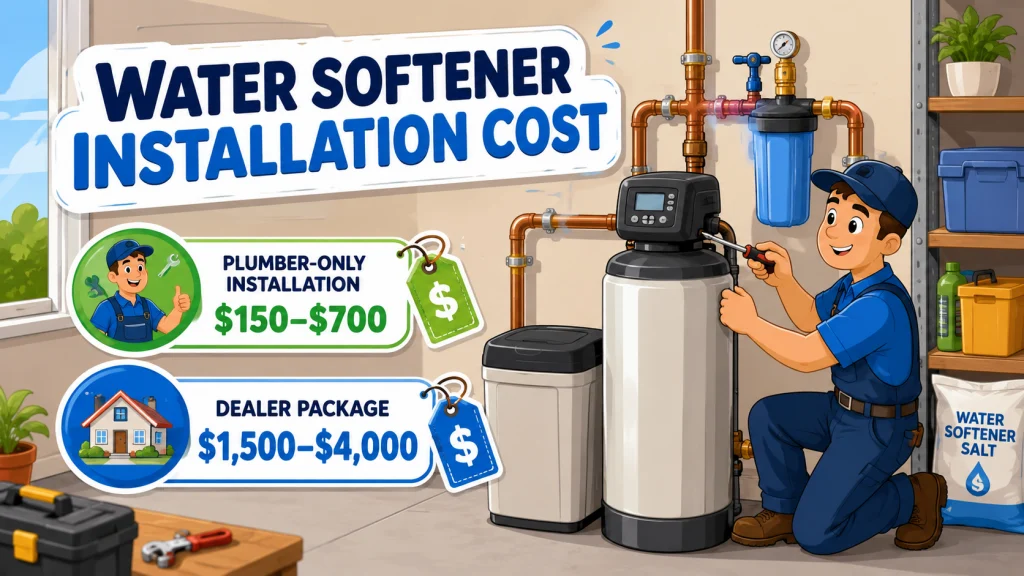
The first number most homeowners see for water softener installation comes from a dealer. That number is usually $1,500 to $4,000, sometimes more, and it almost always bundles equipment and labor into a single line so you cannot see what you are paying for each. That bundling is not accidental. When you can see the pieces separately, the math gets uncomfortable fast.
Here is what the same installation looks like when you separate the costs: equipment purchased direct or at a box store runs $300 to $1,500 depending on capacity. A plumber hired for labor only charges $150 to $700 depending on your market and plumbing complexity. Most straightforward installations land well under $1,000 total. The several-hundred-dollar gap between that and a dealer quote does not go toward better hardware. It goes toward margin, overhead, and in many cases a salt delivery contract built into the package whether you want one or not.
I have watched this play out enough times that it stopped surprising me. A homeowner gets a $2,800 quote from a dealer, buys comparable equipment for $650 at a home improvement store, pays a plumber $350 to connect it, and calls me six months later to say the water is soft and the system works exactly as expected. Nothing exotic happened. They just separated the two parts of the transaction that dealers prefer to sell together.
Equipment Cost: Direct Purchase vs Dealer-Supplied
Water softener equipment pricing varies mainly by grain capacity, which determines how much hardness the system removes between regeneration cycles. For most households with moderate to hard water, systems in the 32,000 to 48,000 grain range cover the need. At that capacity range, direct-to-consumer pricing from online retailers or box stores typically runs $300 to $800. Larger systems or units with added filtration capability push toward $1,000 to $1,500.
Dealer-supplied equipment at the same grain capacity often runs $2,000 to $4,000. The component that does most of the work, the control valve, is a part used broadly across the water treatment industry. The same valve model shows up in budget units and premium dealer installs alike. What changes with dealer pricing is the branding, the service contract, and the margin. I am not saying dealer-installed systems perform badly. I am saying the price premium is not driven by what is inside the tank.
Field Note: One situation I heard directly from a homeowner: a dealer quoted $2,600 to replace an aging softener. He bought a unit at a home improvement store for under $700, paid a plumber $300 to swap it in, and had $50 left over for Sharkbite fittings and Teflon tape. The replacement used the same control valve manufacturer as the dealer’s recommended brand. That was two years before I heard the story. Zero problems reported.
The practical move is to price comparable grain capacity from at least one direct or box store channel before you take any dealer quote at face value. The hardware is more commodity than dealer presentations tend to suggest.

IAPMO certified to NSF/ANSI Standard 44, this system is sized for homes with up to 5 people and 4 bathrooms, using ion exchange to deliver soft, scale-free water from every tap with city or well water compatibility. The user-friendly LCD allows metered operation that uses up to 50% less salt and 28% less water compared to standard time-based softeners, helping lower long-term costs on appliances, soap, and cleaning products. The bundle includes a recommended pre-filter and installation kit, and is backed by a 5 to 10-year limited warranty with dedicated customer support.
Check On AmazonIf you click this link and buy, we earn a commission at no additional cost to you.
Plumber Labor Cost: What the Pipe Work Runs
Hiring a licensed plumber to install equipment you have already purchased typically costs $150 to $700. That range reflects regional labor rates, how accessible your main water line is, and whether your installation point has a floor drain, utility sink, or standpipe close enough to connect the drain hose without extra work. Most installations in accessible locations with a nearby drain come in under $400.
Complexity adds cost. If there is no existing softener loop, the plumber spends more time figuring out where to cut in and making the connections work. If the nearest drain requires running an extension, that is additional labor. If your municipality requires a permit, factor in time for inspection and the permit fee. None of these are surprises if you ask about them upfront before getting a labor quote.
The table below shows typical labor cost ranges by scenario. These are plumber-only estimates, assuming you supply the equipment.
| Installation Scenario | Estimated Labor Cost |
|---|---|
| Straightforward swap, existing softener location | $150 to $300 |
| New installation, good access, drain nearby | $250 to $500 |
| New installation, limited access or drain extension needed | $400 to $700 |
| Softener loop addition (if not present) | Add $200 to $800 |
| Permit (where required by municipality) | Add $50 to $150 |
If you want to understand the full scope of what the pipe work actually involves before you talk to a plumber, the overview of water softener installation walks through what the job covers from start to finish. Knowing what to expect going into the conversation keeps it more productive than asking for a quote with no frame of reference.
DIY Installation Cost: What You Actually Spend
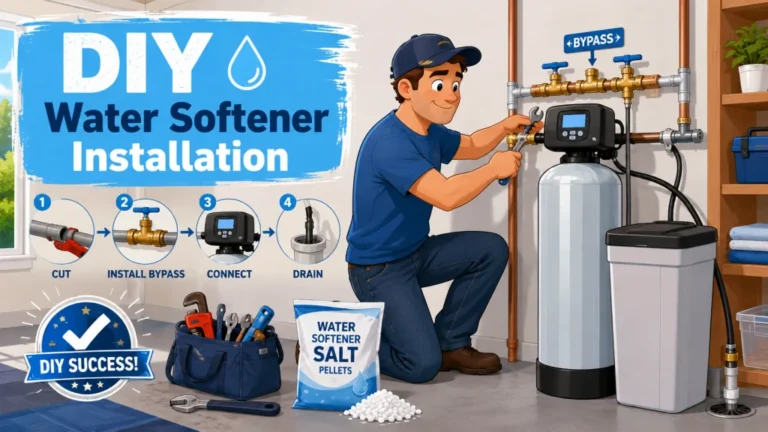
DIY labor costs nothing. What you spend is materials, and for most installations that is $30 to $80. The list is short: a pair of Sharkbite push-fit supply lines in 3/4 inch to 1 inch FIP sizing, Teflon tape, and a drain hose if one is not included with the softener. Most units include both a bypass valve and a drain hose. The only time materials run toward the higher end is when you need a longer drain hose extension or do not own a pipe cutter.
Sharkbite fittings are worth explaining because they change the DIY picture significantly. Push-fit connections work on copper, PEX, and CPVC pipe with no soldering. They are also reversible, which means if you get the connection wrong you pull it off and try again without cutting a new section of pipe. The soldering barrier that used to make softener installation a plumber-only job is effectively gone for anyone with standard plumbing. I have watched homeowners with no plumbing background complete a clean installation in under three hours using push-fit fittings throughout.
- Sharkbite push-fit supply lines (3/4″ to 1″ FIP, pair): $25 to $45 depending on length and retailer
- Bypass valve (if not included with the softener): $15 to $30
- Drain hose extension (if needed beyond what is included): $5 to $15
- Teflon tape: under $5
- Pipe cutter (if you do not already own one): $15 to $30
One thing that catches first-time DIY installers off guard is the electrical requirement. The control head needs a standard 120V outlet within reach of the power cord. If there is no outlet at your planned installation location, adding one is a separate cost and typically requires an electrician. Check for an outlet before you choose the location, not after the unit is on the floor.

This flexible braided stainless steel connector is compatible with PEX, PE-RT, CPVC, SDR-9 HDPE, and copper pipes, making it a versatile fit for nearly any plumbing setup. Both ends make tight turns without kinking, and installation requires no tools, crimping, glue, or soldering, which is ideal for tight spaces or misaligned pipes. Rated for up to 200 PSI and 200 degrees F, this lead-free connector meets commercial and residential plumbing standards for a clean, reliable, leak-free connection.
Check On AmazonIf you click this link and buy, we earn a commission at no additional cost to you.

This 50-micron flushable and reusable filter serves as an ideal first stage in any whole house filtration system, capturing sediment, rust, dirt, and sand before water reaches finer filters downstream. A built-in Siliphos additive helps soften water, prevent scale buildup, and reduce pipe corrosion, with filter replacement recommended every 3 to 6 months for best results. The see-through housing allows easy visual monitoring, and dual threads with 1-inch MNPT and 3 to 4-inch FNPT connections make installation straightforward for indoor use within a pressure range of 20 to 100 PSI.
Check On AmazonIf you click this link and buy, we earn a commission at no additional cost to you.
What the Dealer Markup Actually Reflects
Dealer installation pricing bundles equipment, labor, and service into a single number. That structure is difficult to compare against the open market by design, because the pieces are not broken out. What I have seen across a lot of installs is that the control valves inside dealer-branded systems are often industry-standard components, the same type used broadly across direct-to-consumer units at a fraction of the bundled price. The premium reflects the service relationship, the ongoing salt delivery in many arrangements, and the margin built into every part of the transaction.
That service relationship has genuine value for some homeowners. If you want to write a check and never think about your water again, a dealer arrangement accomplishes that. The problem is when homeowners do not know the alternative exists. Most dealer sales presentations skip the plumber-only option entirely, and most people do not think to ask. Getting a complete picture of your options for water softener installation and maintenance before you sit across from a dealer puts you in a position to evaluate whether the bundled price reflects fair value for what you actually want, rather than accepting it because you had no comparison.
The core function is the same. The water result is the same. What you are choosing is how much ongoing service involvement you want and whether that is worth the cost difference to you specifically. That is a legitimate question with different answers depending on the homeowner. It should be your answer, made with full information.
When the Plumber-Only Route Makes the Most Sense
The plumber-only approach means you source the equipment yourself, online, at a box store, or through a direct water treatment retailer, and hire a local licensed plumber for the pipe connections only. For homeowners who want professional installation without the dealer markup, this is typically the best combination of cost, quality, and accountability available.
It works best when you have already figured out what grain capacity your household needs, your installation location is accessible, and you are comfortable doing a small amount of research upfront to source the right unit. The plumber handles the cutting, the bypass valve, the supply connections, and the drain line. Programming the control head after they leave takes 10 to 15 minutes following the manual. It is not a complicated step.
The plumber-only route is a less natural fit when your plumbing is genuinely complex, when you have a well water system with multiple treatment stages that benefit from a professional assessing the full sequence, or when your municipality’s permitting process runs more smoothly through a dealer with established local relationships. Those situations are real, and they are also the minority. For the average home on municipal water with standard accessible plumbing, sourcing your own equipment and paying a plumber for labor comes out $500 to $1,500 below the typical dealer-bundled quote with no difference in how the water comes out of the tap.
When comparing quotes from any source, match on the same basics: grain capacity, whether a bypass valve is included, drain line connection, warranty length, and whether ongoing service is part of the deal. A $3,000 dealer quote and a $900 equipment-plus-plumber setup are only a fair comparison when the capacity and installation scope are the same. Comparing a 48,000-grain unit with a five-year service contract to a 32,000-grain unit with no service is not a cost comparison, it is a different purchase entirely.
Pro Tips: Get at least two plumber quotes for labor only and tell each one the equipment is already selected and on site. Some plumbers charge differently when they are not sourcing materials. Ask explicitly whether the estimate includes drain line connection and bypass valve installation, since those are sometimes quoted as add-ons rather than part of the base labor.

This kit lets you test drinking water, pool water, or any water source in seconds using a simple dip-and-read method with an oversized color chart ranging from red to green, covering 0 to 25 GPG and 0 to 425 PPM. All 100 strips are protected by FreshSeal technology across a ready-to-use bottle and two sealed pouches for long-term accuracy. Each purchase also funds a full year of clean water for someone in the Central African Republic.
Check On AmazonIf you click this link and buy, we earn a commission at no additional cost to you.
Final Thoughts: Run the Numbers Before You Take the Call
The homeowners who get the worst deals on water softener installation are usually the ones who hear a single dealer quote with no context, no comparison point, and a salesperson sitting in the living room. That is the arrangement most dealer sales processes are designed to produce. Walking in with a rough budget built from the pieces changes the dynamic entirely.
Price the equipment you need from a direct channel. Get a labor estimate from a local plumber for connection only. Add the hidden cost items that apply to your home. Then compare that number to whatever bundled quotes you receive. The gap is usually obvious, and what you decide to do with that information is entirely up to you. But you should be making the decision, not having it made for you by a quote structure that keeps the pieces invisible.
FAQs
💰 How much does water softener installation cost on average?
Plumber-only installation runs $150 to $700 in most markets, with equipment purchased separately for $300 to $1,500. Dealer-bundled installation including equipment typically runs $1,500 to $4,000. In many straightforward installs, the cost difference reflects the bundled service structure more than a major difference in the core equipment or pipe work.
🔧 Can I install a water softener myself to save money?
Yes, for most homeowners with standard plumbing. Sharkbite push-fit fittings eliminated the soldering requirement that used to make this difficult. A straightforward installation in an accessible location with a nearby drain typically takes 2 to 4 hours with basic tools.
🏠 Does water softener installation require a permit?
It depends on your municipality. Some require permits for work that involves the main supply line. Call your local building department before scheduling. Where permits apply, costs generally run $50 to $150.
⚙️ What is a softener loop and why does it affect cost?
A softener loop is a section of pipe pre-plumbed specifically to accept a water softener, often found in the garage or utility room of newer homes. If your home has one, installation is simpler and faster. If it does not, adding one typically costs $200 to $800 in additional plumber labor.
📋 How much does a plumber charge to install a softener I already bought?
Most plumbers charge $150 to $500 for a straightforward installation where the equipment is already on site. Complex situations with drain extensions, loop additions, or permit requirements push higher. Get two quotes and ask each one to confirm the estimate includes bypass valve installation and drain line connection.
🛒 Is buying a water softener at a box store and hiring your own plumber actually cheaper?
In most cases, yes, by $500 to $1,500 compared to a dealer-bundled quote for equivalent equipment. The trade-off is that you are responsible for sourcing the right unit for your water conditions and household size. The installation result is the same.