What the Iron Number on the Box Actually Covers
Pick up any water softener at a box store and you will find a line somewhere on the packaging that says something like “handles up to 6 PPM iron” or “iron-resistant resin.” That number refers, without exception, to ferrous iron: the clear-water form that stays dissolved and invisible at the tap. Run water with ferrous iron through a fine mesh ion exchange resin and it softens alongside the calcium and magnesium. The rating is technically accurate. The problem is that it describes only one of two forms of iron you might actually have in a well.
The label says nothing about ferric iron, which has already oxidized into suspended particles before it ever reaches your equipment. If your water runs orange or leaves rust-colored staining around fixtures, that is ferric iron. Ion exchange resin has no mechanism for filtering particles. It is designed to pull dissolved ions out of solution. Ferric iron bypasses that process entirely and collects in the resin bed, coating the beads, reducing capacity, and shortening the life of any softener it passes through. The iron rating on the box is simply not describing this scenario, and no manufacturer will tell you that on the front of the package.
Field Note: One of the patterns I see repeat most often with well water installs is a homeowner who bought a softener rated for 6 or 8 PPM iron, installed it on a well with orange staining, and called back two years later wondering why the system had stopped performing. The resin bed was fouled with oxidized iron. The product rating was not dishonest. It just described a different problem than the one the house actually had.
Before you buy any softener for a well with iron, you need to know which type you are dealing with. A water test that reports iron in PPM does not automatically split ferrous from ferric. If your water runs any shade of orange or stains fixtures, assume ferric is present until a test confirms otherwise. Clear water from the tap, even with a confirmed iron reading, points toward ferrous iron, and a fine mesh resin softener can handle it within the conditions laid out below.
Ferrous vs. Ferric Iron: Why This Distinction Changes Your Equipment List
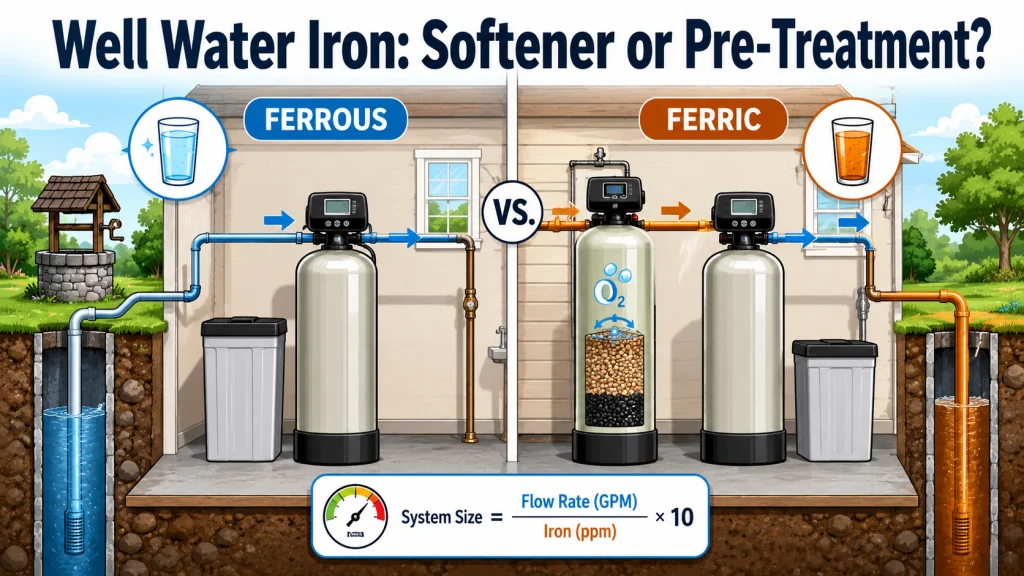
Ferrous iron, sometimes called clear-water iron, is fully dissolved in water. It has not yet reacted with oxygen, so it moves through your plumbing invisibly and shows up on a water test as a concentration in PPM. Because it exists as dissolved ions, ion exchange resin captures it through the same mechanism it uses for calcium and magnesium. Fine mesh resin is wound tighter than standard resin specifically to trap dissolved iron ions more effectively during the exchange cycle. Within its concentration limits, this works reliably.
Ferric iron, sometimes called red-water iron, has already oxidized into suspended rust particles. By the time it reaches your softener, it is no longer dissolved. It is physical matter suspended in the water column. Ion exchange does nothing with physical particles. What happens when ferric iron enters a resin bed is predictable: particles accumulate, restrict flow, coat the resin beads, and progressively block the ion exchange process. Normal regeneration cycles do not clean it out. The bed degrades faster than the manufacturer’s expected service life, and softening capacity drops well below the rated grain number.
There is also bacterial iron, which produces a reddish-brown slime visible in toilet tanks and around fixtures, and manganese, which causes black or dark brown staining with a metallic taste. Manganese above 0.05 PPM should be treated the same as ferric iron for equipment planning: a softener alone will not address it.
| Iron Type | What It Looks Like | Softener Alone? | What Actually Treats It |
|---|---|---|---|
| Ferrous (clear-water iron) | Clear at tap, staining develops after water sits or contacts air | Yes, if under 3 PPM and pH 7.0-7.5, no sulfur | Fine mesh resin softener |
| Ferric (red-water iron) | Orange or rusty color at the tap, visible discoloration | No | Oxidizing pre-filter upstream, then softener |
| Bacterial iron | Reddish-brown slime in toilet tank, around fixtures | No | Shock chlorination, oxidizing filter, then softener |
| Manganese | Black or dark brown staining, metallic taste | No, at levels above 0.05 PPM | Oxidizing filter, then softener |
The practical starting point is simpler than the table makes it look: any color or staining means assume pre-treatment is required and confirm with a full water test before buying anything. Clear water with a confirmed dissolved iron reading under 3 PPM is where a softener-only approach becomes a legitimate option. That split determines everything that follows.
When a Softener Can Handle Iron Without Pre-Treatment
A softener with fine mesh resin can handle iron on its own under a specific set of conditions. The iron needs to be entirely ferrous and fully dissolved. The concentration needs to be under 3 PPM. The water’s pH needs to sit in the 7.0 to 7.5 range. And sulfur should not be present, because hydrogen sulfide accelerates resin degradation independently and requires its own treatment approach. When all four conditions hold, fine mesh resin handles both the hardness and the iron in a single regeneration cycle without anything upstream. This is a real scenario and worth knowing, because some buyers with modest ferrous iron readings get pushed toward full treatment trains they genuinely do not need.
A concrete example: a household testing at 1.8 PPM dissolved ferrous iron, 12 GPG hardness, pH of 7.3, and no sulfur smell is a legitimate single-unit candidate. Understanding what makes well water softener selection different from city water decisions starts with knowing that clear water with low ferrous iron is actually one of the more manageable scenarios, not necessarily a reason to overbuild the treatment train.
- Ferrous iron only, water runs completely clear at the tap
- Iron reading confirmed under 3 PPM on a full water test
- pH between 7.0 and 7.5
- No hydrogen sulfide odor (rotten egg smell)
- No manganese above 0.05 PPM
Miss any one of those and pre-treatment moves from optional to necessary. The limits are real. I have seen what happens to fine mesh resin beds when iron runs above 3 PPM consistently, even without ferric iron present. The resin takes on orange discoloration, regeneration efficiency drops, and system capacity falls below the rated grain level well ahead of schedule.
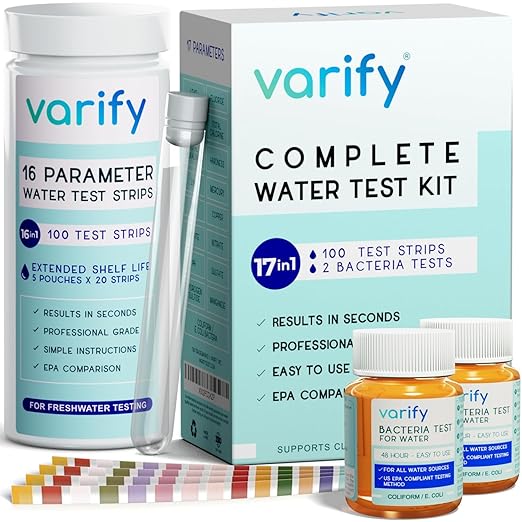
This comprehensive kit tests for 17 parameters including chlorine, fluoride, lead, iron, and bacteria, giving you a full picture of your water's safety in minutes. The 100 color-coded test strips come in 5 individually sealed pouches of 20 for extended freshness, while 2 included bacteria tests deliver results within 48 hours. Every purchase contributes a portion of proceeds to Water For Good, supporting clean water access in Central Africa.
Check On AmazonIf you click this link and buy, we earn a commission at no additional cost to you.
When Pre-Treatment Comes First
Any confirmed ferric iron, ferrous iron above 3 PPM, pH below 6.8, or hydrogen sulfide present means a softener alone is the wrong starting point. The correct sequence is oxidizing filter first, sediment pre-filter second, softener third. Each stage has to complete its job before the next one processes the water. Running that sequence out of order or skipping stages produces predictable failures at whichever stage takes on work it was not built for.
Air Injection Oxidation (AIO) systems are the most common upstream treatment for well water with iron above the softener-only threshold. They inject air into the water stream to oxidize dissolved ferrous iron into ferric particles, then capture those particles in a media bed during a backwash cycle. For a well with ferric iron already present, the AIO removes it and handles the dissolved iron before it can oxidize further inside the softener. The softener downstream sees clean water and performs as designed.
pH below 6.8 adds another complication. Acidic water accelerates resin degradation regardless of iron levels, and it reduces the efficiency of the oxidation process in an AIO system. When pH comes back low on a well water test, an acid neutralizer or calcite filter often needs to sit upstream of everything else. This can feel like an escalating equipment list, but from what I have seen across well water installs, the homeowners who tried to shortcut the treatment train consistently spent more over five years than the ones who built the right system once. For anyone with iron above 5 PPM, ferric iron confirmed, or pH below 6.8, it is also worth stepping back and looking at what a complete whole-house water treatment approach looks like before committing to individual components.
Key point: The correct treatment train for well water with iron above softener-only limits is: oxidizing filter (AIO or greensand), then sediment pre-filter, then softener. Adding pre-treatment after a softener has already been fouled does not undo the resin damage. The order matters and it matters before purchase.
How Iron Changes the Sizing Calculation
Standard water softener sizing starts with your hardness reading in grains per gallon, multiplied by daily household water use, to arrive at a weekly grain removal requirement. Iron is not in that formula by default, and ignoring it is one of the most common and most expensive mistakes I see well water buyers make. The reason iron belongs in the calculation is that the resin treats dissolved ferrous iron through the same ion exchange mechanism it uses for calcium and magnesium. It consumes softening capacity the same way hardness minerals do.
The adjustment is straightforward: add 4 to 5 GPG to your hardness number for every 1 PPM of ferrous iron. A well testing at 10 GPG hardness and 2 PPM ferrous iron should be sized as though it has 18 to 20 GPG hardness. For a family of four, that shift moves the required grain capacity from roughly a 32,000 grain system to a 48,000 grain system. Buying the smaller unit means regenerating more frequently than expected, consuming more salt per month than the manufacturer estimated, and stressing the resin harder than it was rated for.
The full sizing sequence for well water with iron:
- Start with confirmed hardness in GPG from a water test
- Add 4 to 5 GPG for each 1 PPM of ferrous iron, rounding up
- Multiply adjusted hardness by average daily gallons used (number of people times 75 gallons is a standard household estimate)
- Multiply by 7 to get the weekly grain removal requirement
- Add a 20 to 25 percent buffer and match to the next available system capacity above that number
For the family of four example: 20 GPG adjusted times 300 gallons daily times 7 days equals 42,000 grains per week. With a 25 percent buffer, that points to a 48,000 grain system as the practical minimum, not the 32,000 grain unit that hardness alone would suggest. The difference in system price is modest. The difference in long-term performance is not.
This chemical-free whole house system uses air injection and oxidation to remove iron, sulfur, and manganese from your water without the need for added chemicals or separate chemical tanks. A patented piston keeps the entire oxidation process contained within one tank, creating a pressurized air bubble during backwash to trap impurities and minimize maintenance costs and downtime. The system arrives fully equipped with a tank riser tube, deflector, control head, media, and stainless steel bypass valve for straightforward installation in an average-sized home.
Check On AmazonIf you click this link and buy, we earn a commission at no additional cost to you.
Which System Fits Your Iron Test Result
At this point the buying decision splits into two paths based on what your water test actually shows. The educational part is done. Here is how I would narrow the equipment list before looking at any specific unit.
Ferrous Iron Under 3 PPM, Clear Water, No Sulfur
This is the case where a fine mesh resin softener alone is the appropriate tool. The system does not need an upstream oxidizing filter. What matters here is the resin specification: standard softener resin will foul faster under iron than fine mesh resin, so the mesh type is a non-negotiable spec to confirm before ordering. For value buyers who want a proven control valve and a field-serviceable design, the AFWFilters Iron Pro 2 with a Fleck 5600SXT valve fits this scenario well. The Fleck 5600SXT is the most widely serviced control valve in residential water treatment, parts are available everywhere, and the Iron Pro 2 ships with fine mesh resin pre-installed. It is a known quantity for dissolved ferrous iron within the softener-only range described above. For a more accessible entry point with fine mesh resin and enough grain capacity for most mid-sized households, the Aquasure Harmony 48k Fine Mesh is a reasonable option, with the clear caveat that it is appropriate only for ferrous iron under 3 PPM with no ferric iron present.
Ferric Iron Present, or Ferrous Above 3 PPM
This is where a softener-only approach fails regardless of fine mesh resin. What you need is a system with an integrated oxidizing stage upstream of the softener. The SpringWell WSSS is the most common recommendation in this scenario because it combines an air injection oxidation filter and a salt-based softener in a staged system designed to work together. The AIO stage handles the ferric iron and elevated ferrous iron before the water reaches the softener resin. This is the only approach that protects the resin long-term when ferric iron or elevated dissolved iron is confirmed.
Buying a fine mesh softener with a high iron PPM rating and installing it directly on well water with orange staining or ferrous iron above 3 PPM. The rating applies to dissolved iron only. Ferric iron fouls the resin regardless of the number on the box.
Confirming iron type and concentration first, then choosing a softener-only setup for clear-water ferrous iron under 3 PPM or an AIO combo system for ferric iron or elevated ferrous levels. The water test result determines the equipment list, not the other way around.
For the majority of well water scenarios with confirmed iron, the decision comes down to two questions: is the iron dissolved or already oxidized, and is the concentration within the softener-only range. Everything else, including which specific unit fits the budget, follows from those two answers.

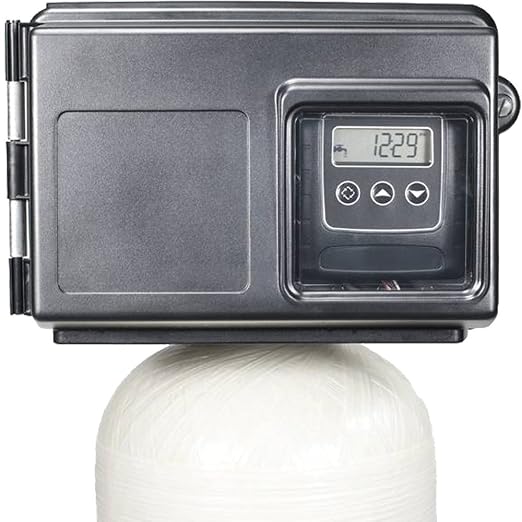
This USA-made Pentair polyglass tank combines a water softener and iron filter in one high-flow system, using fine mesh resin engineered for superior iron removal and long service life. It removes hardness up to 70 GPG, iron up to 4 to 7 ppm, manganese up to 6 ppm, and also tackles sediment, sand, and rust throughout your entire home. The Fleck 5600SXT digital metered valve delivers efficient, easy-to-use operation and is backed by a 5-year warranty, with a bonus installation kit included.
Check On AmazonIf you click this link and buy, we earn a commission at no additional cost to you.
Signs Your Iron Setup Is Failing After Installation
Even a correctly specified system can run into trouble if water conditions shift or if the pre-treatment stage is not maintaining itself properly. The signs of iron-related failure in a softener are usually gradual enough that homeowners miss them for months before calling anyone. Knowing what to look for early makes the difference between a simple service call and a full resin replacement.
Watch for these patterns after installation:
- Orange or rust-colored staining returns after regeneration cycles that previously kept it clear
- Water softness declines noticeably faster than the system’s rated regeneration interval suggests
- Pressure drops measurably through the softener or pre-filter without an obvious plumbing cause
- Salt consumption increases without any change in household water use or hardness levels
- Reddish-brown discoloration appears in the toilet tank or around fixture bases
Any of these patterns, especially appearing together, points to iron fouling in the resin bed or a pre-treatment stage that is no longer doing its job. The response is not to increase regeneration frequency. That addresses the symptom without touching the cause. Re-test the water for iron type, concentration, pH, manganese, and sulfur. If the incoming water chemistry has shifted or if the pre-filter media is exhausted, the treatment train needs adjustment before more damage accumulates downstream in the resin bed.

This professional-grade liquid cleanser removes iron, manganese, silt, metal particles, and other contaminants that salt leaves behind in your resin bed, valve parts, and beads. Regular use helps extend appliance life, reduce maintenance calls, and maintain consistent water quality across any water softener brand. It is NSF certified to NSF/ANSI/CAN Standard 60 for drinking water additives and is made in the USA, making it safe for families and pets. Apply 4 oz before each regeneration or use with the Pro Products Easy Feeder kit for daily low-dose treatment.
Check On AmazonIf you click this link and buy, we earn a commission at no additional cost to you.
Final Buying Rule: Test First, Then Match the System to the Iron Type
The iron type your well produces determines the equipment list, and the water test determines the iron type. Ferrous iron under 3 PPM with a neutral pH and no sulfur points to a fine mesh resin softener sized against your iron-adjusted hardness number. Any ferric iron, elevated ferrous, low pH, or sulfur present means building the treatment train in the correct order before the softener. Get the test right, run the adjusted sizing calculation, and the buying decision becomes straightforward.

This kit lets you test drinking water, pool water, or any water source in seconds using a simple dip-and-read method with an oversized color chart ranging from red to green, covering 0 to 25 GPG and 0 to 425 PPM. All 100 strips are protected by FreshSeal technology across a ready-to-use bottle and two sealed pouches for long-term accuracy. Each purchase also funds a full year of clean water for someone in the Central African Republic.
Check On AmazonIf you click this link and buy, we earn a commission at no additional cost to you.
FAQs
🔴 What is the difference between ferrous and ferric iron in well water?
Ferrous iron is fully dissolved and invisible at the tap. Ferric iron has oxidized into suspended particles and causes orange or rusty-colored water. Softeners with fine mesh resin handle ferrous iron under 3 PPM. Ferric iron requires an oxidizing pre-filter upstream regardless of the softener’s iron rating.
💧 Can a water softener remove iron from well water?
A fine mesh resin softener can remove dissolved ferrous iron up to around 3 PPM when pH is between 7.0 and 7.5 and no sulfur is present. Once ferric iron is confirmed or ferrous iron exceeds 3 PPM, a dedicated oxidizing pre-filter is required before the softener sees the water.
📏 How does iron affect water softener sizing?
Each 1 PPM of ferrous iron adds roughly 4 to 5 GPG to your effective hardness for sizing. A well with 10 GPG hardness and 2 PPM iron should be sized as approximately 18 to 20 GPG. Ignoring iron in the sizing calculation leads to faster regeneration cycles and iron breakthrough ahead of schedule.
🧪 What water test do I need before buying a softener for a well with iron?
Test for total hardness in GPG, ferrous iron in PPM, ferric iron presence, pH, manganese, and hydrogen sulfide. A certified mail-in lab or local water treatment dealer can run a full well water panel. The test costs $30 to $80 and is the only thing that makes every other decision reliable.
⚠️ What happens if ferric iron gets into a water softener?
Ferric iron particles collect in the resin bed and are not removed by normal regeneration. They coat the resin beads, reduce ion exchange capacity, and cause premature system failure. An upstream oxidizing filter is the only protection. Once the resin is fouled, performance does not fully recover without resin replacement.
🔧 Do I need a pre-filter for well water with iron?
It depends on the iron type and concentration. Ferrous iron under 3 PPM with neutral pH and no sulfur can be handled by a fine mesh resin softener alone. Any ferric iron, ferrous above 3 PPM, pH below 6.8, or sulfur all require upstream treatment first. Confirm with a full water test before buying anything.