Hard Water Is Not What Most People Think It Is
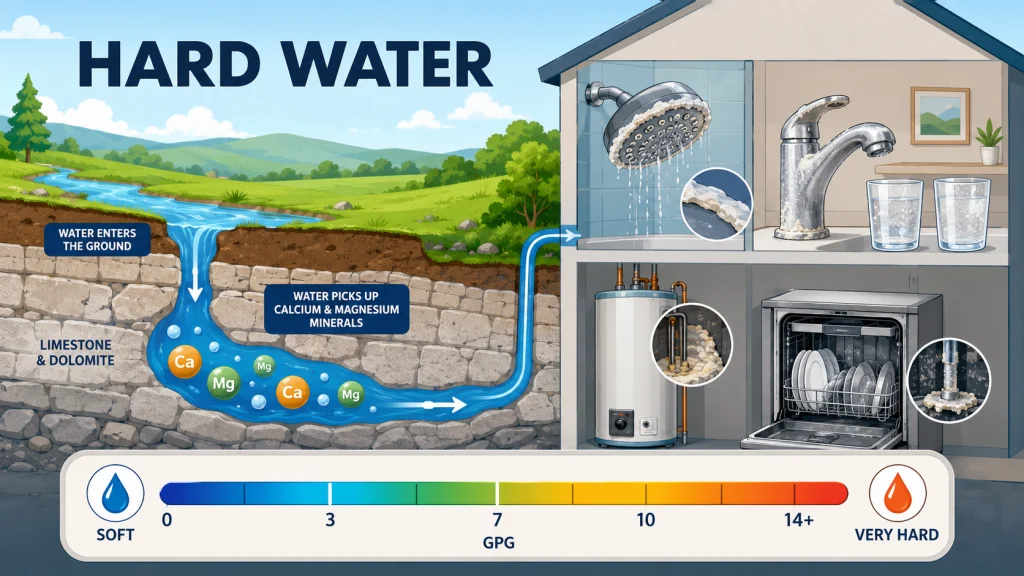
Hard water is not dirty water. It is water with dissolved minerals, primarily calcium and magnesium, picked up as it moves through limestone, chalk, and dolomite formations underground. That is the complete definition. The minerals dissolve naturally as part of the same geological process that puts calcium into the food chain. Nothing has gone wrong. The water has not been contaminated.
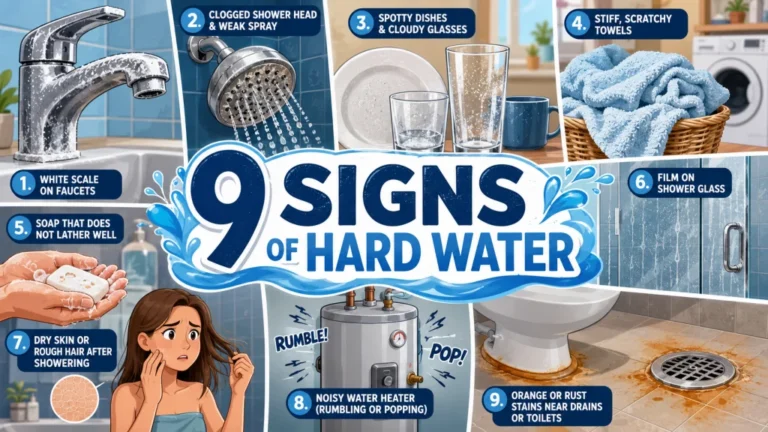
What matters is the concentration, and that is where most homeowners run into trouble. At low concentrations, you will never notice. At moderate levels, you get spots on glasses, stiff laundry, and a ring of scale around the faucet base. At high levels, your water heater is working measurably harder than it should, scale is building inside pipes and fixtures, and appliances are wearing out years ahead of schedule. The label “hard water” covers all of these situations with the same two words. The GPG number tells you where on that spectrum your water actually falls. For a broader look at how all of this shows up across a home, the hard water problem overview connects the pieces before you start making any decisions about treatment.
One of the most common things I run into is homeowners who have been told they have “hard water” by a neighbor, a plumber, or a water dealer, and they treat that as a definitive signal to buy a softener. Sometimes that is exactly the right call. Sometimes their water is 5 GPG and the symptoms they are noticing have more to do with soap choice and water temperature than mineral content. The label without the number does not tell you enough to act on.
Where Hard Water Comes From
Rain falls essentially mineral-free. As it moves through soil and rock on its way to aquifers, rivers, and reservoirs, it dissolves whatever minerals it contacts along the route. In regions built on significant limestone and dolomite deposits, that means calcium and magnesium. In granite-heavy regions, the rock resists dissolution and the water stays soft. Hard water is a geology problem, not a treatment plant failure.
Municipal water plants adjust pH and treat for pathogens, but most do not remove hardness minerals because hardness is not classified as a health hazard. What comes out of your tap reflects what is in the ground beneath your water source. The USGS confirmed that hard water is most prevalent in the east-central and western United States, which maps directly onto the limestone geology of those regions. If you are in Texas, Arizona, Indiana, or most of the Midwest, high hardness readings are the rule, not the exception.
Well water users get whatever is in their local aquifer with no municipal processing between the source and the tap. This is why well water hardness can vary dramatically from one property to the next, even within the same county. I have been on installs where two houses half a mile apart read 9 GPG and 27 GPG, both pulling from the same general formation. You cannot assume hardness from address alone on a private well. You have to test it.

This kit lets you test drinking water, pool water, or any water source in seconds using a simple dip-and-read method with an oversized color chart ranging from red to green, covering 0 to 25 GPG and 0 to 425 PPM. All 100 strips are protected by FreshSeal technology across a ready-to-use bottle and two sealed pouches for long-term accuracy. Each purchase also funds a full year of clean water for someone in the Central African Republic.
Check On AmazonIf you click this link and buy, we earn a commission at no additional cost to you.
The GPG Scale and What Your Number Means Practically
GPG stands for grains per gallon. One grain is 64.8 milligrams of calcium carbonate. It is the standard measurement unit for water hardness in the United States, and it is the number that determines whether and how to act. Water treatment professionals generally break the scale into five practical ranges, and each one carries a different real-world meaning for your home.
| GPG Range | Classification | What It Means in Practice |
|---|---|---|
| 0-3 GPG | Soft | No treatment needed. Scale accumulation is negligible. |
| 3-7 GPG | Moderately Hard | Some spotting and mild scale possible. Treatment is optional and mostly cosmetic. |
| 7-10 GPG | Hard | Scale buildup is real. Appliance efficiency starts declining. Treatment is worth serious consideration. |
| 10-15 GPG | Very Hard | Treatment recommended. Water heater and appliance impact is measurable on energy bills. |
| 15+ GPG | Extremely Hard | Treatment essentially required for appliance longevity. Scale accumulates faster than routine maintenance can address. |
The practical thresholds matter more than the category names. Under 3 GPG, there is no real case for treatment. Between 3 and 7, it comes down to how bothered you are by spotting and scale, not to appliance protection. From 7 GPG upward, the impact on fixtures and appliances is consistent enough that treatment stops being an aesthetic preference and starts being a maintenance calculation.
Field Note: The threshold I have watched matter most in practice is around 12 to 15 GPG. Below that, many homeowners manage fine with periodic descaling and standard water heater maintenance intervals. Above 15, the pattern shifts reliably. Scale builds faster than maintenance can keep up with, and I start seeing water heaters fail years early, shower heads losing 30 to 40 percent of their flow within 18 months, and dishwasher interiors coated in stubborn mineral film that no cleaner fully removes. The category labels give you orientation. That 15 GPG mark is where I have watched “manageable” become “costly” across a lot of different homes and water conditions.

IAPMO certified to NSF/ANSI Standard 44, this system is sized for homes with up to 5 people and 4 bathrooms, using ion exchange to deliver soft, scale-free water from every tap with city or well water compatibility. The user-friendly LCD allows metered operation that uses up to 50% less salt and 28% less water compared to standard time-based softeners, helping lower long-term costs on appliances, soap, and cleaning products. The bundle includes a recommended pre-filter and installation kit, and is backed by a 5 to 10-year limited warranty with dedicated customer support.
Check On AmazonIf you click this link and buy, we earn a commission at no additional cost to you.
GPG, ppm, and mg/L: The Same Number in Three Formats
Water hardness is expressed in three different units depending on who ran the test and what the results are intended for. If you have gotten back a utility report, a test strip reading, and a softener spec sheet and seen three different numbers, they are not measuring three different things. They are measuring the same thing in different units.
- GPG (grains per gallon) is the US standard for water treatment equipment sizing. Softener capacity ratings, resin calculations, and salt dosage requirements all use GPG.
- mg/L (milligrams per liter) is what most utility reports and certified lab results use. It is numerically equivalent to ppm for water at household concentrations.
- ppm (parts per million) is interchangeable with mg/L in water hardness testing. The two terms describe the same measurement and the numbers are identical.
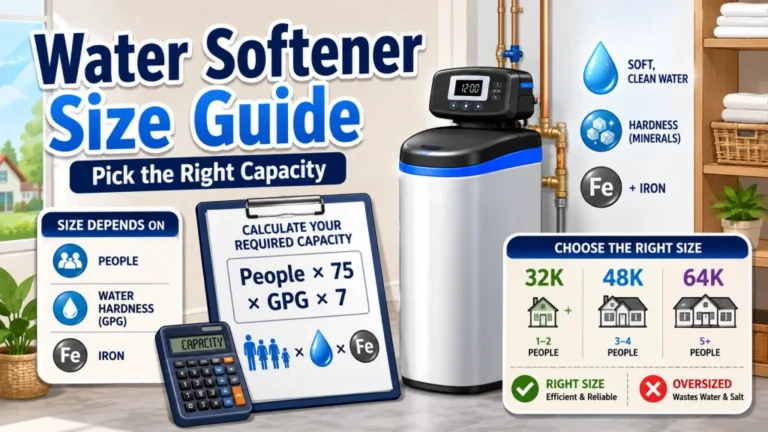
To convert: divide mg/L by 17.1 to get GPG. Multiply GPG by 17.1 to get mg/L. A utility report showing 250 mg/L translates to about 14.6 GPG, which is solidly in the very hard range. A test strip reading of 120 mg/L is about 7 GPG, hard but on the lower end of that category. Getting this conversion right matters if you are going to size any equipment, because softeners are rated in grains and most water reports give you milligrams. Buying a softener sized for 7 GPG when you actually have 14 GPG is one of the more consistent mistakes I see first-time buyers make.
One more thing worth clarifying: hardness is not the same as TDS. A TDS meter measures all dissolved solids in the water, not just calcium and magnesium. A high TDS reading can point toward mineral-heavy water, but it cannot give you a GPG number or tell you how to size a softener. If someone is showing you a TDS reading and calling it a hardness test, those are two different measurements, and only one of them drives treatment decisions.
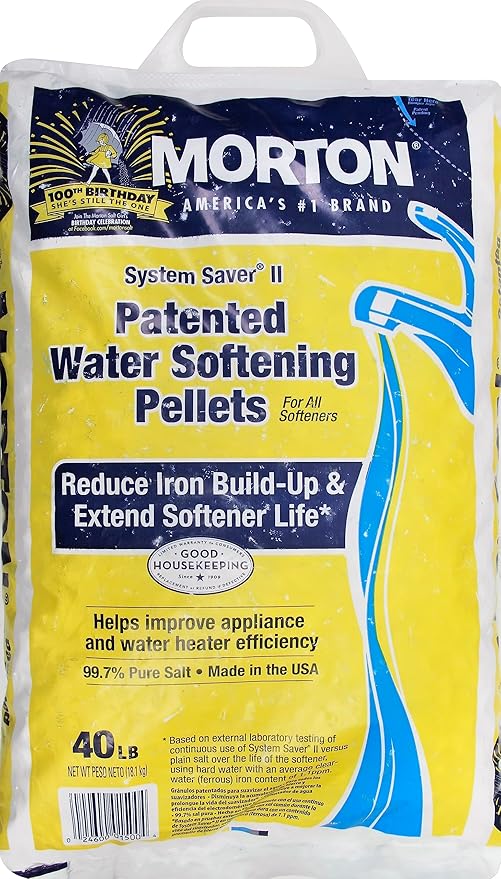
This 40-pound bag of USA-made System Saver pellets is designed to improve the taste of your water while helping extend the life of your appliances and water softener. Simple to use, just add the pellets directly to your softener's brine tank as needed.
Check On AmazonIf you click this link and buy, we earn a commission at no additional cost to you.
What Hard Water Actually Costs You
The clearest documentation on the financial side of hard water comes from the Battelle Memorial Institute, which studied the relationship between water hardness and appliance performance in real operating conditions. At 26 GPG, water heaters in the study lost up to 48% efficiency over the test period. Gas water heaters showed a 22% energy use increase. Dishwashers at hard water conditions required 30% more detergent and showed measurably shorter service lifespans compared to identical units running on soft water.
These are not worst-case projections. They reflect what happens in homes across the hard water regions of the country where hardness runs in the 15 to 30 GPG range and nothing has been done to address it. The efficiency loss shows up in monthly energy bills before it shows up as an obvious appliance failure. A homeowner running a water heater at 20 GPG for several years is paying that penalty every month without connecting it to the water. By the time the heater fails early, most homeowners are surprised by what the hard water has actually cost them.
What I have seen in the field lines up with the Battelle findings consistently. Scale on water heater elements, sometimes an inch or more thick on units only 6 or 7 years old. Shower heads with nozzles clogged down to a fraction of their rated flow. Dishwasher interiors coated in stubborn mineral film baked into the surface that no cleaner removes because it is not food residue. None of these are sudden failures. They are slow, cumulative, and expensive. Understanding your GPG number is what lets you calculate whether the cost of treatment is less than the cost of doing nothing. For the full picture from problem identification through system selection, the complete water softener guide covers each step without the product pitch.

NSF/ANSI 58 certified and trusted by American families for over 15 years, this compact RO system removes up to 99% of more than 1,000 contaminants including PFAS, fluoride, arsenic, and up to 98% of lead, while reducing TDS by 80 to 90%. Filtration reaches down to 0.0001 microns, with a final GAC polishing stage for exceptional taste, and the system includes a 100% lead-free designer faucet and food-grade tubing. The transparent first-stage housing makes filter checks effortless, and the system requires no power source, fits under most kitchen sinks, and is backed by a 1-year warranty with lifetime support from Georgia, USA.
Check On AmazonIf you click this link and buy, we earn a commission at no additional cost to you.
Is Hard Water Safe to Drink?
Yes. Hard water is not a health hazard. The EPA has no maximum contaminant level for hardness, which means federal drinking water standards do not treat it as a safety risk. Calcium and magnesium are the same minerals found in food. They are not harmful at the concentrations present in household water supplies, and in some cases contribute a minor amount to daily mineral intake.
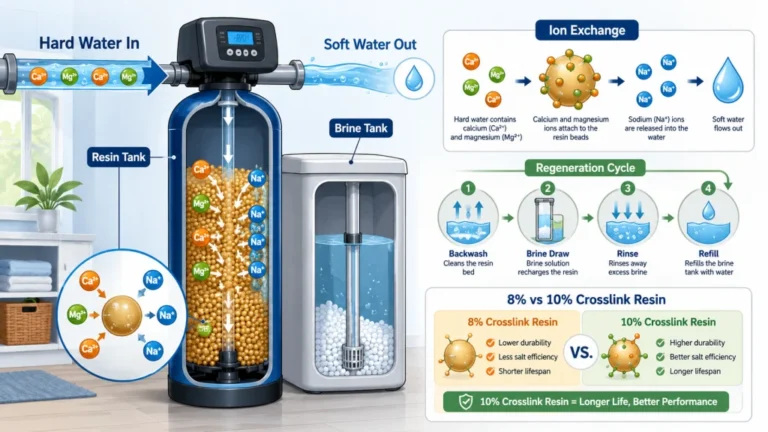
The one group that occasionally receives specific guidance is people on medically restricted low-sodium diets, but that concern applies to softened water, not to hard water itself. The ion exchange process that softens water adds a small amount of sodium in exchange for the removed calcium and magnesium. Hard water as it comes from the ground raises no health flags under standard EPA guidelines. For a thorough breakdown of the research, including the cases where people assume the worst and the actual evidence behind those claims, see whether hard water is safe to drink.

These 99% sodium-free pellets offer a healthier alternative to traditional salt for anyone monitoring sodium intake while still enjoying the benefits of softened water. The bag features a sturdy plastic handle for comfortable carrying and an easy-tear opening for hassle-free pouring.
Check On AmazonIf you click this link and buy, we earn a commission at no additional cost to you.
Final Thoughts: The Definition Is Simple. The Number Is What You Actually Need.
Hard water is dissolved minerals in water. The geology behind it is not complicated, and neither is the health picture. What takes more attention is getting your actual GPG number and understanding what range it puts you in, because “hard water” as a label covers everything from a minor nuisance at 5 GPG to a real appliance and maintenance problem at 20 GPG. Those are not the same situation, and they do not call for the same response.
Under 3 GPG, you likely have nothing to act on. Above 15 GPG, treatment is worth taking seriously and the math on it tends to work out. Between those points, the specifics of your household, your appliance load, and your water use determine whether the case for treatment holds up. The category is just orientation. The decision comes from the number.
The next step is knowing your actual GPG. Your water utility’s annual consumer confidence report is free, accurate, and covers city water. For well water, a test kit or state lab test is required since the utility report does not cover private wells. For a breakdown of each testing method, what each costs, how accurate each one is, and why you should not let anyone selling treatment equipment run your test, how to test for hard water covers all four options in detail. If you want to know what your state typically looks like before running any tests of your own, hard water levels by state has the regional data laid out by area.
FAQs
🪨 What causes hard water?
Hard water forms when rainwater moves through rock formations rich in calcium and magnesium, like limestone and dolomite. The minerals dissolve into the water as it travels toward aquifers and reservoirs. It is a geology issue, not a water treatment failure. Regions sitting on heavy limestone deposits consistently produce higher hardness readings.
📊 At what GPG level is water considered hard?
The standard USGS classification puts hard water at 7 GPG and above. Moderately hard falls between 3 and 7 GPG. Very hard is 10 to 15 GPG, and anything above 15 GPG is extremely hard. In practical terms, the appliance and maintenance case for treatment starts becoming real somewhere above 10 GPG, depending on your household size and water use.
🔢 How do I convert mg/L to GPG?
Divide the mg/L value by 17.1 to get GPG. A utility report showing 200 mg/L equals about 11.7 GPG. To go the other direction, multiply GPG by 17.1 to get mg/L. Most water softeners are rated and sized in grains, so the GPG figure is what you need before comparing equipment specs or talking to anyone about system sizing.
🚿 Does hard water damage pipes?
Scale from hard water builds up inside older metal supply lines over time and can eventually restrict flow. Modern PEX and copper piping is less vulnerable than older galvanized steel. The more immediate and consistent problem is appliance efficiency loss, particularly in water heaters, where scale on heating elements forces the unit to work harder and shortens its service life.
💧 Is hard water the same as unfiltered water?
No. Hard water refers specifically to elevated calcium and magnesium content, not to overall water quality. Filtered water can still be hard if the filter does not target hardness minerals, and most standard filters do not. Reducing hardness requires an ion exchange softener or a specific softening process. Filtration and softening address different things.
🧪 Does hard water affect taste?
It can. High mineral content sometimes produces a flat or slightly chalky taste that some people notice immediately and others never pick up on. It is not a safety concern. If the taste is mineral-related, the only way to address it at the tap is a point-of-use system that actually removes minerals, such as a reverse osmosis unit. A carbon filter handles chlorine taste and odor well but does not remove calcium or magnesium.