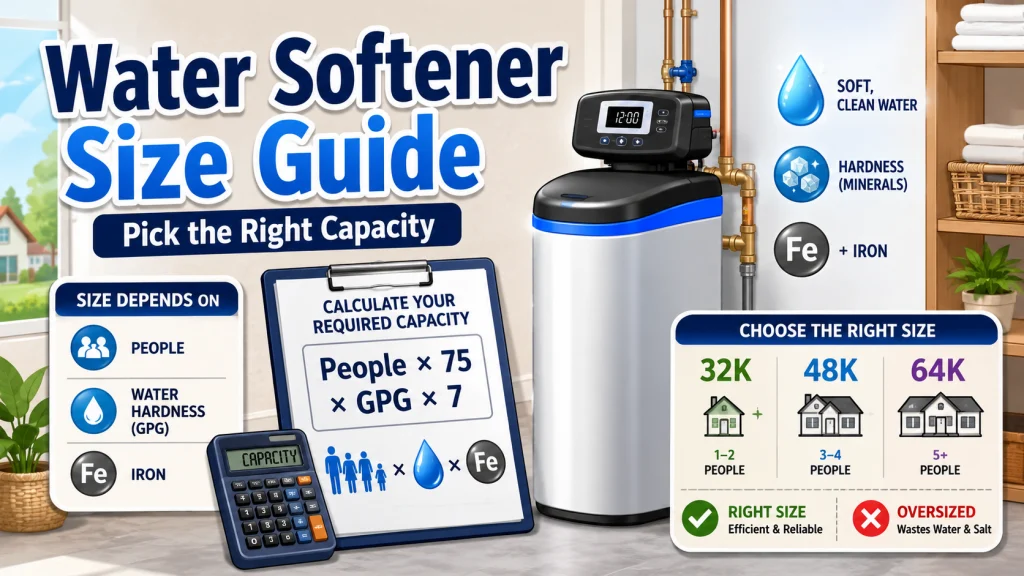
What the Grain Capacity Number on the Box Actually Means
The number on a water softener box represents how much hardness the system can remove before it needs to regenerate. 32,000 grains. 48,000 grains. 64,000 grains. These are not made-up figures, but they are rated under specific laboratory conditions that may not reflect what your home actually demands. More importantly, they tell you nothing about whether that capacity is right for your household size, your hardness level, or what is in your water beyond calcium and magnesium.
Before any of those box numbers mean anything, you need two real inputs: your household size and your actual GPG reading. A vague description like “moderately hard” can cover anywhere from 5 to 9 GPG depending on your municipality. That range changes the sizing answer by an entire product tier. If you have not confirmed your hardness number yet, check your utility’s Consumer Confidence Report before buying anything. Your water company is required to publish it annually. It takes five minutes to find and it gives you the exact number.
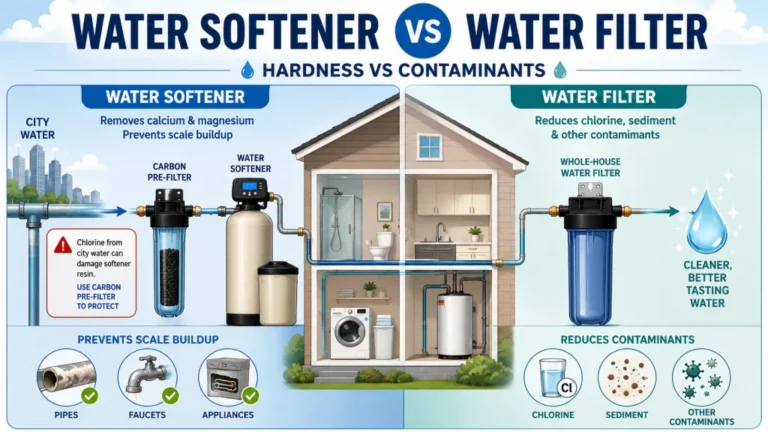
Sizing is also just one step in a larger decision. If you are still working through whether a salt-based softener is the right type for your water situation at all, the complete water softener guide covers that decision from the beginning, including how softeners work, what types exist, and when the answer to whether you need one is actually no.
The Basic Sizing Formula
The standard calculation used in professional water treatment sizing is: number of people in the household multiplied by 75 gallons per day, multiplied by your GPG, multiplied by 7 days. That gives your weekly grain removal requirement, which is the number you match to a softener’s capacity.
A family of 4 on city water at 10 GPG: 4 times 75 times 10 times 7 equals 21,000 grains per week. A 32,000-grain softener covers that comfortably and regenerates roughly every 10 days. A 24,000-grain unit would technically handle it but regenerates every 8 days, which uses more salt over the year and leaves less margin for higher-use weeks. A 48,000-grain unit for that same household is one step into mild oversizing territory, which I will come back to.
The 75-gallon-per-day figure is the industry standard for per-person residential water use. It holds up well for most homes. If your household has an unusually high daily usage pattern, multiple full bathrooms running simultaneously, or a softened water line feeding outdoor irrigation, use your actual average daily usage from your utility bill instead of the 75-gallon estimate and substitute it directly into the formula.
The most common mistake I see in this step is people using hardness estimates rather than tested numbers. If the formula puts you right on the border between a 32k and a 48k unit, that estimate matters a lot. Get the real number first.

This kit lets you test drinking water, pool water, or any water source in seconds using a simple dip-and-read method with an oversized color chart ranging from red to green, covering 0 to 25 GPG and 0 to 425 PPM. All 100 strips are protected by FreshSeal technology across a ready-to-use bottle and two sealed pouches for long-term accuracy. Each purchase also funds a full year of clean water for someone in the Central African Republic.
Check On AmazonIf you click this link and buy, we earn a commission at no additional cost to you.
If You Have Iron in Your Water, the Basic Formula Is Not Enough
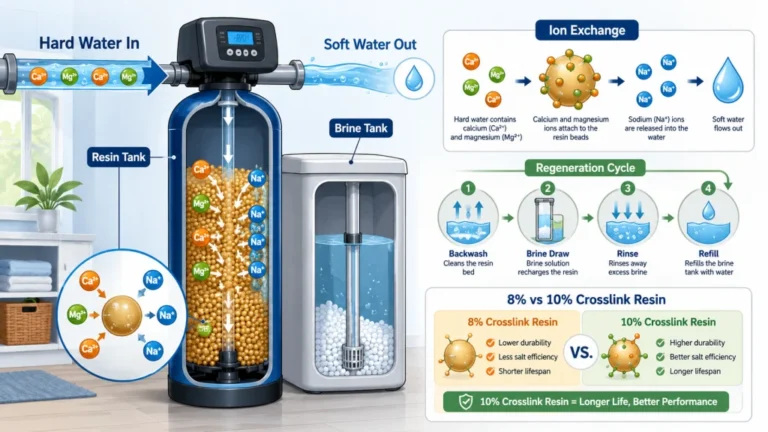
Ion exchange resin removes dissolved iron along with calcium and magnesium, but iron places significantly more demand on the resin than hardness minerals alone. The standard professional adjustment is to add 4 GPG to your effective hardness for every 1 PPM of iron in your water, before running the formula. This is not a conservative cushion estimate. This is the number that appears consistently across professional sizing references and field practice because it reflects how resin actually performs under iron loading.
Here is what that adjustment looks like with real numbers. A well water household testing at 10 GPG with 2 PPM of iron: adjusted hardness is 10 plus (2 times 4) equals 18 GPG. Run the formula: 4 people times 75 times 18 times 7 equals 37,800 grains per week. That household needs a 48,000-grain unit, not a 32,000. The iron alone doubled the required capacity. A buyer who sized off hardness and never tested for iron would purchase the 32k, run it hard, and start seeing inconsistent water quality within a few months as the resin fatigues ahead of schedule.
Field Note: The iron calculation gap is the single most common sizing mistake I run into on well water installs. Homeowners test their hardness, skip the iron panel, and size off the GPG number alone. Six months later the system is underperforming and nobody can figure out why. Fouled resin from iron loading does not announce itself clearly until the damage is done. If you are on a well, run a full lab test covering hardness, iron, and manganese before you size anything. Test strips are not accurate enough for this calculation.
For households where iron tests above 3 PPM, sizing up is not the solution. At that concentration, the softener spends most of its capacity fighting iron rather than hardness, and the resin fouls faster than regeneration cycles can recover it. Dedicated iron removal equipment upstream of the softener is the right sequence for high-iron well water, not a larger softener.
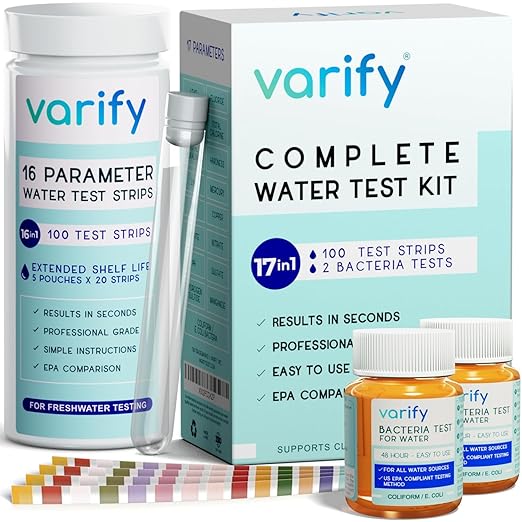
This comprehensive kit tests for 17 parameters including chlorine, fluoride, lead, iron, and bacteria, giving you a full picture of your water's safety in minutes. The 100 color-coded test strips come in 5 individually sealed pouches of 20 for extended freshness, while 2 included bacteria tests deliver results within 48 hours. Every purchase contributes a portion of proceeds to Water For Good, supporting clean water access in Central Africa.
Check On AmazonIf you click this link and buy, we earn a commission at no additional cost to you.
The Rated Capacity Problem: Box Numbers Are Not Real-World Numbers
Grain capacity ratings are based on controlled lab conditions at a specific salt dose and flow rate. In real residential installations, the same resin bed can deliver very different usable capacity depending on how the system is programmed, what the actual water chemistry looks like, and how consistent daily usage is. In practice, actual delivered capacity typically runs 15% to 30% below the rated figure. A 48,000-grain softener in a real home often delivers somewhere between 34,000 and 41,000 usable grains per cycle, not the full number on the box.
The practical correction is straightforward: once you calculate your minimum required capacity, buy the next size up. Not two sizes, just one. If the formula puts your weekly requirement at 28,000 grains, a 32k unit has you running at the edge of its realistic delivery range. The 40k or 48k gives you the margin that covers the rated-vs-real gap and handles higher-use weeks without forcing early regeneration. This is not about padding for comfort. This is about the number on the box not meaning what most buyers think it means.
Well water users with iron are already adjusting for the difference through the GPG calculation above. The one-size-up rule still applies, just starting from a higher calculated minimum after the iron adjustment is factored in.
Why Significantly Oversizing Creates Its Own Problem
Most buyers assume a larger softener is the safer choice. It is not, past a certain point. A softener that is too large for the household regenerates too infrequently, and infrequent regeneration is where things go wrong. Resin that sits without being refreshed for weeks at a time becomes a breeding ground for bacteria. In well water installations with any iron content, iron bacteria in particular takes hold in stagnant resin. The result is water with an odor, a biofilm on the resin that degrades performance, and in some cases a resin bed that requires disinfection or outright replacement well ahead of its normal service life.
The target regeneration frequency is every 7 to 10 days. Frequent enough to keep the resin conditioned, infrequent enough to be reasonably salt-efficient. One size above your calculated minimum stays in that range for most households. Two sizes above it moves you outside it.
I have been in homes with a 64,000-grain softener installed for a 2-person household at 7 GPG. The weekly demand is around 7,350 grains. That 64k unit goes 7 to 8 weeks between regenerations. The water has an odor. The owner has been adding extra salt trying to fix it. That is not the problem. The system is oversized for that installation and no programming change fully solves it. A 24k or 32k unit was the right answer to begin with.
Note: High-GPG households in Arizona, Nevada, and Texas are a different situation. A family of 4 at 20 GPG burns through roughly 42,000 grains per week. A 64k or 80k unit is appropriate sizing for that demand, not excessive. The oversizing concern applies primarily to smaller households in moderate hardness areas who buy the largest unit on the shelf thinking it is the safest choice.
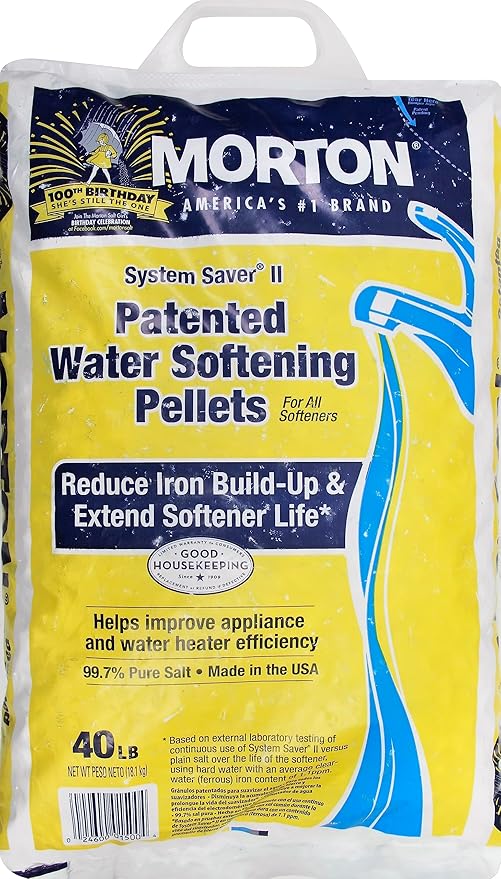
This 40-pound bag of USA-made System Saver pellets is designed to improve the taste of your water while helping extend the life of your appliances and water softener. Simple to use, just add the pellets directly to your softener's brine tank as needed.
Check On AmazonIf you click this link and buy, we earn a commission at no additional cost to you.
Sizing Reference by Household Size and Hardness
The chart below is a starting framework for city water households with no iron. Well water users should run the iron adjustment first, then match the adjusted GPG figure to the hardness column. These recommendations already include one size of margin above the calculated minimum to account for the rated capacity gap.
Very low-demand homes, especially single-person households or homes under 5 GPG, may find that even the smallest unit on the chart regenerates less often than the ideal 7-to-10-day window. In those cases, a demand-initiated valve with a calendar override set at 10 to 14 days is the right solution, not buying more capacity.
| Household Size | Water Hardness | Approx. Weekly Demand | Recommended Capacity |
|---|---|---|---|
| 1 to 2 people | Under 7 GPG | Up to 7,350 grains | 24,000-grain |
| 2 to 4 people | 7 to 10 GPG | 7,350 to 21,000 grains | 32,000-grain |
| 3 to 5 people | 10 to 15 GPG | 15,750 to 39,375 grains | 48,000-grain |
| 4 to 6 people | 15 GPG and above | 31,500 grains and up | 64,000- to 80,000-grain |
A few situations where the chart alone is not enough to give you a final answer:
- City water, no iron: Use the basic formula and apply the one-size-up rule. The rated capacity gap is real and one size of margin covers it without pushing into oversizing.
- Well water, iron under 1 PPM: Still adjust for iron proportionally before calculating. For example, 0.5 PPM iron adds about 2 GPG to your effective hardness. A small iron reading still affects resin performance over time and is worth accounting for.
- Well water, iron 1 to 3 PPM: Run the full iron adjustment before calculating. Consider sediment filtration upstream for any particulate iron, and look into dedicated iron treatment if the iron level is high enough that the softener is spending a significant portion of its capacity on iron removal alone.
- Well water, iron above 3 PPM: Dedicated iron treatment equipment should come before the softener in the treatment sequence. Sizing up does not solve this problem.
One more factor worth checking: whether the softener is using demand-initiated regeneration or a timer-based cycle. Demand-initiated systems regenerate based on actual water usage, which keeps the resin fresher and uses salt more efficiently. Timer-based systems regenerate on a fixed schedule regardless of how much water moved through. For any household that is not running a predictable daily volume, demand-initiated is the better choice.
Grain Capacity and Flow Rate Are Not the Same Thing
Grain capacity tells you how long the softener goes between regeneration cycles. Flow rate tells you whether the softener can keep up when multiple fixtures are running at the same time. These are two different specs, and a system that is correctly sized for capacity can still be undersized for peak demand if the household has multiple bathrooms in simultaneous use.
A typical single-tank residential softener handles a service flow rate of around 7 to 12 gallons per minute depending on the valve and resin volume. For most households, that is enough. A shower runs at roughly 2 gallons per minute. A washing machine uses 3 to 5. If three bathrooms, a dishwasher, and a laundry cycle run at the same time, peak demand can exceed what a smaller valve can handle, allowing some hardness to slip through. This is more of a concern for larger homes than for average households, but it is worth checking the service flow rate specification on any unit you are considering before you finalize the purchase.
If your home has three or more full bathrooms and high simultaneous use is common, look for a unit with a higher-flow valve or consider whether a dual-tank configuration makes sense. The grain capacity calculation gets you to the right resin volume. The flow rate spec confirms the valve can handle your peak demand without becoming the bottleneck.

This universal cleaner removes iron, sediment, dirt, and rust from your softener's resin bed, valve, and internal components, tackling the tough buildup that salt alone cannot address. It is compatible with virtually any brand including Whirlpool, Culligan, GE, Kenmore, Morton, and more, making it a reliable maintenance choice regardless of your system. Used every 4 months, it restores softening performance and can extend the parts and labor warranty on EcoPure systems up to 5 years with product registration.
Check On AmazonIf you click this link and buy, we earn a commission at no additional cost to you.
Final Thoughts: The Math Is Simple. The Inputs Are Where It Goes Wrong.
Most sizing mistakes come down to bad inputs, not bad math. A hardness estimate instead of a tested GPG reading. A skipped iron panel on well water. A household usage assumption that does not reflect how the home actually runs. Fix those three inputs and the rest of the calculation lands cleanly. The formula has been around for decades because it works. The problem is when buyers shortcut the inputs and trust the box store to steer them.
Once you have your grain capacity number, the logical next step is understanding what configuration and regeneration settings make sense for that demand. Single tank versus dual tank, timer versus demand-initiated, and what the resin is actually doing during each cycle are all covered in the water softener systems overview. The formula this article covers gets you to the right capacity. That next step gets you to the right system for that capacity.
FAQs
🏠 What size water softener do I need for a family of 4?
At 10 GPG city water with no iron, a family of 4 needs roughly 21,000 grains per week. A 32,000-grain softener covers that with a reasonable margin. If your GPG is higher or you have iron in your water, run the full adjusted calculation before deciding on a size.
🧮 How do I calculate what size water softener I need?
Multiply your household size by 75 gallons per day, then multiply by your GPG, then multiply by 7. That gives your weekly grain requirement. If you have iron, add 4 GPG to your hardness reading for every 1 PPM of iron before running that formula.
💧 Is a 48,000-grain water softener enough for most homes?
For a household of 3 to 5 people at 10 to 15 GPG with city water and no iron, yes. At higher hardness levels, or with iron in the water, a 48k unit may fall short once you run the adjusted calculation. Keep in mind that rated capacity and real-world delivered capacity are not the same number.
⚠️ What happens if my water softener is too big for my house?
An oversized softener regenerates too infrequently, often weeks apart instead of every 7 to 10 days. Resin that sits stagnant that long can develop bacterial growth, produce water with an odor, and degrade ahead of its expected service life. One size over your minimum is fine. Significantly oversized is a real problem.
🔬 Does iron in well water affect what size softener I need?
Yes, significantly. Add 4 GPG to your hardness for every 1 PPM of iron before calculating. At 2 PPM iron, a 10 GPG system is sized as if it were 18 GPG. That often moves the recommendation up an entire product tier. Above 3 PPM, a softener alone is not the right primary treatment regardless of capacity.
🔄 How often should a water softener regenerate?
Every 7 to 10 days is the target. More frequent and you are burning excess salt. Less frequent and the resin sits too long without being refreshed, which creates conditions for bacterial growth. If your system is regenerating far outside that window in either direction, the sizing is likely off.