The Best Water Softener Salt for Most Homes
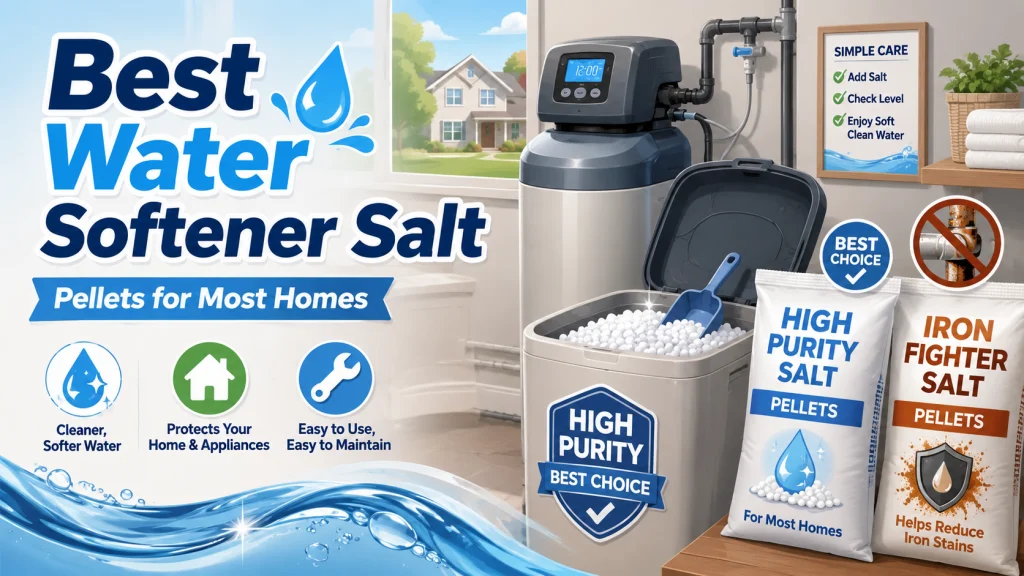
The best water softener salt for most residential softeners is high-purity evaporated pellets, and the two brands that cover the widest range of situations without reliability issues are Diamond Crystal and Morton. I have used both across more installs than I can count, and in practice they perform identically. The choice usually comes down to which one is on the shelf at your local store that week.
Diamond Crystal Bright and Soft Pellets run about $7.33 per 40 lb bag at Walmart and carry 99.8% purity. The pellets are formulated specifically to resist mushing and bridging, which matters more in humid climates than most people realize. The bags use a dual-handle design that makes pouring into a brine tank noticeably easier than the old single-handle format. For a household on city water with moderate to high hardness, this is the product I reach for first.
Morton Clean and Protect Pellets are the direct equivalent at about $8.34 per 40 lb bag, also 99.8% pure. Morton is what you will find at most Lowe’s and Home Depot locations. Same softening performance as the Diamond Crystal, different bag design. If your store stocks one and not the other, that is the one to buy. There is no meaningful performance difference that would justify driving to a different store.
Field Note: The most common complaint I hear from homeowners is that their brine tank has a thick sludge layer at the bottom they have never cleaned. In almost every case, I trace it back to years of using rock salt or low-purity crystals with high impurity content. Switching to high-purity pellets stops new accumulation, but it does not fix what is already there. If you are seeing a dense grey layer at the bottom of the tank, plan to clean it out before loading up with pellets. The cleanup is not complicated, but skipping it means the new salt is sitting on top of the old problem.
| Product | Type | Purity | Approx. Price (40 lb) | Best for |
|---|---|---|---|---|
| Diamond Crystal Bright and Soft | Pellets | 99.8% | ~$7.33 | City water, standard residential softeners |
| Morton Clean and Protect | Pellets | 99.8% | ~$8.34 | City water, standard residential softeners |
| Morton Clean and Protect Plus Rust Defense | Pellets | 99.8% | ~$9.52 | City water with minor rust staining on fixtures |
| Diamond Crystal Iron Fighter | Pellets | 99.6% | ~$10-12 | Well water with detectable iron under 1 PPM |
Prices shift depending on location and timing, but the relative ranking holds across the products above. If you are not sure which row applies to you, here is the short version:
Choose based on your water:
- City water, no rust staining: Diamond Crystal Bright and Soft or Morton Clean and Protect. Whichever is cheaper at your store.
- City water with rust stains on fixtures or laundry: Morton Clean and Protect Plus Rust Defense.
- Well water with confirmed iron under 1 PPM: Diamond Crystal Iron Fighter.
- Well water with iron above 2 PPM: do not upgrade the salt yet. The iron filtration problem upstream of the softener is the fix, not the salt brand.
Skip these:
- Rock salt or any bag below 99% purity.
- Solar crystals in humid climates.
- Block or tablet salt in a standard two-tank softener.
Diamond Crystal Bright and Soft or Morton Clean and Protect are the baseline options for most installations. The iron fighter and rust defense formulas cost a bit more and are worth it under specific conditions, which the next section covers.

Refined to up to 99.8% purity and virtually 100% water soluble, these premium salt pellets deliver consistent softening performance while helping extend the life of your appliances, pipes, and fixtures. Soft water also keeps laundry brighter and hair noticeably softer with regular use.
Check On AmazonIf you click this link and buy, we earn a commission at no additional cost to you.
When to Use Iron Fighter Salt, and When It Is Not Enough
Iron fighter salt contains additives, typically sodium hydrosulfite or a citric acid compound, that help loosen iron deposits from resin beads between deep cleanings. The way it works is straightforward: the additive is mixed into the brine solution during regeneration and goes to work on the iron coating that gradually fouls the resin over time. For well water installations with iron under 1 PPM, switching to an iron fighter formula is often the most practical first step before investing in additional filtration equipment.
Morton Clean and Protect Plus Rust Defense at around $9.52 per 40 lb bag is a solid choice for city water homes that see noticeable rust staining on fixtures, shower walls, or laundry. The citric acid additive manages low-level iron well in that context. For well water with confirmed iron, Diamond Crystal Iron Fighter at 99.6% purity is the more targeted option. Both perform better than standard pellets in iron conditions. Neither replaces a dedicated iron pre-filter when iron levels are significant.
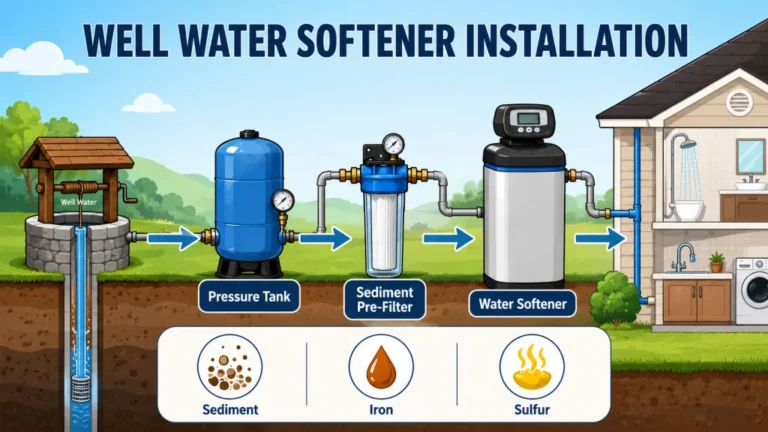
That distinction is important and worth stating directly. Iron fighter salt is a maintenance supplement, not an iron removal system. In my experience, once you are above 1 to 2 PPM iron in the source water, resin fouls faster than iron fighter salt can keep up with. A home with 3 or 4 PPM iron and no pre-filter can foul resin quickly, often within just a few years, regardless of which salt is used. The fix at that level is an air-injection iron filter or a dedicated iron pre-filter upstream of the softener, not a salt upgrade. If you are working through the full setup for a well water installation, the overview of how installation and maintenance connect, including where the softener fits in the treatment sequence, is at the guide to water softener installation and maintenance.
The well water version of this mistake comes up regularly. A homeowner with 3 PPM iron switches to Iron Fighter salt and is disappointed that staining continues after six months. The salt helped slow the fouling, but it was never going to solve the underlying problem. Getting a water test that shows the actual iron level is the first step before deciding whether a salt upgrade is enough or whether pre-filtration is required.
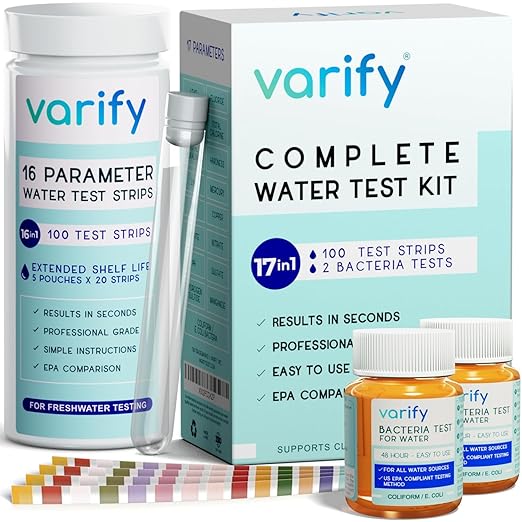
This comprehensive kit tests for 17 parameters including chlorine, fluoride, lead, iron, and bacteria, giving you a full picture of your water's safety in minutes. The 100 color-coded test strips come in 5 individually sealed pouches of 20 for extended freshness, while 2 included bacteria tests deliver results within 48 hours. Every purchase contributes a portion of proceeds to Water For Good, supporting clean water access in Central Africa.
Check On AmazonIf you click this link and buy, we earn a commission at no additional cost to you.
What to Skip and Why
Not all water softener salt is equivalent, and a few categories consistently cause more maintenance problems than the few dollars saved at checkout justify. Knowing what to avoid matters as much as knowing what to buy.
- Rock salt: Typically 98 to 99% pure. That 1 to 2% impurity content accumulates as insoluble sludge at the bottom of the brine tank over time. After a few years, that layer reduces effective brine volume and eventually requires manual tank cleaning. Rock salt is the cheapest option at the shelf and the one most likely to generate the brine tank maintenance call I keep getting. High-purity pellets cost a few dollars more per bag and save considerably more in maintenance time.
- Solar crystals: These run around 99.6% purity on better brands, which is acceptable. The issue is bridging and mushing tendency, especially in humid environments. I have serviced homes in coastal regions where a full tank of solar crystals turned into a single solid mass above the waterline, making it look like the tank was full while delivering no brine at all. Pellets were engineered specifically to address that tendency. In a dry climate, solar crystals are a workable cost-saving option. In a humid one, they create more problems than they are worth.
- Block or tablet salt: Designed for cabinet-style softeners where the block sits directly in contact with the brine water. Using blocks in a standard two-tank softener is a mistake that clogs the brine line. The dissolution rate is wrong for the configuration. Check your system type before buying block salt.
- Unbranded generics below 99% purity: Some stores carry unbranded bags at lower price points. The purity percentage is printed on every bag. Anything below 99% is effectively rock salt territory. Anything at 99% or above is generally acceptable. Check the label before assuming the price difference is just a branding premium.
For a deeper breakdown of how the different salt forms compare across all use cases, including when solar crystals are a reasonable trade-off and why blocks are system-specific, the salt types guide covers the full comparison. The short version for most people: evaporated pellets, 99.6% purity or higher, from a reliable brand.
Where to Buy and How to Get the Best Price
Salt is heavy, and the best price per bag is almost always at the warehouse stores. Costco and Sam’s Club typically carry 40 lb bags in the $8 to $10 range depending on location and current pricing. Buying four or five bags at a time reduces trips and gets you below the per-bag cost at Lowe’s or Home Depot. If you have a membership to either warehouse store, buying salt there is one of the few genuinely good deals on consumables for homeowners.
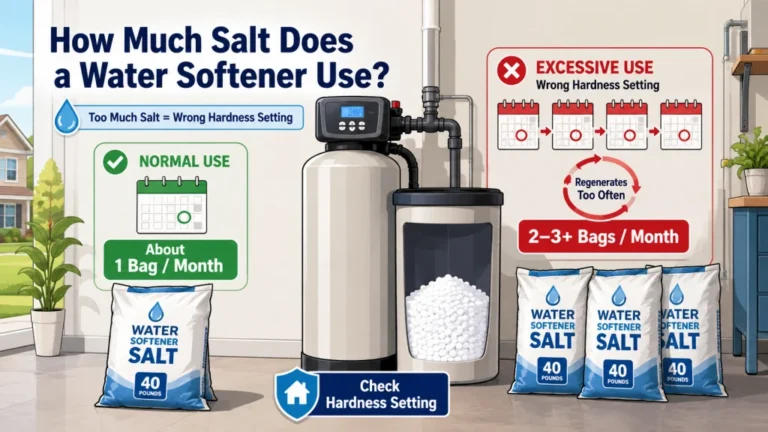
For households who prefer not to haul heavy bags home, Amazon Subscribe and Save on Morton or Diamond Crystal is a reasonable alternative. Scheduling deliveries every 6 to 8 weeks works well for a family of four at typical city water hardness levels, where salt consumption runs roughly one 40 lb bag per month. For a more precise estimate based on your specific hardness and household size, the guide on water softener salt usage walks through the calculation so you are not just guessing when to reorder.
Lowe’s and Home Depot typically run $10 to $12 per 40 lb bag for standard pellet options. Not the cheapest, but the store network is wide and the brands they carry are the same reliable products. If you need one bag to top off the tank and the warehouse store is not convenient, the hardware store is the straightforward option. The price premium over Costco is not significant on a single bag.
Pro Tip: Check your brine tank before the salt level drops below one-third full. Running too low between refills can leave too little brine available during regeneration, meaning the resin does not get fully recharged. Keeping the tank consistently in the half-to-two-thirds range is better for the system than letting it run low and then filling it all the way to the top in one shot. The weight also makes a full tank significantly harder to manage when you do need to clean it.
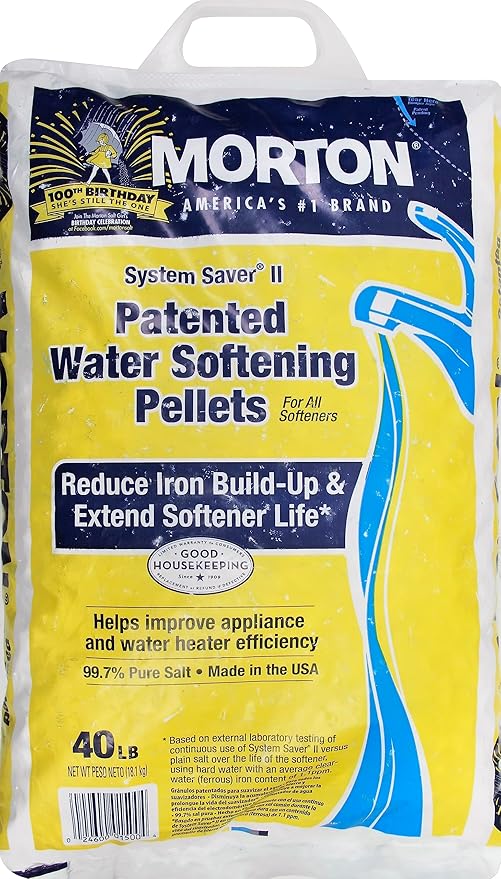
This 40-pound bag of USA-made System Saver pellets is designed to improve the taste of your water while helping extend the life of your appliances and water softener. Simple to use, just add the pellets directly to your softener's brine tank as needed.
Check On AmazonIf you click this link and buy, we earn a commission at no additional cost to you.
Final Thoughts: Keep the Salt Decision Simple
Salt does not have to be a complicated decision. High-purity evaporated pellets from Diamond Crystal or Morton handle the vast majority of residential situations without issues. The upgrade to an iron fighter formula makes sense if you are on well water with detectable iron or seeing rust staining on laundry or fixtures. Rock salt, block salt in the wrong system, and low-purity generics usually cause more problems than the savings justify.
The most consistent thing I see across softener installs is that homeowners who use a reliable salt and check the tank every month or so have fewer problems overall. That is not coincidence. Salt purity affects how cleanly the resin regenerates each cycle, how often the brine tank needs attention, and how much work the venturi valve takes on over time. Getting the salt right is the lowest-effort maintenance decision in softener ownership. For the full picture on salt types, potassium versus sodium, how much to use, and where to buy in volume, the complete salt overview is at the water softener salt guide.

Refined to 99.8% purity, these pellets minimize tank residue and are specifically formulated to resist clumping and salt bridges that can cause system malfunctions. By removing hard minerals like calcium and magnesium, they help extend the life of your dishwasher, washing machine, and water heater while preventing scale buildup in pipes. Compatible with all major water softening systems, the 50-pound bag features a patented dual-handle design for easier and safer lifting and pouring.
Check On AmazonIf you click this link and buy, we earn a commission at no additional cost to you.
FAQs
🧂 Is Diamond Crystal or Morton water softener salt better?
Both are 99.8% pure and perform identically in standard residential softeners. The practical answer is whichever one your store stocks at the better price. There is no performance difference between the two brands that warrants paying more or driving to a different store.
💧 Can I use any salt in my water softener?
You need the correct form for your system type. Standard two-tank softeners use pellets or solar crystals. Cabinet-style softeners use block salt. Using the wrong form can clog the brine line. Regardless of form, look for 99% or higher purity printed on the bag before buying.
🔩 Is iron fighter salt enough for well water with iron?
Under 1 PPM iron, iron fighter salt helps slow resin fouling and can extend cleaning intervals meaningfully. Above 2 PPM, a dedicated iron pre-filter upstream of the softener is necessary. Iron fighter salt supplements maintenance but does not replace proper iron pre-treatment at higher levels.
🪣 How often should I check the salt level in my water softener?
Check it every 4 to 6 weeks. A household of 4 with water hardness around 10 GPG uses roughly one 40 lb bag per month on a demand-initiated system. Higher hardness or timer-based regeneration increases consumption. Keep the tank at least one-third full to avoid partial brine draws during regeneration.
💰 Where is the cheapest place to buy water softener salt?
Costco and Sam’s Club typically offer the best per-bag pricing at $8 to $10 for a 40 lb bag. Amazon Subscribe and Save is competitive for delivery convenience. Lowe’s and Home Depot run $10 to $12 per bag and are the right choice when you only need one or two bags without a warehouse trip.