
Where You Are in Texas Changes What You Need
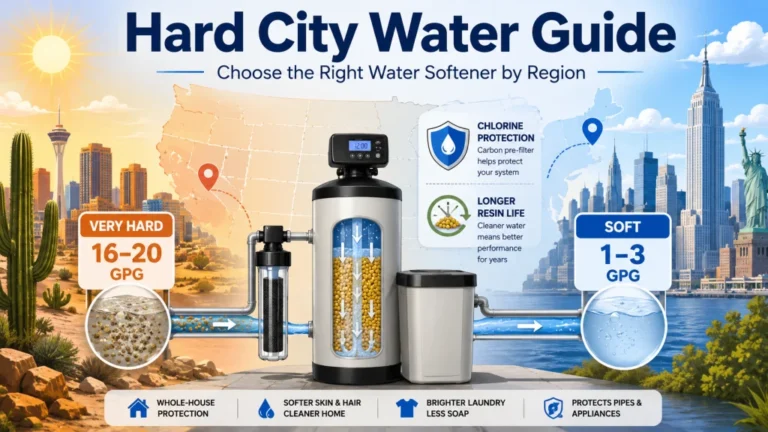
Texas hardness is not a single number. The difference between Dallas at 7-9 GPG and San Antonio at 15-20 GPG is not a minor variation. It changes the minimum grain capacity you need, how often your system regenerates, how much salt you go through in a year, and whether a standard box store recommendation is anywhere close to adequate. Most softener sizing guides online were calibrated for the 7-10 GPG national average. San Antonio, Austin, El Paso, and much of West Texas are well outside that range.
Before looking at any system, the two questions that determine almost everything else are: where in Texas are you, and are you on city water or a private well? The table below gives a practical starting point. Check your municipal water quality report for your exact GPG, or order a water test before running the sizing calculation. Cities within the same metro can vary by neighborhood and by season, and a wrong GPG number produces a wrong grain capacity target.
| City / Region | Typical Hardness (GPG) | Water Source | Sizing Note |
|---|---|---|---|
| San Antonio | 15-20 GPG | Edwards Aquifer (city) | 64k minimum for family of 4; 80k covers the upper range |
| Austin | 15-20 GPG | Colorado River | Same sizing requirements as San Antonio |
| El Paso | 17-19 GPG | Rio Grande / groundwater blend | 80k safer for families of 4+ |
| Fort Worth | 12-15 GPG | Lake surface water | 48k marginal for family of 4; 64k more practical |
| Dallas | 7-9 GPG | Lake Texoma / Trinity River | Standard sizing applies; 48k adequate for most households |
| Houston | 8-10 GPG | Trinity / San Jacinto rivers | Moderate hardness; heavy chlorination from surface water |
| Texas Hill Country (well) | 11-20+ GPG | Private well / limestone aquifer | Add iron adjustment to GPG before sizing; fine mesh resin and pre-filter required |
The GPG numbers above reflect commonly reported ranges from city water reports and local water quality data, not ballpark estimates. That said, your specific tap may test outside the typical range for your city depending on your supply zone and seasonal conditions. A mail-in water test from your actual tap, available for $20-30, is the most reliable starting point before you run any sizing calculation.

This kit lets you test drinking water, pool water, or any water source in seconds using a simple dip-and-read method with an oversized color chart ranging from red to green, covering 0 to 25 GPG and 0 to 425 PPM. All 100 strips are protected by FreshSeal technology across a ready-to-use bottle and two sealed pouches for long-term accuracy. Each purchase also funds a full year of clean water for someone in the Central African Republic.
Check On AmazonIf you click this link and buy, we earn a commission at no additional cost to you.
San Antonio and the Edwards Aquifer Problem
San Antonio sources most of its water from the Edwards Aquifer, a limestone-rich underground reservoir where water picks up calcium carbonate as it moves through the rock. The San Antonio Water System confirms a typical hardness range of 15 to 20 grains per gallon. That puts San Antonio among the hardest city water systems in the United States and well above the national average that most softener buying guides assume when they give you their sizing recommendations.
Here is the specific failure pattern I see most often in high-hardness markets. A homeowner in San Antonio buys a 48,000-grain system because every guide online recommends 48k for a family of four. What that guide does not say is that those recommendations assume 7-10 GPG. At 18 GPG, the math works out to approximately 37,800 grains per week: 4 people times 75 gallons per day times 18 GPG times 7 days. A 48,000-grain system set to regenerate at two-thirds capacity has about 32,000 grains of usable capacity before triggering a regeneration cycle. That means it is cycling roughly every six days at 18 GPG, with almost no margin for high-demand weeks or guests. At the upper end of San Antonio’s range, 20 GPG, it cycles every five days.
Field Note: The undersized softener in a hard water market is one of the most predictable patterns I run into. The homeowner does not notice it immediately because the water still feels soft right after each regeneration. Six months later, the salt bag is empty again, and they just filled it two weeks ago. They call it a hungry softener. It almost always turns out to be a correctly functioning 48k system doing its job in a market that needed a 64k or 80k.
A 64,000-grain system handles 18 GPG comfortably for a family of four, cycling around every 7-8 days with reasonable margin. But San Antonio’s range runs up to 20 GPG, and at the upper end, 64k is again marginal. For households in San Antonio, Austin, or El Paso that want more margin instead of sizing right at the edge, 80,000 grains covers the full 15-20 GPG range across different household sizes and high-demand weeks. For larger households of five or more, or for anyone hitting 20 GPG on a water test, twin alternating is the cleaner solution: two tanks alternating so one is always in service while the other regenerates. It eliminates breakthrough entirely, which matters more when your baseline hardness is already this high. The full framework for matching a softener to your specific water situation covers the sizing calculation in detail if you want to work through your exact numbers.
Dallas, Fort Worth, and the Rest of the Metroplex
Dallas and San Antonio often get lumped together when people talk about Texas hard water, and it is worth separating them because they are genuinely different problems. Dallas draws primarily from Lake Texoma and the Trinity River, and typical hardness runs 7-9 GPG. That is hard by the standard definition, but it is well within the range where standard sizing recommendations actually work. A 48,000-grain demand-initiated softener handles a family of four at 8 GPG on a comfortable 12-14 day regen cycle with margin to spare.
Fort Worth is a different calculation. At 12-15 GPG from lake surface water, Fort Worth sits in the middle range where a 48k system is technically adequate but not comfortable. At 14 GPG and four people, the weekly grain load is just over 29,400 grains. A 48k system cycles roughly every 7-8 days, which works, but there is not much margin for above-average use weeks. At the upper end of the Fort Worth range, 64,000 grains is the more honest recommendation. The additional capacity is cheap insurance against breakthrough, and for anyone in the 12-15 GPG range, one size step up from whatever a standard guide recommends is the practical rule.
Houston is worth a brief note on its own. Hardness runs 8-10 GPG, which is manageable with standard sizing. What sets Houston apart is its surface water source, which requires heavier chlorination than groundwater-sourced city water. That chlorine load has implications for resin longevity, something the next section covers in more detail.

IAPMO certified to NSF/ANSI Standard 44, this system is sized for homes with up to 5 people and 4 bathrooms, using ion exchange to deliver soft, scale-free water from every tap with city or well water compatibility. The user-friendly LCD allows metered operation that uses up to 50% less salt and 28% less water compared to standard time-based softeners, helping lower long-term costs on appliances, soap, and cleaning products. The bundle includes a recommended pre-filter and installation kit, and is backed by a 5 to 10-year limited warranty with dedicated customer support.
Check On AmazonIf you click this link and buy, we earn a commission at no additional cost to you.
Rural Texas and the Iron Problem
The Texas Hill Country is a different category of water problem. Private wells in that region pull from the same limestone geology that makes the Edwards Aquifer so hard, and they also bring iron, sediment, and in many cases hydrogen sulfide. In Hill Country homes, I commonly see hardness in the 11-20 GPG range combined with ferrous iron above 1 PPM. These are not separate or unusual problems in that area. They are routine. And buying a softener without accounting for the iron first is the most consistent way to foul a resin bed within two years of installation.
Iron adds to the sizing calculation in a specific way: for every 1 PPM of iron, you add 4-5 GPG to your hardness number before calculating grain capacity. A Hill Country well testing at 15 GPG hardness with 2 PPM iron should be sized as if the water were 23-25 GPG. For a family of four at 24 GPG, the weekly load works out to just over 50,000 grains, which means shopping for a 64k-80k system before peak water use, guests, or seasonal variation are even considered.
- Ferrous iron under 1 PPM: fine mesh resin handles it, but the GPG iron adjustment still applies to your sizing calculation.
- Ferrous iron 1-3 PPM: fine mesh resin plus a dedicated sediment pre-filter is the minimum; an iron pre-filter is strongly recommended at the higher end of this range.
- Ferrous iron above 3 PPM: an iron pre-filter upstream of the softener is required. The resin will foul regardless of what any product page claims about iron handling capability.
- Any orange water, rust staining, or reddish residue: that is ferric iron, and it requires an oxidizing filter upstream. No ion exchange softener removes ferric iron effectively.
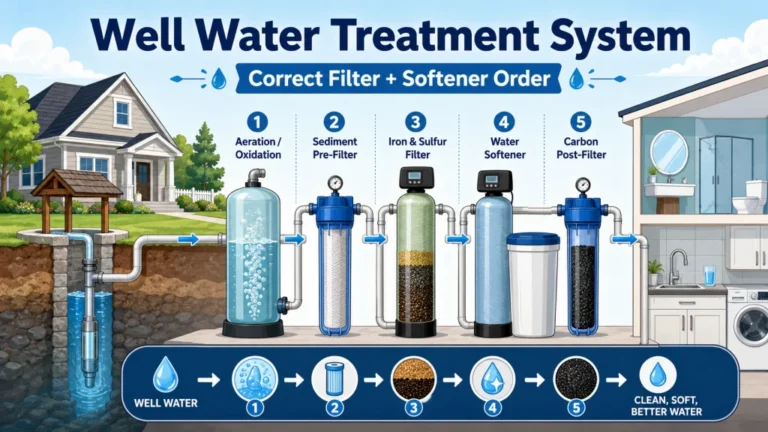
Sediment pre-filtration is not optional for Hill Country well water. The limestone geology that creates the hardness also delivers fine particles that accelerate resin wear under repeated regeneration. A 20-micron sediment pre-filter before the softener adds minimal cost and meaningfully extends resin life. Skipping it is the kind of decision that looks fine in year one and becomes obvious in year three when the system starts losing capacity ahead of schedule. For the full well water treatment sequence, including when a softener is only one stage in a larger system, the guide on treating well water hardness and iron covers the treatment train and when each stage is required.
The Hill Country iron and hardness combination is not unique to Texas. North and Central Florida well water from the Floridan Aquifer frequently produces similar conditions, sometimes with sulfur added. The Florida water softener guide covers how that regional profile differs if you are comparing scenarios.
The Resin Spec That Matters Most for Texas City Water
Dallas, Houston, Fort Worth, and San Antonio are all on city water, and city water means chlorine. Municipal systems use chlorine for disinfection, and chlorine is what gradually degrades ion exchange resin over the service life of a softener. There are two common resin crosslink densities in residential systems: 8% and 10%. The difference matters more in hard water cities than anywhere else, because a softener in San Antonio regenerates more frequently than one in Dallas, which means the resin is exposed to more chlorinated water over time.
A 10% crosslink resin is more resistant to chlorine oxidation than 8% crosslink. In a Dallas installation at 8 GPG, a softener might cycle once every two weeks. In a San Antonio installation at 18 GPG, that same system cycles every 6-7 days. Over five years, the cumulative chlorine exposure is roughly twice as high. That is not a reason to panic about 8% resin, but it is a reason to specify 10% crosslink when it is available, particularly in San Antonio, Austin, El Paso, and Fort Worth where hardness keeps the system cycling frequently. Most box store product labels do not print the crosslink percentage. Ask for the specification sheet before buying or look for it on the manufacturer’s product page directly.
This resin question is part of a broader set of city water softener selection factors, including control valve type, regeneration mode, and warranty coverage for electronics. The full framework for selecting a city water softener based on hardness level covers how these specs combine and which matter most at different GPG ranges.

This whole-home water softener comes pre-loaded with 1.5 cubic feet of high capacity resin in a black USA-made mineral tank, paired with a USA brine tank featuring a safety float. The on-demand digital metered system ensures efficient water treatment, and the included 1-inch Noryl plastic bypass valve makes installation straightforward. Toll-free customer support is available whenever you need help.
Check On AmazonIf you click this link and buy, we earn a commission at no additional cost to you.
What Specs to Prioritize by Texas Scenario
With the regional GPG breakdown and sizing math above, the spec decisions become fairly clear. The table below summarizes the minimum requirements by scenario. These are starting points based on typical conditions, not guarantees. Your actual water test numbers should drive the final calculation.
| Texas Scenario | Minimum Capacity | Key Specs |
|---|---|---|
| Dallas / Houston, 7-10 GPG | 42k-48k for family of 4 | Demand-initiated; 10% crosslink worth specifying due to surface water chlorine |
| Fort Worth, 12-15 GPG | 64k preferred for family of 4 | Demand-initiated; 48k marginal at the upper range |
| San Antonio / Austin / El Paso, 15-20 GPG | 64k minimum; 80k safer across the full range | 10% crosslink strongly preferred; demand-initiated; field-serviceable control valve with widely available parts |
| 5+ people or confirmed 20+ GPG | Twin alternating preferred | Continuous soft water during regen; demand-initiated on each tank |
| Hill Country well water, iron under 1 PPM | 64k-80k after iron GPG adjustment | Fine mesh resin; sediment pre-filter mandatory |
| Hill Country well water, iron 1-3 PPM | 80k minimum after iron adjustment | Fine mesh resin; iron pre-filter strongly recommended; sediment pre-filter mandatory |
| Hill Country well water, iron above 3 PPM or ferric present | Size after pre-treatment removes iron | Oxidizing iron filter upstream first; softener specs apply to remaining hardness only |
A few things this table does not capture: household water use above the 75-gallon-per-person average, sulfur in the well water, and seasonal hardness variation in surface water cities. Each of those adds margin requirements beyond the minimums above. When in doubt, size up rather than right at the threshold.
Before You Buy: Texas Water Softener Checklist
Before comparing any systems, work through these seven points. Texas water conditions vary enough between cities and well sources that skipping any of them can lead to a system that works fine somewhere else and fails in your specific situation.
Pro Tips: Run through this list before you open any product comparison. The answers change the recommendation significantly, especially if you are in San Antonio, in the Hill Country, or on a household of five or more.
- Your city or region: San Antonio / Austin / El Paso / Fort Worth / Dallas / Houston / Hill Country well water. Each has a different baseline requirement.
- Actual GPG from a tap test: Do not rely on city averages. Your specific supply zone may test differently, and a $20-30 test eliminates the guesswork from the sizing calculation.
- Iron PPM if on well water: Ferrous iron above 0.3 PPM changes the effective GPG you size for. Above 3 PPM, pre-treatment is required before the softener.
- City water chlorine exposure: Surface water cities like Houston and Fort Worth use more chlorine. 10% crosslink resin handles long-term chlorine degradation better than 8%.
- Household size and water use: The standard 75 gallons per person per day is an average. High-use households, multiple showers running simultaneously, or heavy laundry use push the weekly grain load above that estimate.
- Minimum regeneration type: Demand-initiated regeneration only. Timer-based systems regenerate on a fixed schedule regardless of actual water use, which wastes 30-50% of salt in households with variable usage patterns.
- Single tank versus twin alternating: Above 18 GPG or for households of five or more, twin alternating avoids the hardness breakthrough window during single-tank regeneration, which is particularly noticeable at high baseline GPG.
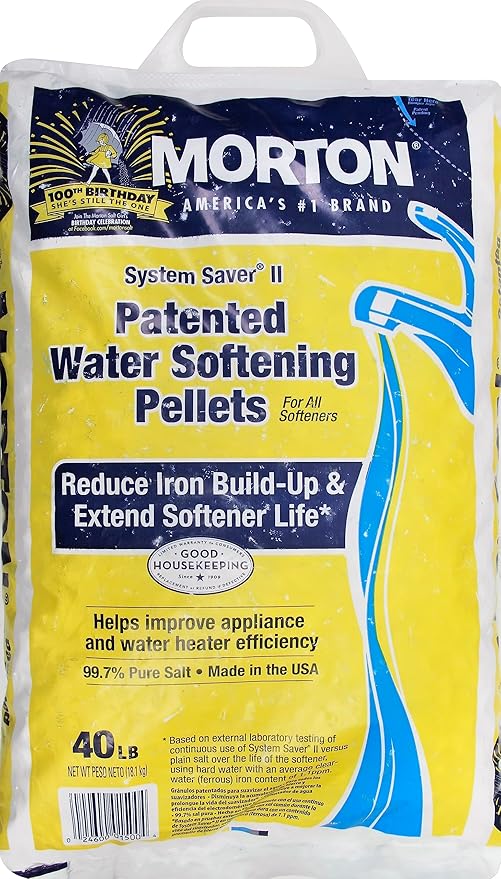
This 40-pound bag of USA-made System Saver pellets is designed to improve the taste of your water while helping extend the life of your appliances and water softener. Simple to use, just add the pellets directly to your softener's brine tank as needed.
Check On AmazonIf you click this link and buy, we earn a commission at no additional cost to you.
Final Thoughts: Size for Texas, Not for the National Average
The consistent mistake Texas buyers make is trusting sizing guides that were not written for Texas water. San Antonio at 18 GPG generates roughly 37,800 grains per week of demand for a family of four. A 48,000-grain system handles that on a 6-day regen cycle with almost no margin. At the upper end of the city’s range, 20 GPG, it cycles every 5 days. These are not system failures. They are systems being asked to handle harder water than the sizing advice assumed.
Know your region, confirm your GPG, add a size step above 12 GPG, and if you are on Hill Country well water, test for iron before buying anything. A correctly sized system for Texas water is not an upsell. It is the system your water conditions actually require.
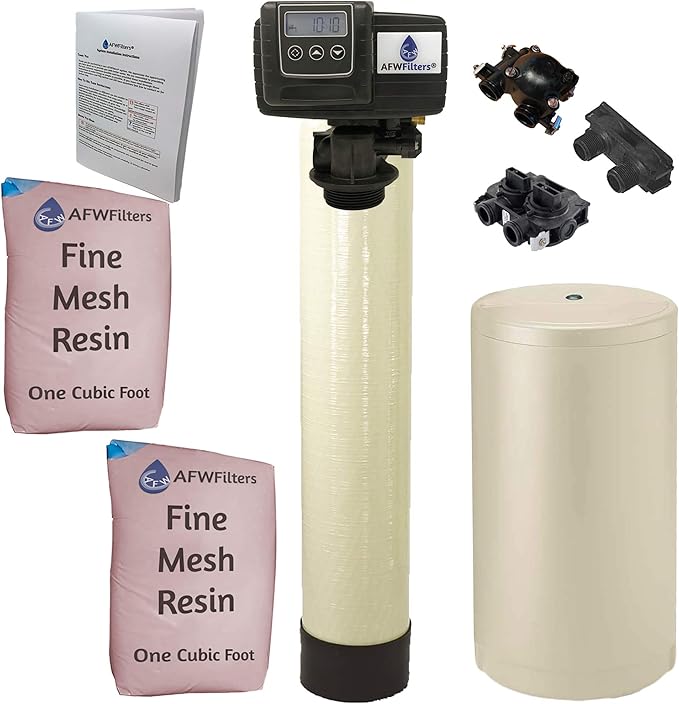
This all-in-one whole house system tackles hard water, iron up to 6 ppm, manganese up to 6 ppm, and rust in a single unit, eliminating the need for separate treatment systems. Powered by the Fleck 5600SXT digital metered valve, it operates efficiently by regenerating only based on actual water usage, making it both reliable and cost-effective. The high flow rate design ensures every tap in your home receives a consistent supply of clean, treated water. The Fleck control valve is backed by a 5-year warranty for added confidence.
Check On AmazonIf you click this link and buy, we earn a commission at no additional cost to you.
FAQs
🔬 How hard is San Antonio tap water?
San Antonio Water System reports typical hardness between 15 and 20 grains per gallon, sourced primarily from the Edwards Aquifer. That puts it among the hardest city water systems in the United States, roughly double the 7 GPG national average. Your specific home may test at either end of that range depending on your supply zone, so testing your tap before sizing a softener is worth the effort.
📐 What grain capacity do I need for a family of 4 in San Antonio?
At 18 GPG with four people averaging 75 gallons per day, the weekly grain load is approximately 37,800 grains. A 48,000-grain system provides around 32,000 grains of usable capacity before triggering regeneration, which means it cycles roughly every 6 days with almost no margin for above-average weeks. At 20 GPG it cycles every 5 days. A 64,000-grain system handles 18 GPG comfortably; 80,000 grains gives more margin across the full San Antonio range before adding unusual water use or other water quality factors.
💧 Is Dallas water hard enough to need a softener?
Dallas typically runs 7-9 GPG, which qualifies as hard but is manageable with a standard 48,000-grain demand-initiated system for most households. Fort Worth runs harder at 12-15 GPG and benefits from one size step up. Whether a softener is worth it depends on your scale sensitivity and appliance protection goals more than a specific GPG cutoff.
🏕️ My Hill Country well water has iron. Does a standard softener handle it?
A fine mesh resin softener handles ferrous (clear) iron up to about 3 PPM, with the iron adjustment added to your grain capacity calculation. If your water runs orange or leaves rust stains, that is ferric iron, and it requires an oxidizing pre-filter upstream of the softener. Ferric iron fouls resin regardless of what any product label claims about iron handling capability.
⚗️ Does the 10% crosslink resin spec matter for Texas city water?
Yes, particularly in high-hardness cities. City water chlorine degrades ion exchange resin over time. At San Antonio or Austin hardness levels, a softener regenerates frequently, which means more cumulative chlorine exposure through the resin bed. A 10% crosslink resin is more resistant to that oxidation than 8%. In Dallas at 8 GPG it matters less; in San Antonio at 18 GPG cycling every 6-7 days, it matters meaningfully over a 10-year service window.
🌡️ Does Texas water hardness change by season?
It can, particularly in surface water cities. In drought conditions, reduced reservoir levels concentrate minerals and hardness readings can tick up. San Antonio’s Edwards Aquifer is relatively stable compared to surface water sources, but Dallas and Houston see more seasonal variation. If you test your water after an unusually wet period, your reading may be lower than annual averages suggest. Testing in a typical season gives you a more reliable baseline for sizing.