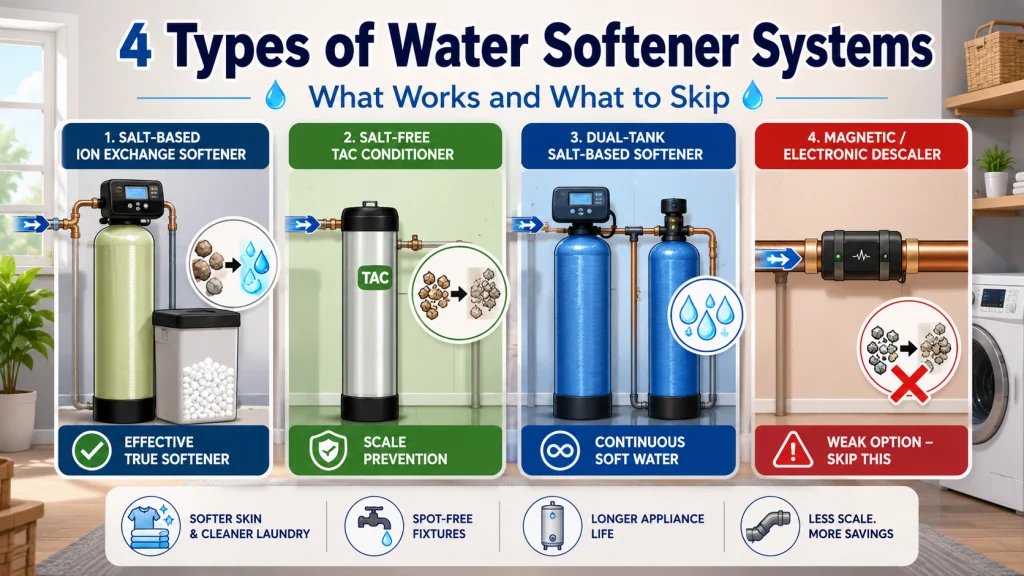
Four Technologies, One Honest Breakdown
The phrase “types of water softener systems” covers a lot of ground, and not all of it is water softeners. Some of what gets sold under that label softens water. Some prevents scale without softening anything. And some of it, frankly, does not have a single peer-reviewed study confirming it does what the box says. What I find most useful, when a homeowner is trying to sort through their options, is to set aside the marketing language and look at what each technology actually does to your water chemistry. The outcome you want drives which type makes sense.
Before going any further: this article covers the four main types at a comparison level. If you want to understand the full picture of how these systems fit into a broader decision, the complete water softener guide covers the lifecycle from identifying your problem through installation and maintenance. If you already know your GPG and are trying to figure out whether softening is worth the investment for your situation, that is a different question entirely. Here, we are focused on technology type only: what each one does, where it works, and where it does not.
Type 1: Salt-Based Ion Exchange
This is the standard single-tank ion exchange setup, and ion exchange is the technology category that actually removes calcium and magnesium from your water. The process works through ion exchange: water passes through a resin bed where hardness minerals are pulled out and replaced with sodium. What comes out the other side tests at zero to one GPG. Your dishes come out spot-free, your soap lathers properly, your skin stops feeling like you rinsed with mineral dust. For a full explanation of the mechanism, see how a water softener works. It is worth reading if you are trying to understand resin lifespan, regeneration cycles, and why salt consumption varies by water hardness.
Salt-based ion exchange is effective across the full hardness range. A household at 8 GPG will see results. A household at 22 GPG, which is common in parts of Arizona and Texas, will also see results. The system regenerates periodically using a brine solution to recharge the resin, and the frequency of that cycle depends on how hard your water is and how much water you use. There are ongoing costs: salt, typically 40 to 80 pounds per month depending on your hardness level and household size, and occasional resin replacement after many years of use. For most homes with hard water, this is the baseline against which the other three types should be measured.
| Type | What It Does | Water Test After Treatment | GPG Range | Skip It If |
|---|---|---|---|---|
| Salt-based ion exchange | Removes calcium and magnesium | 0 to 1 GPG | All levels | You are on a sodium-restricted diet and have no RO for drinking water |
| Salt-free TAC conditioner | Changes mineral crystal structure to reduce scale adhesion | Unchanged from source | Best at 3 to 15 GPG; variable from 15 to 25 GPG; avoid above 25 GPG | You want soft water feel, better lather, or you are above 25 GPG |
| Dual-tank salt-based | Same as ion exchange with no soft water interruption | 0 to 1 GPG | All levels | Your household is small or your usage does not run continuously |
| Magnetic or electronic descaler | Claims to alter mineral behavior via electromagnetic field | Unchanged from source | Disputed | You need independently verified results |
The table above is a starting point, not a final answer. Your GPG level, household size, whether you are on city or well water, and whether you are in a salt-restricted region all factor into the decision. The type that works at 6 GPG in coastal California is not the same one that makes sense for a family of five in Indianapolis at 20 GPG.
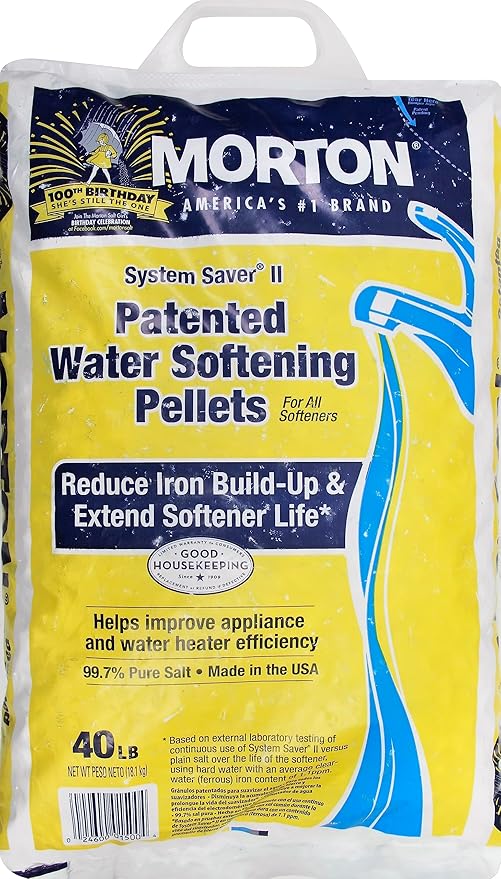
This 40-pound bag of USA-made System Saver pellets is designed to improve the taste of your water while helping extend the life of your appliances and water softener. Simple to use, just add the pellets directly to your softener's brine tank as needed.
Check On AmazonIf you click this link and buy, we earn a commission at no additional cost to you.
Type 2: Salt-Free TAC Conditioners
Template Assisted Crystallization, usually called TAC, is the technology behind most salt-free systems. Instead of removing calcium and magnesium, it converts them into microscopic crystals that no longer adhere to pipe walls, appliances, or fixtures. The scale prevention is real. What does not happen is softening. If you test your water hardness before and after a TAC conditioner, you will get the same GPG reading both times. The minerals are still there. They have just changed form.
This distinction matters more than most buyers realize before they purchase. A homeowner at 12 GPG who installs a TAC system expecting softer skin, better soap lather, and spot-free dishes is going to be disappointed. Those results come from removing hardness minerals, not from restructuring them. What the TAC system does deliver is meaningful scale protection across the plumbing system, appliances, and water heater, without the need for salt, electricity, or a drain connection for brine discharge. For households in cities or counties with salt discharge restrictions, this is often the only practical option for scale management. TAC performs reliably at 3 to 15 GPG. Between 15 and 25 GPG it may still reduce scale, but results become less consistent, and the gap against a properly sized ion exchange softener widens. Above 25 GPG, the mineral load is too concentrated for the technology to handle reliably, and a salt-based system is the better answer.
Field Note: One of the most consistent patterns I see is homeowners who bought a salt-free system expecting the full soft water experience. The water still tests at 14 GPG. The skin still feels dry. The shower door still spots. Nothing changed in any of the ways they hoped, because what they bought prevents scale, not softening.
The naming issue here is worth flagging. Many salt-free TAC products are marketed using the words “water softener” because that is what consumers search for. Technically, they are conditioners. The difference between a conditioner and a softener is not a matter of brand preference or sales framing. It is a chemistry difference with real consequences for what you experience after installation. If this distinction is confusing, the article on the difference between a water softener and a water conditioner covers it in full, including why your hardness test will still read the same number after a conditioner is installed.
One real advantage of TAC over salt-based is maintenance. There are no salt bags to carry and no brine cycles to manage. The conditioner media typically lasts three to six years before replacement. For a household primarily concerned with protecting appliances and plumbing in a low-to-moderate hardness area, it is a legitimate choice, as long as the buyer understands what they are getting.

Designed for 1 to 3 bathroom homes on municipal water, this salt-free descaler system uses advanced anti-scale technology that requires no electricity or salt to protect your plumbing and appliances from scale buildup. The built-in triple-purpose sediment, carbon, and zinc pre-filter delivers 5-stage filtration, removing 99% of contaminants including chlorine, VOCs, rust, and sediment, with a recommended filter change every 6 months. Built from high-strength fiber-reinforced materials, it handles water hardness up to 25 grains per gallon and delivers a peak flow rate of 10 GPM without any pressure drop. It can also be paired with the Aquasure Fortitude Lite System for enhanced whole-house water treatment.
Check On AmazonIf you click this link and buy, we earn a commission at no additional cost to you.
Type 3: Dual-Tank Salt-Based Systems
A dual-tank system is still an ion exchange softener. The difference from a standard single-tank unit is that it uses two resin tanks. While one tank is regenerating, the other is actively softening. The result is continuous soft water, twenty-four hours a day, without the brief hard water period that a single-tank system produces during its regeneration cycle. For most households, that window of hard water during regeneration, which typically happens overnight when usage is low, goes completely unnoticed. But in some situations it matters.
Where dual-tank makes sense: households of five or more people with high daily water usage, homes where water demand runs at unpredictable hours, and properties in the 15 GPG and above range where a single tank regenerates more frequently. The tradeoff is upfront cost, which is higher than a comparable single-tank unit, and the physical footprint of having two tanks in addition to the brine tank. In a mechanical room with limited space, that can be a real constraint. I have walked into more than a few homes where the planned softener location simply could not accommodate a dual-tank setup, and the homeowner had to reconsider. Measure before you buy.
- Best fit for dual-tank: Household of 5 or more, water hardness at 15 GPG or above, or schedule requires soft water at all hours including early morning when regeneration typically occurs.
- Single-tank is usually sufficient for: Households of 4 or fewer at moderate hardness, overnight regeneration on a timer, or budget-constrained buyers who do not need continuous flow.
- Space requirement: Two resin tanks plus one brine tank. Confirm available floor space in your utility area before purchasing.
- Demand-initiated regeneration: Both single and dual-tank salt-based systems benefit from demand-initiated controls, which regenerate only when the resin is actually depleted rather than on a fixed schedule. This reduces salt use and is worth specifying when buying.
One thing I always check when a homeowner is considering dual-tank is whether their hardness level and household size actually justify it. A family of three at 9 GPG does not need continuous regeneration. The single-tank unit regenerates every week or so, and that brief overnight period is not going to affect anything. Dual-tank is a real solution for a real situation. It is not automatically better.
Type 4: Magnetic and Electronic Descalers
Magnetic and electronic descalers wrap around the outside of your water supply pipe and claim to alter the behavior of hardness minerals using an electromagnetic field. No plumbing. No salt. No drain connection. The pitch is appealing, and the price is low enough, typically under $100, that it looks like a low-risk trial. The problem is the evidence, or more accurately, the absence of it.
There is no peer-reviewed independent study confirming that magnetic or electronic descalers deliver measurable, consistent results. Research that has examined these devices under controlled conditions has not found the scale reduction effects their marketing claims. One of the larger water treatment manufacturers in the US developed its own version of this technology, tested it under real-world conditions, and eventually discontinued the product line. That is not a fringe outcome. That is a company with significant resources deciding the technology did not perform reliably enough to stake its name on. Product listings for some of these devices include fine-print language suggesting that for water above 25 GPG, a conventional water softener would still be needed alongside the device. That is the product itself acknowledging a core limitation.
Note: If you are considering an electronic descaler because the upfront cost is attractive, that is understandable. What I would suggest instead is confirming your GPG first, and then comparing that number against what a properly sized ion exchange or TAC system would realistically cost you. The gap in effectiveness is significant enough that a descaler is rarely the right answer even at half the price.
I am not saying these products do nothing in every home under every condition. Water chemistry is variable, and anecdotal reports go both ways. What I can say is that after going through the available research and watching the mainstream water treatment industry’s response to this category, I would not install one in a home where scale protection actually matters. The risk is not the cost of the device. The risk is going without effective treatment while believing you have it covered.
Choosing the Right Type for Your Home
The decision comes down to four variables: your GPG level, your household size, whether you are in a salt-restricted area, and what outcome you actually need from the system. Most of the confusion I see in this category comes from buyers who have not clearly separated those last two. Do you want soft water with all the benefits that come from removing minerals? Or do you want scale protection without the ongoing cost and maintenance of a salt-based system? Both are valid goals. They lead to different systems.
If your water tests above 10 GPG and your goal is genuinely soft water, an ion exchange softener is the right answer. That is not a brand recommendation; it is a chemistry reality. TAC will not deliver the skin feel, the improved lather, or the fully scale-free result at that hardness level. If you are at 6 to 8 GPG and scale protection on appliances is your primary concern, a TAC conditioner handles that job without salt, without a drain, and with minimal maintenance. If you are in a household of five or more with high daily demand and water in the 15 GPG range or above, a dual-tank setup is worth the extra cost. And if someone is suggesting a magnetic clip that wraps around your pipe, ask them for the independent test data before you hand over any money.
For the full breakdown of how to calculate what size system your household actually needs, the guide to water softener systems covers sizing, regeneration frequency, and how to match capacity to your specific water conditions. Buying the wrong size, whether too small or meaningfully oversized, creates problems that the right type choice cannot fix.
Quick Match: Map Your Situation to the Right Type
Most homeowners already know their approximate situation before they land on this page. Here is a direct map from common scenarios to the technology that fits, without the full framework if you just need a starting point.
- You want genuinely soft water, better soap lather, and the full soft water feel: Salt-based ion exchange, single or dual-tank depending on household size. No other type delivers this.
- You only care about scale on appliances and pipes, and you live in a salt-restricted area: TAC conditioner, provided your water is under 15 GPG. Effective for scale prevention with no salt and no ongoing maintenance beyond media replacement every few years.
- Your household has five or more people, high daily usage, or water above 15 GPG: Dual-tank salt-based. The additional cost is justified when regeneration gaps would affect a high-demand home.
- Your water tests above 25 GPG: TAC is not reliable at this concentration. Ion exchange is the right answer, sized correctly for your household and hardness level.
- You are looking at a magnetic or electronic descaler: Ask for the independent test data before buying. If none is available, treat it as experimental, not primary scale protection.
If you do not know your GPG, that is the first step before any of these decisions become meaningful. A $15 test kit from a hardware store or your utility’s Consumer Confidence Report will give you the number in under an hour.

This kit includes 150 dip-and-read test strips for quickly measuring water hardness across virtually any source, including home faucets, well water, softeners, dishwashers, showers, and aquariums. Results are instant and easy to read against a color chart, making it simple to verify whether your water softener, reverse osmosis, or water conditioning system is performing as expected. A bonus eBook is included to help you record, track, and interpret your results over time.
Check On AmazonIf you click this link and buy, we earn a commission at no additional cost to you.
Final Thoughts: Buy for the Result You Actually Want
The market for water treatment products has a strong incentive to blur the line between “removes hardness” and “prevents scale.” Both can be described as treating your water. Only the ion exchange options produce soft water. If what you want is the real thing, soft water that tests at zero to one GPG, an ion exchange softener is your answer. If scale protection without salt is what you are after, TAC does that job at moderate hardness levels. Dual-tank earns its cost in high-demand homes. And electronic descalers, whatever the packaging says, do not have the independent evidence to justify placing them alongside the other three.
Know your GPG before you commit to anything. A water test costs under $20 and takes fifteen minutes. That single number makes every decision on this list cleaner. Without it, you are shopping based on marketing language, and this category has more of that than most.

IAPMO certified to NSF/ANSI Standard 44, this system is sized for homes with up to 5 people and 4 bathrooms, using ion exchange to deliver soft, scale-free water from every tap with city or well water compatibility. The user-friendly LCD allows metered operation that uses up to 50% less salt and 28% less water compared to standard time-based softeners, helping lower long-term costs on appliances, soap, and cleaning products. The bundle includes a recommended pre-filter and installation kit, and is backed by a 5 to 10-year limited warranty with dedicated customer support.
Check On AmazonIf you click this link and buy, we earn a commission at no additional cost to you.
FAQs
💧 What is the most common type of water softener?
Salt-based ion exchange is by far the most widely installed type. It is the only technology that fully removes calcium and magnesium from your water supply, which is why it remains the standard for residential use across most of the US.
🧪 Will a salt-free water softener change my water hardness test result?
No. Salt-free TAC systems prevent scale without removing hardness minerals. Your water will still test at the same GPG level before and after installation. If you need your hardness reading to drop to near zero, you need an ion exchange softener, not a conditioner.
🔁 When does a dual-tank water softener make sense?
Primarily for households of five or more people, homes with water hardness at 15 GPG or above, or any situation where water demand runs at unpredictable hours and a regeneration gap would cause problems. For most families of four or fewer at moderate hardness, a single-tank unit is sufficient.
⚡ Do electronic or magnetic descalers actually work?
Independent peer-reviewed research has not confirmed consistent, measurable results for magnetic or electronic descalers. At least one major manufacturer developed and later discontinued this type of product after testing it themselves. I would not rely on a descaler as your primary hard water treatment strategy.
🏠 Can I use a salt-free conditioner if I have very hard water?
TAC conditioners are generally effective up to around 25 GPG for scale prevention, though performance can diminish above 15 GPG. Above 25 GPG, a salt-based ion exchange system is the more reliable choice. And in any case, a conditioner will not produce the soft water feel that ion exchange delivers.
🌵 Are any water softener types restricted in California?
Salt-based softeners are banned or restricted in certain California counties due to concerns about sodium discharge into the water supply. Salt-free TAC conditioners have no such restrictions and are the standard recommendation for those areas. Check your local municipality before purchasing any salt-based system if you are in California.