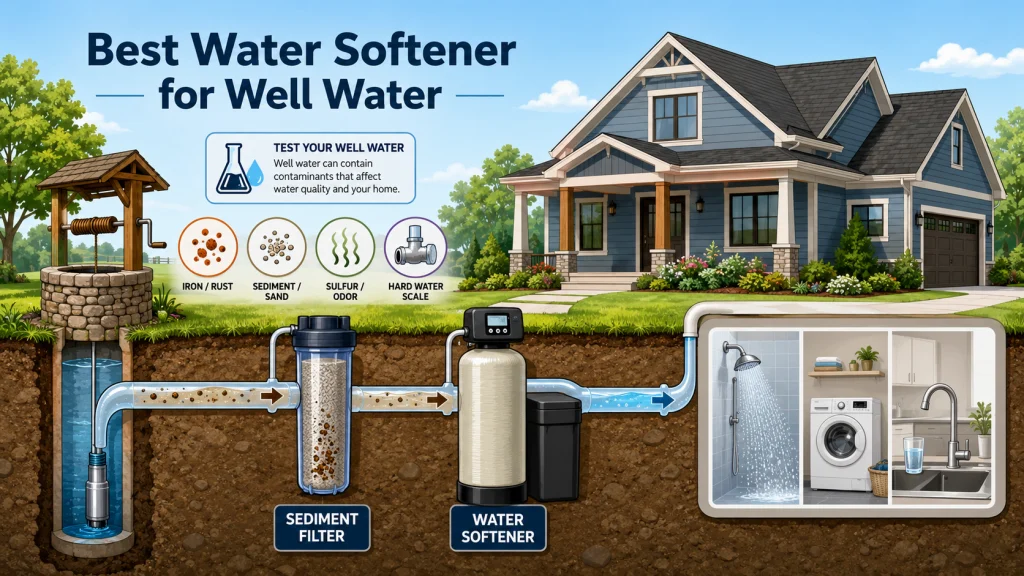
What Well Water Actually Throws at a Softener
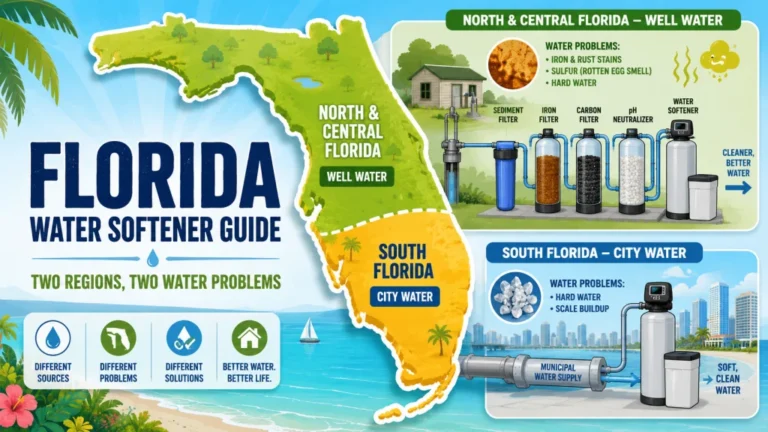
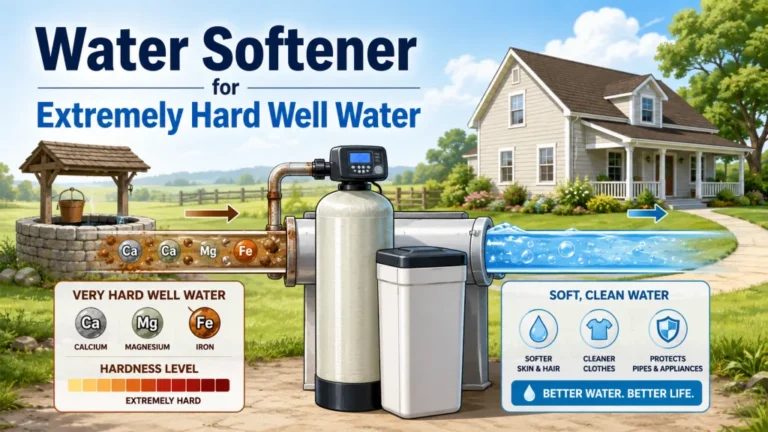
Well water hardness is not the same problem as city water hardness, and that distinction matters before you buy anything. Municipal water arrives at your home already treated: chlorine added, pH adjusted, sediment removed upstream. Private well water is whatever the aquifer delivers, unfiltered and unregulated. That gap changes what equipment you need, how you size it, and what pre-treatment belongs upstream of the softener.
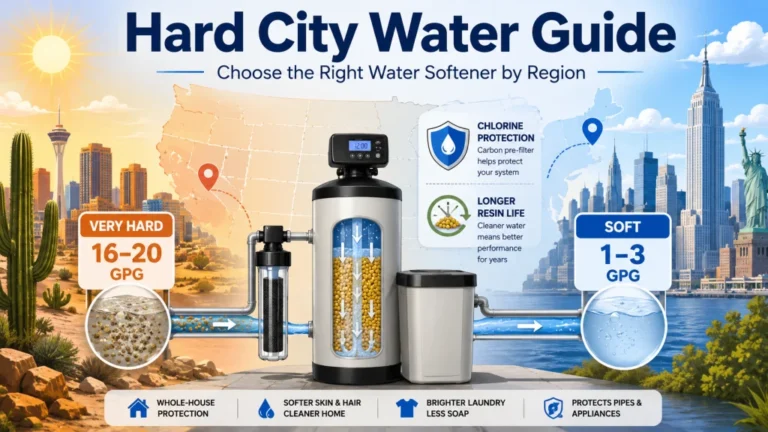
There is one genuine advantage to well water that most buyers never hear about. City water chlorine is hard on ion exchange resin. It oxidizes the resin beads over time and reduces softening capacity. Well water, when it does not carry iron or sediment problems, is easier on resin than chlorinated municipal supply. I have seen well water systems outlast city water installs in service life, all else equal. The catch is everything else that can come with it.
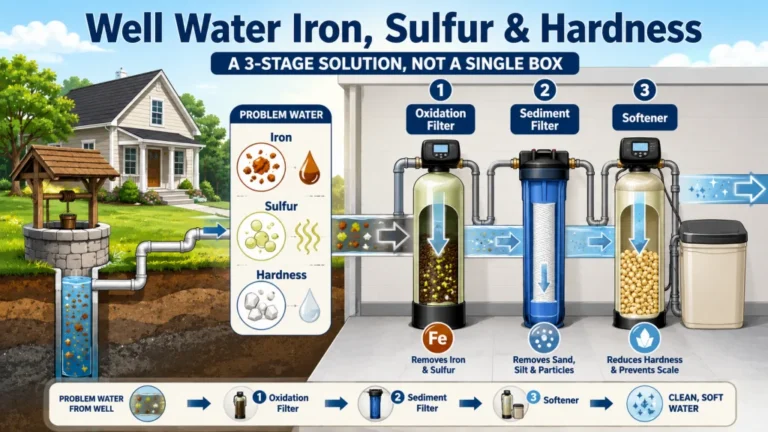
Iron is the most common complication, followed by hydrogen sulfide, sediment, and sometimes low pH. Each one requires a different response. A standard softener is not designed to handle any of them beyond low-level dissolved iron, and running untreated well water through a softener without knowing what is in it is a reliable way to shorten the system’s life significantly. The right starting point for any well water buyer is a water test, not a product page.
Field Note: One of the most common situations I walk into is a softener that is two or three years old and already underperforming, installed directly on a well with no pre-filtration. The resin is brown when you open the tank. The homeowner has been pouring salt in every few weeks wondering why the water still feels hard. In almost every case, the installer never asked about iron or sediment, and nobody tested the water before specifying equipment. The softener was not the wrong brand. It was the wrong setup from day one.
The Iron Problem: What the Box Rating Does Not Tell You
The iron rating printed on any residential water softener refers specifically to ferrous iron. That is dissolved, clear water iron, the kind you cannot see until it oxidizes on contact with air or surfaces. Some softeners with the right resin can handle ferrous iron above 1 PPM under proper conditions, but I would not treat that as a simple softener-only well water case. Once iron rises past trace levels, the margin for error gets smaller, sizing changes quickly, and pre-treatment may become the smarter first step.
That rating also does not extend to ferric iron, the oxidized particulate form that shows up as orange or rust-colored water straight from the tap. Ferric iron is not dissolved. Running it through an ion exchange resin bed is not removing it, it is filtering it, and resin is not a filter. I have pulled softener tanks out of service where the resin bed was so compacted with oxidized iron that water could barely flow through. Every one of those cases involved ferric iron with no upstream pre-treatment.
The homeowner had read the iron rating on the box, the number looked sufficient, and nobody had explained the difference between ferrous and ferric. That distinction does not appear clearly on residential softener packaging, which is why I am putting it plainly here. If your water runs orange or leaves reddish stains inside the toilet tank before you have flushed, you likely have ferric iron. Before a softener enters the picture, that iron needs to be oxidized and removed upstream. What the right pre-treatment looks like depends on the concentration and whether sulfur is also present. I cover those specifics in the article on choosing the right well water softener when iron is part of the problem.
| Iron Level | Type | What It Looks Like | Treatment Approach |
|---|---|---|---|
| Under 0.3 PPM | Ferrous (dissolved) | Clear, no staining | Standard softener, fine mesh resin, sediment pre-filter |
| 0.3 to 1 PPM | Ferrous (dissolved) | Clear water, possible light staining on fixtures | Fine mesh resin softener, sediment pre-filter, sized with iron adjustment |
| 1 to 3 PPM | Ferrous (elevated) | Clear water, more noticeable staining | Fine mesh resin, sediment pre-filter, consider dedicated iron pre-filter |
| Above 3 PPM or any ferric | Ferric or high ferrous | Orange or rust color from tap, or heavy staining | Oxidizing pre-filter required before any softener can work effectively |
The sizing adjustment for iron is something most online calculators skip entirely. For every 1 PPM of ferrous iron, add 4 to 5 GPG to your hardness number before calculating grain capacity. A well testing at 15 GPG hardness and 3 PPM iron is not a 15 GPG sizing problem. It is closer to a 28 to 29 GPG problem. That changes which system you need, and ignoring it is why some well water buyers end up with softeners that regenerate every two days instead of every week and still cannot keep up.
Sediment: The Slow Kill Nobody Warns You About at the Point of Sale
Sediment does not cause the dramatic failures that iron does. Sand, silt, and fine clay particles from the aquifer accumulate in the resin bed gradually. There is no obvious warning sign until flow drops noticeably or regeneration cycles stop cleaning the resin effectively. By that point, the damage is usually done.
The Minnesota Department of Health has specifically noted that excessive iron and sediment can foul softener resin beds well before their rated service life ends. What I have seen in practice lines up with that: wells drawing from sandy aquifers can foul a resin bed in two years or less without upstream sediment filtration. A 20-micron or 50-micron whole-house sediment pre-filter installed before the softener is not an optional add-on for well water installs. It is part of the baseline. The cartridge costs almost nothing compared to a resin replacement or a tank you have to pull out of service early.
One practical reason to install that filter even on cleaner wells: the cartridge gives you a visible record of what is in your water. Pull a used cartridge after a few months and look at it. That is material that would otherwise be in your resin bed. Most well water installs I have done without this protection came back to me within a few years with fouled tanks. Most of the ones I installed with it have not.

This lead-free brass and stainless steel mesh filter captures sediment, rust, dirt, and sand at 50 microns, protecting your entire plumbing system before water reaches finer filters downstream. Unlike traditional cartridge filters, it is fully flushable and reusable, with the stainless steel screen lasting 1 to 2 years under normal use. The see-through housing makes it easy to monitor buildup at a glance, and dual threads with 1-inch MNPT and 3 to 4-inch FNPT connections on both ends allow for straightforward installation indoors within a pressure range of 15 to 115 PSI.
Check On AmazonIf you click this link and buy, we earn a commission at no additional cost to you.
Sizing a Well Water Softener Correctly
If you are just getting started on what hardness numbers actually mean before running sizing calculations, the article on understanding hard water and what the GPG number tells you covers the basics. For well water buyers who already know their numbers, here is where the math differs from the city water version.
The standard formula: daily grain demand equals people in the household multiplied by 75 gallons per person per day, multiplied by hardness in GPG, multiplied by 7 for a weekly total. You then pick a system large enough to handle that weekly load with a comfortable margin before regenerating. For well water with iron, the formula is the same but the hardness number is not always what the test report says at first glance.
Here is what that looks like with real numbers. A household of four, 15 GPG hardness, 3 PPM ferrous iron. Iron-adjusted hardness: 15 plus (3 multiplied by 4.5) equals 28.5 GPG. Daily grain demand: 4 multiplied by 75 multiplied by 28.5 equals 8,550 grains. Weekly total: roughly 59,850 grains. The right system for this household is a 64,000 grain unit at minimum, not the 32,000 or 48,000 that a city water buyer at 15 GPG would reach. If those four people size on hardness alone, they end up with a system that regenerates constantly, burns through salt, and still cannot keep the water soft.
A family of four at 15 GPG with iron under 1 PPM and no sulfur is the simpler case this article is built around. Weekly grain demand without the iron correction: 4 multiplied by 75 multiplied by 15 multiplied by 7 equals 31,500 grains. A 48,000 grain system with a metered valve and upstream sediment filtration covers this cleanly, regenerating roughly once per week at normal usage. Apply the iron adjustment even at trace levels if your test shows anything above 0.3 PPM. Building in that buffer up front is cheaper than correcting an undersized system after installation.
Before buying any system, get your well water tested. A complete panel should cover at minimum:
- Total hardness in GPG or mg/L
- Iron: total, ferrous (dissolved), and ferric (particulate) separately
- Manganese
- pH
- Total dissolved solids (TDS)
- Hydrogen sulfide, if there is any rotten egg smell from the tap or drain
Most county extension offices and state health departments offer low-cost well water testing. If your last test is more than two years old, treat it as expired. Well chemistry can shift after heavy rain seasons, drought periods, or changes in nearby land use.

The only water test kit to earn the Good Housekeeping Seal and named one of the Top 10 New Products at the National Hardware Show, this USA-made kit uses patented technology to test 12 different parameters across city tap and well water supplies. Each purchase includes 10 test strips, trilingual instructions, and guided support before, during, and after testing. A portion of every sale is donated to clean water initiatives around the world.
Check On AmazonIf you click this link and buy, we earn a commission at no additional cost to you.
When Hardness Is Your Only Problem
Not every well water situation is complicated. Some wells deliver water with moderate hardness, ferrous iron under 1 PPM, no sulfur smell, stable pH around 7.0 to 7.5, and minimal sediment. In those cases, a standard ion exchange softener with a sediment pre-filter is a clean solution. The main decisions come down to grain capacity, control valve design, and resin type.
For well water without complicating factors, demand-initiated metered regeneration is the control valve design to look for. The system should regenerate based on actual water usage, not a fixed timer. Timer-based regeneration wastes salt by running cycles regardless of whether the resin needs it, and it can leave hard water passing through during high-usage periods between cycles. Metered demand-based valves avoid both problems, and they are common enough across the market that there is no reason to settle for a timer-based system.
Resin type matters more on well water than city water buyers typically expect. Fine mesh resin has a smaller bead size and more surface area than standard coarse resin, which improves contact with dissolved iron even at low concentrations. For ferrous iron between 0.3 and 1 PPM, fine mesh resin is the right call. Standard 8% crosslink resin works for many private well applications. If your well has any chlorine exposure, or if iron is near the 1 PPM limit, 10% crosslink holds up better over time. The pre-filter still belongs in the system regardless of how clean the well tests today. Well chemistry is not static, and protecting the resin is cheaper than replacing it early.
What to Look For in a Simple Well Water Softener
What follows applies to a specific situation: hardness is the primary issue, ferrous iron is under 1 PPM, there is no rotten egg smell, pH is near neutral, and sediment filtration is installed upstream. If any of those conditions do not apply, the situation guides at the bottom of this page are where to start. A shortlist built for clean well water does not transfer to a problem with iron above 1 PPM or any sulfur in the picture.
| Your Test Result or Symptom | What It Means Before Buying |
|---|---|
| Clear water, no rotten egg smell, iron under 1 PPM | You are in the simple well water range this guide is built for. |
| Orange water from the tap or reddish staining before water sits | Do not buy a softener-only setup first. Ferric iron needs upstream treatment. |
| Rotten egg smell from hot or cold water | Hydrogen sulfide is present or likely. A softener alone will not fix the smell. |
| Iron above 1 PPM, even if the water looks clear | Move carefully. Fine mesh resin may help, but sizing and pre-treatment become more important. |
| Low pH, heavy sediment, or unknown well chemistry | Test and correct the water profile before treating this as a straightforward softener purchase. |
For the simple case, there are three things I weigh most when comparing systems. First, the control valve: demand-initiated and metered, regenerating on actual usage rather than a timer, with replacement parts available through regular water treatment distributors and not locked to a single factory service technician. Fleck and Clack are the two valves with the longest track record in residential water treatment and the widest independent parts availability. Second, resin type: fine mesh for any well with trace ferrous iron, 10% crosslink if iron is near the 1 PPM threshold or if chlorine exposure is a possibility. Third, grain capacity calculated from the iron-adjusted hardness number, not the raw GPG from the test report.
| Priority | Best For | Key Specs to Confirm | Skip If |
|---|---|---|---|
| Best overall package | Simple well water, hardness primary, iron under 1 PPM | 10% crosslink resin, Clack valve with lifetime warranty, capacity options that cover iron-adjusted sizing | Ferric iron, sulfur, iron above 1 PPM |
| Best long-term serviceability | Buyers prioritizing DIY service and lowest 20-year cost | Fleck metered demand valve, fine mesh resin, parts available from independent distributors | Buyers who want a fully warranted plug-and-play package |
| Most accessible entry point | Clean wells, moderate hardness, iron well under 0.5 PPM | Fine mesh resin, metered regeneration, confirmed neutral pH and no sulfur | Iron near 0.5 PPM or above, pH below 7.0, any sulfur uncertainty |
The Best Overall Package: 10% Crosslink Resin and a Clack Valve
Choose this profile if you want the safest long-term setup for a clean well and you are willing to pay more for better resin durability, stronger valve support, and more sizing flexibility. For the simple well water case, the combination I would prioritize is a Clack control valve with a lifetime valve warranty and 10% crosslink resin specified for the tank.
The 10% crosslink specification matters for well water in two ways: it handles trace ferrous iron contact more durably than standard 8% crosslink, and it holds up better if the well water chemistry shifts or if any incidental chlorine reaches the resin over time. A Clack valve is widely serviceable independent of the system brand, which matters when a service call on a rural property is expensive. Look for a system that offers multiple tank capacities so you can match the iron-adjusted grain demand without overbuilding or undersizing.
This profile fits wells with hardness up to around 25 GPG, ferrous iron under 1 PPM, no sulfur, and pH in the neutral range. If iron is approaching 1 PPM, size from the corrected hardness number, not the raw GPG. No system built around this profile should be run as a standalone solution for ferric iron, sulfur, or extreme hardness, regardless of what the product listing claims.

This whole-home water softener comes pre-loaded with 1.5 cubic feet of high capacity resin in a black USA-made mineral tank, paired with a USA brine tank featuring a safety float. The on-demand digital metered system ensures efficient water treatment, and the included 1-inch Noryl plastic bypass valve makes installation straightforward. Toll-free customer support is available whenever you need help.
Check On AmazonIf you click this link and buy, we earn a commission at no additional cost to you.
The Best Long-Term Value: A Fleck Metered Demand Valve
Choose this profile if you care more about repairability and long-term ownership cost than having the most polished packaged system. If serviceability is the deciding factor, the configuration I would compare first is one built around a Fleck metered demand valve with fine mesh resin.
The Fleck valve is one of the most widely deployed residential water treatment valves in North America. Parts are stocked by virtually any water treatment distributor, and a capable homeowner or independent plumber can rebuild the valve head without special tools or a service contract. That matters on a well. Dealer service calls in rural areas are slow and expensive, and a system built around a proprietary valve puts you at the dealer’s schedule and pricing every time something needs attention.
This configuration fits the same clean well profile as the option above. The difference is the 15 to 20 year service horizon and the flexibility to service it yourself. It is not the more polished package in terms of warranty coverage, but over the life of a well water system the total cost including service usually comes out lower.
The Entry-Level Option: Fine Mesh Resin for Clean Wells
Choose this only if your test results are genuinely clean and budget matters more than long-term margin. When the well situation is on the clean end, with moderate hardness, ferrous iron well under 0.5 PPM, pH solidly in the neutral range, no sulfur, and minimal sediment, fine mesh resin with a metered demand valve delivers the core function at a lower upfront cost.
Fine mesh resin is the right call for any well water application with trace iron. The control valve in lower-cost configurations is typically less field-serviceable than a dedicated Fleck unit, but for water profiles this clean the reliability record is solid and the serviceability gap matters less over the realistic service life.
This is not the profile I would choose if iron is close to 0.5 PPM or above, if pH is below 7.0, or if there is any uncertainty about sulfur. In those cases, the more durable resin spec and a field-serviceable valve give you meaningful margin against variation. The entry-level option fits a specific buyer: clean well, straightforward hardness problem, and budget is the deciding factor after confirming the water test supports it.
Note: If your water test shows iron above 1 PPM, orange water at any point, rotten egg smell, or hardness above 25 GPG, none of these three profiles is the right starting point. If iron is between 0.5 and 1 PPM, narrow to the first two options only. Each of the more complex situations has a dedicated scenario guide below.

Refined to 99.8% purity, these pellets minimize tank residue and are specifically formulated to resist clumping and salt bridges that can cause system malfunctions. By removing hard minerals like calcium and magnesium, they help extend the life of your dishwasher, washing machine, and water heater while preventing scale buildup in pipes. Compatible with all major water softening systems, the 50-pound bag features a patented dual-handle design for easier and safer lifting and pouring.
Check On AmazonIf you click this link and buy, we earn a commission at no additional cost to you.
Final Thoughts: The Water Profile Determines the System, Not the Other Way Around
The single biggest mistake I see well water buyers make is treating this like a city water purchase with a different label. The ion exchange mechanism is the same. The sizing formula is the same. But the variables that change the right answer, iron level and form, sediment load, sulfur, pH, are different enough from city water that recommendations designed for municipal supply often fail on a well.
For the simple case where hardness is the main issue and iron is under 1 PPM ferrous, the three system profiles above give you a solid starting comparison. Get fine mesh resin. Use a metered demand valve. Install sediment filtration upstream. Size from the iron-adjusted hardness number. Those four decisions account for most of the well water installs that go wrong when they are skipped.
For anything beyond that, the scenario guides below cover each specific situation. Start with the one that matches your water test results and work from there. The general framework for evaluating any softener system across different water situations is covered in the overview on what actually matters when choosing a water softener by situation, if you want the broader context before narrowing down.
FAQs
🧪 Do I need a water test before buying a softener for well water?
Yes, and hardness alone is not enough. Test for iron (ferrous and ferric separately), manganese, pH, TDS, and hydrogen sulfide at minimum. Those results determine whether a softener alone handles your situation or whether pre-treatment stages are required upstream of it.
🔩 Is a sediment filter required before a water softener on well water?
In most cases, yes. Well water carries sand, silt, and fine particles that accumulate in resin beds over time and reduce softening capacity well before the system’s rated service life. A 20-micron or 50-micron sediment pre-filter upstream of the softener is inexpensive and extends resin life significantly.
💧 What is the difference between ferrous and ferric iron in well water?
Ferrous iron is dissolved and invisible in water. A fine mesh resin softener can handle it at concentrations under 1 PPM with neutral pH and no sulfur present. Ferric iron is already oxidized and shows up as orange or rust-colored water from the tap. It is particulate, not dissolved, and requires an oxidizing pre-filter before any softener can work effectively.
📐 How do I size a water softener for well water with iron?
Add 4 to 5 GPG to your hardness number for every 1 PPM of ferrous iron, then run the standard sizing calculation from the corrected number. At 15 GPG hardness and 3 PPM iron, size as approximately 28 to 29 GPG, not 15 GPG. Most online calculators do not include this adjustment, so you need to apply it manually.
🦨 Can a water softener remove the rotten egg smell from well water?
No. That smell is hydrogen sulfide, and ion exchange resin is not designed to remove it. Some softeners will temporarily trap the odor and release it unpredictably. Aeration or an air injection oxidation system handles hydrogen sulfide. The softener comes after that stage, not in place of it.
⚙️ What control valve should I look for in a well water softener?
A demand-initiated metered valve that regenerates based on actual water usage, not a timer. Fleck and Clack are the two valves with the widest parts availability and service network in residential water treatment. Avoid proprietary valves with no independent service support, especially on a rural well where dealer service calls are slow and expensive.