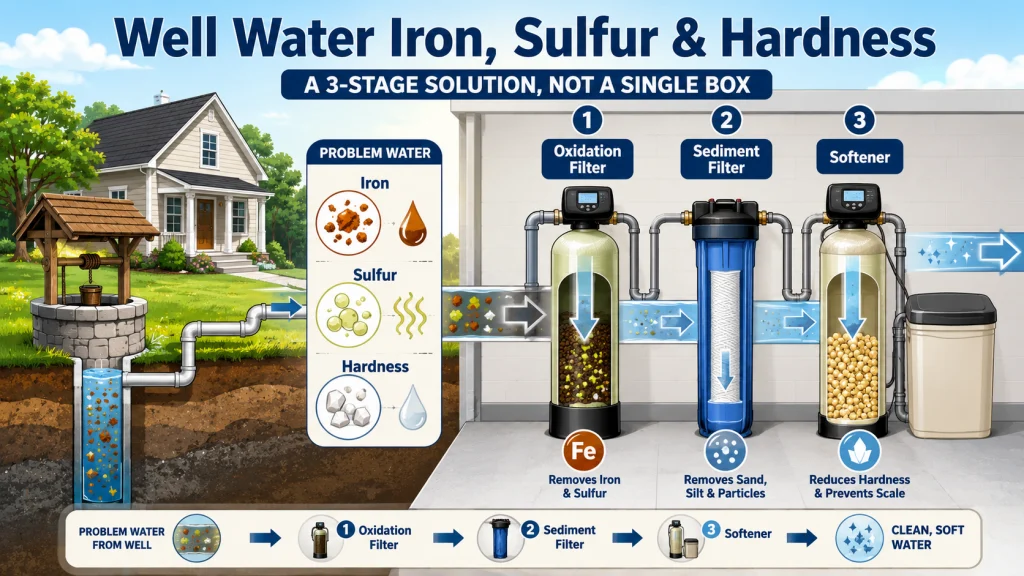
Iron and Sulfur Together: Why This Is Not a One-System Problem
Iron and sulfur in well water are both common on their own. Having both at the same time, on top of hardness, is one of the most frustrating residential treatment scenarios I come across, partly because the equipment industry does a poor job of telling homeowners what they are actually dealing with. The default sales pitch is that a single softener or a single combo unit will handle everything. It usually will not.
Each contaminant requires a fundamentally different removal mechanism. Hardness requires ion exchange resin. Ferrous iron, the dissolved kind that keeps water clear in the glass, can be handled by fine mesh resin up to about 3 PPM. Ferric iron, the particulate kind that runs orange or leaves rust stains, requires oxidation and physical filtration before any softener can see it. Hydrogen sulfide, the gas behind the rotten egg smell, is not removed by ion exchange at all. Some softeners trap it temporarily and release it in bursts during regeneration cycles, which can make the smell worse, not better.
That is three distinct problems requiring three different treatment approaches. Understanding that framing early prevents a lot of wasted spending. The first thing to do before buying anything is get a full water test: total hardness in GPG, ferrous iron in PPM, a visual check for ferric iron, hydrogen sulfide in PPM, and pH. A proper lab test is far cheaper than replacing fouled resin or discovering after installation that the system was not matched to your water.
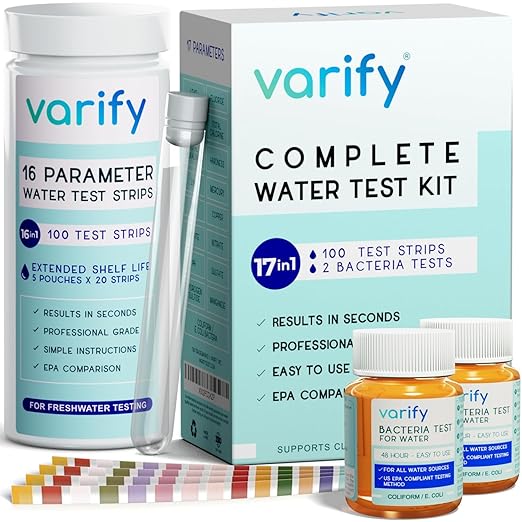
This comprehensive kit tests for 17 parameters including chlorine, fluoride, lead, iron, and bacteria, giving you a full picture of your water's safety in minutes. The 100 color-coded test strips come in 5 individually sealed pouches of 20 for extended freshness, while 2 included bacteria tests deliver results within 48 hours. Every purchase contributes a portion of proceeds to Water For Good, supporting clean water access in Central Africa.
Check On AmazonIf you click this link and buy, we earn a commission at no additional cost to you.
The Limits That Determine Whether a Single System Works
Integrated air injection oxidation systems combined with a softener are genuinely capable equipment for moderate well water contamination. Within the right range they handle iron, sulfur, and hardness without separate stages. The problem is that the phrase “handles iron and sulfur” on a product page almost always comes with limits buried in the spec sheet, or not mentioned at all.
Field Note: A homeowner contacted me after a dealer installed a two-tank AIO plus softener combo on a property with water testing at 4 PPM iron, mostly ferric, and around 1.5 PPM hydrogen sulfide. The system was rated for ferrous iron up to 3 PPM and sulfur up to 1 PPM. Within a year the resin was fouled, the AIO media was exhausted ahead of schedule, and the sulfur smell had returned. The dealer had not checked the actual water test against the spec limits before installing. The homeowner had been sold an inventory item, not a matched solution.
The thresholds below reflect the practical operating range I would use when deciding whether a combo is appropriate. All four conditions need to be met at the same time, not just one or two.
| Contaminant | Combo system works within | Staged systems needed above |
|---|---|---|
| Ferrous (clear water) iron | Under 3 PPM | 3 PPM or higher |
| Ferric (red or orange) iron | Not applicable | Any detectable amount |
| Hydrogen sulfide (H2S) | Under 1 PPM H2S | 1 PPM or higher |
| Water hardness | Under 15 GPG | Above 15 GPG |
The mechanism behind AIO treatment is oxygen injection into the water stream, which oxidizes ferrous iron into ferric iron and reacts with H2S so both can be filtered out through the media bed. That process has a capacity ceiling tied to media bed size and the system’s oxygen supply. High contamination loads exhaust that capacity faster than the system is designed to handle. The result is breakthrough, where untreated contaminants pass through and reach the softener, fouling the resin from the inside out.
The Treatment Train: Why Order Matters as Much as Equipment Choice
Whether you use an integrated system or separate components, the sequence of treatment determines whether everything downstream functions properly. The correct order for iron, sulfur, and hardness is: oxidation and filtration first, then a sediment cartridge filter positioned before the softener, then the softener last.
The logic for softening last is straightforward. Iron coats ion exchange resin beads and reduces their capacity to attract and hold calcium and magnesium ions. H2S accelerates that fouling. Even fine mesh resin, which handles iron better than standard 8% crosslink resin, is not immune when iron and sulfur reach it continuously. Protecting the softener means removing those contaminants before the water gets there.
- Stage 1, oxidation and iron/sulfur filtration. An AIO system, greensand filter, or aeration setup oxidizes ferrous iron and H2S and captures the resulting particulates. This stage is responsible for preventing iron staining and removing the rotten egg smell. Greensand handles higher loads than most residential AIO units but requires periodic regeneration with potassium permanganate to recharge the media.
- Stage 2, sediment cartridge filter before the softener. A 20-micron sediment filter removes fine particles that pass through the oxidation stage. On any well water system this step adds value. With iron present it is not optional. To be clear, this filter sits between the oxidation stage and the softener, not before the AIO.
- Stage 3, water softener. With iron and sulfur already addressed upstream, the softener works the way it was designed to. Ion exchange removes hardness cleanly, the resin is not being contaminated, and regeneration cycles function at normal efficiency.
This three-stage approach is what I would expect to see on severe well water when the installer is matching equipment to the actual test results. One homeowner account I have referenced before in similar situations captured it plainly: the solution was an iron filtration system installed upstream of the softener, the softener handled hardness, and the filter handled everything else. That is the right division of labor, and it is the standard any dealer working in this space should be using.
For a deeper look at iron treatment specifically, including when fine mesh resin alone is sufficient versus when a dedicated filter is required, the guide to well water softeners for iron covers the ferrous versus ferric distinction and the limits on softener-only approaches in detail. For the sulfur side, including aeration versus greensand versus AIO, the guide to treating sulfur smell in well water explains what actually works and why a softener alone will not solve it.

This large-capacity filter housing is compatible with any standard 20 by 4.5-inch Big Blue sediment or carbon filter cartridge, making it a versatile choice for high-flow whole house filtration applications. A built-in pressure relief button makes cartridge replacements quick and hassle-free, and Teflon tape on threaded connections along with hand-tight plus a quarter to half turn installation helps ensure a leak-free seal. Note that mounting brackets, screws, and a tightening wrench are not included and must be purchased separately.
Check On AmazonIf you click this link and buy, we earn a commission at no additional cost to you.
Best System Type by Water Test Profile
Once you have a full water test in hand, the equipment decision follows from the numbers. The ranges below are based on how each system type performs in practice, not just rated specs. If your water falls between profiles, err toward the more capable option.
Ferrous iron under 3 PPM, no ferric iron, H2S under 1 PPM, hardness under 15 GPG. An integrated AIO plus softener system sized correctly for household demand and water load handles all three within these limits. Sizing still requires the iron adjustment: add 4 to 5 GPG per 1 PPM of ferrous iron to your hardness number before calculating grain capacity. For example, 12 GPG hardness with 2 PPM iron should be sized as a 20 to 22 GPG load, not 12 GPG.
Ferrous iron between 3 and 6 PPM, or any ferric iron present, or H2S between 1 and 2 PPM. A dedicated backwashing oxidizing filter, greensand or catalytic carbon, handles the iron and sulfur load, followed by a 20-micron sediment cartridge filter before the softener. This setup protects the resin and handles higher contamination than a combo system can maintain. The softener is sized to the adjusted GPG, which at this iron level will be significantly higher than the raw hardness reading.
For severe well water, meaning ferrous iron above 6 PPM, heavy ferric iron staining, H2S above 2 PPM, or hardness above 20 GPG, the right approach is a larger-capacity backwashing oxidizing filter sized specifically to the iron and sulfur load, a sediment pre-filter before the softener, and a softener with demand-initiated regeneration. Timer-based regeneration in this scenario either under-regenerates during high-use periods or wastes salt and water during low-use ones. The variability in severe well water makes demand-initiated the only practical choice.
The broader question of how this decision fits into the full water softener selection picture, including city water situations and sizing for household size, is covered in the overview of water softener selection by situation. And if your primary question is whether to start with the well water side or the hardness side, the guide to water softeners for well water covers the fundamental differences between treating well water versus city water before getting into equipment specifics.
Note: If your water has any ferric iron, meaning orange staining on fixtures or a reddish tint when water sits in a white container, a dedicated upstream filter is required regardless of what any softener’s iron rating claims. Ferric iron is particulate. The iron rating on a softener box refers to dissolved ferrous iron only. No softener handles ferric iron without the resin fouling.
Why Separate Components Are Often Worth the Extra Cost
The modular approach, dedicated equipment at each stage rather than an all-in-one unit, costs more upfront in some configurations. It is still usually the better long-term decision for well water above the moderate range, for two reasons.
First, performance. A dedicated backwashing oxidizing filter has a larger media bed and a more aggressive backwash cycle than the AIO stage inside a combo unit. It handles higher iron and H2S loads without breakthrough. The softener downstream is protected from the contamination that shortens resin life, and the system as a whole maintains consistent output over time rather than degrading steadily as the combo media exhausts under a load it was not rated for.
Second, serviceability. When something needs attention in a staged system, each component can be diagnosed and serviced independently. If the greensand media needs replacement, the softener keeps running. If the softener develops a valve issue, the upstream filtration is unaffected. Diagnosing a performance problem is also cleaner when each stage has a single function. In a combo unit, a drop in performance could be coming from the AIO media, the resin, the control valve, or the air injection mechanism, and separating the cause is harder.
The upfront cost difference between a combo and a staged setup is often smaller than homeowners expect, particularly when the combo is a higher-end unit sized for upper-moderate contamination. Running the numbers on media replacement schedule and expected resin lifespan usually narrows the gap further over a five to ten year horizon.
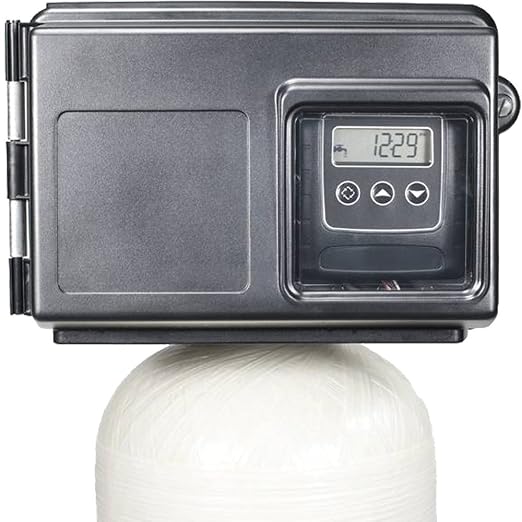
This chemical-free whole house system uses air injection and oxidation to remove iron, sulfur, and manganese from your water without the need for added chemicals or separate chemical tanks. A patented piston keeps the entire oxidation process contained within one tank, creating a pressurized air bubble during backwash to trap impurities and minimize maintenance costs and downtime. The system arrives fully equipped with a tank riser tube, deflector, control head, media, and stainless steel bypass valve for straightforward installation in an average-sized home.
Check On AmazonIf you click this link and buy, we earn a commission at no additional cost to you.
How to Check a Dealer Quote Before You Commit
The most common place I see homeowners lose money on iron and sulfur treatment is at the quote stage. A confident dealer with a slick system presentation is not the same thing as a dealer who matched equipment to your water. Before accepting any quote for a combined iron, sulfur, and hardness system, go through these six points.
- Does the quote list your actual test numbers? Iron PPM and type, H2S PPM, total hardness, and pH should all be written on the quote or the supporting spec sheet. If the dealer has not asked for your test results, or has not listed them in the proposal, they are not matching equipment to your water.
- Does the system’s rated limit exceed your test result on every contaminant? Pull the spec sheet for the specific model and compare each number. The rated iron limit, the rated H2S limit, and the rated hardness capacity all need to be above your actual readings, with a margin, not just barely above them.
- Is ferric iron addressed by a dedicated filter upstream, or is the quote just calling the softener an “iron softener”? If any ferric iron is present in your test, there needs to be an oxidizing filter stage upstream of the softener. A softener described as handling iron without a filter in front of it for ferric iron is not the right equipment.
- Is the softener positioned after the iron and sulfur treatment, not before? The treatment order should be filtration first, sediment cartridge second, softener last. A quote that places the softener first or in parallel with the AIO is not using the correct staging.
- Does the quote specify media type, backwash requirements, and maintenance schedule? Greensand requires potassium permanganate regeneration. AIO media has a rated lifespan at specific load levels. A quote that does not mention maintenance is not giving you the full cost picture.
- If the proposal is a combo system, does the dealer state clearly what happens when your water exceeds the rated limits? A dealer who knows their equipment will tell you what the system is not designed for. If they do not bring up limits, ask directly: what happens to this system if my iron or sulfur level is higher than what it is rated for?
If a dealer cannot answer those questions with specific numbers, that is not a quote worth accepting. It is a sales presentation.

Sized for homes with 3 to 4 bathrooms and up to 5 family members, this system treats 48,000 grains of hardness and up to 10 ppm of iron by removing hard minerals like iron and magnesium that can clog pores and cause skin irritation. A built-in sediment and GAC pre-filter captures sand, dirt, rust, and other large particles at the source, protecting appliances and extending the life of your water softener. The high-efficiency Aquatrol control head helps conserve water and lower maintenance costs over time.
Check On AmazonIf you click this link and buy, we earn a commission at no additional cost to you.
Final Thoughts: Match the Equipment to the Numbers, Not the Other Way Around
Iron and sulfur together in well water almost always point toward a staged treatment approach. The window where a combo system is genuinely appropriate is real, but it is not wide. If your test results put you near the upper boundary on iron or H2S, or if any ferric iron is present, move to separate components. The resin protection alone justifies the decision over the life of the system.
Before accepting a quote, put your water test numbers next to the rated limits of the exact system being proposed. If any number sits above a rated limit, staged equipment is the right call. If the dealer cannot tell you what the rated limits are, find a different dealer.
Treat the iron and sulfur first. Soften last. And do not let anyone sell you a single-box solution without showing you, in writing, exactly where your water sits relative to the spec limits of that system.
FAQs
🧪 Can a water softener handle iron, sulfur, and hardness all at once?
Not reliably on its own. A standard softener does not remove H2S gas, and iron above 3 PPM ferrous or any ferric iron fouls the resin. An integrated AIO plus softener combo can handle moderate levels of all three within specific limits, but above those limits a staged treatment setup is required.
💧 What is the correct order to install treatment equipment for iron and sulfur?
Oxidation and filtration first to handle iron and H2S, then a sediment cartridge filter positioned before the softener, then the softener last. The sediment filter sits between the oxidation stage and the softener, not before the AIO. Softening always comes last.
🔢 How does iron affect softener grain capacity sizing?
Add 4 to 5 GPG to your hardness number for every 1 PPM of ferrous iron before calculating grain capacity. Water testing at 10 GPG hardness and 3 PPM iron should be treated as roughly 22 to 25 GPG for sizing purposes. Always size up, not down, when iron is present.
🟠 My water leaves orange stains on fixtures. Does that change what I need?
Yes. Orange or reddish staining indicates ferric (particulate) iron. Ferric iron fouls softener resin on contact and cannot be handled by any softener regardless of the iron rating on the box. A dedicated oxidizing filter upstream of the softener is required before any softening will work properly.
🐣 What actually causes the rotten egg smell in well water?
Hydrogen sulfide gas, produced by sulfur-reducing bacteria in groundwater. It is a separate problem from hardness and iron. A water softener does not remove it. Effective treatment options include aeration, AIO oxidation systems, and greensand or catalytic carbon oxidizing filters upstream of the softener.
🔧 Is an AIO softener combo worth it for well water with both iron and sulfur?
It depends entirely on your water test numbers. Within the limits, ferrous iron under 3 PPM, H2S under 1 PPM, hardness under 15 GPG, and no ferric iron, a quality combo is a reasonable and cost-effective choice. Above any of those limits, a staged setup with dedicated filter components will outperform the combo over time and protect the softener resin from fouling.
📋 What tests do I need before buying treatment equipment for iron and sulfur?
Total hardness in GPG, ferrous iron in PPM, a visual check for ferric iron, hydrogen sulfide in PPM, and pH at minimum. Manganese testing is also useful if it is common in your area. A certified lab test gives more accurate PPM readings for iron and H2S than home test strips, and the cost is far lower than buying the wrong system.