Hard Water in Phoenix Is Not the Same Problem as Hard Water in New York
The best water softener for hard water depends almost entirely on your local GPG, not the brand name on the box or a recommendation from someone in a different region. A homeowner in upstate New York at 3 GPG and a homeowner in Phoenix at 18 GPG can both have “hard water,” but the system requirements are so different that one product recommendation cannot serve both situations. The same 48k grain unit that works well for a family in upstate New York will struggle to make it a full week between regeneration cycles for that same family in Scottsdale.
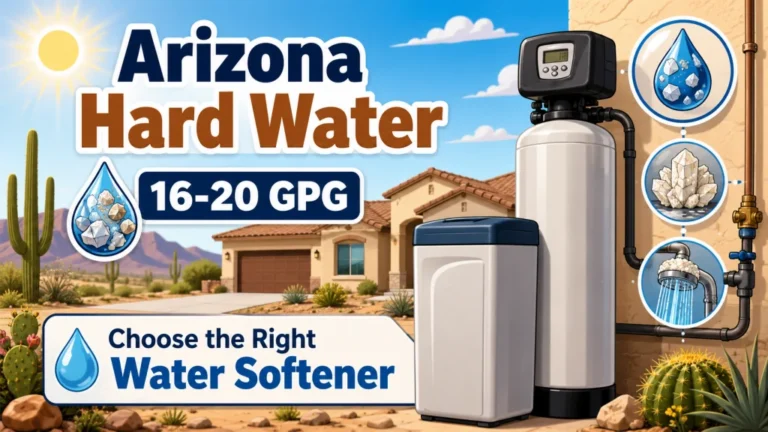
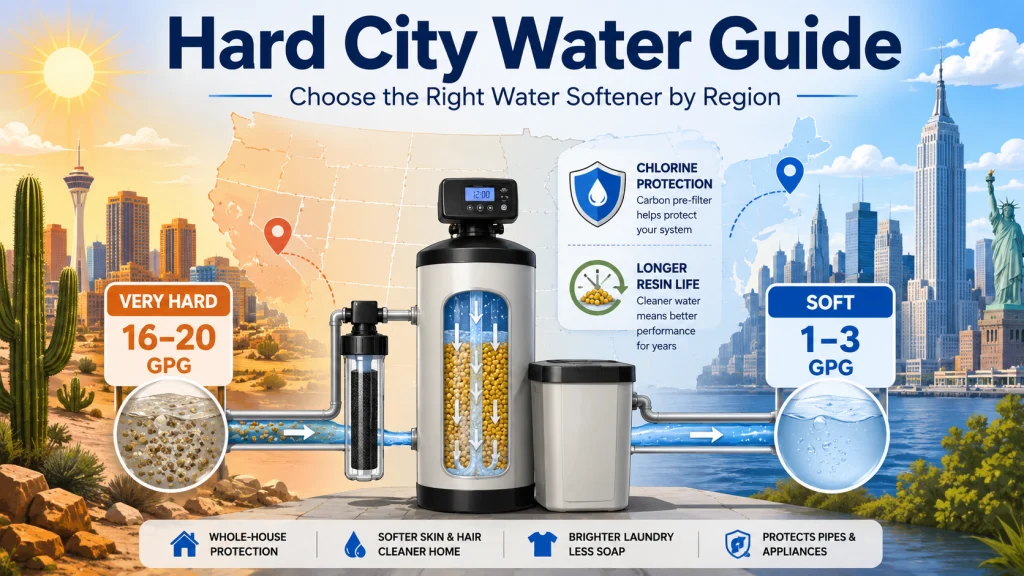
The extreme hardness in the Southwest and South Texas comes from different regional sources, but the practical result is similar: elevated calcium and magnesium. Phoenix and Las Vegas are heavily shaped by Colorado River basin water, with Las Vegas water sourced from Lake Mead and concentrating those minerals further through evaporation as reservoir levels drop. San Antonio’s hardness is driven more by limestone-heavy Edwards Aquifer water. The result across these regions is consistently elevated GPG that standard national sizing guides were never calibrated for. The table below reflects typical ranges by region based on utility data and USGS sources.
| Region or City | Typical GPG Range | Hardness Classification |
|---|---|---|
| Phoenix / Scottsdale, AZ | 16-20 GPG | Very Hard |
| Las Vegas / Henderson, NV | 16-18 GPG | Very Hard |
| San Antonio, TX | 15-20 GPG | Very Hard |
| Dallas / Fort Worth, TX | 10-15 GPG | Hard |
| South Florida | 8-15 GPG | Hard |
| US National Average | 7-10 GPG | Moderately Hard |
| New York City | 1-3 GPG | Soft to Slightly Hard |
| Seattle, WA | 1-4 GPG | Soft to Slightly Hard |
Regional GPG is where every sizing calculation starts. A family of four in Phoenix at 18 GPG uses roughly 37,800 grains of softening capacity per week: four people at 75 gallons per day, times 18 GPG, times seven days. A 48k grain system running at real-world efficiency of around 70% has usable capacity of about 33,600 grains per cycle. That falls short of a full week’s demand, which means regenerating before the seven-day mark, slightly more salt per month, and more valve wear than the system was designed for. The correct sizing for that household is 64k at minimum, with 80k giving a comfortable margin. Getting that calculation right before purchasing is what the water softener sizing guide covers in full, including the complete formula across household sizes and GPG levels.

This complete high-flow system comes equipped with a digital metered 5600SXT control head, 2 cubic feet of resin in a 12 by 48-inch tank, and a larger 18 by 33-inch round brine tank with bypass valve included and ready to install. On-demand metered regeneration treats up to 16 GPM and only cycles when needed, conserving salt and water while protecting plumbing, appliances, and fixtures from scale buildup. The system is backed by a 5-year warranty on the control head and a 10-year warranty on the tank.
Check On AmazonIf you click this link and buy, we earn a commission at no additional cost to you.
City Water and Well Water Are Not the Same Softening Problem
City water and well water both produce hard water, but the chemistry diverges early. Municipal water is treated before it reaches your home: consistent mineral levels, reliable hardness readings, no iron in most cases, no sulfur, and no sediment loading the resin bed. And consistently, chlorination. That last factor is a constant in city water that is almost never present in a private well, and it changes the most important resin spec in a city water installation.
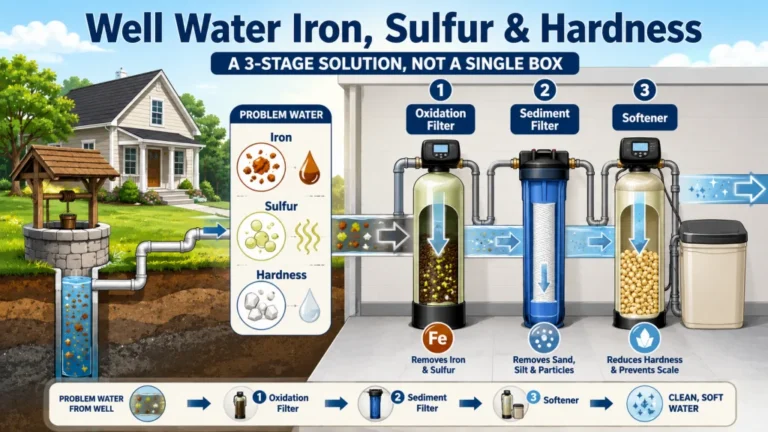
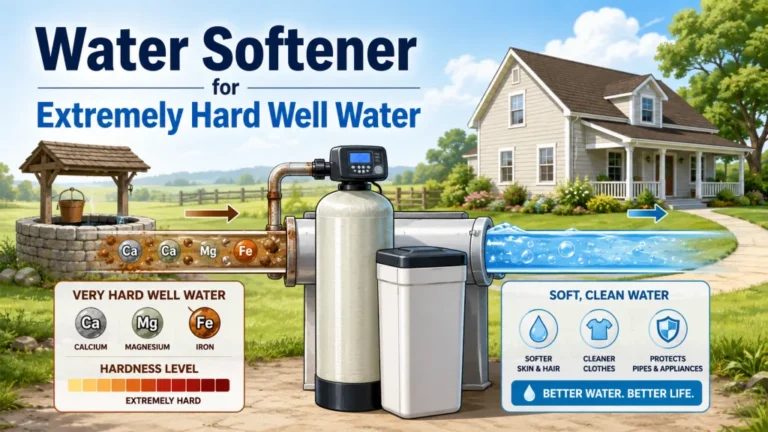
This page focuses on city water specifically. If your water comes from a private well, the iron, sulfur, sediment, and pre-filtration decisions that don’t apply here become the primary variables instead. The well water softener guide covers those scenarios in full. The treatment approach differs enough that mixing city and well water advice leads to the wrong equipment in the wrong configuration.
Field Note: One of the patterns I see repeat in high-GPG city water areas is homeowners who sized their system based on a recommendation from someone in a much softer-water region. The system regenerates more often than expected, salt disappears faster than budgeted, and nobody investigates until the resin is already under early stress. The utility’s annual water quality report is free, usually available on the utility’s website, and takes five minutes to find. It changes every decision downstream.
How to Read Your Utility Report Before Buying Anything
Your utility publishes an annual Consumer Confidence Report that includes hardness data for your supply. The catch is that hardness is not always reported in GPG. Many utilities list it in mg/L as CaCO3, which is milligrams per liter expressed as calcium carbonate. Converting to GPG is straightforward: divide the mg/L figure by 17.1. A report showing 300 mg/L as CaCO3 translates to roughly 17.5 GPG. A report showing 120 mg/L is about 7 GPG.
If the report covers a range across months or quarters, use the higher end for sizing. Hardness can vary seasonally depending on source water blending, and sizing for a peak-hardness period prevents the most noticeable problems. A home test strip at your specific tap is a useful cross-check if you want to verify the utility’s number at your address rather than the supply average.
A few things worth flagging once you have your number. If your GPG is below 4, which is common in cities like Seattle, New York, and parts of the Pacific Northwest, a salt-based softener may provide minimal practical benefit. The scale accumulation that motivates most softener purchases becomes significant above 7 GPG. Below that threshold, whether the installation cost and ongoing salt maintenance are justified depends on your specific situation. On the other end of the range, if your utility report lists chloramine rather than chlorine as the disinfectant, that affects the pre-filtration approach for protecting resin. A carbon pre-filter still applies, but chloramine requires a different contact time and carbon type than standard chlorine removal. That distinction matters when speccing the pre-filter stage alongside your softener.
The guide to understanding hard water and what different GPG levels mean goes through the full range in more detail, including what each hardness threshold produces in terms of scale buildup, soap behavior, and appliance wear.

This kit lets you test drinking water, pool water, or any water source in seconds using a simple dip-and-read method with an oversized color chart ranging from red to green, covering 0 to 25 GPG and 0 to 425 PPM. All 100 strips are protected by FreshSeal technology across a ready-to-use bottle and two sealed pouches for long-term accuracy. Each purchase also funds a full year of clean water for someone in the Central African Republic.
Check On AmazonIf you click this link and buy, we earn a commission at no additional cost to you.
The Resin Spec That Determines How Long Your System Lasts
Ion exchange resin is the working core of any salt-based softener. The resin beads capture calcium and magnesium during the softening cycle and release them during regeneration. Over time, those beads degrade. In city water, the primary cause of accelerated degradation is not the hardness minerals. It is chlorine.
Resin is manufactured in two common crosslink densities: 8% and 10%. The crosslink percentage describes how tightly the polymer strands are interwoven. Chlorine attacks ion exchange resin by oxidizing those strands, causing beads to swell, crack, and gradually lose softening capacity. At 8% crosslink, that process moves faster. At 10% crosslink, the denser structure resists chlorine degradation significantly better. The manufacturing cost difference between the two grades is modest. The lifespan difference in a city water installation is not. I’ve pulled resin from city water installations after seven years and seen 8% crosslink beads that looked noticeably degraded, while comparable 10% crosslink resin from well water systems, running without chlorine exposure, was still performing well past ten years.
Most product listings don’t state the crosslink percentage clearly. The spec is buried in technical documentation, omitted from the label entirely, or described vaguely as “premium resin.” For city water specifically, confirming whether a system uses 10% crosslink resin before purchasing is worth a direct question to the manufacturer. The city water softener buying guide covers which systems confirm this spec and what to look for in listings that don’t disclose it upfront.
Key point: A whole-house carbon pre-filter installed upstream of the softener removes chlorine before it reaches the resin, extending resin life regardless of crosslink percentage. For a city water installation intended to last two decades or more, factoring a carbon pre-filter into the total budget from the start is worth the additional cost.

Installed at the main water supply line, this system removes up to 99% of chlorine and up to 95% of sediment, rust, herbicides, industrial solvents, and other contaminants from every tap in your home. With 1-inch NPT connections and 20 by 4.5-inch cartridges supporting up to 15 GPM, it delivers strong whole-house flow with minimal pressure drop and straightforward DIY installation. Unlike reverse osmosis systems, it retains healthy minerals in your water and is backed by a lifetime personalized support warranty with online product registration.
Check On AmazonIf you click this link and buy, we earn a commission at no additional cost to you.
Where Standard Sizing Guides Fall Short for High-GPG City Water
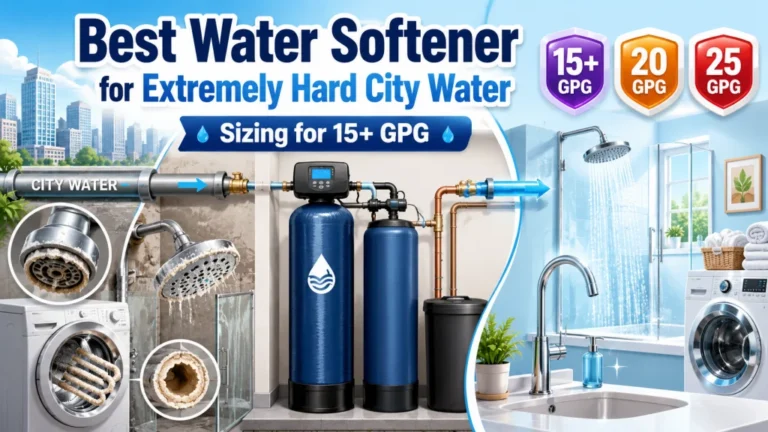
Standard sizing tools assume a GPG around the national average. For homeowners in cities running 15 to 20 GPG, those tools produce recommendations that are systematically too small. A 48k grain system that handles a family of four comfortably at 8 GPG cannot maintain weekly regeneration cycles for that same family at 18 GPG. The math doesn’t work in their favor, and the consequences show up in salt bills and premature valve wear.
Two problems compound from undersizing. First, more frequent regeneration cycles mean more salt consumed per month and more mechanical cycling of the control valve, which shortens its practical lifespan. Second, at high GPG the resin bed reaches saturation faster, increasing the chance of hardness breakthrough, where hard water passes through an exhausted bed before the next regeneration cycle runs. For a water heater or dishwasher downstream, inconsistently softened water at 15 to 20 GPG builds scale accumulation that defeats the purpose of having a softener in the first place.
Correct sizing thresholds by GPG level look like this:
- At 7-12 GPG, a 48k grain system handles most three- to five-person households on a weekly regeneration schedule with room to spare. This is the range where standard guide recommendations hold up.
- At 13-17 GPG, a 64k minimum is appropriate for families of three or four. A 48k system at this hardness level regenerates noticeably more often, adding to annual salt costs and accelerating valve wear.
- At 18-20 GPG, a 64k system is the floor for a family of three, and most families of four will be better served by 80k or a twin-alternating setup. Twin-alternating units run two resin tanks and alternate between them during regeneration, so one tank is always in service and soft water delivery is never interrupted.
- Iron in city water is uncommon but possible. If your utility report lists iron above 0.5 PPM, add 4-5 GPG to your hardness number before sizing. The same iron adjustment that applies to well water applies here.
These are starting points based on typical usage. A household with high daily water consumption, or one running frequent large laundry loads, should size up from the threshold. The detailed formula and the full breakdown of what grain capacity ratings mean at different usage levels are in the softener sizing guide. The regional guides below include specific minimum sizes for cities where local GPG is documented and the undersizing problem is confirmed.
The Dealer Markup Reality for City Water Installs
Most homeowners buy a water softener through a local dealer, a regional water treatment company, or a national service chain. That purchase path has real value: professional installation, service agreements, and warranty support that direct-to-consumer purchases don’t include by default. But there is something worth understanding before signing a contract, and it comes down to what is actually inside the box.
The regeneration control valves in most residential softeners come from a small number of manufacturers. Those same valves show up in systems sold under premium dealer names at two to five times the price of equivalent direct-to-consumer units using the identical hardware. The premium in a dealer channel often reflects the service relationship around the system, not proprietary technology inside it. I’ve replaced enough dealer-installed systems over the years to confirm that the valve at the core is frequently the same one available through direct channels for a fraction of the installed price.
What I tell homeowners getting dealer quotes: ask directly what control valve is in the system. A reputable dealer answers without hesitation. An evasive response is information. If the system being proposed uses the same valve as a direct-to-consumer alternative available for significantly less, you are paying for the service wrapper, not for hardware superiority. That service relationship may still be worth it, depending on your comfort with self-installation and ongoing maintenance. Going in knowing the difference makes the conversation more useful. The overview of what actually separates better water softener systems from overpriced ones covers the component-level factors worth knowing before any dealer conversation.
California Restrictions and HOA Rules: When Regulations Change the Options
Salt-based ion exchange softeners discharge brine during the regeneration cycle. In most of the country that is unrestricted. In certain California water districts, and in some HOA developments in Arizona and Nevada, that discharge is a legal constraint that affects which systems are available before any performance comparison begins.
The California restrictions are not a statewide blanket ban. Specific water districts, primarily in Southern California and portions of the Bay Area, prohibit or limit sodium chloride discharge into local wastewater systems. The underlying concern is chloride concentration in recycled water supplies used for irrigation. Checking directly with your water district before purchasing is the only reliable way to determine what applies to your address, since rules vary by district rather than by city or zip code.
Where restrictions apply, the alternatives most commonly available are: potassium chloride-based ion exchange systems, which deliver true soft water using KCl rather than NaCl and may be compliant depending on your specific district’s rules; portable exchange service, where a water treatment company delivers a pre-charged tank and swaps it out when exhausted, so no brine discharge occurs on your property; and salt-free TAC conditioners, which prevent scale without any discharge. Salt-free systems do not reduce GPG or deliver the soft-water feel of ion exchange. The salt-free conditioner guide covers what those systems actually deliver and the hardness ranges and goals where they make a reasonable alternative to ion exchange.
HOA restrictions outside California are less common but worth checking before purchasing. Some planned communities in the Las Vegas area and parts of the Phoenix metro have covenants restricting softener installation or brine discharge. Checking the HOA documents before buying takes less time than discovering the restriction after the installation is already done.

These 99% sodium-free pellets offer a healthier alternative to traditional salt for anyone monitoring sodium intake while still enjoying the benefits of softened water. The bag features a sturdy plastic handle for comfortable carrying and an easy-tear opening for hassle-free pouring.
Check On AmazonIf you click this link and buy, we earn a commission at no additional cost to you.
Final: Four Questions to Answer Before Comparing Systems
Pro Tips: Before comparing any systems, answer these four questions. First, what is your GPG, from your utility report or a test strip at your tap? Second, how many people are in your household and what is your daily water use? Third, does your utility disinfect with chlorine or chloramine? Fourth, does your water district or HOA restrict brine discharge? The answers determine your grain capacity target, resin spec requirement, pre-filtration need, and whether salt-based ion exchange is even the legal option available to you.
City water softening is more predictable than well water, but it still requires knowing your actual numbers before looking at any product. GPG drives sizing. Chlorine drives the resin spec decision. Local regulations determine what is legal to install. And dealer channels benefit from you understanding what hardware you are purchasing before you agree to a price. The regional guides below go deeper on each situation, with product picks and sizing guidance built around documented local water conditions rather than national averages.
Guides by City Water Situation
Each guide below covers a specific hard city water scenario in full, with product picks, sizing guidance, and the variables unique to that situation. The regional guides use documented local GPG data rather than national averages, so the recommendations reflect what homeowners in those cities actually need rather than what works for a national average household.
| Guide | What It Covers |
|---|---|
| Best Water Softener for City Water | 10% crosslink resin, demand-initiated regeneration, and product picks for standard municipal hardness at 7-15 GPG. |
| Best Water Softener for Arizona | Why standard sizing fails at 16-20 GPG, minimum capacity requirements for Phoenix and Scottsdale, and the Colorado River mineral profile. |
| Best Water Softener for Texas | San Antonio’s 15-20 GPG, how Dallas-area hardness differs, and why parts of rural Texas introduce an iron problem that city guides skip. |
| Best Water Softener for Las Vegas | Lake Mead’s concentrated mineral profile, elevated TDS beyond hardness alone, and HOA restriction considerations for Nevada buyers. |
| Best Water Softener for Florida | Florida’s regional hardness variation, chloramine use in some utilities, and the rural iron problem that catches buyers off guard. |
| Best Water Softener for Extremely Hard Water | Sizing math and product options for any location above 15 GPG, including when a dual-tank setup makes more sense than a high-capacity single tank. |
| Best Water Softener for Tankless Water Heaters | Why scale damages tankless units faster than storage tanks, the softening specs that matter, and what to install upstream before the heater. |
FAQs
💧 What GPG level is considered hard water?
Water above 7 GPG is generally classified as hard. The range 7-10 GPG is moderately hard, 10-15 GPG is hard, and above 15 GPG is very hard. The US national average sits around 7-10 GPG, but cities in the Southwest, South Texas, and parts of the Great Plains commonly run 15-20 GPG or higher.
🔍 How do I find out how hard my city water is?
Your utility publishes an annual Consumer Confidence Report with hardness data. Search “[your city] water quality report” or look for a CCR link on your utility’s website. If hardness is listed in mg/L as CaCO3, divide by 17.1 to convert to GPG. A home test strip at your tap can confirm the utility’s figure for your specific address.
🧪 Does city water need a different water softener than well water?
Not a different type, but different specs. City water contains chlorine, which degrades standard resin faster, making 10% crosslink resin more important. Well water typically has no chlorine but often has iron, sulfur, or sediment requiring pre-treatment. The equipment overlaps, but the priorities differ enough that advice for one situation frequently leads to the wrong choices for the other.
📏 What size water softener do I need for hard city water?
At 7-12 GPG, a 48k grain system handles most three- to five-person households. At 13-17 GPG, 64k is a reasonable minimum for a family of three or four. At 18-20 GPG, a family of three needs at least 64k and most families of four will be better served by 80k or a twin-alternating setup. Standard online calculators consistently underestimate for high-GPG cities like Phoenix, San Antonio, and Las Vegas.
🌵 Does a water softener remove chlorine from city water?
A standard ion exchange softener removes hardness minerals only. It does not remove chlorine. To eliminate chlorine before it reaches the softener resin, you need a whole-house carbon pre-filter installed upstream. Beyond improving taste, that pre-filter protects the resin from chlorine degradation and can meaningfully extend the resin’s working life in a city water installation.
⚖️ Are water softeners banned in California?
No statewide ban exists. Specific water districts in Southern California and parts of the Bay Area restrict sodium chloride discharge from traditional ion exchange softeners. Outside those districts, salt-based systems are legal. Whether potassium chloride systems or salt-free conditioners are compliant in restricted areas varies by district, so verify directly with your local water authority before purchasing.