Why Tankless Heaters Are More Vulnerable to Hard Water Than Tank Heaters
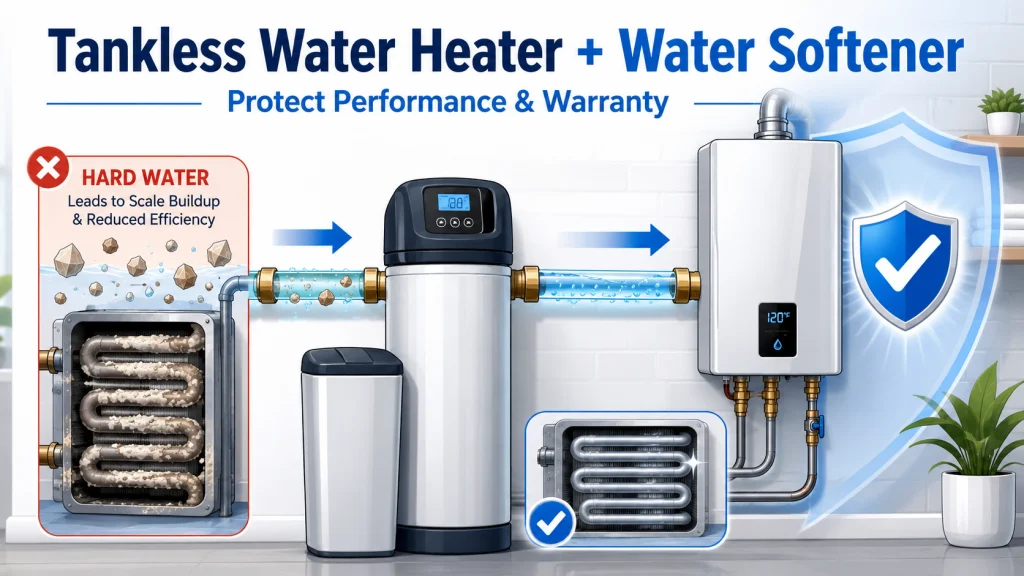
If you are trying to pair the best water softener for a tankless water heater setup, the first thing to understand is why tankless units face a different scale problem than conventional storage heaters. A traditional tank heater has a buffer. Minerals settle at the bottom of the tank and accumulate gradually, and the unit keeps functioning through early-stage scaling. A tankless heater has no such buffer. Water flows directly and continuously through a compact heat exchanger, and scale forms on the fins almost immediately at hardness levels that a tank heater would handle without much consequence.
The result is predictable. Flow rate drops as the exchanger fins narrow with scale buildup. The unit works harder to heat the same volume of water. Efficiency falls. In harder water areas, this process happens fast enough that homeowners notice a real decline within two to three years, sometimes sooner. What I see happen in practice is a homeowner installing a tankless heater in a city with 12 to 15 GPG water, skipping the softener to save money, and by year four they are looking at an expensive flush procedure or an early replacement. When they check the warranty documentation after the fact, they find a hardness limit they never knew existed. That is a costly discovery to make in retrospect.
Field Note: I have seen tankless units pulled at barely four years old with fins so scaled they were running at maybe 60% capacity. Every single time, nobody had told the homeowner that their water hardness exceeded the manufacturer’s stated limit. The unit had been installed cleanly, the water pressure was fine at install, and the paperwork was in order. The hard water part never came up in the sales conversation.
What the Warranty Documentation Actually Says
The hardness threshold is not always prominently disclosed on the product page or in sales materials. Most manufacturers bury it in the installation manual or warranty terms, where most buyers never look until something goes wrong. The typical limit across major tankless brands sits between 7 and 11 GPG. At or below that level, manufacturers generally accept the water without treatment. Above it, they expect softening or scale prevention upstream of the unit, and the burden of proof falls on the homeowner if a warranty claim involves the heat exchanger.
Monkey Wrench Plumbing, a licensed plumbing company that works regularly with tankless installations, has stated it plainly: a softener is not strictly required if your water falls within the hardness limits, but the manufacturer will void the warranty if the water is harder than specified and no treatment is present. That is not a gray area in most warranty documents. It is a stated condition of coverage, and it is enforceable.
The table below gives a general framework for thinking about hardness level relative to typical tankless requirements. Always check your specific brand’s documentation for the exact threshold.
| Hardness Level (GPG) | Typical Risk to Tankless Heater | What Is Typically Required |
|---|---|---|
| Under 7 GPG | Low. Most heaters operate within tolerance without treatment. | None required by most manufacturers. |
| 7 to 11 GPG | Moderate. Near or at the threshold for most major brands. | Confirm your specific manufacturer’s documentation. |
| 12 to 15 GPG | High. Scale formation on heat exchanger fins accelerates significantly. | Softener or confirmed-compliant conditioner required upstream. |
| Above 15 GPG | Very high. Heat exchanger damage likely within a few years without treatment. | Full ion exchange softening typically required. Verify manufacturer language on salt-free. |
Brand requirements vary more than the general framework suggests. Some manufacturers specify a GPG ceiling without defining the treatment method. Others require that water tests below 3 GPG at the point of entry to the heater. That distinction matters for whether a salt-free conditioner qualifies, and I come back to it after covering the installation sequence. Either way, reading your specific documentation before purchasing anything is not optional if you want the warranty to remain intact.

This kit lets you test drinking water, pool water, or any water source in seconds using a simple dip-and-read method with an oversized color chart ranging from red to green, covering 0 to 25 GPG and 0 to 425 PPM. All 100 strips are protected by FreshSeal technology across a ready-to-use bottle and two sealed pouches for long-term accuracy. Each purchase also funds a full year of clean water for someone in the Central African Republic.
Check On AmazonIf you click this link and buy, we earn a commission at no additional cost to you.
Installation Order: Softener Before Heater, Without Exception
This is where a surprising number of installations go wrong, and it is completely avoidable. The softener must be installed upstream of the tankless heater, meaning water flows through the softener first, then to the heater. Installing the softener anywhere downstream, even just after the heater on the hot water return line, provides zero scale protection to the heat exchanger. The unit sees untreated water on every heating cycle regardless of what is downstream.
The correct sequence for a typical residential setup is straightforward:
- Main water supply enters the home from the street or well.
- Sediment pre-filter, recommended for all setups and mandatory for well water.
- Water softener or conditioner, sized for your household’s hardness and flow demand.
- After the softener, treated water splits: one branch feeds cold fixtures directly, the other feeds the tankless heater.
- Tankless heater output supplies all hot fixtures throughout the home.
One detail that causes confusion during planning is the outdoor hose bib situation. If the softener is plumbed at the main line, outdoor irrigation and hose bibs will receive softened water. Softened water carries elevated sodium, and applying it consistently to lawns and gardens accumulates sodium in the soil over time. The right approach is to tap outdoor lines from the unsoftened supply, upstream of the softener. It adds a small amount of work to the installation but protects both your plants and your warranty setup.
For anyone building out a complete treatment plan from scratch in a hard water area, selecting the right softener for your hardness level and household size is worth doing before finalizing the plumbing layout. The physical footprint of the unit affects where it realistically fits in a utility room, especially when a sediment pre-filter stage is added upstream.
Field Note: One of the more frustrating situations I have walked into was a homeowner who already had a softener, installed on the hot water line only, after the heater. He had assumed that because he had soft water at the tap, the heater was protected. It was not. The heat exchanger had been seeing untreated 14 GPG city water for three years by the time I arrived. The fins were partially blocked, the flow sensor was struggling, and the warranty had long since lapsed. Upstream, on the cold supply line, before the heater, is the only position that does anything.

This 50-micron flushable and reusable filter serves as an ideal first stage in any whole house filtration system, capturing sediment, rust, dirt, and sand before water reaches finer filters downstream. A built-in Siliphos additive helps soften water, prevent scale buildup, and reduce pipe corrosion, with filter replacement recommended every 3 to 6 months for best results. The see-through housing allows easy visual monitoring, and dual threads with 1-inch MNPT and 3 to 4-inch FNPT connections make installation straightforward for indoor use within a pressure range of 20 to 100 PSI.
Check On AmazonIf you click this link and buy, we earn a commission at no additional cost to you.
Does a Salt-Free Conditioner Satisfy the Tankless Warranty?
This question comes up often, particularly in areas with salt discharge restrictions or in homes where the owner prefers to avoid ongoing salt maintenance. The answer is not universal, and anyone who tells you definitively one way or the other without referencing your specific brand’s documentation is guessing.
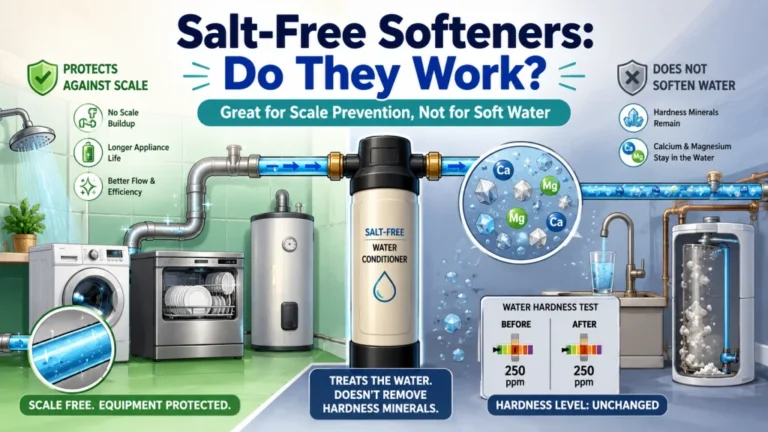
A salt-free TAC (template-assisted crystallization) conditioner prevents scale by changing the physical structure of hardness minerals so they do not adhere to surfaces. It does not remove those minerals from the water. If you run a hardness test after installing a salt-free conditioner, the GPG reading is unchanged. The minerals are still present in the same concentration. They are simply in a form less likely to deposit on surfaces.
Some manufacturers specify a GPG ceiling in their warranty without defining what type of treatment is required. In that scenario, a conditioner providing documented scale prevention may technically comply, since preventing scale accumulation is the actual goal. Other manufacturers require that water tests below a specific GPG at the point of entry to the heater. Since a salt-free conditioner does not change the measured GPG, it fails that requirement regardless of how effective it is at scale prevention. An independent DVGW-certified conditioner still shows the same hardness reading on a test strip as untreated water.
My recommendation is to pull the actual warranty documentation or contact the manufacturer directly and ask whether TAC-based scale prevention satisfies the hardness treatment requirement. For an expensive condensing unit, get the answer in writing. A $1,500 to $2,000 tankless heater is too expensive to risk on an assumption.
Key point: Salt-free conditioners prevent scale but do not lower the GPG reading. Warranties specifying a maximum hardness in GPG are not automatically satisfied by a salt-free conditioner, even a certified one, unless the manufacturer explicitly accepts scale prevention as equivalent to softening.
Sizing a Softener for Tankless Flow Demand
Tankless heaters draw water at rates that vary significantly by unit and installation. A whole-house condensing unit can pull 6 to 10 GPM at peak demand. A smaller point-of-use unit serving a single bathroom might draw 2 to 3 GPM. The softener needs to handle whatever peak flow the heater demands without creating a pressure drop that affects the heater’s performance or triggers a cold water sandwich effect at low draw rates.
Most residential softeners are rated for 7 to 12 GPM service flow under normal operating conditions. A single-bathroom application at moderate hardness will not stress a standard unit. A whole-house installation with multiple simultaneous demands, common in homes with two or more bathrooms running at once, can push a lower-rated softener to its limits during peak use. It is worth checking the softener’s rated service flow against your heater’s documented peak GPM before committing to a specific unit.
A concrete example: a family of 4 in a Phoenix suburb at 17 GPG running a whole-house condensing unit with a peak draw of 8 GPM needs a softener rated for at least 10 GPM service flow, with enough grain capacity to regenerate no more than every 5 to 7 days. At 17 GPG for 4 people, the weekly grain requirement is roughly 4 persons times 75 gallons per day times 17 GPG times 7 days, which works out to approximately 35,700 grains per week. A 48k system regenerates about every 9 to 10 days at that load, which is acceptable. A 32k system regenerates every 5 to 6 days, which is more frequent than ideal at high hardness levels and shortens control valve life over time.
Demand-initiated regeneration matters more in a tankless pairing than in most other setups. A timer-based softener regenerating on a fixed schedule can leave you with partially exhausted resin on high-use days, which means the heater sees harder water during those cycles. For the broader question of what else to look for before any softener purchase, the fundamentals of evaluating a water softener system are worth reviewing alongside the manufacturer’s tankless warranty requirements.
Buy the most affordable 32k softener on sale, install it anywhere downstream that fits, and assume the tankless heater is covered.
Check your heater’s warranty hardness limit first, size the softener for your actual GPG and peak flow demand, and install it upstream before the heater.
The two decisions, which softener to buy and where to position it, are connected. A correctly sized unit in the wrong location does nothing. A correctly positioned unit that is undersized for your hardness level and flow demand creates its own problems. Both have to be right.

IAPMO certified to NSF/ANSI Standard 44, this system is sized for homes with up to 5 people and 4 bathrooms, using ion exchange to deliver soft, scale-free water from every tap with city or well water compatibility. The user-friendly LCD allows metered operation that uses up to 50% less salt and 28% less water compared to standard time-based softeners, helping lower long-term costs on appliances, soap, and cleaning products. The bundle includes a recommended pre-filter and installation kit, and is backed by a 5 to 10-year limited warranty with dedicated customer support.
Check On AmazonIf you click this link and buy, we earn a commission at no additional cost to you.
What to Look for in a Softener for This Application
The warranty language determines the first decision. If the installation manual requires that water test below a specific GPG at the point of entry to the heater, you need ion exchange softening. If it specifies scale prevention without requiring a measured GPG reduction, a certified salt-free conditioner may qualify. Those are two different products with different mechanisms, and the warranty document is the deciding document, not the product marketing page. Starting with that clause before comparing any equipment saves time and avoids buying the wrong type entirely.
Beyond the salt-based versus salt-free question, the specs that matter most for this pairing are service flow rating, regeneration type, grain capacity, and bypass valve. Service flow must exceed your heater’s documented peak GPM, with enough margin that simultaneous draws do not create a pressure drop at the heater inlet. Demand-initiated regeneration is not optional here: a timer-based softener regenerates on a fixed schedule regardless of actual use, which can leave partially exhausted resin in place on heavy-use days and deliver harder water to the heat exchanger exactly when demand is highest. Grain capacity should be sized for your actual household hardness using the standard calculation, not for the national average of 7 to 10 GPG. A bypass valve is required for service access without cutting water to the whole home.
If you are on well water, a sediment pre-filter before the softener is not optional regardless of which type you choose. Well water sediment fouls resin beds significantly faster than typical city water scaling does. At 15 GPG with moderate sediment load, I have seen resin performance degrade noticeably within two years on a system that would last considerably longer on treated city water. The pre-filter is a low-cost component relative to the softener, and skipping it undermines everything upstream of it.
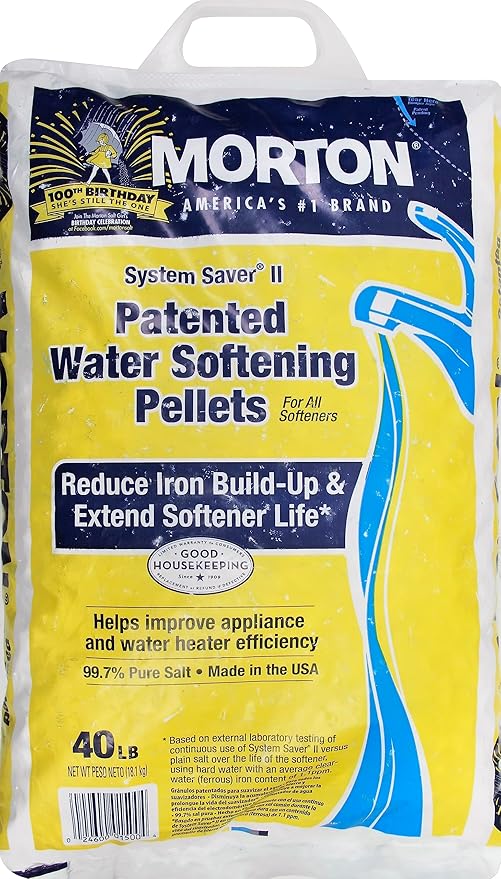
This 40-pound bag of USA-made System Saver pellets is designed to improve the taste of your water while helping extend the life of your appliances and water softener. Simple to use, just add the pellets directly to your softener's brine tank as needed.
Check On AmazonIf you click this link and buy, we earn a commission at no additional cost to you.
Common Mistakes That Leave the Heat Exchanger Unprotected
Most warranty-voiding situations I have seen trace back to one of a small number of avoidable errors. The failures are almost never about equipment quality. They are about placement, selection, or sizing decisions made without the right information.
- Installing the softener on the hot water line only, after the heater. The heat exchanger sees raw water on every draw. Soft water at the tap does not mean the heater is protected.
- Using a salt-free conditioner when the warranty requires a measured GPG reduction. The conditioner prevents scale but does not lower the hardness reading. If the warranty clause specifies a GPG ceiling, this does not satisfy it.
- Sizing by grain capacity but not checking service flow. A softener rated for 7 GPM paired with a heater pulling 9 GPM at peak creates inlet pressure restriction that affects the heater’s ability to maintain consistent output temperature.
- Skipping the sediment pre-filter on well water. Fouled resin means premature exhaustion, which means partially hard water passing through to the heat exchanger between regeneration cycles.
- Assuming the plumber installing the heater is also managing softener positioning, sizing, and warranty compliance. Many contractors are not water treatment specialists. Verifying those details typically falls on the homeowner unless it is explicitly written into the scope of work.
Running through a short pre-installation check before the plumber arrives covers most of these. Test water hardness in GPG. Locate and read the tankless heater’s installation manual for the stated hardness limit. Confirm whether the warranty requires actual GPG reduction or accepts scale prevention. Verify the softener’s rated service flow against the heater’s peak GPM. Size grain capacity for actual household demand at your hardness level, not the generic recommendation. Plan sediment pre-filter placement before the softener if on well water. Confirm outdoor hose bibs are tapped upstream of the softener if any irrigation use is expected. None of that takes long, and every item on that list has a corresponding failure mode in the field.

This professional-grade liquid cleanser removes iron, manganese, silt, metal particles, and other contaminants that salt leaves behind in your resin bed, valve parts, and beads. Regular use helps extend appliance life, reduce maintenance calls, and maintain consistent water quality across any water softener brand. It is NSF certified to NSF/ANSI/CAN Standard 60 for drinking water additives and is made in the USA, making it safe for families and pets. Apply 4 oz before each regeneration or use with the Pro Products Easy Feeder kit for daily low-dose treatment.
Check On AmazonIf you click this link and buy, we earn a commission at no additional cost to you.
Final Thoughts: Check the Documentation Before Any Installation Begins
The tankless warranty situation is one of those things that seems obvious in retrospect but almost nobody gets told upfront. Dealers selling the heater are focused on the heater. Dealers selling the softener may not know the specific hardness thresholds in your heater’s warranty language. The homeowner ends up in the middle, holding a voided warranty and a repair bill for a problem that a straightforward upstream installation would have prevented.
The sequence is not complicated once you have the right information in front of you. Check your water hardness. Read the installation manual for your specific heater model. Confirm whether salt-free treatment satisfies the warranty clause or whether actual ion exchange softening is required. Size the softener for your household’s grain demand and your heater’s peak flow rate. Install the softener upstream of the tankless heater, with any required sediment pre-filter placed before the softener. None of that is technically difficult. It just requires doing it in the right order, with the actual documentation in hand, before the plumber shows up.
FAQs
⚠️ Will hard water void my tankless water heater warranty?
It depends on your specific manufacturer’s documentation. Most major brands set a hardness threshold, commonly between 7 and 11 GPG. If your water exceeds that limit and no treatment is installed upstream, the manufacturer can deny warranty claims related to scale damage. Check your installation manual or contact the manufacturer directly before assuming coverage.
🔧 Does the softener have to go before the tankless heater in the plumbing?
Yes, always. The softener must be installed upstream of the heater so that treated water reaches the heat exchanger on every draw. A softener installed on the hot water line downstream of the heater does nothing to prevent scale inside the unit.
💧 Will a salt-free conditioner satisfy my tankless heater’s warranty?
It depends entirely on the warranty wording. Salt-free conditioners prevent scale but do not lower the measured GPG. If your manufacturer requires water below a certain GPG, a conditioner will not satisfy that requirement. Some warranties accept scale prevention as sufficient. Read the documentation or ask the manufacturer in writing before relying on a salt-free system for warranty compliance.
📊 What hardness level is too high for a tankless heater without treatment?
Most major brands list a threshold between 7 and 11 GPG. Below 7 GPG, most heaters operate within tolerance without treatment. Above 11 GPG, scale accumulation on the heat exchanger is a documented performance and warranty concern across most brands. Some manufacturers set the limit even lower, so verify your specific model.
🌊 Will a water softener reduce pressure or flow to my tankless heater?
A properly sized softener should not create a noticeable pressure drop. Match the softener’s rated service flow in GPM to your heater’s peak demand. An undersized softener can restrict flow during simultaneous high-demand draws, which is particularly noticeable with tankless units that rely on consistent inlet pressure to maintain temperature.
🔁 How often will a softener regenerate when paired with a tankless heater?
Regeneration frequency depends on your grain capacity, daily water use, and hardness level. At 10 to 14 GPG for a family of 4, a properly sized 48k unit with demand-initiated control should regenerate roughly every 7 to 10 days. More frequent regen than that usually means the system is undersized for your actual hardness and usage, and the heater may be seeing partially treated water during high-demand cycles.