Why Sizing Guides Built for Average Water Fail You Here
Most published sizing advice uses 7 to 10 GPG as the baseline because that covers the majority of US households on municipal water. Well water in the Southwest, Midwest, and rural areas frequently runs 15, 18, even 20 GPG or higher. When you plug those numbers into a guide built around the national average, the recommended capacity comes out too small and the system ends up working harder than it was designed to.
What that looks like in practice: a family of four at 20 GPG with a 48k grain softener is processing roughly 75,000 grains of demand per week after a standard efficiency buffer. That is well above what a 48k system should handle. The unit regenerates constantly trying to keep up, and frequent short-interval regeneration puts real wear on both the resin bed and the control valve. I have been called in more than once to troubleshoot a “defective” softener that turned out to be a correctly functioning unit running in the wrong application. The system was not broken. It was undersized by a margin that would not have mattered at 8 GPG but was significant at 18.
Field Note: A family of four on a rural well in the Midwest, 17 GPG raw hardness, 1.8 PPM iron. They bought a 48k unit based on a generic sizing calculator that did not ask about iron. Salt consumption was nearly double what the spec sheet projected, and the system was regenerating every four days. Adjusted effective GPG was around 25. They needed at minimum an 80k unit. The 48k was not defective, it was just the wrong tool for the job, and nobody told them before they bought.
The Iron Multiplier: Why 15 GPG Well Water Is Rarely Just 15 GPG
Iron competes with calcium and magnesium for resin exchange sites. The standard rule in water treatment is to add 4 to 5 GPG of effective hardness for every 1 PPM of dissolved ferrous iron. So if your well tests at 15 GPG hardness and 2 PPM iron, you are not sizing for 15 GPG. You are sizing for 23 to 25 GPG. That is a fundamentally different system than the one a standard guide would point you toward.
The multiplier stacks badly at extreme hardness. A lower-hardness well at 8 GPG with 1 PPM iron sizes for roughly 12 to 13 GPG, a modest adjustment. A well at 20 GPG with 2 PPM iron sizes for 28 to 30 GPG. That adjustment pushes the required capacity into a tier most buyers do not expect when they first see their water test results.
One detail worth flagging: if your water runs orange when it sits in a glass or leaves rust staining in fixtures, you likely have ferric iron, not dissolved ferrous iron. Ferric iron is particulate and requires oxidation and filtration before it ever reaches a softener. If that is your situation, the sizing conversation is secondary to pre-treatment. The guide on well water softeners with iron covers the ferrous versus ferric distinction in full. This article assumes your iron is primarily ferrous and under 3 PPM, where fine mesh resin can handle it directly.
Get a full water test before you calculate anything. Even 0.5 PPM iron adds 2 to 2.5 GPG to your effective sizing number, and basic hardness tests do not pick it up.
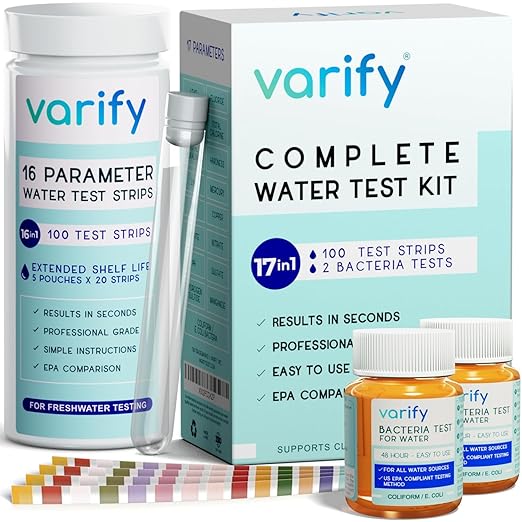
This comprehensive kit tests for 17 parameters including chlorine, fluoride, lead, iron, and bacteria, giving you a full picture of your water's safety in minutes. The 100 color-coded test strips come in 5 individually sealed pouches of 20 for extended freshness, while 2 included bacteria tests deliver results within 48 hours. Every purchase contributes a portion of proceeds to Water For Good, supporting clean water access in Central Africa.
Check On AmazonIf you click this link and buy, we earn a commission at no additional cost to you.
Running the Numbers for Extremely Hard Well Water
The sizing formula: people times 75 gallons per day times effective GPG times 7 days equals weekly grain demand. Because softeners run most efficiently when they regenerate before reaching full capacity, the standard approach is to choose a rated capacity roughly 50 percent above the weekly demand figure. That buffer also covers higher-than-average usage days without pushing the system to exhaustion.
| Household Size | Raw Hardness (GPG) | Iron (PPM) | Effective GPG | Weekly Grain Demand | Minimum Rated Capacity |
|---|---|---|---|---|---|
| 2 people | 15 | 1 | 19-20 | ~20,000 | 48k |
| 3 people | 15 | 2 | 23-25 | ~37,000 | 64k |
| 4 people | 15 | 2 | 23-25 | ~50,000 | 80k (twin preferred) |
| 4 people | 20 | 2 | 28-30 | ~60,000 | Twin alternating |
| 5 people | 18 | 1.5 | 24-26 | ~68,000 | Twin alternating |
The table makes the escalation visible. A family of four that would need a 48k system at 10 GPG city water needs an 80k-plus system at 15 GPG well water with 2 PPM iron. That is roughly double the capacity requirement from the same household. The broader framework for how well water changes the softener decision is covered in the well water softener guide, but the core takeaway here is straightforward: always apply the iron adjustment before you look at any product, or the sizing number you start with is wrong.
Single Tank vs Twin Alternating: The Cost Trade-Off at High GPG
A single-tank softener takes itself offline to regenerate, typically 60 to 90 minutes. At typical hardness, that happens every 7 to 10 days at off-peak hours and nobody notices. At 15-plus GPG with iron, regeneration frequency climbs. A properly sized 80k single-tank system for a family of four at effective 25 GPG might regenerate every 5 to 6 days. During that window, anyone using water gets untreated hardness passing through. Most of the time this is not catastrophic, but it is noticeable over time as limescale accumulates on fixtures.
A dual-tank alternating system runs two resin tanks with one control valve that switches automatically between them. When tank one exhausts, the valve switches to tank two instantly while tank one regenerates in the background. The result is continuous soft water regardless of when or how often regeneration occurs. The upfront cost is meaningfully higher, typically 40 to 70 percent more than a comparable single-tank setup. Whether that premium pays off depends on your situation.
Best fit for households of 2 to 3 at 15 to 18 GPG with iron under 2 PPM. Regenerates every 5 to 7 days with correct sizing. Lower upfront cost, simpler service. Some hardness breakthrough during regen windows. Resin bears the full load of every cycle.
Best fit for households of 3 or more at 15-plus GPG, or any household at 20-plus GPG with iron. Continuous soft water coverage. Each tank regenerates less often because the load is shared, which extends resin life under high-demand conditions. Harder to service if the control valve needs repair.
The long-term resin life argument is real. I have seen single-tank installs at 18 to 20 GPG where the resin needed replacement inside of seven years because the system was cycling so frequently. Two tanks at 64k each sharing the same demand, each regenerating at a more comfortable interval, tend to hold up considerably better. Whether that trade-off pencils out financially depends on the specific GPG level, household size, and how much the two-tank valve costs to service in your area.
Sediment Pre-Filtration: Why This Matters More at High Regen Frequency
For well water, I treat a 20-micron sediment pre-filter as the baseline. At 15-plus GPG, the reason goes beyond standard well water caution. High hardness drives more frequent regeneration, and each regeneration cycle passes water through the resin bed in a backwash sequence. If that water carries fine sediment from the well, deposits accumulate faster than they would at normal cycling frequency. At typical hardness, a good pre-filter keeps the bed clean for years. At high GPG with high cycling frequency, sediment exposure compounds and shortens the interval before resin performance degrades.
If the water test shows elevated turbidity or any ferric iron present, add a secondary 5-micron filter downstream of the 20-micron stage. The second stage adds cartridge replacement cost, but resin replacement on a high-capacity system is expensive enough that the pre-filter investment pays for itself easily. For a twin alternating setup, one pre-filter on the feed line upstream of the control valve protects both tanks. No need to double up.

Designed specifically for well water problems like iron staining, sulfur odors, and heavy sediment, this system pairs a 30-micron pleated sediment filter with KDF and premium GAC carbon media to reduce iron, sulfur, chlorine, chemicals, and organic compounds through both redox reaction and adsorption. Built with commercial-grade 4.5 by 20-inch housings and 1-inch ports, it supports up to 15 GPM with minimal pressure drop and is rated for up to 100,000 gallons or 12 months of use. Unlike reverse osmosis systems, it retains beneficial minerals like calcium and magnesium, and comes backed by a 1-year limited warranty with USA-based customer support.
Check On AmazonIf you click this link and buy, we earn a commission at no additional cost to you.
What to Buy: Three Configurations for Extremely Hard Well Water
With the sizing math done and the iron-adjusted GPG in hand, the product decision narrows considerably. There are three configurations worth knowing at this hardness level. Each fits a specific situation, and none of them is the right answer for everyone.
| Situation | Recommended Configuration | Why |
|---|---|---|
| 2-3 people, 15-18 GPG effective, iron under 1.5 PPM | Aquasure Harmony 80k (single tank) | Adequate capacity, lower cost, manageable regen frequency |
| 3-4 people, 15-20 GPG effective, iron under 2 PPM | SpringWell SS4 (single tank) | High single-tank capacity, 10% crosslink resin, smart monitoring |
| 4-5 people, 18+ GPG effective, iron up to 3 PPM | Fleck 9100SXT dual-tank | Continuous soft water, shared resin load, field-serviceable valve |
| Any household at 20+ GPG effective with iron | Fleck 9100SXT dual-tank | Single-tank limitations become pronounced above this threshold |
The details behind each configuration are below, including who should skip each one.
Fleck 9100SXT: Best for High-Demand Households at 18+ GPG
For high-demand well water, a Fleck 9100SXT twin setup is the configuration I would look at first. The main reason is serviceability: the valve family has been widely used in residential and light commercial treatment, replacement parts are available through water treatment distributors, and a technician can replace a worn seal or spacer on-site at year 10 without replacing the whole system. The 9100SXT is the demand-initiated version, meaning it tracks actual water usage and switches tanks based on remaining capacity rather than a fixed schedule. You can pair it with tanks sized for your specific demand, typically 64k-64k or 80k-80k for demanding well water applications.
That serviceability matters more the harder you push a softener. At 18 to 20 GPG with iron, you are running the system at the high end of residential demand. A valve you can service long-term, with parts you can actually get, is worth the premium over alternatives that are cheaper to buy but proprietary to repair.
Who should buy it: households of 4 or more at 18-plus GPG effective hardness, or any household where continuous soft water coverage is a priority. Who should skip it: households of 2 at 15 to 16 GPG where an 80k single tank is genuinely sufficient, and where the twin alternating cost premium is hard to justify.

This twin-tank system uses two 14 by 65-inch polyglass resin tanks loaded with 6 cubic feet of high-capacity resin total, delivering 96,000 grains of hardness removal and a continuous 20 GPM service flow with soft water available 24/7 as tanks alternate cycles. The digital metered 9100SXT control head regenerates based on actual water use rather than a timer, conserving both salt and water. The 18 by 40-inch brine tank holds up to 350 pounds of salt, and the system is backed by a 5-year control head and 10-year tank warranty with a 30-day satisfaction guarantee.
Check On AmazonIf you click this link and buy, we earn a commission at no additional cost to you.
SpringWell SS4: Best High-Capacity Single Tank for 15-20 GPG
The SpringWell SS4 is the highest-capacity single-tank option in the SpringWell SS lineup, and it is one of the few consumer-accessible softeners that explicitly specifies 10 percent crosslink resin. The crosslink percentage matters for durability, not iron handling. Standard resin uses 8 percent crosslink and degrades faster under chlorine exposure, which is less relevant on well water, but the denser 10 percent crosslink structure also holds up better under repeated high-load cycling. On well water at 15 to 20 GPG, the resin cycles hard and often. The denser resin structure extends functional resin life.
The SS4 comes with a Bluetooth-enabled control head that lets you monitor salt levels and regen cycles from a phone. That is not a gimmick at this hardness level, because tracking regen frequency is the clearest indicator of whether the system is keeping up with demand or getting pushed past its efficient operating range. The system does not specify fine mesh resin by default, so if your iron is above 1 to 1.5 PPM, confirm the resin spec with SpringWell before buying or consider a fine mesh upgrade.
Who should buy it: households of 3 to 4 at 15 to 20 GPG effective hardness where a single-tank solution is preferred and the regen window is acceptable. Who should skip it: households at 20-plus GPG effective hardness where twin alternating becomes the more reliable long-term call, or buyers with iron above 2 PPM who need confirmed fine mesh resin.
Aquasure Harmony: Most Accessible High-Capacity Option
The Aquasure Harmony 80k is the most accessible entry point into high-capacity softening for extremely hard well water. It costs less than both alternatives above, and it comes with a demand-initiated metered control head, which is the minimum spec I would accept at this hardness level. Timer-based systems that regenerate on a fixed schedule waste salt and are poorly matched to the variable demand cycles of most households.
The trade-off with the Aquasure is documentation. The resin crosslink percentage is not clearly specified on the product listing, and getting confirmation on the resin spec requires contacting the vendor directly. The control valve is proprietary rather than a Fleck or Clack unit, which means parts availability is less straightforward if service is needed years down the line. For a household at 15 to 17 GPG effective hardness with iron under 1.5 PPM and a budget constraint, the Aquasure 80k is a workable choice. For anything above that hardness level or iron load, the additional cost of the SpringWell SS4 or the Fleck twin setup is worth it.
Who should buy it: households of 3 to 4 at 15 to 17 GPG effective hardness, budget-constrained, iron under 1.5 PPM, and willing to verify the resin spec with the vendor before purchasing. Who should skip it: households at 18-plus GPG effective hardness, buyers with iron above 2 PPM, and anyone prioritizing long-term parts availability and serviceability.
One thing worth saying clearly: none of these systems replaces proper pre-treatment. Fine mesh resin handles ferrous iron up to about 3 PPM, but only if clean water is going into the resin bed. For all three configurations, a sediment pre-filter on the feed line is the baseline.

Designed for homes with 4 or more bathrooms, this professional-grade softener treats 64,000 grains of hardness by removing calcium and magnesium to deliver soft water from every outlet while protecting appliances like dishwashers, washing machines, and water heaters from scale buildup. The fully programmable backlit digital metered control head allows customizable auto-flush intervals based on your water quality and usage for efficient, hands-free operation. Built with a fiberglass-lined polyethylene tank and prefilled premium resin, it is backed by a 30-day money-back guarantee, 5-year manufacturer warranty, and lifetime free US-based tech support with online product activation.
Check On AmazonIf you click this link and buy, we earn a commission at no additional cost to you.
Warning: If your water has any sulfur smell, confirmed ferric iron (orange or rust-colored water), or dissolved iron above 3 PPM, do not treat this as a softener-only purchase. Pre-treatment needs to happen first, before any of the systems above. Installing a softener without addressing those conditions shortens resin life significantly and the system will not perform as rated.
Final Thoughts: Size First, Then Buy
The mistake I see repeatedly with extremely hard well water is buyers who start with a product and work backward to convince themselves it is big enough. The correct order is the opposite: get a full water test, apply the iron adjustment to get your effective GPG, run the sizing math, and only then look at products. By that point, the right configuration usually becomes obvious. A family of four at effective 25 GPG with iron is not a “what softener should I buy” question. It is a “which two-tank alternating setup fits my household” question, and the sizing math gets you there without guesswork.
If your water is very hard but comes from a city main rather than a well, the hardness challenge is real but the iron and sediment variables are absent. That scenario is covered separately in the article on water softeners for extremely hard city water.

These salt pellets help prevent rust stains on fixtures and clothing, reduce mineral buildup inside pipes and appliances, and soften water to protect skin and hair from the drying effects of hard water. Soft water also leaves glasses, dishes, and faucets virtually spot-free for easier cleaning throughout your home. The 40-pound bag features a sturdy plastic handle and easy-tear opening for comfortable lifting and hassle-free pouring.
Check On AmazonIf you click this link and buy, we earn a commission at no additional cost to you.
FAQs
💧 What GPG qualifies as extremely hard well water?
Most water treatment professionals classify water above 15 GPG as very hard to extremely hard. The US average is around 7 to 10 GPG. Well water in much of the Southwest, Midwest, and rural areas routinely tests at 15 to 25 GPG or higher. Above 15 GPG, standard sizing guides no longer give reliable results, particularly once iron is factored in.
🔧 How do I adjust softener sizing for iron in well water?
Add 4 to 5 GPG of effective hardness for every 1 PPM of dissolved ferrous iron. A well at 15 GPG with 2 PPM iron sizes for 23 to 25 GPG. Run that adjusted number through the standard formula: people times 75 gallons per day times effective GPG times 7 days. Then choose a rated capacity about 50 percent higher than the resulting weekly demand.
🔄 When does twin alternating become worth the extra cost?
For most households of 3 or more at 15-plus GPG effective hardness, a dual-tank alternating setup pays off in continuous coverage and longer resin life. Below that threshold, a properly sized single tank at 64k to 80k is usually sufficient. At 20-plus GPG effective hardness for any household size, the single-tank limitations become pronounced enough that the two-tank configuration is the more reliable long-term choice.
🧲 What is the difference between fine mesh resin and 10% crosslink resin?
They address different things. Fine mesh resin refers to the bead size: smaller beads create more surface area and handle dissolved ferrous iron more effectively. Crosslink percentage refers to structural density: 10 percent crosslink resin is denser and more resistant to physical degradation than standard 8 percent crosslink resin. For extremely hard well water with iron, both specs matter. Fine mesh for the iron load, higher crosslink percentage for durability under frequent cycling.
📊 How often will a softener regenerate at 20 GPG well water?
It depends on system capacity and household size. A correctly sized 80k single-tank system for a family of four at effective 25 to 28 GPG typically regenerates every 5 to 6 days. An undersized 48k system at the same demand regenerates every 2 to 3 days. Frequent short-interval cycling accelerates valve wear and increases salt cost significantly over time.
⚙️ Can I use a standard softener for 20 GPG well water?
You can, but the system needs to be sized for 20 GPG, not for average hardness. A standard 48k softener designed for city water at 10 GPG is not rated for 20 GPG well water with iron. The correct minimum for a family of four at that hardness level, after the iron adjustment, is typically 80k capacity, and twin alternating is the better long-term choice for continuous coverage.