
The Difference Most Buyers Don’t Understand Until After the Purchase
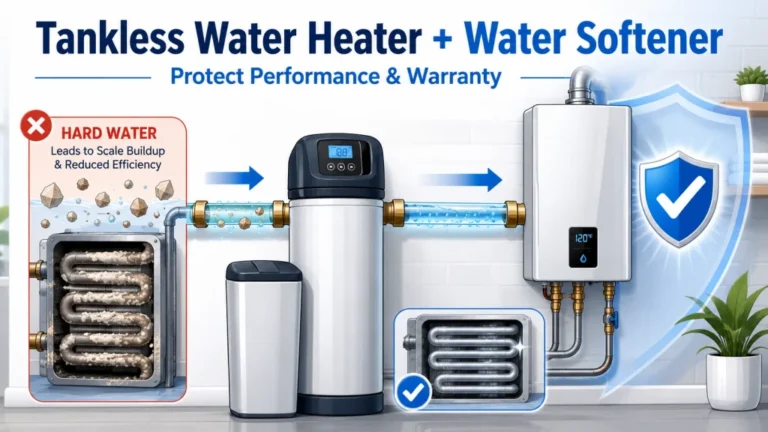
Salt-based softeners work through ion exchange. Hard water passes through a resin bed, calcium and magnesium ions swap places with sodium ions, and what comes out tests at 0 to 1 GPG. The water is chemically different from what went in. That’s not marketing language, that’s what the test strip shows.
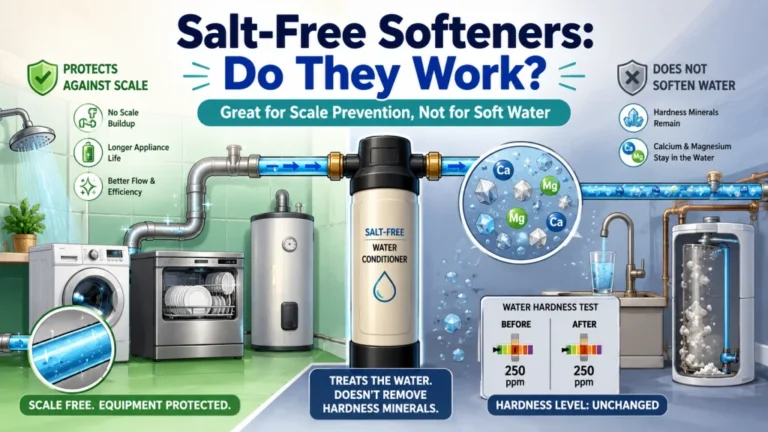
Salt-free conditioners work through template-assisted crystallization, or TAC. Hard water passes through a catalytic media, and the calcium and magnesium are converted into microscopic crystals that stay suspended in the water instead of depositing on surfaces. The water tests the same GPG after treatment as before. The minerals didn’t go anywhere. What changed is their behavior: they pass through pipes and appliances without adhering as scale.
That last point is the one that generates the most frustration when it goes unexplained. People buy a salt-free system, their water still tests 18 GPG, and they call the manufacturer convinced the unit isn’t working. It is working. Their expectation was wrong. If you’re still working through which system type fits your water situation at a broader level, the full situation-based softener guide covers how to think through the decision from the start. But for this side-by-side, the starting point is accepting that these are two different products solving two different problems.
What Salt-Based Ion Exchange Actually Delivers
A properly sized and programmed salt-based softener changes the water. Soap lathers more easily. Dishes come out of the dishwasher without spots or film. Laundry feels softer and needs less detergent to get clean. Showerheads stop calcifying. And for people who’ve been living with water above 20 GPG, the skin and hair difference is real and noticeable within the first week.
I’ve walked through homes before and after installation at 25 GPG and the feedback is consistent. Families notice the shower immediately. The glassware situation improves fast. Water heater elements that used to need replacement every couple of years stop being a recurring issue. These aren’t edge-case outcomes. They’re what ion exchange does when it’s sized correctly for the house.
Field Note: One pattern I’ve seen repeat: homeowners at 20+ GPG who bought a salt-free system on a neighbor’s recommendation, lived with it for a year, and then called saying it wasn’t working. In most of those cases, the system was doing exactly what it was rated to do. Scale on pipes and appliances was reduced. But the shower still felt the same, skin was still dry, and the soap still didn’t lather properly. The issue wasn’t the system failing, it was that nobody explained what salt-free actually does to the water before they bought it.
The ongoing requirement is salt. A typical household at moderate hardness goes through one to two bags per month. At current pricing that works out to roughly $100 to $200 per year, and a properly set demand-initiated system uses 40 to 65 gallons of water per regeneration cycle. That’s the full cost picture on the operating side.

IAPMO certified to NSF/ANSI Standard 44, this system is sized for homes with up to 5 people and 4 bathrooms, using ion exchange to deliver soft, scale-free water from every tap with city or well water compatibility. The user-friendly LCD allows metered operation that uses up to 50% less salt and 28% less water compared to standard time-based softeners, helping lower long-term costs on appliances, soap, and cleaning products. The bundle includes a recommended pre-filter and installation kit, and is backed by a 5 to 10-year limited warranty with dedicated customer support.
Check On AmazonIf you click this link and buy, we earn a commission at no additional cost to you.
What Salt-Free Conditioners Actually Deliver
Salt-free TAC conditioners do one thing well: they prevent scale from forming on pipes, water heaters, and appliances. Independent testing of certified TAC systems at controlled flow rates shows scale prevention rates around 99.6%. That’s a real and meaningful result for anyone primarily concerned about appliance longevity and pipe deposits.
Beyond that, the operating costs drop to essentially zero for years. There’s no salt to buy, no drain line required, no water waste from regeneration cycles. The catalytic media lasts 3 to 10 years depending on hardness level and water volume. When it needs replacement, that’s typically a $200 to $600 cost depending on the system, and then you’re back to zero-maintenance operation. For a city water household at 10 GPG whose main concern is protecting a tankless water heater and extending appliance life, the math for salt-free is genuinely reasonable.
What salt-free doesn’t deliver is soft water. I want to be direct about this because the marketing around some of these products is vague enough to create real confusion. The water after a salt-free conditioner tests the same GPG it did before treatment. Calcium and magnesium are still present. Soap reacts to them the same way. The feeling in the shower doesn’t change. There’s no independent evidence that TAC-treated water improves skin feel or hair texture. If that’s what you’re after, a salt-free conditioner is not the product that gets you there.
What Certification Actually Tells You
Not all salt-free systems are equivalent. The DVGW W 512 certification is the only independent laboratory verification specifically for TAC scale prevention performance. A system with that certification has been tested under controlled conditions and confirmed to prevent scale at the rated level. A system without it is relying on manufacturer claims alone. That distinction matters when you’re evaluating whether a system is likely to perform as described. For a closer look at what to look for when selecting a salt-free conditioner specifically, the salt-free softener guide covers the selection criteria in more detail.
The Hardness Level Where Each Option Performs
Salt-based ion exchange works at any residential hardness level. I’ve installed systems at 45 GPG from well water and they performed exactly as sized. There’s no upper limit on the hardness a properly configured salt-based system can handle, only a sizing and regeneration frequency calculation.
Salt-free TAC systems have an effective range. Below 15 GPG with a city water source, a certified TAC conditioner prevents scale adequately for most households. Between 15 and 25 GPG the results become more variable depending on the specific system, flow rate, and water temperature. Above 25 GPG, most salt-free systems lose reliability even at the core job of scale prevention. At that hardness level, the mineral concentration is high enough that the crystallization process can’t keep pace at normal residential flow rates.
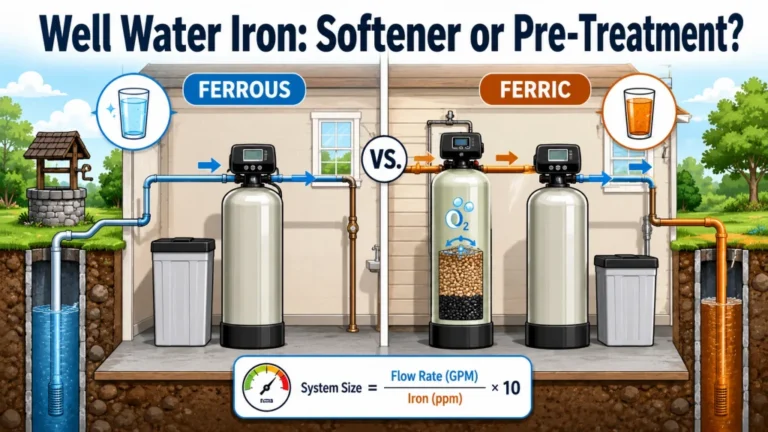
Well water complicates the salt-free picture further. Iron above 1 PPM fouls TAC media over time and isn’t treated by the crystallization process. Sulfur requires its own separate treatment. Salt-free systems are designed for and validated against hardness on city water. Using one on a complex well water profile without addressing the other contaminants first is a setup for poor performance and early media failure.
| Hardness Level | Salt-Based | Salt-Free (TAC) |
|---|---|---|
| Under 7 GPG | Works, may be more than needed | Works well for scale |
| 7 to 15 GPG (city water) | Reliable, full soft water results | Reliable for scale prevention |
| 15 to 25 GPG | Reliable, higher salt use | Variable, system-dependent |
| Above 25 GPG | Reliable with correct sizing | Not recommended |
| Well water with iron or sulfur | Requires pre-treatment, then reliable | Not suitable without separate pre-treatment |
The table above is a general guide, not a guarantee. Actual results depend on water temperature, flow rate, and whether the specific system has been certified at your hardness level. If you’re at 14 GPG and considering salt-free, check whether the system you’re evaluating carries independent certification at that hardness. If it doesn’t, you’re taking the manufacturer at their word.

This kit lets you test drinking water, pool water, or any water source in seconds using a simple dip-and-read method with an oversized color chart ranging from red to green, covering 0 to 25 GPG and 0 to 425 PPM. All 100 strips are protected by FreshSeal technology across a ready-to-use bottle and two sealed pouches for long-term accuracy. Each purchase also funds a full year of clean water for someone in the Central African Republic.
Check On AmazonIf you click this link and buy, we earn a commission at no additional cost to you.
What Happens to the Scale That’s Already in Your Pipes
This is a question most buyers don’t ask until after installation, and it matters more than most comparison articles acknowledge. Scale prevention is not scale removal. Both salt-based and salt-free systems protect against new mineral buildup, but neither one automatically dissolves deposits already sitting inside your water heater, tankless unit, or fixture aerators.
Salt-free TAC conditioners work specifically by changing the crystal structure of incoming minerals so they don’t adhere to surfaces. There’s no mechanism for lifting scale that has already formed and hardened. If your tankless water heater has been running on untreated 20 GPG city water for five years, installing a salt-free conditioner will prevent new deposits from that point forward. It won’t touch the existing buildup affecting heat transfer efficiency or flow rate.
Salt-based softeners remove hardness from all incoming water, which over time can allow some lighter soft deposits to slowly loosen and flush out, particularly in pipes. But heavily calcified components, like a water heater element coated in scale or a showerhead with years of buildup, won’t self-correct just because the incoming water is now soft. A descaling flush, citric acid soak, or component replacement is still needed for those.
Key point: If you’re buying a new system because a tankless heater is already throwing error codes related to scale, don’t install the softener or conditioner and expect the problem to resolve on its own. Descale the equipment first. Then protect it going forward with whichever system fits your water profile.
It’s worth understanding before you buy. The system you install today protects everything downstream from this point forward. What’s already built up requires a separate action.

This complete descaler kit includes a 32 oz bottle of citric acid-based Haymaker solution, two 5-foot hoses with 3 quarter inch NPT fittings, a 550 GPH recirculation pump with a 25-foot power cord, and a 3.5 gallon pail for a full flush setup right out of the box. The citric acid formula is 3 times more effective than vinegar at dissolving carbonates, sulfates, rust, and other mineral deposits, and is completely free of solvents, VOCs, and foul odors. Non-corrosive and compatible with metals, rubber, PVC, CPVC, and ABS, it is also safe for septic systems and potable water, making it ideal for regular preventative maintenance to extend the life of your tankless water heater.
Check On AmazonIf you click this link and buy, we earn a commission at no additional cost to you.
What Each Option Costs Over Time
Upfront costs for entry-level systems in both categories often land in a similar range, roughly $400 to $1,200 for a typical residential installation. The divergence is in ongoing costs, and the picture over a 7 to 10 year window is worth thinking through before you decide.
Salt-based systems require salt purchases for as long as they run. At $100 to $200 per year, a system running for 7 years adds $700 to $1,400 in salt costs on top of the original purchase. There’s also water used for regeneration, which for a properly programmed demand-initiated system is a modest but real ongoing cost. A system that was $800 upfront can end up costing $1,500 to $2,200 in total over that period.
Salt-free systems have effectively zero ongoing cost until media replacement. A $900 system with 6-year media life and a $400 media replacement cost comes to roughly $1,300 over 6 years, with no other inputs required. The comparison over a similar period often comes out closer than people expect.
That said, I’d be cautious about letting cost alone make the decision. The gap isn’t large enough to justify choosing a system that doesn’t do what you actually need. If you want the full break-even analysis done out in detail, the salt-free cost and value breakdown goes through the specific scenarios and where each option comes out ahead.
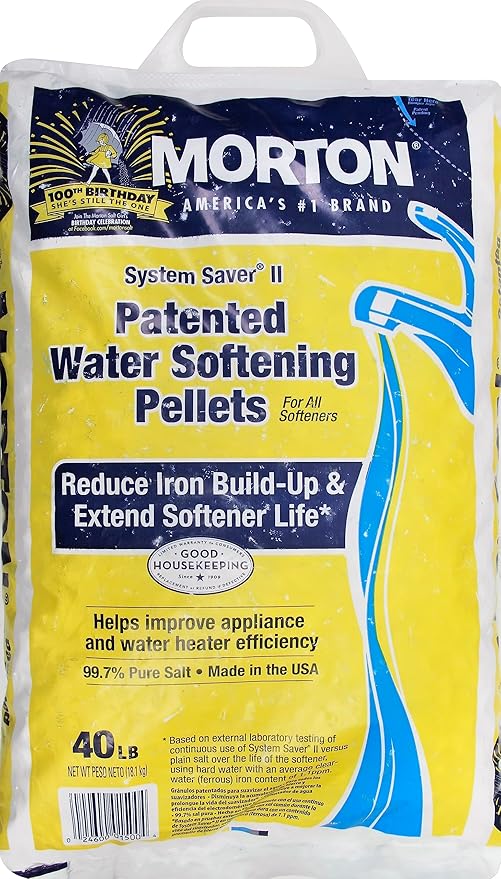
This 40-pound bag of USA-made System Saver pellets is designed to improve the taste of your water while helping extend the life of your appliances and water softener. Simple to use, just add the pellets directly to your softener's brine tank as needed.
Check On AmazonIf you click this link and buy, we earn a commission at no additional cost to you.
Skin and Hair: Where the Two Options Diverge Most
This is the question I hear most often from homeowners who are on the fence, and the honest answer is one-sided: salt-based softeners improve the skin and hair experience for most people coming from hard water, and salt-free conditioners do not.
The mechanism for salt-based is straightforward. Remove the calcium and magnesium from the water, and soap rinses cleanly instead of reacting with the minerals to form soap scum. Hair is less brittle. Skin feels less dry after showering. At 20+ GPG, the improvement is obvious. At 10 GPG it’s more subtle, but still measurable.
Salt-free TAC conditioners don’t change the mineral content of the water, so the soap-mineral reaction is unchanged. I haven’t seen any independent study showing improved skin feel from TAC-treated water versus untreated hard water. Some brands suggest otherwise in their marketing. Without independent verification, those claims should carry the same weight as any unsubstantiated product claim, which is not much.
If dry skin or hair is the primary complaint driving the decision, salt-based is the only option that addresses it. That’s not a knock on salt-free systems. They were designed for a different goal.
How to Choose Between the Two
The choice becomes clear once you identify the actual goal. Most confusion comes from treating the two systems as interchangeable, when they’re not.
- City water at 7 to 15 GPG, primary goal is protecting pipes and appliances from scale, no concerns about water feel: a certified salt-free conditioner is a legitimate choice with lower ongoing cost and zero maintenance for years.
- Any hardness level with skin dryness, poor soap lather, or spotty dishes as the primary complaint: salt-based ion exchange is the only option that addresses these. Salt-free won’t change any of them.
- Hardness above 25 GPG, regardless of goals: salt-based is the more reliable option. Salt-free systems become inconsistent above that threshold even for scale prevention.
- Well water with iron above 1 PPM or any sulfur presence: neither system works as a standalone. Pre-treatment is required first, and the complexity of the setup usually points toward a staged approach with a salt-based softener downstream.
- California water districts with salt discharge restrictions, or HOA restrictions on brine discharge: salt-free or potassium chloride-based systems may be your only compliant options, which changes the comparison from a performance question to a regulatory one.
Your main complaint is dry skin, brittle hair, poor soap lather, spotty dishes, or stiff laundry. It is also the safer choice if your hardness is above 15 GPG, if you have well water with iron or sulfur, or if you want the water to actually test soft.
Your primary goal is protecting pipes and appliances from scale, your city water is 7 to 15 GPG, you do not expect the shower to feel different, and you have confirmed there is no significant iron or sulfur present.
Note: Don’t buy either option without first knowing your GPG level, your water source, and whether iron or sulfur is present. A basic water test removes the guesswork from the decision entirely.
The bracket I see go wrong most often is 10 to 15 GPG with soft water feel as the underlying complaint. It’s a hardness range where salt-free works for scale. But if someone’s real frustration is dry skin after showering and they buy a salt-free conditioner because it’s simpler, they’re going to be disappointed six months later. The scale on their dishwasher is better. Everything else is the same. For a closer look at what to look for in salt-free products specifically, the salt-free conditioner review covers the specs and certifications worth evaluating before buying.
What the decision comes back to is this: test your water, identify the specific problem you’re trying to solve, and match the technology to that problem. For questions about whether salt-free systems perform as advertised at a technical level, the breakdown of how salt-free systems actually work goes through the evidence.

This advanced whole house system combines carbon, KDF, UV, and salt-free scale control media to reduce 97% of chlorine while tackling bacteria, viruses, cysts, and scale buildup, all without salt, backwashing, or electricity. Healthy minerals are preserved throughout the process, making it a cleaner alternative to traditional softening systems. Best suited for households of 4 or more with water hardness under 15 grains per gallon, it delivers an outstanding lifespan of up to 1 million gallons or 10 years at under one cent per gallon. Scale control works best on water with pH below 8.3, alkalinity under 250 mg per liter, and iron under 0.3 ppm.
Check On AmazonIf you click this link and buy, we earn a commission at no additional cost to you.
Final Thoughts: Two Products, Two Jobs, One Decision
Salt-based and salt-free aren’t locked in a competition where one has to win. They do different things. Salt-based removes hardness and delivers genuinely soft water with all the tangible results that come with it. Salt-free prevents scale formation without changing the mineral content of the water, costs less to maintain long-term, and works well for the right situation and hardness range.
The mistake isn’t choosing one over the other. The mistake is choosing one without understanding what problem it actually solves. Know your GPG level, know what’s bothering you about your current water, and the right answer usually becomes straightforward. If you’re still working through the broader decision, running a water test first is worth more than any comparison guide, including this one.
FAQs
💧 Does salt-free water feel softer after treatment?
No. Salt-free conditioners don’t remove hardness minerals. The water tests the same GPG before and after treatment. If you want water that feels softer in the shower or improves soap lather, a salt-based ion exchange softener is the only option that changes those results.
🔢 What GPG level is too high for salt-free to work?
Most water treatment professionals consider 25 GPG the practical upper limit for reliable TAC scale prevention. Between 15 and 25 GPG results become variable. Above 25 GPG, salt-based is the more reliable choice even if your only goal is scale protection.
💰 Is salt-free cheaper long-term than salt-based?
Often, but the gap is smaller than most people expect. Salt-free has no ongoing salt cost but requires media replacement every 3 to 10 years at $200 to $600. Salt-based runs $100 to $200 per year in salt. Over 6 to 7 years the total cost of both often comes out in a similar range.
🏡 Can I use a salt-free conditioner on well water?
It depends on what’s in the water. Salt-free TAC systems are not effective at treating iron or sulfur, and iron above 1 PPM will foul the media over time. If your well water has significant iron, sulfur, or hardness above 25 GPG, salt-free alone is not adequate treatment. Pre-treatment and a staged approach are usually required.
🧴 Will a salt-free system help with dry skin or brittle hair?
No. There’s no independent evidence that TAC-treated water improves skin or hair feel. The minerals are still present in the water after treatment, so the soap-mineral interaction doesn’t change. Skin and hair improvement comes from removing those minerals, which only salt-based ion exchange does.
⚖️ Which option is better for protecting appliances?
Both protect appliances from scale better than untreated hard water. Salt-based removes the minerals entirely so scale can’t form. Salt-free changes the mineral structure so scale is less likely to adhere. Either approach extends water heater and appliance life compared to running hard water untreated.
🌵 Does the California salt discharge ban mean I have to use salt-free?
Not necessarily. The restrictions vary by water district and don’t cover all of California. Where restrictions apply, compliant options include salt-free TAC conditioners, potassium chloride-based ion exchange systems, and portable exchange (PEXT) tank service. Check with your specific water district before assuming a blanket ban applies to your address.