
If You Have Already Decided on Salt-Free, Start Here
The decision to go salt-free narrows the field significantly, but it does not make the buying decision easy. Most of the systems on the market make the same claims: 99.6% scale prevention, zero maintenance, whole-house coverage. The problem is that those claims come from very different evidence bases. Some are backed by independent lab certification. Most are not. The difference between those two categories is worth understanding before you spend $400 to $1,500 on something you will live with for the next decade.
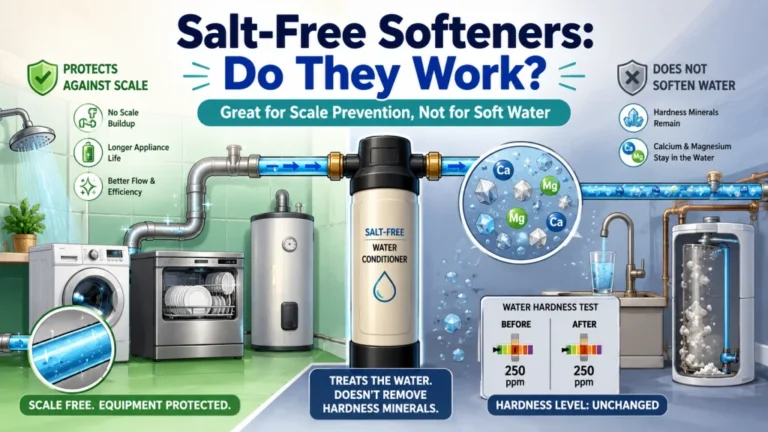
Before I get into how to choose, one thing worth repeating for clarity: a salt-free conditioner does not soften water the way a salt-based system does. Your water will test the same GPG after installation as it did before. What changes is the behavior of hardness minerals in your pipes and on appliance heating elements. They still enter your home; they just lose the ability to stick and form scale. If you are still working through whether salt-free makes sense for your situation at all, the breakdown of how salt-free systems actually work covers that question in full. If you have already made the call and want to know how to pick a good one, keep reading.
City water in the 7 to 20 GPG range with scale prevention as the primary goal is where TAC conditioners perform best. That is the scenario this article is written for. Well water with iron is a different problem that calls for a different approach, and I cover that separately for buyers in that situation.
The Only Certification That Actually Means Something
DVGW W 512 is the first thing I check. It is a German testing standard from the Deutsche Vereinigung des Gas- und Wasserfaches, which translates roughly to the German Technical and Scientific Association for Gas and Water. It is the closest thing to independent third-party verification that exists in the TAC conditioner category, and it tests actual scale prevention performance under a structured protocol rather than relying on manufacturer-supplied data.
Here is what the number actually means. To pass DVGW W 512, a system has to achieve at least 80% scale prevention efficiency under the test protocol. Some systems that carry the certification tested at 99.6%. That 99.6% number gets repeated in marketing materials as though it is the certification requirement. It is not. It is a performance result. The threshold is 80%. That distinction matters because it tells you the certification is meaningful without being a magic guarantee of performance in your specific water conditions.
The protocol also has real limits worth knowing. Testing is conducted under one set of conditions: one hardness level, one flow rate, one temperature. If your water has elevated silica, extreme hardness, or iron, the certification tells you less than it would for straightforward city water at moderate hardness. Within the parameters it was designed for, it is still the only independently verified benchmark in this space. Every other claim in the salt-free conditioner category is internal lab data or manufacturer testing. That distinction alone makes DVGW the most useful filter when evaluating systems.
Field Note: I have walked homeowners through marketing sheets that reference DVGW prominently on the front page and then, buried in the fine print, reference a study conducted on the original media supplier’s formulation, not the media currently in production. The certification was real. What was certified was not what they were buying. A company that changed their TAC media formulation after the original certification was granted cannot automatically carry that test result forward to the new media. Confirm the certification applies to the current product, not a previous version of it.
One practical test: look for the actual certificate number or certification mark, not just the phrase “DVGW tested” in a product description. A certified product can show you the document. A product that was tested but not certified, or was tested on an older formulation, typically cannot. If a system cannot produce that on request, I would not treat it as a serious contender regardless of price. For most city-water buyers in the 7 to 20 GPG range, this single filter eliminates a significant portion of what is marketed in this category.

This kit lets you test drinking water, pool water, or any water source in seconds using a simple dip-and-read method with an oversized color chart ranging from red to green, covering 0 to 25 GPG and 0 to 425 PPM. All 100 strips are protected by FreshSeal technology across a ready-to-use bottle and two sealed pouches for long-term accuracy. Each purchase also funds a full year of clean water for someone in the Central African Republic.
Check On AmazonIf you click this link and buy, we earn a commission at no additional cost to you.
Flow Rate: What Whole-House Coverage Actually Requires
Flow rate determines whether a system genuinely handles your whole house or just most of it most of the time. Salt-free TAC conditioners do not require a regeneration cycle, but they do need sufficient flow capacity to treat all the water entering your home during peak demand without causing a pressure drop. This is where the category varies more than most buyers expect.
The benchmarks I use: one to three bathrooms needs a minimum of 12 GPM for reliable whole-house performance during normal peak use. Four to six bathrooms needs 15 GPM or more to handle a shower, dishwasher, and washing machine running at the same time without the conditioner becoming a bottleneck. Anything below 10 GPM is marginal for most households, and systems rated at 7 to 8 GPM are better understood as partial-house systems regardless of how they are marketed.
| Home Size | Minimum Flow Rate Needed | Notes |
|---|---|---|
| 1 to 2 bathrooms | 10 to 12 GPM | Most TAC conditioners qualify; verify under peak load, not average use |
| 3 bathrooms | 12 to 15 GPM | Check rated flow at operating pressure, not zero-pressure-drop condition |
| 4 to 6 bathrooms | 15 GPM minimum | Fewer systems qualify; flow rate becomes the primary filter before anything else |
| 7 or more bathrooms | 20 GPM or more | Very limited options; confirm with manufacturer before purchasing |
One thing to watch: whether the manufacturer’s rated flow is measured at zero pressure drop or at a realistic operating pressure. A system rated at 15 GPM under ideal conditions may deliver noticeably lower pressure during actual use. The rating you want is at a standard operating pressure, not the best-case number. For buyers specifically evaluating systems for larger homes, I go deeper on this in the whole-house salt-free sizing guide, which covers flow rate as the primary selection criterion for high-demand applications.

This maintenance-free descaler prevents lime scale buildup on pipes, fixtures, and appliances and can even help remove existing scale over time, all without salt, electricity, backwashing, or drainage. Designed for 1 to 3 bathroom homes, it delivers a flow rate of 12 gallons per minute and connects with a simple pipe-in and pipe-out setup. Unlike traditional softeners, it retains beneficial calcium and magnesium minerals and adds no sodium, making it a healthier option for those with cardiovascular concerns. The complete unit includes media, mineral tank, distributor assembly, tank head, and bypass valve.
Check On AmazonIf you click this link and buy, we earn a commission at no additional cost to you.
Media Life: What the Range Means and How to Budget for It
TAC media does not last forever, and the range you will see quoted across product pages, anywhere from 3 to 10 years, is not just marketing variance. It reflects genuine differences in how media ages under different water conditions. Understanding what drives that range helps you plan replacement costs more accurately than trusting the best-case number on a spec sheet.
The factors that shorten media life the most are high hardness, flow volume above what the tank size was rated for, and sediment in the water. City water at 10 GPG running through a properly sized system will see media life closer to the longer end of the range. City water at 20 GPG under heavy household use will be toward the shorter end. The most common mistake I see here is homeowners budgeting for replacement based on a 6 to 10 year figure without accounting for their actual hardness. If your water is on the harder end, plan for 3 to 5 years and treat anything longer as a bonus.
- Hardness below 10 GPG: Media life typically falls in the 6 to 10 year range under normal residential use. Budget $200 to $400 for eventual replacement.
- Hardness 10 to 20 GPG: Expect 4 to 7 years depending on water usage and flow rate. Budget $300 to $500.
- Hardness 20 to 25 GPG: TAC conditioners are near their effective upper limit. Media ages faster at this level. Plan for 3 to 5 year replacement cycles and $400 to $600.
Also worth checking before you buy: whether media replacement is a cartridge swap you can do yourself or a bulk media refill that requires a service call. The long-term cost difference between those two approaches adds up over multiple replacement cycles. A cartridge-based system that costs slightly more upfront may be cheaper to maintain over 10 years than a tank system requiring a technician visit each time.
Note: A few manufacturers market their TAC media as lasting 10 or more years with no replacement. That claim is worth scrutinizing. TAC media does degrade over time as nucleation sites become occupied. Real-world expectations based on actual use are 3 to 10 years depending on conditions, not indefinitely. A company that gives you an honest middle range is a better sign than one promising the maximum with no qualifications.
A cheaper system with unclear media replacement terms can cost more over 10 years than a pricier system with a documented cartridge replacement process. That math is worth running before price becomes the deciding factor.

This two-in-one whole house system pairs a TAC-based water conditioner with a carbon filtration unit, preventing scale buildup while also removing impurities and improving overall water quality throughout your home. Template-assisted crystallization prevents lime scale from forming on pipes, fixtures, and appliances and can help dissolve existing scale without the use of salt, chemicals, or electricity. Designed for 3 to 6 bathroom homes, it delivers an impressive flow rate of 20 gallons per minute and each unit includes media, mineral tank, distributor assembly, tank head, and bypass valve.
Check On AmazonIf you click this link and buy, we earn a commission at no additional cost to you.
Warranty Terms and What They Signal
Warranty coverage is a proxy for manufacturer confidence and, more practically, a measure of what recourse you have if something goes wrong. In the salt-free conditioner category, warranty quality varies enough that it is worth reading carefully before committing.
What I look for: a lifetime warranty on the tank and valve, separate coverage on the media since media is a consumable and is almost never covered for full life, and a money-back guarantee period long enough to actually evaluate performance. A 30-day return window is not sufficient. You are not going to see meaningful evidence of scale prevention or absence of it in a month. A 6-month trial period is the standard that gives you a real evaluation window. Some manufacturers offer this. Most do not. It is a meaningful differentiator for buyers who want a legitimate window to assess whether the system does what it claims in their specific water conditions.
Read the exclusions before you buy. Some warranties exclude well water use, specific hardness ranges above a stated maximum, or installation without a pre-filter. If your situation falls into an excluded category and a problem develops, the warranty does not apply. This is one of the more reliable red flags for a system that was not designed with real-world edge cases in mind.
Matching the Right System Type to Your Situation
Once you have filtered by certification, flow rate, and media life, the next question is which type of system fits your specific situation. Most salt-free conditioner buyers fall into one of three categories, and the priority spec differs meaningfully between them.
Priority: independent verification over brand reputation. If you want the most defensible choice based on third-party evidence rather than marketing claims, prioritize DVGW W 512 certification over everything else, confirm it applies to the current media formulation, and verify the flow rate meets your home’s demand. Systems without certification are asking you to take manufacturer claims at face value. For most city-water buyers, this is the first filter before price, brand recognition, or anything else on the spec sheet.
Priority: lowest total cost of ownership over 10 years. If ongoing cost matters more than upfront cost, the calculation runs like this. A higher-priced system with longer-rated media life and cartridge-based replacement often costs less over a decade than a cheaper upfront system with 3-year bulk media cycles requiring a service call. Add warranty coverage and a money-back window to the equation. A system with a 6-month guarantee and a 10-year media life estimate under your hardness conditions is a better 10-year bet than one with a 30-day return and a 3-year replacement cycle.
Priority: scale protection for a home in a restricted area. California homeowners dealing with salt discharge bans face a different decision tree. The question is not which salt-free system performs best in ideal conditions; it is which compliant options exist and what each delivers within those constraints. This includes TAC conditioners, potassium chloride systems, and portable exchange service. I cover the full picture of what is restricted, where, and what options remain in the California water softener regulations guide.
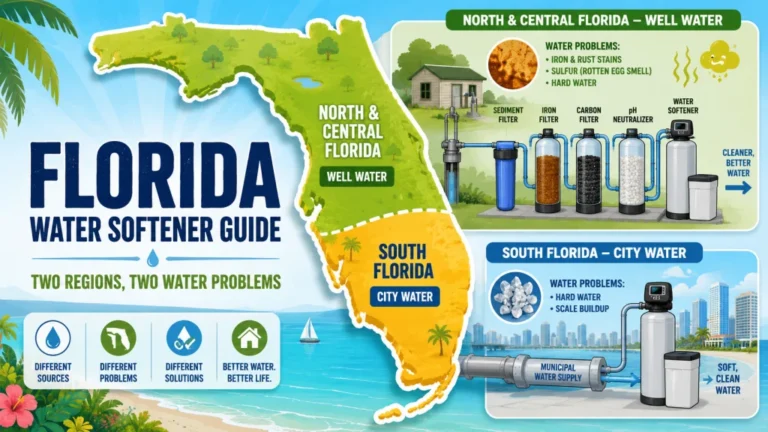
For buyers specifically on well water, I want to be direct: a standard TAC conditioner is not the right starting point if iron is present. Iron fouls TAC media over time regardless of what the product page claims about iron tolerance. Well water with iron needs a dedicated pre-treatment stage upstream of any conditioner. The salt-free options for well water covers that scenario with the pre-treatment sequencing it actually requires.

This 50-micron flushable and reusable filter serves as an ideal first stage in any whole house filtration system, capturing sediment, rust, dirt, and sand before water reaches finer filters downstream. A built-in Siliphos additive helps soften water, prevent scale buildup, and reduce pipe corrosion, with filter replacement recommended every 3 to 6 months for best results. The see-through housing allows easy visual monitoring, and dual threads with 1-inch MNPT and 3 to 4-inch FNPT connections make installation straightforward for indoor use within a pressure range of 20 to 100 PSI.
Check On AmazonIf you click this link and buy, we earn a commission at no additional cost to you.
How to Verify a Salt-Free Conditioner Before You Buy
Most product pages for salt-free conditioners are written to answer the question “is this a good product?” rather than “does this product fit my situation?” The five checks below are what I would run through before committing, regardless of which system you are evaluating.
- Confirm the certification applies to the current media. Ask whether the DVGW W 512 certification was granted for the exact media formulation currently in the product, not an earlier version. If the company changed their media after the original certification, the test data does not automatically carry over.
- Check flow rate at operating pressure, not ideal conditions. Ask what the rated flow is at a standard inlet pressure. A system listed at 12 GPM under zero pressure drop may deliver 9 to 10 GPM in real use, which changes the whole-house coverage picture for a 3-bathroom home.
- Find out whether media replacement is a DIY cartridge or a service call. This affects your actual 10-year cost more than the upfront price difference between two systems at similar price points.
- Read the warranty exclusions for your specific situation. Check for exclusions related to water hardness above a stated GPG, well water use, iron content, or missing pre-filter installation. If any of those apply to you and the warranty excludes them, factor that into the purchase decision.
- Flag vague claims before you buy. Phrases like “softens water without salt,” “certified performance,” and “maintenance-free for life” each mean something specific or they mean nothing. “Softens without salt” is technically inaccurate since TAC does not remove hardness. “Certified performance” without a named standard and certificate number is marketing language. “Maintenance-free for life” ignores media aging. These are signals worth catching before the purchase, not after.
The goal of running through these is not to talk yourself out of a purchase. It is to enter the transaction with accurate expectations. A salt-free conditioner that delivers 85% scale reduction in your 12 GPG city water, requires a cartridge swap every 5 years, and carries a legitimate 6-month money-back period is a good buy. The same system oversold as permanent scale elimination with a 30-day return window is a different experience entirely.
The Hardness Ceiling and Where Salt-Free Stops Working
TAC conditioners have a practical upper limit for hardness, and most certified systems show effective scale prevention up to around 25 GPG. Above that, the technology starts losing effectiveness. The volume of hardness minerals exceeds what the media can consistently crystallize before they reach pipe surfaces and appliance heating elements. The sweet spot for city water is 7 to 20 GPG. Below 7 GPG, scale is generally not a significant problem to begin with. Above 25 GPG, a salt-based system becomes the more appropriate solution for the hardness problem. The full water softener guide covers the complete range of situations, including well water, extreme hardness, and iron, with the right equipment recommendation for each.
Buying a salt-free conditioner at 28 GPG because you want to avoid salt, then spending the next six months wondering why scale is still building on your water heater element.
Confirming your GPG before choosing a system type. If it is above 25, solving the hardness problem with the right technology first, then addressing salt restrictions or maintenance preferences separately.
One thing I want to be direct about: the hardness ceiling is not a reason to dismiss TAC technology. It is a reason to match technology to the actual problem. In the range where TAC works, which is most city water households in the US, a certified and properly sized salt-free conditioner is a genuinely defensible choice with no ongoing salt cost, no drain line, and low long-term maintenance.

Designed for homes with 2 to 4 bathrooms, this maintenance-free Template Assisted Crystallization system prevents scale buildup and protects pipes and appliances without salt, chemicals, electricity, backwashing, or drainage. The TAC process converts hard water minerals into microscopic seed crystals that stay suspended in the water stream rather than attaching to surfaces, gradually dissolving existing scale over time. Installation is a simple pipe-in and pipe-out connection, and the complete system includes media, mineral tank, distributor assembly, tank head, and bypass valve.
Check On AmazonIf you click this link and buy, we earn a commission at no additional cost to you.
Final Thoughts: The Short Version for Buyers Ready to Decide
If I were helping someone buy a salt-free conditioner today, the filter I would apply first is certification. Does the system carry DVGW W 512 certification for its current media formulation? If yes, it clears the most important bar in the category. If no, every performance claim on the product page is unverified and you are taking the manufacturer’s word for it. That alone is enough to remove a system from serious consideration at any price point.
After certification, flow rate matched to your home’s actual peak demand. After that, media life adjusted for your real hardness number, not the manufacturer’s best-case estimate. Then warranty terms, with a 6-month money-back window as the minimum worth holding out for. A system that clears all four filters and fits your hardness range is a straightforward buy. A system that fails on certification but scores well on price is not a deal. Run through the five verification checks above before committing, and you will know exactly what you are getting before the purchase, not after.
For the full category picture, including how TAC conditioners compare to salt-based systems and which situations genuinely favor each, the salt-free water softener hub covers all of it in one place.
FAQs
🧪 What is DVGW W 512 certification and why does it matter for salt-free conditioners?
DVGW W 512 is a German testing protocol for scale prevention performance. To pass, a system must achieve at least 80% scale prevention efficiency under standardized conditions. It is the only independent third-party certification that tests actual scale prevention in the TAC conditioner category. Every other performance claim in this space is manufacturer-reported data. It matters because it gives you a verifiable external standard rather than a marketing number.
💧 How long does TAC media actually last before needing replacement?
Typically 3 to 10 years, depending on your water hardness, household water usage, and flow conditions. Harder water and higher usage shorten media life. If your water is above 15 GPG, budget toward the shorter end of that range. Be cautious of any claim that media lasts indefinitely or beyond 10 years without qualification.
🏠 What flow rate do I actually need for full whole-house coverage?
12 GPM minimum for 1 to 3 bathrooms during peak demand. 15 GPM or more for 4 to 6 bathrooms. Verify the rating is measured at standard operating pressure, not zero pressure drop. Below 10 GPM is marginal for most households regardless of how the product is marketed.
🔢 At what hardness level does a salt-free conditioner stop being effective?
Most certified TAC systems show reliable scale prevention up to around 25 GPG. Above that level, the technology starts losing effectiveness and a salt-based softener becomes the more appropriate choice. The practical sweet spot is 7 to 20 GPG city water.
⚠️ Will a salt-free conditioner work with my well water?
It depends on what is in your well water beyond hardness. Salt-free TAC conditioners are not designed for iron or sulfur removal, and elevated iron will foul TAC media over time. Well water with iron needs a dedicated pre-treatment stage upstream of any conditioner before this question even applies.
🛡️ What warranty terms should I look for in a salt-free water conditioner?
Look for a lifetime warranty on the tank and valve, a separate consumable policy on the media, and a money-back trial period of at least 6 months. Thirty days is not enough time to evaluate scale prevention performance. Read the exclusions for well water, hardness limits, or pre-filter requirements before purchasing.
🔍 How do I spot misleading claims on a salt-free conditioner product page?
Three phrases to flag: “softens water without salt” (TAC does not remove hardness minerals), “certified performance” without a named standard and certificate number, and “maintenance-free for life” without any media replacement guidance. Each of these can indicate a product page written for conversion rather than accuracy.