The One Thing Salt-Free Product Pages Skip on Well Water
Salt-free water conditioners work through a process called template-assisted crystallization, or TAC. Dissolved calcium and magnesium get converted into microscopic crystals that pass through your plumbing without bonding to pipe walls, heating elements, or appliance internals. No salt, no drain line, no regeneration cycle. The technology is legitimate for the right water conditions, and on the right water it does what it says.
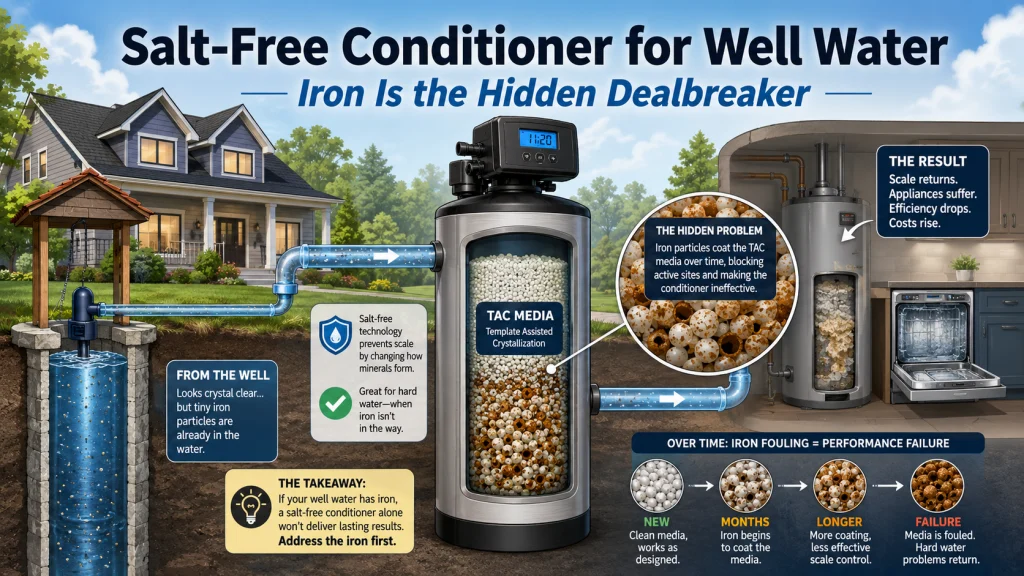
The right water conditions do not include most well water. The problem is iron. When dissolved iron is present, it deposits on the nucleation sites of the TAC media, the specific surface points where crystallization is supposed to initiate. Once those sites are coated, the process stalls. Water still moves through the system. You just stop getting scale prevention, which is the only thing the conditioner was ever designed to deliver. From the outside, nothing looks broken. You will not know it failed until the scale starts returning on your water heater element or inside the dishwasher.
Most product pages either omit the iron issue entirely or include a brief line about a pre-filter being recommended. That phrasing understates the situation considerably. What it means in practice is that the system will not function reliably on well water with iron unless you install a complete iron removal system upstream of it first, at additional cost, before the conditioner sees your water at all. That does not make salt-free useless on well water. It makes the water test non-negotiable before you spend anything.
Field Note: A homeowner reached out after installing a salt-free conditioner on their well. Water looked clean, no orange staining, no smell. The basic strip test they had used showed hardness but flagged iron as “trace.” Within fourteen months they were seeing scale on the water heater element again and inside the dishwasher. When I asked where scale appeared first, they said the lower heating element on the electric water heater, which is precisely the surface a functioning scale conditioner should have been protecting. When I walked through it with them, the issue was clear. The trace iron level, somewhere around 0.2 PPM based on a later lab test, had been gradually coating the TAC media since day one. The conditioner was still physically in place. It just was not doing anything useful anymore.

Recommended by SimpleLab and trusted by millions of American homes and businesses, this certified lab test is specifically designed to detect iron levels that can cause metallic taste, water discoloration, and staining on tubs, tiles, and fixtures. Each kit includes sampling materials, clear instructions, and pre-paid return shipping, with results delivered in an award-winning lab report featuring unbiased filtration recommendations and health guidance at no sales pitch. PhD scientists and engineers are available for direct support before, during, and after testing.
Check On AmazonIf you click this link and buy, we earn a commission at no additional cost to you.
What Iron Does to TAC Media and Why There Is No Recovery
The TAC media in a salt-free conditioner is a polymer bead engineered with a specific surface structure designed to initiate crystal nucleation. That surface is the mechanism. Remove it or coat it and you have an expensive piece of plastic sitting in a housing. Dissolved ferrous iron, the clear kind that gives no visible sign in the water, forms an oxide film on that surface over time. The iron does not need to be visible. It does not need to turn fixtures orange or leave residue in the toilet tank. It just needs to be present in the water passing through.
The fouling is cumulative and, under normal operating conditions, it is irreversible. A salt-based ion exchange softener has a regeneration cycle. Brine flushes through the resin on a set schedule or meter, and iron up to the system’s rated limit gets flushed out during that process. Some resin formulations are specifically designed for iron tolerance, and periodic resin cleaners extend that tolerance further. TAC media has no equivalent. There is no backwash, no regeneration, no cleaning process that restores fouled nucleation sites. Once they are coated, the only fix is media replacement.
The degradation is also gradual rather than sudden. A salt-free conditioner on iron-bearing well water does not fail on day one. It typically performs reasonably for the first several months while iron accumulates slowly. Then performance drops off, also slowly, without any alert or visible sign. That pattern is part of why the iron problem is underreported. By the time a buyer notices scale returning, the system has been failing quietly for months, and the connection to iron fouling is easy to miss if no one explained the mechanism upfront.
The Iron Threshold: Lower Than Most Tests Will Show You
Here is where the well water situation gets genuinely difficult. TAC media fouling has been documented starting at iron concentrations as low as 0.1 to 0.3 PPM. The EPA secondary standard for iron in drinking water is 0.3 PPM, set for aesthetic reasons around taste and staining, not equipment protection. Most basic strip test kits do not reliably distinguish between zero and 0.2 PPM. A result that comes back “undetected” or “trace” on a strip test may still contain enough iron to degrade TAC media meaningfully over time.
The standard a salt-free conditioner needs is iron below 0.1 PPM, confirmed by a lab test at 0.05 PPM sensitivity or better. What is acceptable for your pipes, your taste, and your fixtures is not the same threshold your conditioner needs to perform as marketed. Those are two different standards, and product pages that cite the EPA 0.3 PPM number as the threshold are quoting the wrong metric for this purpose.
A few practical examples of how this plays out:
- Your well tests at 10 GPG hardness with 0.2 PPM iron on a strip test. The strip shows iron as “trace” or possibly “not detected.” That level is still within the range where TAC fouling occurs over time.
- Your water runs completely clear, no smell, no orange staining anywhere. That means iron is present as dissolved ferrous iron, not precipitated ferric iron. Ferrous iron is invisible and still fouls TAC media.
- Your neighbor has the same aquifer and a salt-free system that has worked fine for three years. Their well may draw from a different depth or different part of the formation. Groundwater iron varies by location, depth, and season within the same aquifer.
- You had a water test done a few years ago that showed iron as non-detect. Well water chemistry changes. Iron levels shift with water table fluctuations, nearby land use, and pump depth over time.
The only reliable way to know whether your well is in the safe range for a salt-free conditioner is a certified lab test, specifically one that measures total iron at 0.05 PPM sensitivity or lower. A strip test gives you a starting point, but not the resolution you need for this decision.
| Iron Level (PPM) | TAC Media Risk | Salt-Free Viability |
|---|---|---|
| 0.0 (lab confirmed) | None | Viable if other conditions are met |
| 0.1 to 0.3 PPM | Low to moderate, cumulative | Fouling begins, reduced media life, not recommended |
| 0.3 to 1.0 PPM | High | Rapid fouling, significant performance loss within 1 to 2 years |
| Above 1.0 PPM | Severe | Not appropriate, iron filtration required regardless of system type |
Those thresholds reflect practical performance observations, not numbers from a manufacturer spec sheet. Most manufacturers state a maximum iron level without explaining the rate of degradation below that number. In my experience, any detectable iron shortens media life relative to what the product page implies.
The Pre-Treatment Math Nobody Runs for You
Making a salt-free conditioner work on well water with iron requires complete iron removal upstream of the conditioner. To reliably get iron below 0.1 PPM, you need a dedicated iron filtration system. A quality whole-house iron filter runs $800 to $1,500 before labor, depending on your iron concentration and flow rate requirements. The salt-free conditioner itself runs $600 to $1,500 for a system sized for a typical household. Equipment alone puts a functional salt-free setup for iron-bearing well water at $1,400 to $3,000, with installation added on top of that.
What you get at the end of that spend is scale prevention only. The water still tests hard. Your skin still feels the effects of hard water. Dishes still spot. The conditioner does one thing: it converts the dissolved calcium and magnesium into a form that does not bond to surfaces. That is genuinely valuable for appliance longevity and pipe protection, but it is the complete list of what the system delivers.
Compare that to a salt-based softener with the same iron pre-filter. The pre-filter cost is identical either way, because you need iron removal upstream of any treatment system on iron-bearing well water, regardless of what comes after it. The softener itself, a proven metered-regeneration unit with a quality control valve, runs $600 to $1,200 for the same household. Total system cost lands in a similar range. What you get at the end includes actual soft water: no spotting, improved lather, skin and hair that feel the difference, and scale prevention simultaneously.
For most buyers, running that comparison ends the conversation. The upfront cost is similar. The salt-free outcome is scale prevention. The salt-based outcome is soft water plus scale prevention, with the ongoing cost of salt averaging $100 to $200 per year depending on usage and water hardness. The only reason to land on salt-free after running this math is if you want to avoid that ongoing salt cost and maintenance burden, or if a local restriction on salt discharge applies to your area. Both are legitimate reasons. The decision should just be made with real numbers in front of you, not a general preference for “going chemical-free.”
Note: Some California water districts and a handful of municipalities elsewhere restrict salt discharge from ion exchange softeners. In those areas, a salt-free conditioner with proper iron pre-treatment may be the only compliant option regardless of cost. Check with your local water district before purchasing either type of system.
Your well has any detectable iron on a lab test. You have a sulfur smell. Hardness is above 15 GPG. Your primary goal is soft water feel on skin and hair. Your budget does not have room for iron pre-treatment before the conditioner.
Lab confirms iron below 0.1 PPM. No sulfur. Hardness under 15 GPG. Your goal is appliance and pipe protection, not soft water feel. You have a genuine reason to avoid ongoing salt cost, maintenance, or a local discharge restriction applies.
If your water falls into the second group, a salt-free conditioner is a reasonable purchase. If it falls into the first group, spend the money on testing and iron treatment before you choose any conditioner.

This whole house system tackles iron up to 3.0 ppm and manganese up to 1.0 ppm using a catalytic media third stage that lasts up to 3 times longer than traditional greensand, while also reducing sediment, chlorine, rust, herbicides, and industrial solvents. The first two stages feature a 5-micron polypropylene sediment filter and a coconut shell carbon block filter, both independently tested to NSF/ANSI standards with a 100,000-gallon capacity, enough to supply a family of four for a full year. With 1-inch NPT connections, 20 by 4.5-inch cartridges, and up to 15 GPM flow rate, it is backed by a 1-year manufacturer warranty and lifetime free US-based tech support.
Check On AmazonIf you click this link and buy, we earn a commission at no additional cost to you.
The Five-Year Cost Reality: When Salt-Free Actually Wins the Math
Upfront cost is only part of the picture. The real comparison plays out over five years of ownership, and which system wins depends heavily on your well water profile and what you actually need from it. On the right well water, salt-free wins clearly. On the wrong one, the math reverses quickly.
Salt-free scenario with lab-confirmed iron below 0.1 PPM: conditioner at $800 to $1,000, no iron pre-filter needed, no salt or regeneration cost for five years beyond a $30 to $80 annual water test to confirm iron has not changed. Five-year total lands around $950 to $1,400 if you test annually. Scale prevention from day one, nothing to maintain. For a homeowner with confirmed low-iron water at 10 GPG whose only goal is protecting the water heater and the RO membrane under the sink, this is hard to argue against.
Salt-free scenario with iron-bearing well water: iron filter at $800 to $1,500, conditioner at $800 to $1,500, installation on both, and the real ongoing cost is media replacement if iron levels rise or the pre-filter loses capacity. Five-year total easily reaches $2,500 to $4,000 depending on what goes wrong. And the outcome is still scale prevention only. Salt-based scenario with the same iron pre-filter: similar equipment cost, salt averaging $100 to $200 per year adds $500 to $1,000 over five years, but you get soft water in return. After five years, the cost delta between the two routes is often $500 to $1,000. Whether that is worth paying for actual soft water is a personal call. Most households I have seen with iron-bearing well water decide it is.
The scenario where salt-free wins definitively over five years is a specific one: confirmed low-iron well water, hardness under 15 GPG, homeowner who genuinely does not need soft water feel and has a real reason to eliminate the salt maintenance routine. That buyer saves the ongoing salt cost, eliminates the regen cycle, and gets reliable scale protection for close to nothing after the initial purchase. That is a real outcome. It just requires the water profile to actually match.

IAPMO certified to NSF/ANSI Standard 44, this system is sized for homes with up to 5 people and 4 bathrooms, using ion exchange to deliver soft, scale-free water from every tap with city or well water compatibility. The user-friendly LCD allows metered operation that uses up to 50% less salt and 28% less water compared to standard time-based softeners, helping lower long-term costs on appliances, soap, and cleaning products. The bundle includes a recommended pre-filter and installation kit, and is backed by a 5 to 10-year limited warranty with dedicated customer support.
Check On AmazonIf you click this link and buy, we earn a commission at no additional cost to you.
When a Salt-Free Conditioner Is Actually the Right Call for Well Water
There is a real scenario where salt-free makes sense for a well water home. It is specific, and if your water does not fit it closely, the system will underdeliver relative to what you paid. The conditions need to be true simultaneously, not just individually.
The full list of what needs to be confirmed:
- Iron below 0.1 PPM, confirmed by a certified lab test at that sensitivity. Not a strip test. Not a previous test from a few years ago.
- No hydrogen sulfide present, meaning no rotten egg smell. Sulfur compounds also interfere with TAC media performance, and they are more common in well water than most buyers expect.
- Hardness under 15 GPG. Above that level, TAC crystallization becomes less reliable as the mineral load increases. At 20 GPG or higher, ion exchange softening is a more consistent approach regardless of water source.
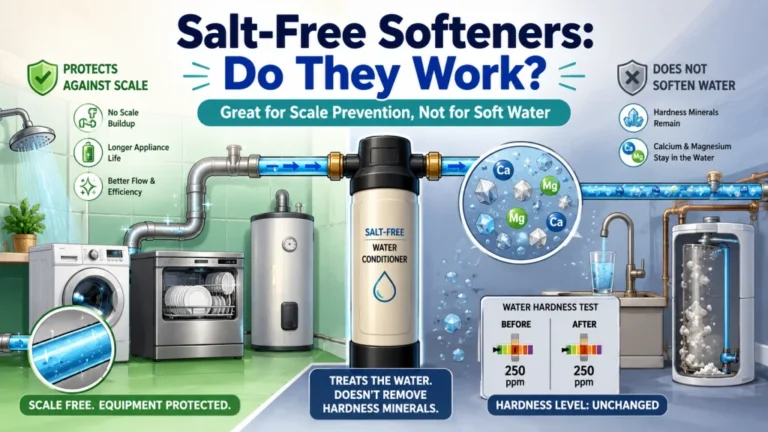
- No expectation of soft water feel. If your primary goal is to eliminate the dry skin, flat hair, and spotty dishes that come with hard water, a salt-free conditioner will not deliver that. It prevents scale. It does not remove hardness minerals from the water.
- A genuine reason to avoid salt: ongoing cost avoidance, environmental preference, a local discharge restriction, or a physical limitation that makes hauling salt bags impractical.
If all of those conditions are true, a salt-free conditioner on well water is a reasonable purchase and in some cases the better choice. I have seen them work well in rural homes where the well draws from a deep granite formation with no iron, hardness around 8 to 12 GPG, and the homeowner’s primary goal was protecting the water heater and an under-sink reverse osmosis system. That is a good use case. The conditioner does what it says, requires nothing ongoing, and the buyer got what they needed.
That is also not the typical well water situation. Most well water I have worked with has at least trace iron, and often more than trace. It is the nature of groundwater in iron-rich geological formations, and the issue is more common in homes where the well has been in service for years and the pump draws from depth with high mineral contact. If you have never had your well tested for iron at lab sensitivity, the reasonable starting assumption is that iron is present until you prove otherwise. Testing first costs $30 to $80. A mismatched system costs significantly more than that to replace.
If you are still working through the basics of what your well water needs before any softener decision, the complete guide to water softeners for well water covers how to read your test results and what each problem requires before you spend anything on treatment equipment.

Designed for homes with 2 to 4 bathrooms, this maintenance-free Template Assisted Crystallization system prevents scale buildup and protects pipes and appliances without salt, chemicals, electricity, backwashing, or drainage. The TAC process converts hard water minerals into microscopic seed crystals that stay suspended in the water stream rather than attaching to surfaces, gradually dissolving existing scale over time. Installation is a simple pipe-in and pipe-out connection, and the complete system includes media, mineral tank, distributor assembly, tank head, and bypass valve.
Check On AmazonIf you click this link and buy, we earn a commission at no additional cost to you.
Final Thoughts: The Water Test Comes Before the Product Page
Salt-free on well water is viable, but for a narrower group of buyers than the product pages suggest. With lab-confirmed iron below 0.1 PPM, no sulfur, hardness under 15 GPG, and a genuine reason to avoid ongoing salt maintenance, a salt-free conditioner is a legitimate choice and sometimes the better one. Outside those conditions, the pre-treatment cost closes the price gap with salt-based quickly, and salt-based delivers more for a similar spend.
What I see consistently is buyers skipping the water test and making a $1,000 decision based on a product page that never mentioned iron. A certified lab test runs $30 to $80 and changes the entire recommendation. There is no reason to spend four figures on a treatment system without knowing what is actually in your water first.
For the broader question of which system fits your specific situation, whether city water or well, moderate hardness or extreme, the water softener guide organized by water situation covers the full decision framework, including where salt-free fits and where it does not.

This comprehensive certified lab test analyzes 116 parameters including heavy metals, coliform and E. coli bacteria, disinfection byproducts, nitrates, pH, hardness, and alkalinity, making it especially well-suited for homes near farming or industrial activity on either city or well water. The metals panel alone covers 24 elements including lead, arsenic, uranium, mercury, and chromium, delivered through EPA, NELAC, ISO, and state certified labs for the fastest and most accurate results available. Every kit includes sampling materials, pre-paid return shipping, an award-winning lab report with unbiased filtration recommendations, and direct support from PhD scientists and engineers.
Check On AmazonIf you click this link and buy, we earn a commission at no additional cost to you.
FAQs
💧 Does a salt-free water conditioner work on well water?
It depends entirely on your iron level. If your well water has iron above 0.1 PPM, the TAC media will foul gradually and the system will lose effectiveness without any obvious sign of failure. On well water with iron confirmed below 0.1 PPM by lab test, no sulfur, and hardness under 15 GPG, a salt-free conditioner can work for scale prevention. Most well water does not meet those conditions without pre-treatment first.
🔬 What iron level starts fouling a salt-free conditioner?
TAC media fouling has been documented starting at 0.1 to 0.3 PPM iron. That is below the EPA secondary standard of 0.3 PPM and below what most basic strip tests can detect reliably. A certified lab test at 0.05 PPM sensitivity is the only way to confirm whether your well water is in the safe range for a salt-free system.
🛠️ Can I install an iron filter before a salt-free conditioner to make it work?
Yes, and that is the correct sequence if you want to pursue a salt-free system on iron-bearing well water. The iron filter adds $800 to $1,500 to the total equipment cost, bringing the combined system to roughly $1,400 to $3,000 before labor. Before going that route, run the math against a salt-based softener with the same pre-filter. The cost difference is often smaller than buyers expect, and the salt-based outcome includes actual soft water.
🚿 Will a salt-free conditioner make my well water feel softer?
No. Salt-free conditioners convert dissolved minerals into crystals that pass through without bonding to surfaces. They do not remove the minerals from the water. Your water will still test hard, and you will not notice the skin, hair, or lather difference that ion exchange softening delivers. If that outcome matters to you, a salt-free system is the wrong starting point.
⚠️ What happens to fouled TAC media? Can it be cleaned or restored?
No. Unlike resin in a salt-based softener, which regenerates on a regular cycle, TAC media has no backwash or regeneration process. Iron fouling is cumulative and irreversible under normal operating conditions. Once the nucleation sites are coated, the only fix is media replacement. This is one of the reasons getting the water test right before purchase matters more for salt-free than for other system types.
💰 Is salt-free cheaper than salt-based for well water over time?
On paper, yes, because there is no ongoing salt cost. In practice, if your well has iron and you need pre-treatment, the upfront cost is higher and the result is scale prevention only, not soft water. Salt costs $100 to $200 per year for a typical household. The break-even on that savings, weighed against the higher upfront cost and narrower outcome, is worth calculating before you commit.