
A Large Household Is a Different Problem, Not Just a Bigger Version of the Same One
When someone with 5 or 6 people in the house asks me what size softener they need, my first question is always about water hardness, not just headcount. Those two variables multiply against each other, and the combination of high daily volume and high GPG is where most generic sizing advice falls apart. A family of 5 at 10 GPG city water has a manageable situation. The same household at 18 GPG is a fundamentally different problem, and treating it like a slightly larger version of the average install is how buyers end up with systems cycling every 3 or 4 days.
The other thing I notice with large households is that hardness breakthrough is more disruptive than it is for smaller families. When a single-tank system regenerates, it either passes untreated water or takes itself offline for 90 minutes to 2 hours. For two people at moderate hardness, that window is usually invisible. For 5 people running showers, laundry, and a dishwasher in the same morning, it is not. Getting the grain capacity right from the start avoids that pattern entirely.
The Weekly Grain Requirement for Large Households
The formula is: number of people, multiplied by 75 gallons per person per day, multiplied by your water hardness in GPG, multiplied by 7 days. That gives your minimum weekly grain requirement. The system you buy should comfortably exceed that number, not just meet it, because real-world softening capacity typically runs 15 to 30 percent below the rated grain figure depending on salt dose and efficiency settings.
For a family of 5, the daily use baseline is 375 gallons. At 10 GPG, the weekly demand works out to 26,250 grains. A 32k system covers that with room to spare on a weekly cycle, though 48k gives you buffer and regenerates less frequently. At 15 GPG the requirement climbs to 39,375 grains, which puts 48k at the practical minimum and 64k as the more comfortable choice. At 20 GPG the weekly demand reaches 52,500 grains. At that point, a 64k system is tight for a weekly regen schedule, and an 80k unit or a twin alternating setup becomes the right answer.
For a family of 6, the numbers shift again. At 10 GPG: 31,500 grains per week, 48k minimum. At 15 GPG: 47,250 grains, solidly into 64k territory. At 20 GPG: 63,000 grains per week, and a twin alternating setup is the practical choice rather than an unusual one. For households of 7 or more, I would start the conversation at twin alternating for anything above 12 GPG. The weekly demand simply exceeds what most single tanks can deliver without regenerating on a pace that wears the valve faster than it should.
| Household Size | At 10 GPG | At 15 GPG | At 20 GPG | Recommended Starting Point |
|---|---|---|---|---|
| Family of 5 | 26,250 grains/week | 39,375 grains/week | 52,500 grains/week | 48k at 10 GPG, 64k at 15 GPG, twin at 20+ GPG |
| Family of 6 | 31,500 grains/week | 47,250 grains/week | 63,000 grains/week | 48k at 10 GPG, 64k at 15 GPG, twin at 20+ GPG |
| Family of 7+ | 36,750+ grains/week | 55,125+ grains/week | 73,500+ grains/week | 64k minimum at 10 GPG, twin at 15+ GPG |
One clarification on how rated grain capacity works in practice: the numbers on the label are calculated at maximum salt dose, which is rarely how systems are run. At a more realistic 6 lbs of salt per cubic foot of resin, a 48k-rated system may deliver closer to 35k to 40k usable grains before needing to regenerate. That gap matters when you are sizing for a large household where every bit of capacity needs to be accounted for. The complete water softener sizing guide walks through this efficiency adjustment in detail, including how to build appropriate margin into the calculation without oversizing.

This kit lets you test drinking water, pool water, or any water source in seconds using a simple dip-and-read method with an oversized color chart ranging from red to green, covering 0 to 25 GPG and 0 to 425 PPM. All 100 strips are protected by FreshSeal technology across a ready-to-use bottle and two sealed pouches for long-term accuracy. Each purchase also funds a full year of clean water for someone in the Central African Republic.
Check On AmazonIf you click this link and buy, we earn a commission at no additional cost to you.
The Iron Adjustment: When Your Hardness Number Is Not the Whole Story
If your water comes from a well, or if you are in a region where dissolved iron shows up in the supply, iron adds directly to your effective hardness before you run the sizing formula. The standard adjustment is 4 to 5 GPG for every 1 PPM of dissolved ferrous iron. That is not a rounding error. A family of 5 at 15 GPG with 2 PPM dissolved iron should be sizing as though they are at 23 to 25 GPG. For a large household, that single correction can move the recommendation from a 64k single tank into twin alternating territory, and skipping it is one of the more common and expensive sizing mistakes I see on well water installs.
Field Note: A situation I have seen play out more than once: a family of 5 on well water sized based on their hardness strip test reading, never got the iron tested separately, installed a 64k system, and found themselves regenerating every 4 days within the first few months. The iron was sitting at 1.8 PPM, which added 8 to 9 GPG to the effective hardness they were actually treating. After retrofitting a pre-filter and resizing the system, the cycle stretched back to weekly. The lab test before the purchase would have cost less than $30. The correction after the fact cost considerably more.
If your water has any measurable iron, get a proper lab test rather than relying on a strip test or a basic hardness kit. Strip tests typically detect iron at 0.3 PPM or higher, but even lower levels affect resin over time. For large households where daily throughput is high, iron exposure accumulates faster than it does for smaller households. Getting a complete water test before finalizing your sizing is the most useful thing you can do before any purchase decision. This is true regardless of household size, but for large families where the system runs at higher volume, it matters more.
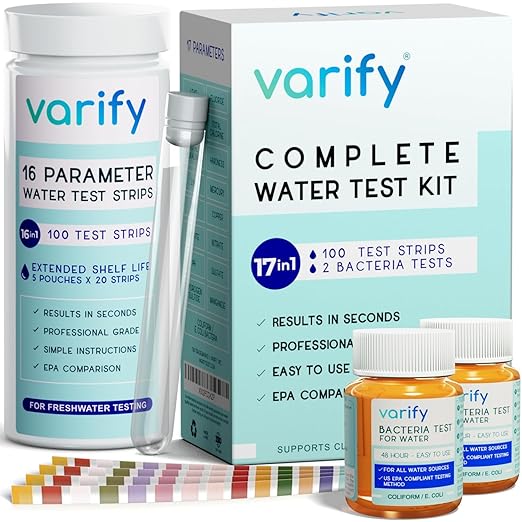
This comprehensive kit tests for 17 parameters including chlorine, fluoride, lead, iron, and bacteria, giving you a full picture of your water's safety in minutes. The 100 color-coded test strips come in 5 individually sealed pouches of 20 for extended freshness, while 2 included bacteria tests deliver results within 48 hours. Every purchase contributes a portion of proceeds to Water For Good, supporting clean water access in Central Africa.
Check On AmazonIf you click this link and buy, we earn a commission at no additional cost to you.
Where Single-Tank Systems Fall Short With High Daily Demand
A standard ion exchange softener regenerates when its resin bed reaches exhaustion. During that cycle, typically 90 minutes to 2 hours, the system either passes hard water or holds flow depending on configuration. For a small household at moderate hardness, this window is rarely a problem. Regen happens overnight, demand is low, and the timing works. For a large household at high GPG, the morning looks very different: showers, laundry, a dishwasher, and a coffee maker all running within the same hour or two. If the system triggers regen at 5 AM because it exhausted its resin the night before, multiple people are showering with hard water during the highest-demand window of the day.
The deeper issue is that large families at high GPG push resin exhaustion toward a shorter cycle regardless of what size system is installed, if the system is undersized. A 48k grain system serving a family of 5 at 18 GPG is regenerating every 4 to 5 days, not weekly. That pace accelerates valve wear, increases salt consumption per gallon softened, and creates more opportunities for hardness to slip through during the regen window. The fix is not managing around the cycle. It is choosing a capacity that lets the system run on a weekly schedule or close to it.
This is also why demand-initiated regeneration is not optional at large household scale. A fixed-schedule timer that regenerates every 4 days regardless of actual use wastes salt when demand is lower than expected and still runs short when a particularly high-use week pushes exhaustion ahead of the schedule. Demand-initiated systems track actual usage and regenerate when the resin needs it, not on a clock. For families with variable patterns, teenagers, or frequent guests, that difference in control logic shows up in salt efficiency and in how reliably soft water is available.
Twin Alternating: Continuous Soft Water Without the Regen Gap
A twin alternating softener uses two resin tanks connected to a single control valve head. The valve tracks water use across both tanks and switches between them automatically. When tank one exhausts its usable capacity, the system switches immediately to tank two, without interrupting supply, and tank one enters its regeneration cycle in the background. When tank two approaches exhaustion, the valve switches back to tank one, which has fully regenerated and is ready for service. The result is uninterrupted soft water at any hour, regardless of how much your household is drawing.
For large families at 15 GPG or higher, this configuration is not an upgrade tier. It is the setup that matches how high-demand households actually use water. At 20 GPG for a family of 5, the weekly grain demand exceeds what most single large tanks can deliver in one service cycle without running the regen cycle more frequently than is practical. Two tanks in alternating rotation cover the demand without ever requiring the household to work around a regen window or accept occasional hardness breakthrough during peak morning hours.
Key point: For households of 5 or more, twin alternating becomes worth serious consideration at 15+ GPG and is often the more practical choice at 20+ GPG, especially when peak morning demand is high or iron adjustment pushes the effective hardness higher. The cost difference over a comparably sized single tank is smaller than most buyers assume, and the operational benefit of never running short during a high-demand week is significant for large families.
One practical detail worth checking before committing: twin alternating systems require more physical space than single-tank setups. Two tanks plus a dual-head control valve take up more floor area and vertical clearance than the specifications for a single tank suggest. Measure your installation space, including height clearance for the valve head, before purchasing. A system that does not fit the available space creates installation problems that are far more frustrating to solve after the fact.

This whole-home water softener comes pre-loaded with 1.5 cubic feet of high capacity resin in a black USA-made mineral tank, paired with a USA brine tank featuring a safety float. The on-demand digital metered system ensures efficient water treatment, and the included 1-inch Noryl plastic bypass valve makes installation straightforward. Toll-free customer support is available whenever you need help.
Check On AmazonIf you click this link and buy, we earn a commission at no additional cost to you.
What Specs Actually Matter When You Are Buying High-Capacity
Grain capacity is the first number to get right, but it is not the only one that determines how a system performs over 10 or 15 years of heavy daily use. The control valve quality, the resin specification, and how the system handles salt efficiency all affect long-term performance in ways that are not visible in the purchase decision but become apparent in year 5 or 7 when something needs service or replacement.
- Demand-initiated regeneration. Already covered above, but worth restating plainly: for large households, demand-initiated is the functional baseline, not an upgrade feature. Fixed-schedule regeneration wastes salt on unnecessary cycles and creates breakthrough risk when usage runs high. At large household volume, those inefficiencies compound.
- 10% crosslink resin for city water. If your water source is municipal, chlorine is present in the supply. Chlorine degrades ion exchange resin over time, and the crosslink percentage of the resin determines how quickly that degradation occurs. Standard 8% crosslink resin fails faster under chlorine exposure than 10% crosslink. For a large household system running at high daily volume, resin longevity is worth verifying before you buy. Not every manufacturer publishes this specification on retail listings. Ask directly if it is not stated, and treat an inability to answer as a yellow flag.
- Control valve quality and parts availability. The control valve is the component most likely to need service over a 10 to 15 year system life. For twin alternating setups, the valve is also handling switching logic in addition to regen sequencing. Look for valve models with a documented service history and readily available replacement parts. If a part fails in year 8, the ability to source a replacement without a dealer service call is a real practical consideration.
- Bypass valve configuration. High-capacity systems should always include a proper bypass valve as part of the installation. This allows the softener to be isolated for service without cutting off water to the house. For a household of 5 or 6 people, losing supply pressure for even a short window during service is disruptive. A correctly configured bypass makes routine maintenance straightforward and reduces the temptation to defer service.
- Rated capacity at realistic salt dose. Watch how grain capacity is advertised. Some manufacturers rate at maximum salt dose to make the number appear larger. The usable figure at 6 lbs per cubic foot is the operational number for most homeowners running demand-initiated systems. Capacity rated at 12 or 15 lbs per cubic foot is technically achievable but at a salt efficiency that defeats the purpose of demand-initiated regeneration. Ask which dose the rated number refers to.
If your household is also dealing with hardness above 15 GPG specifically and you want to understand how that level of hardness changes the sizing and valve selection conversation beyond just the capacity numbers, the broader guidance on choosing the right water softener by situation covers how control valve quality and resin specs interact with high-hardness conditions across different household configurations.
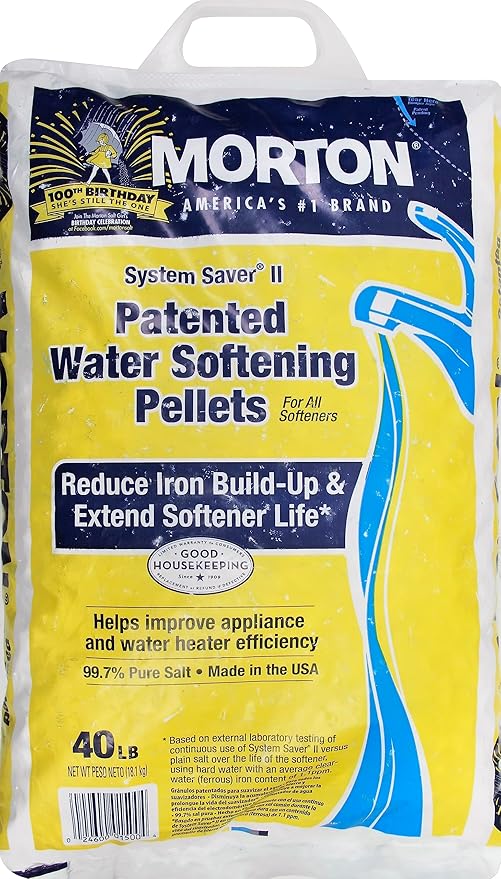
This 40-pound bag of USA-made System Saver pellets is designed to improve the taste of your water while helping extend the life of your appliances and water softener. Simple to use, just add the pellets directly to your softener's brine tank as needed.
Check On AmazonIf you click this link and buy, we earn a commission at no additional cost to you.
A Note on Oversizing: Bigger Is Not Always Safer
Large households tend to worry about running short on capacity, which is a reasonable concern. The less obvious risk runs the other direction. A system that is two sizes too large for actual demand regenerates so infrequently that the resin bed can develop stagnant water conditions. Infrequent regeneration also allows salt to compact in the brine tank, which leads to bridging and mushing over time. For large families at high GPG, actual oversizing is unlikely because the demand is genuinely high. But for a family of 5 at 7 GPG city water, buying the largest twin alternating setup available because it seemed like the safest choice can create its own maintenance headaches.
The goal is a system that regenerates roughly once per week under normal household conditions. One size up from the calculated minimum is reasonable buffer. Two sizes up at modest hardness is worth reconsidering. Run the formula, add a realistic margin for the efficiency gap between rated and real-world capacity, and let that number guide the purchase rather than defaulting to the largest option in the catalog.
How to Choose Between a Single Tank and Twin Alternating for Your Household
Once you have your grain requirement calculated and your iron situation sorted, the actual setup choice comes down to where your household falls in the demand and hardness matrix. The table below is not a product recommendation. It is a framework for narrowing the type of system that fits your situation before you start evaluating specific options.
| Your Situation | Best Setup Type | Must-Have Specs | Avoid |
|---|---|---|---|
| 5 people, 10 GPG | Single tank | 48k minimum, demand-initiated regen | Timer-only control, 32k or smaller |
| 5-6 people, 15 GPG | 64k single tank; twin if peak morning demand is high | 64k, demand-initiated, realistic salt-dose rating | 48k or smaller, manufacturer grain rating at max salt dose only |
| 5-6 people, 20+ GPG | Twin alternating preferred | Dual tank, serviceable valve, adequate installation space | Standard retail 48k, fixed-schedule timer |
| Any iron detected | Size after iron adjustment, then choose above | Lab test before sizing, iron-adjusted effective GPG | Sizing from strip hardness test only |
| 7+ people, any GPG | Twin alternating unless hardness is at or below 10 GPG | High-capacity dual tank, demand-initiated, bypass valve | Single tank at 15+ GPG for 7 or more people |
One pattern worth naming directly: large families tend to worry about running short on capacity, which is reasonable, but the answer is not always twin alternating. A family of 5 at 10 GPG city water with a correctly sized 48k or 64k demand-initiated system will run reliably on a weekly regen schedule without breakthrough issues. Twin alternating becomes the better practical choice when the combination of high household volume and high hardness creates a weekly grain demand that outpaces what a single tank can deliver comfortably, or when morning peak demand means any regen window during waking hours is genuinely disruptive.

Specially formulated for high-iron well water, this resin cleaner dissolves metallic and organic buildup in resin beds, converting rust and iron into a clear solution that rinses away during normal regeneration cycles without harsh or abrasive chemicals. Regular use extends the life of your resin tank and keeps your water softener performing at peak efficiency. Simply add half a cup for every 40 pounds of salt, layering it between bags to ensure a continuous dose with each regeneration. It also doubles as a rust stain remover for dishwashers, glassware, white fabrics, tubs, and surfaces including porcelain, fiberglass, and acrylic.
Check On AmazonIf you click this link and buy, we earn a commission at no additional cost to you.
Final Thoughts: Three Steps Before You Buy
Get your actual hardness number, not a strip test estimate. Adjust for iron if your water has any detectable amount. Run the weekly grain formula and build in margin for the gap between rated and real-world capacity. Those three steps, done before the purchase, are what separate a system that runs reliably for 15 years from one that gets replaced or retrofitted at year 3.
The sizing math is not complicated, but it does need to be done with the right inputs. A large household at high GPG is one of the scenarios where the gap between “what the label says” and “what your household actually needs” is widest. Close that gap with the calculation, and the rest of the selection becomes considerably more straightforward.
FAQs
💧 What size water softener does a family of 5 need?
At 10 GPG, a 48k grain system covers a family of 5 comfortably with roughly weekly regen. At 15 GPG, 64k is the right minimum. At 20 GPG or above, a 64k system is tight for a weekly cycle and a twin alternating setup becomes the practical choice. The formula is: 5 × 75 × GPG × 7. Add 15 to 30 percent to account for the gap between rated and real-world capacity before you finalize the size.
🔄 Do large families really need a twin alternating water softener?
Not always, but frequently yes at higher hardness levels. At 10 to 12 GPG, a correctly sized single tank covers most families of 5 without breakthrough issues. Once hardness reaches 15 GPG or above with 5 or more people in the household, the weekly grain demand can push an undersized single tank into regenerating every 4 to 5 days. Twin alternating eliminates the regen gap and provides uninterrupted coverage regardless of demand timing.
🧂 How does iron in well water affect sizing for a large family?
Add 4 to 5 GPG to your hardness number for every 1 PPM of dissolved iron before running the sizing formula. A family of 5 at 15 GPG with 2 PPM iron should calculate as though they are at 23 to 25 GPG. For large households on well water, this adjustment frequently changes the recommendation from a single large tank to a twin alternating setup.
📏 How often should a large household water softener regenerate?
Roughly once per week is the target for most residential systems. Regenerating every 3 to 4 days is a sign the system is undersized for your actual grain demand. Regenerating less than once every 10 to 14 days at normal household usage can indicate oversizing, which carries its own risks including resin stagnation and increased chance of bacterial growth in the mineral tank.
⚙️ What is the difference between demand-initiated and timer-based regeneration for large families?
Demand-initiated regeneration tracks actual water use and cycles when the resin reaches exhaustion. Timer-based regeneration cycles on a fixed schedule regardless of actual demand. For large families with variable usage patterns, a timer system either wastes salt by regenerating when the resin is not yet exhausted, or allows breakthrough by not regenerating when a high-use week pushes exhaustion ahead of the schedule. Demand-initiated is the correct choice for high-volume households.
🏠 Can a large family use a single-tank softener instead of twin alternating?
Yes, if the hardness and household size combination falls within what a properly sized single tank can handle on a weekly regen schedule. A family of 6 at 10 GPG with a 48k to 64k unit can work well. The problem is specifically the combination of large household size and high hardness, typically 15 GPG or above, where weekly grain demand exceeds single-tank practical capacity and breakthrough during regen becomes a regular occurrence.