
Why $600 to $1,000 Is Where the Best Water Softener Value Lands
If you are shopping for the best water softener under $1,000, the first thing worth establishing is that this range sits in a genuine sweet spot in the market. Below $500, the compromises start stacking up. Above $1,000, you are mostly paying for added grain capacity or smart features that most households do not need. Between $600 and $1,000, the core specs align in a way that they simply do not at the lower tier, and without the markup that pushes similar hardware into the $2,000 to $3,500 range through the dealer channel.
What specifically shifts at $600? The control valve. At $300 to $500, most systems use proprietary valves with limited parts availability and manufacturer-dependent service options. At $600 and above, systems built around the valve types that water treatment communities consistently recommend become accessible. These are field-serviceable units with parts stocked by distributors nationally, in production for decades, and familiar to any water treatment technician. That matters more than most buyers realize at purchase time. It becomes obvious a few years after the warranty expires.
For context on how water type, hardness level, and household situation should shape your decision before price range even enters the conversation, the framework at choosing a water softener by water situation walks through the full picture. Price range is a filter you apply after you know what you actually need.
| Price Range | Control Valve | Resin Crosslink | Regeneration Type | Parts Availability |
|---|---|---|---|---|
| Under $500 | Often proprietary | Usually 8% or unspecified | Timer-based common | Manufacturer-dependent |
| $600 to $1,000 | Established manufacturers available | 10% available in better builds | Demand-initiated standard | Widely stocked through dealers |
| Above $1,000 | Same valve options, higher capacity | 10% crosslink standard | Demand-initiated with smart features | Same as mid-range |
The gap between under $500 and the $600 to $1,000 range is meaningful across every column in that table. The gap between $1,000 and $1,500 is mostly grain capacity and additional features. Knowing where the real spec jump happens keeps you from either underspending on hardware that will cost you later or overspending on a capacity you will never use. The control valve question is where most of that jump lives, and it is worth understanding in detail.
The Control Valve Question: What the Water Treatment Community Knows That Most Buyers Do Not
A water softener is an assembled system. The resin tank holds the ion exchange media. The brine tank stores the salt. The control valve runs everything else: it meters water flow, triggers regeneration when the resin is near capacity, manages the backwash and brine draw cycles, and monitors usage over time. The valve is the most serviceable component in the system. It is also the part most likely to become a long-term problem if you bought the wrong one at the start.
Field Note: The pattern I see repeatedly with proprietary-valve failures follows a predictable timeline. A seal fails or the motor sticks, usually somewhere between years three and six. The homeowner contacts whoever installed the system. The part is discontinued, or it is only available direct from the manufacturer at a cost that makes repair barely worth it compared to replacement. That problem does not exist with valves from the manufacturers the water treatment community has settled on over the last few decades. Parts are stocked at distributors across the country. Any technician who works on water treatment equipment knows them and can source what is needed locally.
The water treatment community has a shorthand for this. A frequently quoted comment from a Slickdeals forum thread captures the general consensus clearly: “Not based off Clack or Fleck valve so a hard pass.” That is not brand loyalty. It is pattern recognition from buyers who have owned multiple systems and understand what field serviceability means over a fifteen-year ownership window. In the $600 to $1,000 range, systems built around these valves are accessible as direct-to-consumer builds through water treatment dealers, and as the base of better retail systems that do not obscure the valve spec.
The dealer comparison is worth stating plainly. National dealer-brand systems at $2,000 to $3,500 installed often contain the same control valves available in direct builds at this price range. The markup covers the service relationship, the installation, and the brand name. The hardware inside is frequently identical. If the service relationship matters to you, it has value. The three to five times markup is not coming from a fundamentally better component. That is the part the dealer channel has no incentive to explain, and why this price range rewards buyers who understand what they are looking at. The resin specification is the next place that understanding pays off.
10% Crosslink Resin: The Specification That Determines How Long a City Water System Lasts
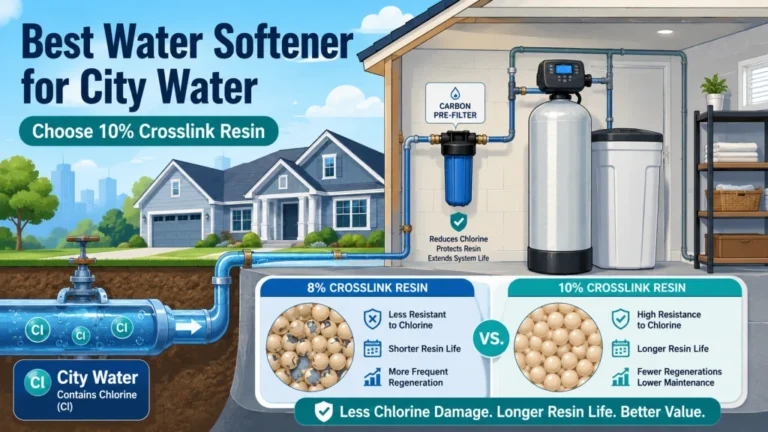
Ion exchange resin is made of tiny polymer beads that capture calcium and magnesium ions as water passes through the tank. During regeneration, those ions are flushed out with a brine solution and replaced with sodium. How long the beads hold up and how efficiently they keep working depends heavily on the water chemistry they are exposed to every day. For city water, the primary threat to resin longevity is chlorine.
Municipal water treatment uses chlorine for disinfection. By the time water reaches your softener, chlorine levels are lower, but they are not zero. Over years of continuous exposure, chlorine oxidizes the polymer bonds within each resin bead. The beads start to fracture. They pack more tightly in the tank. Pressure drop increases. The system keeps regenerating, but softening performance drops. Most homeowners attribute this to the system being worn out, without realizing the resin reached end of useful life ahead of schedule because of the crosslink specification.
The crosslink percentage is the density of polymer bonds within each bead. 8% crosslink resin has a less dense structure and degrades noticeably faster under chlorine exposure. 10% crosslink is more resistant. In many city-water installs I have watched over time, 8% crosslink resin starts showing meaningful performance degradation somewhere in the seven to nine year range, depending on actual chlorine levels and usage. A higher-crosslink system running on the same water commonly makes it fifteen years or more before the resin needs attention, though your results will vary with local water chemistry. That is not a minor spec-sheet footnote when you are buying something you plan to keep for the life of the house.
The frustrating part is that most retail product listings do not state crosslink percentage. If the listing does not explicitly say 10%, it is almost certainly 8%. At the $600 to $1,000 range, the better direct builds confirm 10% crosslink in their product specs. If you cannot find that confirmation on the product page for a system you are evaluating, ask the seller directly. A seller who cannot answer that question clearly is giving you useful information about the level of support you can expect later.

This professional-grade liquid cleanser removes iron, manganese, silt, metal particles, and other contaminants that salt leaves behind in your resin bed, valve parts, and beads. Regular use helps extend appliance life, reduce maintenance calls, and maintain consistent water quality across any water softener brand. It is NSF certified to NSF/ANSI/CAN Standard 60 for drinking water additives and is made in the USA, making it safe for families and pets. Apply 4 oz before each regeneration or use with the Pro Products Easy Feeder kit for daily low-dose treatment.
Check On AmazonIf you click this link and buy, we earn a commission at no additional cost to you.
Demand-Initiated Regeneration: What It Saves and When Smart Monitoring Adds Something Real
A timer-based water softener regenerates on a fixed schedule regardless of actual water usage. If it is set to cycle every six days and the household only used 40% of grain capacity that week, it still runs a full regeneration, flushing through salt and backwash water with nothing to show for it. Metered regeneration uses a flow counter on the control valve to track actual water volume processed. Regeneration is triggered when the resin is genuinely near capacity, not when the clock says so. The result is salt savings of 30 to 50% compared to a timer system in most household usage patterns, and less unnecessary cycling of the valve and resin.
Most systems at $600 and above include metered, demand-initiated regeneration as standard. In the sub-$500 range, timer-based systems are still common enough that it is worth checking. Over a ten-year ownership period at $150 per year in unnecessary salt cost on a timer system, the compounding effect is real. Add the reduction in unnecessary regeneration cycles extending valve and resin life, and demand-initiated regeneration is one of the clearest return-on-investment specs available at this price range.
Smart monitoring starts appearing reliably in this range, typically as a Bluetooth or Wi-Fi app that shows current salt level, estimated days until the next regeneration, and usage history. For some households this is genuinely useful. A low-salt notification on a phone is more practical than checking a utility closet brine tank every week. For other households, a glance at the salt level once a month is sufficient and the app adds nothing. What is worth checking before buying is the specific scope of the monitoring. Some systems show only salt level. Others log daily water usage and flag anomalies. If visibility into consumption patterns matters for your household, verify exactly what the app tracks, not just whether an app exists.
Note: Smart monitoring features vary significantly between systems in this price range. Confirm what the app actually shows before purchasing if remote visibility matters to you. A listed “smart” feature that only alerts on low salt is materially different from one that logs usage history and flags unusual consumption.

Refined to 99.8% purity, these pellets minimize tank residue and are specifically formulated to resist clumping and salt bridges that can cause system malfunctions. By removing hard minerals like calcium and magnesium, they help extend the life of your dishwasher, washing machine, and water heater while preventing scale buildup in pipes. Compatible with all major water softening systems, the 50-pound bag features a patented dual-handle design for easier and safer lifting and pouring.
Check On AmazonIf you click this link and buy, we earn a commission at no additional cost to you.
Sizing This Range to Your Hardness and Household
The most consistent mistake I see in the $600 to $1,000 range is buyers choosing the system with the lowest upfront cost within their budget without running the sizing calculation first. The formula is simple: multiply your hardness in grains per gallon by your household’s daily water usage in gallons, then multiply by seven to get weekly grain demand. A family of four using 300 gallons per day at 10 GPG needs 21,000 grains per week. A 32k grain system handles that and regenerates approximately every eleven days. A 48k system regenerates every sixteen. Both work. The key is matching grain capacity to demand so you are not cycling every three to four days, which accelerates valve wear and burns through salt faster than a properly sized system would.
Where the $600 to $1,000 budget starts to tighten is at higher hardness levels. At 15 GPG, that same family of four needs around 31,500 grains per week minimum. A 48k system covers it but without much headroom. At 18 GPG, weekly demand is closer to 37,800 grains, and stepping up to a 64k system is the right call even if it pushes slightly past $1,000. Undersizing at high hardness means frequent cycling, faster wear, and salt costs that will exceed the price difference in a relatively short time. For a full walkthrough of how household size and hardness level interact in the sizing calculation, the guide at matching water softener grain capacity to your household covers it in detail.
- Under 10 GPG, 1 to 3 person household: 32k to 48k grain capacity handles most scenarios without unnecessary headroom.
- Under 10 GPG, 4 to 5 person household: 48k is the minimum, 64k gives comfortable margin for weeks with guests or higher usage.
- 10 to 15 GPG, 3 to 4 person household: 48k works at the lower end of this range, 64k is a better fit and extends regeneration intervals more practically.
- Above 15 GPG: size up one step from what the standard calculation gives you. Very large households at high hardness may need capacity above the typical $600 to $1,000 range, which is worth knowing before setting a firm budget ceiling.
One practical note on hardness data: published city water averages from utility annual reports and actual tap readings sometimes differ by a few GPG, especially in older distribution systems or during seasonal treatment changes. If your last actual test is more than a year old, a basic tap test is a more reliable sizing baseline than a published citywide average.

This kit lets you test drinking water, pool water, or any water source in seconds using a simple dip-and-read method with an oversized color chart ranging from red to green, covering 0 to 25 GPG and 0 to 425 PPM. All 100 strips are protected by FreshSeal technology across a ready-to-use bottle and two sealed pouches for long-term accuracy. Each purchase also funds a full year of clean water for someone in the Central African Republic.
Check On AmazonIf you click this link and buy, we earn a commission at no additional cost to you.
Red Flags in the $600 to $1,000 Range
This price band has marketing noise. Some systems in it are worth the money. Some use the $600 to $1,000 price point as cover for specs that belong in the sub-$500 tier. The difference is not always obvious from a product listing, and sellers at this price have no incentive to make the gaps easy to spot.
The patterns I have learned to avoid, in rough order of how often they show up:
- Product page does not name the valve manufacturer. A vague description like “heavy-duty control valve” or “professional-grade head” with no brand or model reference almost always means a house-brand valve with limited serviceability.
- Resin crosslink percentage is not stated anywhere. If it is not on the product page and the seller cannot confirm it in writing, assume 8%. At $600 to $1,000, a seller worth buying from will answer this question without hesitation.
- The word “smart” appears in marketing copy but the listing does not confirm metered or demand-initiated regeneration. Smart monitoring and smart regeneration are not the same thing. A system can have a Bluetooth app and still run on a fixed timer. Confirm explicitly.
- Warranty coverage is one year on electronics and the valve. Five years or more is reasonable at this price for a system you expect to run fifteen-plus years. A one-year parts warranty in this range is a mismatch worth noting.
- Large grain capacity is advertised as the headline spec with no mention of valve parts availability, resin specification, or flow rate. Grain capacity is easy to claim. Serviceability specs take more work to confirm, which is why sellers with weaker hardware lead with the number.
- “Professional grade” language with no verifiable third-party specs. Professional grade means something when it comes with a confirmed valve, a confirmed resin spec, and a warranty structure that reflects long-term use. As a standalone claim, it means nothing you can check.
None of these are disqualifying on their own if you can get clear answers by asking directly. The flag is when a seller cannot or will not answer. A product worth buying in this range should be able to tell you the valve manufacturer, the resin crosslink percentage, and exactly what the warranty covers in a single email exchange.
Which Direction to Prioritize Based on Your Situation
Most buyers in this range fall into one of a few situations, and the priority order shifts depending on which one applies. None of these require a specific product recommendation to be useful.
If long-term repair cost and serviceability are your primary concern, the valve choice is your most important decision. A system with a confirmed valve from one of the established water treatment manufacturers, 10% crosslink resin, and a five-year electronics warranty is the right profile. Smart features are secondary. Grain capacity matters, but serviceability comes first.
If smart monitoring or remote visibility is important for your household, verify the scope of the monitoring system before buying anything else. Check that the system is metered, not timer-based. Then look at what the app actually tracks. A system that sends a low-salt alert and logs daily usage is materially different from one with only a single alert threshold. Within this price band, the better smart-monitoring systems still meet the valve and resin spec threshold. You should not have to choose between monitoring capability and component quality.
If your water hardness is above 15 GPG, be willing to exceed the $1,000 ceiling for the right grain capacity. A properly sized 64k or 80k system at $1,000 to $1,200 is still a fraction of dealer pricing for equivalent hardware. Forcing a budget ceiling at $1,000 and landing on an undersized 48k system at 18 GPG will cost more in salt and wear over three years than the price difference you saved. The $600 to $1,000 range works well for most standard city water situations. High-hardness households should treat $1,000 as a guide, not a ceiling.
If you are on standard city water at 7 to 12 GPG with a household of two to four people, this range handles your situation cleanly. Confirm the four specs in the checklist below, match grain capacity to your weekly demand, and a mid-range system in this band will outperform a dealer install at three times the price on every measurable spec.

This whole-home water softener comes pre-loaded with 1.5 cubic feet of high capacity resin in a black USA-made mineral tank, paired with a USA brine tank featuring a safety float. The on-demand digital metered system ensures efficient water treatment, and the included 1-inch Noryl plastic bypass valve makes installation straightforward. Toll-free customer support is available whenever you need help.
Check On AmazonIf you click this link and buy, we earn a commission at no additional cost to you.
Final Thoughts: Four Things to Confirm Before You Buy in This Range
This price band earns its reputation as the affordable whole-house water softener sweet spot for a straightforward reason: it is where the specs that determine long-term reliability become consistently available without dealer pricing. That does not mean every system in this range delivers what it could. The price range is necessary, not sufficient. Not every system at $700 has 10% crosslink resin and a field-serviceable valve. Some do. That is what you are screening for.
Before committing to anything in this range, confirm four things. First, the control valve: does the product page name the valve manufacturer, or describe a proprietary design? A seller who will not identify the valve brand is usually telling you something. Second, the resin crosslink: 10% should be stated explicitly on the product page or in the spec sheet. If it is not there, ask. If the answer does not come back clearly and quickly, treat that as 8% and evaluate accordingly. Third, the regeneration type: demand-initiated should be explicitly confirmed, not assumed from “smart” marketing language. Fourth, the warranty: five years or more on electronics and the valve head is reasonable at this price. A one-year parts warranty on a system you plan to run for fifteen years is a mismatch worth factoring into the decision.
A system that answers all four of those questions clearly is probably worth the money. Most in this range that are genuinely well-built will not hesitate on any of them. The ones that hedge or deflect tend to reflect that in other ways eventually.
FAQs
💧 Is a $1,000 budget enough for a whole-house water softener?
For most households on city water at 7 to 15 GPG, yes. A well-specified system in the $600 to $1,000 range handles whole-house softening for families of two to five with the right control valve and grain capacity. Above 15 GPG or for larger households, grain capacity requirements may push costs slightly past $1,000 for a properly sized system.
🔬 What is the difference between 8% and 10% crosslink resin?
Crosslink percentage refers to the density of polymer bonds within each resin bead. Higher crosslink resists chlorine degradation better over time. For city water with ongoing chlorine exposure, 10% crosslink resin typically maintains performance significantly longer before replacement is needed. If a product page does not state crosslink percentage, assume 8%.
⚙️ What does demand-initiated regeneration mean and why does it matter?
Demand-initiated systems track actual water volume processed and trigger regeneration only when the resin is near capacity. Timer-based systems regenerate on a fixed schedule regardless of usage. Demand-initiated reduces unnecessary salt consumption and backwash water, particularly in households where usage varies from week to week.
🛠️ Why are Clack and Fleck valves recommended so consistently in water treatment communities?
Both valve lines have been in continuous production for decades, with replacement parts stocked by distributors nationally. If the valve head fails in year twelve, a local water treatment technician can source and install the part without needing factory support. Proprietary valves from less-established manufacturers frequently have no available replacement parts a few years after the warranty expires.
🏠 How long should a water softener in the $600 to $1,000 range last?
A properly sized system with 10% crosslink resin and a quality control valve, maintained with the right salt type and periodic cleaning, typically runs fifteen to twenty years. The resin may need replacement at ten to fifteen years depending on water chemistry. A field-serviceable valve often outlasts the rest of the system.
💰 Why does a dealer charge $3,500 for hardware I can buy direct for under $1,000?
Dealer pricing covers installation, the service relationship, and brand markup, not a fundamentally different component set. Many dealer-brand systems use the same control valves available in direct-to-consumer builds at this price range. Whether the service relationship justifies the price difference depends on your situation. The hardware difference alone does not.