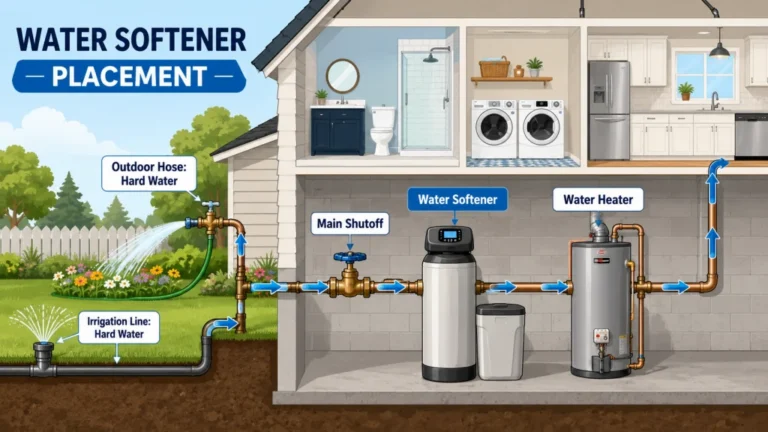

The Service Schedule That Actually Fits How These Systems Work
How often a water softener needs servicing depends almost entirely on what you mean by the word. The answer homeowners usually get from dealers and home service companies is “once a year,” and that answer lines up conveniently with service contracts and scheduling fees. The answer from someone who has installed and maintained these systems in real homes looks different.
How often a water softener needs to be serviced, in practical terms, comes down to this: check the salt every 4 to 6 weeks, clean the venturi valve once a year, and run resin cleaner through the system every 3 to 6 months. That is the full water softener maintenance schedule for most residential systems on city water. Well water with iron calls for more attention to the pre-filter and more frequent resin cleaner use, but the basic framework holds. None of those tasks require a technician, and most take under 20 minutes.
Professional service only enters the picture when something specific has failed and the standard maintenance tasks have not resolved it. That is not a criticism of professional technicians. It is just an honest description of how these systems actually fail and what most failures actually need.
What Falls in the Homeowner’s Lane
The tasks that keep a residential water softener running for 15 to 20 years are almost entirely accessible without special tools or training. I have walked hundreds of homeowners through these on-site, and the consistent reaction is surprise at how approachable they are. Here is what belongs on your side of the line:
- Salt refill: Check the brine tank every 4 to 6 weeks and add salt when the level drops below one-third of the tank capacity. A family of four with water at 10 GPG on a demand-initiated system typically goes through about one 40 lb bag per month. Timer-based systems regenerate on a fixed schedule regardless of water use, so they consume more.
- Venturi valve cleaning: The venturi is a small injector inside the control head that draws brine into the resin tank during each regeneration cycle. It clogs gradually with mineral deposits and sediment, and cleaning it once a year is the single most impactful maintenance task on this list. It takes about 15 minutes, involves removing two or three screws, and a toothbrush is the only tool required.
- Salt bridge clearing: Press a broom handle down through the salt. If it meets solid resistance before reaching water, a hard crust has formed above the brine level. Break it up firmly and the system can dissolve salt into brine again. No parts, no tools.
- Resin cleaner: Pour the cleaner into the brine well before manually initiating a regeneration cycle. On city water with chlorine, every 3 to 6 months is the right interval. On well water with detectable iron, monthly treatment is worth building into the routine.
- Sediment pre-filter cartridge: If you are on well water and have a sediment pre-filter upstream of the softener, that cartridge needs changing every 3 to 6 months. On city water, annually is typically sufficient. A clogged cartridge causes pressure drop and sends sediment toward the resin bed.
- Manual regeneration: Most control heads have a button that initiates a full cycle on demand. Running one and watching it complete confirms the motor is turning, brine is drawing, and the system is finishing the rinse sequence. It takes about an hour and answers a lot of questions before a phone call does.
Field Note: Of all the items on this list, the venturi cleaning is the one I see skipped most consistently. Homeowners know to add salt. They have heard of salt bridges. But the venturi is invisible inside the control head, and nothing in the owner’s manual makes it feel like a priority until the softener has already stopped regenerating effectively. One annual cleaning prevents most of the “not using salt” calls I have seen. It is that reliable.
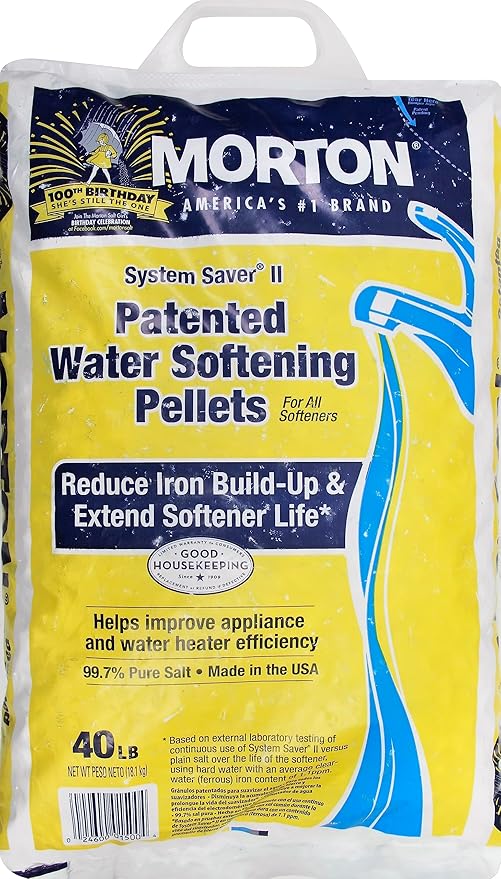
This 40-pound bag of USA-made System Saver pellets is designed to improve the taste of your water while helping extend the life of your appliances and water softener. Simple to use, just add the pellets directly to your softener's brine tank as needed.
Check On AmazonIf you click this link and buy, we earn a commission at no additional cost to you.
The Service Call That Usually Was Not Necessary
The most common reason homeowners call a water softener technician is that the system has stopped using salt. The salt level is not going down, hard water is coming back, and the assumption is that something internal has failed. In most cases, it has not.
The actual cause is usually one of three things: a clogged venturi valve, a salt bridge near the top of the brine tank, or a stuck float valve. All three are homeowner-fixable. The venturi especially is one of those simple maintenance tasks homeowners are rarely taught, even though it often prevents a paid service call. A technician who shows up, pulls the venturi assembly, rinses it under the faucet, and reinstalls it in 15 minutes is performing a task that most homeowners can complete without help. The invoice typically runs $150 to $200 for the visit.
What comes up repeatedly in homeowner forums and installer communities is that the internal valve parts in residential water softeners are largely standardized across the industry. An injector that fits one common valve design often fits several others. A stuck float valve is a stuck float valve regardless of what logo appears on the control head. One forum contributor described finding a video walkthrough online, taking the valve apart, cleaning it, and getting the system working again without any professional help. His conclusion was that there was nothing inside the valve complicated enough to justify professional labor for something like a clogged injector. That is a consistent observation, not an isolated one.
Key point: Before you pay for a service call, check these four things first:
- Has the salt level changed in the last 4 to 6 weeks?
- Is there no salt bridge when pressed with a broom handle?
- Has the venturi been cleaned and reinstalled?
- Did manual regeneration complete normally?
If all four pass and the water still tests hard, the problem has moved beyond routine maintenance and a technician makes sense.
For the broader context of how installation decisions connect to long-term maintenance demands, the guide to water softener installation and maintenance covers both sides of that relationship.

This universal cleaner removes iron, sediment, dirt, and rust from your softener's resin bed, valve, and internal components, tackling the tough buildup that salt alone cannot address. It is compatible with virtually any brand including Whirlpool, Culligan, GE, Kenmore, Morton, and more, making it a reliable maintenance choice regardless of your system. Used every 4 months, it restores softening performance and can extend the parts and labor warranty on EcoPure systems up to 5 years with product registration.
Check On AmazonIf you click this link and buy, we earn a commission at no additional cost to you.
When a Technician Actually Makes Sense
There are four situations where calling a professional is the right call. It is worth knowing what they are so you do not end up paying for a service visit that your own hands could have resolved.
Resin bed replacement is the clearest case. When the resin has lost its softening capacity and cleaning has not recovered it, the media needs to come out and new resin needs to go in. Draining the mineral tank, removing old resin, installing fresh media around the distributor tube, and reassembling the system requires patience and basic plumbing confidence. It is doable as a DIY project. It is also a reasonable job to hand to a technician, particularly on older systems where the tank condition may be worth a professional eye before spending money on resin.
Control head failure is the second situation. If the motor that drives the regeneration cycle will not turn, or if the timer, circuit board, or valve mechanism has seized, you are looking at component replacement rather than cleaning. Some control heads use widely available parts that are field-serviceable. Others are proprietary enough that replacement of the entire valve is more practical than sourcing individual components. A technician with experience across multiple brands is better positioned to give an honest answer here than someone trying to steer you toward a full replacement.
Resin beads escaping into your plumbing is the third, and it requires immediate action. If small beads or grit are coming out of your faucets, the distributor tube inside the mineral tank has broken. Put the system in bypass mode right now. Running hot water while resin beads are in the lines draws them into the water heater, and water heater damage from resin accumulation is a more expensive problem than the softener repair itself. The tube replacement is inexpensive. The downstream consequences of waiting are not.
Persistent leaking after O-ring replacement is the fourth. Most bypass valve leaks resolve with a $3 to $8 O-ring. If the leak continues after new O-rings are properly seated, the valve body is the issue, not the seal. That is a valve replacement conversation, and it is worth a technician’s assessment before committing money in either direction.
The complete water softener maintenance guide covers the full range of upkeep topics, including how to work through common problems systematically before deciding whether a technician is the next step.
How Long a Properly Maintained Softener Lasts
A well-built control valve on a residential water softener is rated for 20 or more years of service. In practice, the systems that reach that lifespan share a common pattern: someone was paying attention regularly, catching salt bridges when they formed, and cleaning the venturi before resin problems developed. The ones that did not make it to 15 years were usually either ignored or only addressed when a problem was already well advanced.
City water and well water age softeners differently, and the water softener maintenance frequency that makes sense depends on which one you have. Chlorine in municipal water gradually oxidizes standard resin, breaking down the polymer structure over time. Standard 8% crosslink resin on heavily chlorinated city water commonly loses meaningful softening capacity within 7 to 12 years. The 10% crosslink resin handles the same conditions significantly better, typically lasting 15 to 20 years or more. If your system uses standard crosslink resin and you are on chlorinated city water, a carbon pre-filter installed upstream is one of the better investments available for extending resin life. It removes chlorine before it ever contacts the resin bed.
Well water with iron degrades resin differently. Iron coats the beads and reduces softening capacity over time, independent of the polymer crosslink rating. At iron levels above 1 PPM without adequate pre-treatment, I have seen resin begin losing meaningful capacity within 3 to 5 years. Regular resin cleaner treatments slow that progression. They do not stop it indefinitely if the iron load is high without a proper pre-filter in the treatment train.
There is one situation where professional inspection on a more regular basis is worth considering: systems that are over 10 years old, or any system running on well water with high iron or very hard water above 25 GPG. At that point, a trained eye can spot resin degradation and valve wear before they become failures. Keeping basic maintenance supplies on hand is usually cheaper than waiting for a failure, but older systems in demanding water conditions benefit from the kind of assessment a homeowner cannot easily run themselves.
| Maintenance Task | Recommended Frequency | Who Handles It |
|---|---|---|
| Salt refill | Every 4 to 6 weeks | Homeowner |
| Venturi valve cleaning | Annually | Homeowner |
| Resin cleaner (city water) | Every 3 to 6 months | Homeowner |
| Resin cleaner (well water with iron) | Monthly or more frequent | Homeowner |
| Sediment pre-filter cartridge (well water) | Every 3 to 6 months | Homeowner |
| Sediment pre-filter cartridge (city water) | Annually | Homeowner |
| Professional assessment | When symptoms persist after DIY troubleshooting | Technician |
| Resin replacement | When cleaning fails; typically 10 to 20 years depending on water type | DIY or technician |
The tasks above account for the vast majority of what keeps a residential system running well. If those are being handled on schedule, the situations that actually require a professional call are uncommon and usually obvious when they arrive.

This 50-micron flushable and reusable filter serves as an ideal first stage in any whole house filtration system, capturing sediment, rust, dirt, and sand before water reaches finer filters downstream. A built-in Siliphos additive helps soften water, prevent scale buildup, and reduce pipe corrosion, with filter replacement recommended every 3 to 6 months for best results. The see-through housing allows easy visual monitoring, and dual threads with 1-inch MNPT and 3 to 4-inch FNPT connections make installation straightforward for indoor use within a pressure range of 20 to 100 PSI.
Check On AmazonIf you click this link and buy, we earn a commission at no additional cost to you.
Final Thoughts: Knowing the Line Before Something Goes Wrong
Most homeowners either do too little until something fails, or they pay for professional service on a schedule that does not match how these systems actually break down. Both approaches cost more than they should. The middle path is straightforward: keep salt in the tank, clean the venturi once a year, run resin cleaner on a schedule, and call someone only when something specific does not respond to those basics.
If your system is older, knowing whether you are buying resin cleaner, cartridges, O-rings, or a full valve replacement matters more than booking a routine annual visit. The homeowners who get 20 years out of a residential softener made those distinctions early. They did not wait for the water to go hard before opening the control head for the first time.
If you want a task-by-task breakdown with enough detail to complete each item confidently, the water softener maintenance checklist organizes everything by frequency and walks through each step. If a specific problem has already appeared and the basics have not cleared it, the water softener troubleshooting guide covers the most common failures in diagnostic order.

This kit includes 150 dip-and-read test strips for quickly measuring water hardness across virtually any source, including home faucets, well water, softeners, dishwashers, showers, and aquariums. Results are instant and easy to read against a color chart, making it simple to verify whether your water softener, reverse osmosis, or water conditioning system is performing as expected. A bonus eBook is included to help you record, track, and interpret your results over time.
Check On AmazonIf you click this link and buy, we earn a commission at no additional cost to you.
FAQs
🔧 How often should I clean the venturi valve on my water softener?
Once a year is the standard for most homes on city water. Well water with higher sediment levels may call for cleaning every 6 months. The venturi controls brine draw during regeneration and clogs gradually without any visible warning. The cleaning takes about 15 minutes and requires nothing more than a toothbrush and some warm water.
📅 Do I really need annual professional service for my water softener?
Not on a fixed annual schedule for most systems. Salt, venturi cleaning, and resin cleaner handle the majority of what keeps a well-maintained softener running. That said, systems over 10 years old or running on well water with high iron or very hard water above 25 GPG are worth having a technician look at periodically. At that point, wear patterns and resin condition are harder to evaluate without experience, and catching problems early is cheaper than reacting to them.
💧 My softener has not used any salt in weeks. Is that a service call?
Usually not. Check for a salt bridge first by pressing a broom handle firmly through the salt in the brine tank. If there is no bridge and the tank looks clear, the next likely cause is a clogged venturi valve. Remove the venturi assembly, rinse it thoroughly under running water, and reinstall it. Those two steps resolve most “not using salt” situations without a technician.
⏳ How long should a residential water softener last?
A well-maintained system with a quality control valve can last 20 years or more. Without regular attention, the realistic average is closer to 10 to 15 years. The main variables are whether the resin was protected from chlorine degradation (city water) or iron fouling (well water), and whether the venturi was kept clean enough to allow effective regeneration over time.
🌊 Does city water vs well water change how often I should service my softener?
Yes, meaningfully. City water with chlorine calls for resin cleaner every 3 to 6 months to offset chlorine degradation of the resin beads. Well water with iron requires more frequent resin cleaner use and a sediment pre-filter that needs regular cartridge changes every 3 to 6 months. Well water installations need more consistent maintenance attention overall to protect the resin bed.
🏠 What is the difference between what I can do myself and what needs a professional?
Homeowner tasks: salt refill, venturi cleaning, resin cleaner, salt bridge clearing, pre-filter cartridge replacement, manual regeneration. Professional tasks: resin bed replacement, control head or motor failure, resin beads escaping into plumbing, persistent leaking after O-ring replacement. If the problem does not respond to the homeowner-accessible steps, that is the signal a technician is the right next move.