The Pre-Filter Is Not Optional With Well Water
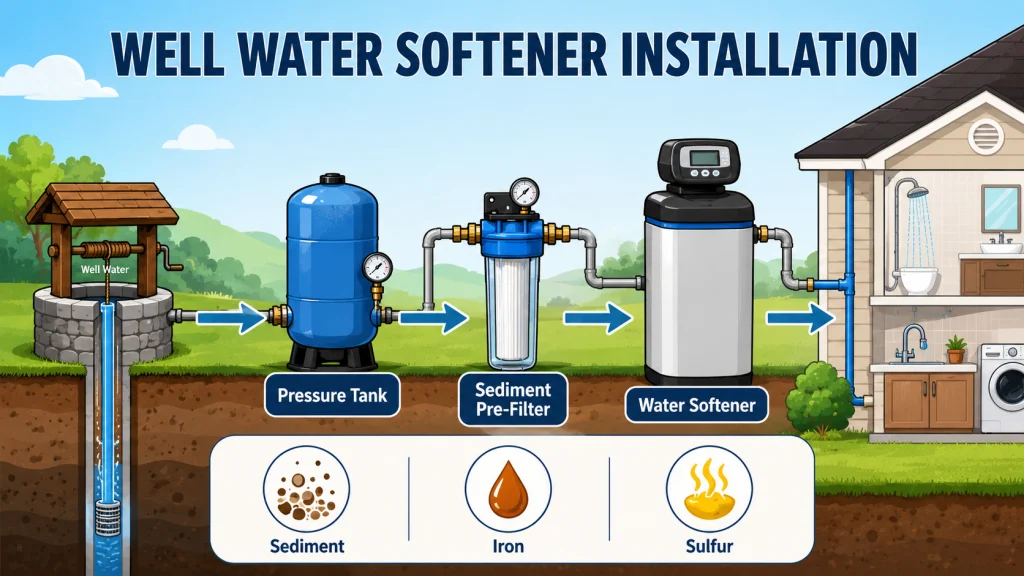
City water arrives at your home after the municipality has already filtered it. Well water does not. What comes out of a private well depends entirely on the aquifer, and in my experience, even wells with relatively clean test results carry fine particles that accumulate over time inside a resin tank. A 20 to 50 micron sediment cartridge filter, installed on the cold water supply line upstream of the softener, intercepts those particles before they reach the resin bed. Without it, the resin bed takes on the filtering job it was never designed for.
What fouled resin looks like in practice: the softener works fine for 12 to 18 months, then efficiency drops. Regeneration cycles run on schedule but water hardness climbs back up faster between cycles. You pull the control head for service and the resin beads are coated in a fine brownish layer, sometimes compacted. If iron is present in the water, the coating is worse. Resin cleaner helps with iron fouling, but sediment fouling is mechanical damage, and no chemical treatment fully reverses a bed that has been accumulating fine sand and rust particles for two years.
Field Note: One of the most common well water service situations I see is a softener that starts underperforming inside 18 months. Good unit, correct sizing, clean installation. No sediment pre-filter upstream. The resin bed is coated, flow restriction is building, and the homeowner has no idea why their system is already struggling. A basic filter housing setup with cartridges on a well water change schedule would have prevented the whole thing.
A 20 micron cartridge is a reasonable starting point for most well water. If your test shows high turbidity or visible particles, the instinct is to use a finer micron rating, but a 5 micron cartridge as the first stage creates its own problem: it clogs significantly faster and can cause a meaningful pressure drop between the filter and the softener, adding strain to a pump that may already be working near its lower threshold. The better approach with heavy sediment loads is staged filtration, a 50 micron housing followed by a 20 micron housing. The coarser stage handles the bulk load, the finer stage catches what passes through, and both cartridges last considerably longer than a single fine-stage setup would. The housing or housings mount on the cold water supply line before the softener inlet and need to stay accessible, since you will be changing cartridges on a shorter schedule than any city water system requires.

This 50-micron flushable and reusable filter serves as an ideal first stage in any whole house filtration system, capturing sediment, rust, dirt, and sand before water reaches finer filters downstream. A built-in Siliphos additive helps soften water, prevent scale buildup, and reduce pipe corrosion, with filter replacement recommended every 3 to 6 months for best results. The see-through housing allows easy visual monitoring, and dual threads with 1-inch MNPT and 3 to 4-inch FNPT connections make installation straightforward for indoor use within a pressure range of 20 to 100 PSI.
Check On AmazonIf you click this link and buy, we earn a commission at no additional cost to you.
When Iron or Sulfur Is Present: The Treatment Order That Protects Your Softener
A water softener can handle a modest iron level, typically up to 1 to 2 parts per million, with an iron-rated resin and a regular resin cleaner program running in the background. Above that threshold, iron fouls the resin faster than any maintenance routine can keep up with, and softening performance degrades steadily. If your well test comes back at 3, 5, or 8 PPM iron, the softener alone is not the answer. You need a dedicated iron filter placed in the treatment train before the softener.
The sequence of equipment matters more than most first-time well water buyers realize. A pattern I have watched repeat across hundreds of installs: a homeowner installs a softener without addressing iron first, expecting the softener to handle it all. The unit works for the first several months, resin cleaner keeps it functional a while longer, then capacity slowly disappears and the homeowner starts blaming the salt brand or the softener model. The problem was upstream the whole time. Getting the order right from the start avoids an expensive retrofit down the road.
| Well Water Condition | Treatment Order |
|---|---|
| Sediment only, iron below 1 PPM | Sediment pre-filter → Water softener |
| Iron 1 to 2 PPM, no sulfur | Sediment pre-filter → Water softener (iron-rated resin, resin cleaner program) |
| Iron above 2 PPM, no sulfur | Sediment pre-filter → Iron/manganese filter → Water softener |
| Sulfur present (rotten egg odor), low iron | Aeration or AIO filter → Sediment pre-filter → Water softener |
| Iron above 2 PPM plus sulfur | Aeration or AIO filter → Sediment pre-filter → Iron/manganese filter → Water softener |
Note: A carbon post-filter installed after the softener is an optional final stage for any of the configurations above. It is not a water safety issue for most well water homes, but if residual taste or odor remains after the rest of the treatment train is running, a carbon stage at the end addresses what the other stages are not designed to handle.
If you are not sure what is in your water, test before buying anything. A basic hardness and iron panel is enough to determine which of those configurations applies to your situation. Sulfur is usually self-evident from the odor, but a test confirms the concentration and tells you whether aeration alone handles it or whether you need a more aggressive approach. Skipping the test and guessing puts you at risk of building the wrong treatment train from the start.
One detail worth spelling out on the iron-and-hardness combination: if your water is, say, 18 GPG hard with 2.5 PPM iron, the effective load on a softener without upstream iron treatment is higher than the hardness number alone suggests. Iron binds to resin aggressively. A common calculation in the field adds 4 GPG for every 1 PPM of iron when determining effective hardness for sizing purposes, which means that 18 GPG with 2.5 PPM iron behaves closer to 28 GPG in terms of resin demand. If you size for 18 GPG and ignore the iron contribution, you will be regenerating far more often than the spec sheet implies.
Pro Tips: Know your test results before you buy anything. Sediment only, iron below 1 PPM: a single filter housing with 20 micron cartridges is the minimum starting point. Heavy sediment or fast-clogging cartridges: add a 50 micron stage upstream of the 20 micron stage. Iron above 2 PPM: budget for a dedicated iron or manganese filter before the softener. Sulfur present: an aeration or AIO filter goes at the head of the entire train. Uncertain about your line pressure: measure it with a gauge before ordering equipment, not after everything is already on the wall.
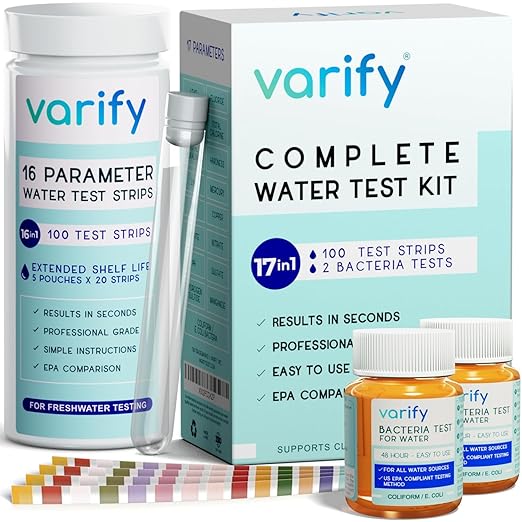
This comprehensive kit tests for 17 parameters including chlorine, fluoride, lead, iron, and bacteria, giving you a full picture of your water's safety in minutes. The 100 color-coded test strips come in 5 individually sealed pouches of 20 for extended freshness, while 2 included bacteria tests deliver results within 48 hours. Every purchase contributes a portion of proceeds to Water For Good, supporting clean water access in Central Africa.
Check On AmazonIf you click this link and buy, we earn a commission at no additional cost to you.
Pump Pressure, the Pressure Tank, and Where the Softener Goes
Well pumps typically operate on a pressure switch set at 40/60 PSI, meaning the pump kicks on at 40 PSI and shuts off at 60 PSI. Water softeners require a minimum of 20 to 25 PSI to function properly and are rated to handle up to 80 to 100 PSI on the high end. That range fits comfortably within a standard well pressure setup. Where problems show up is when line pressure drops below 20 PSI during high-demand periods or mid-regeneration. If your pump is undersized or the pressure tank is too small, the softener may stall partway through a regeneration cycle, which creates its own set of headaches.
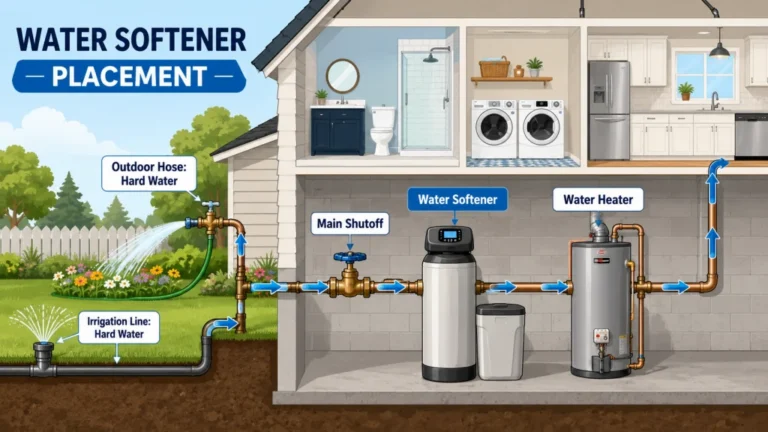
The placement rule for well water systems: install the softener after the pressure tank, not between the well and the pressure tank. The pressure tank exists to buffer the system from the sharp pressure surges that occur every time the pump cycles on and off. A softener installed before the pressure tank absorbs those surges directly through the bypass valve and internal components. After the pressure tank, the supply line is stable, and the softener sees the kind of steady operating pressure it was designed for. The same principles that govern city water placement apply here; the full breakdown of positioning logic is covered in the water softener installation overview.
Note: Check your actual static line pressure with a gauge before installation. Pressure switch settings tell you the target range, but real line pressure under simultaneous demand can differ meaningfully. If static pressure at the installation point is below 30 PSI, investigate why before adding a softener to the system.
The outdoor hose bib and irrigation rules apply on well water the same as on city water. Any outdoor faucets, garden connections, or irrigation lines should be plumbed upstream of the entire treatment train, before the sediment filter and softener. Softened water applied to soil accumulates sodium over time and damages lawns and garden beds. This is one of those details that becomes obvious only after the lawn starts declining, and by then the fix requires replumbing a section of the supply line.
Pre-Filter Maintenance on Well Water Runs on a Different Clock
With city water, a sediment pre-filter cartridge typically needs changing once a year. With well water, that schedule does not hold. Depending on your water’s sediment load and iron content, the cartridge may need replacing every 3 to 6 months. I have seen particularly turbid well water sources foul a 20 micron cartridge in 6 to 8 weeks. The variance is significant, and the only reliable way to know your specific change interval is to monitor carefully through the first year of operation.
The easiest way to track cartridge condition is to install a pressure gauge on both sides of the filter housing. A differential of more than 10 to 15 PSI across the housing means the cartridge is restricting flow and needs changing. Without gauges, the symptoms appear downstream: reduced flow at faucets, the softener may behave erratically during regeneration because the brine draw and backwash steps depend on adequate flow rate, and in iron-heavy water, staining can return at fixtures even though the softener appears to be regenerating normally.
- Reduced flow at faucets during normal use: the pre-filter is restricting flow before water reaches the softener. This typically shows up first at fixtures farthest from the pressure tank, where pressure is already lowest.
- Pressure gauge differential above 15 PSI across the housing: if you have gauges installed on each side, this reading means the cartridge is overdue for replacement regardless of how recently you changed it.
- Softener stalling or producing incomplete regeneration cycles: a partially clogged cartridge reduces available flow during the backwash, brine draw, and slow rinse steps, which can cut a cycle short or produce poor results.
- Iron staining returning at sinks or shower fixtures: on systems handling moderate iron with an iron-rated resin, a fouled pre-filter sends more iron to the resin bed than the cleaner program can handle.
- Heavy discoloration when you pull the cartridge: a brown or orange-coated cartridge after a short service interval suggests the iron and sediment load is higher than a single cartridge stage can manage efficiently. Adding a coarser upstream stage, a 50 micron filter before the 20 micron filter, extends the finer cartridge’s life considerably.
The full maintenance picture for a well water softener system, including venturi cleaning, resin cleaner dosing schedule, and brine tank inspection, sits within the broader water softener installation and maintenance guide. The pre-filter is one component of a maintenance routine that runs on a shorter cycle than city water systems, and treating it as an afterthought is precisely how well water softeners end up in early service calls that a properly installed sediment pre-filter would have prevented. On well water, maintenance is not an optional extra; it is what keeps a properly sized, properly installed system performing the way it should year after year.

This targeted cleaner chemically dissolves iron and rust buildup from your softener's resin bed, converting deposits into a clear solution that rinses away completely during the regeneration cycle to restore peak softening performance. Beyond the softener, it also removes tough rust stains from toilets, sinks, tubs, white clothing, and exterior surfaces, making it a versatile addition to any hard water household.
Check On AmazonIf you click this link and buy, we earn a commission at no additional cost to you.
Final Thoughts: Well Water Asks a Little More of the System
Most of what makes well water softener installation different from city water comes down to one principle: you are conditioning raw groundwater, not pre-treated municipal supply. The sediment pre-filter, the treatment train order when iron or sulfur is present, the pump pressure check, the pressure tank positioning rule, and the more demanding maintenance schedule all follow from that single reality. None of it is complicated, but all of it matters, and each step skipped tends to show up as a problem 12 to 18 months later.
What it comes down to practically: test your water before you buy equipment, install the pre-filter before startup, position the softener after the pressure tank, and build your maintenance schedule around what well water actually demands rather than what the city water estimate on the cartridge box suggests. Do those things and this installation is no harder than any other. Skip one, and the problem it creates tends to show up 12 to 18 months later wearing the disguise of a faulty softener.

These unscented, fragrance-free pellets are specially formulated to reduce hard water minerals, prevent scale buildup in appliances and plumbing, and minimize rust stains on laundry, sinks, and fixtures. Uniform pellet size ensures even dissolving for consistent softening performance, leaving dishes spot-free and fabrics noticeably softer. The 40-pound bag fits most standard water softener tanks and is compatible with all standard softener systems.
Check On AmazonIf you click this link and buy, we earn a commission at no additional cost to you.
FAQs
🔧 Do I need a sediment filter before a water softener with well water?
Yes. Well water contains fine particles and iron fines that municipal treatment removes before city water reaches homes. Without a sediment pre-filter upstream, those particles accumulate in the resin bed and cause fouling within 1 to 2 years. A 20 to 50 micron cartridge filter on the supply line before the softener inlet is the standard starting point for any well water installation.
🧪 Can a water softener remove iron from well water?
Up to about 1 to 2 PPM, yes, with an iron-rated resin and a consistent resin cleaner program. Above 2 PPM, iron fouls the resin faster than maintenance can clear it and softening performance degrades over time. If your iron test is above 2 PPM, a dedicated iron filter should come before the softener in the treatment train, not after.
📍 Where do I install a water softener on a well water system?
After the pressure tank, before the water heater. Installing before the pressure tank exposes the softener to pump cycling surges it was not designed to absorb. The pressure tank stabilizes the supply line, and the softener should sit on that stabilized section. Outdoor faucets and irrigation lines should be plumbed before the entire treatment train, not after the softener.
⚡ What water pressure does a water softener need to function properly?
Most residential water softeners require 20 to 25 PSI minimum and handle up to 80 to 100 PSI maximum. A standard well pressure switch set at 40/60 PSI puts the operating pressure well within that range. If your system pressure drops below 30 PSI under simultaneous household demand, investigate the cause before adding a softener.
🗓️ How often should I change the pre-filter cartridge with well water?
Every 3 to 6 months is the general well water guideline, compared to annually with city water. The actual interval depends on your specific sediment and iron load. Monitor the first year closely, either with pressure gauges across the housing or by pulling and inspecting the cartridge at 3 months to assess how fouled it is. That tells you your real change schedule.
💧 What is the correct treatment order for well water with both iron and sulfur?
If iron is above 2 PPM and sulfur is present, the order is: aeration or AIO filter first, then sediment pre-filter, then iron/manganese filter, then water softener. The aeration stage handles sulfur and oxidizes dissolved iron so the filter can remove it. Running a softener before iron treatment causes resin fouling regardless of how much resin cleaner you add.
🏠 Is well water softener installation harder than city water?
The plumbing steps are identical. The difference is what goes upstream of the softener. A city water install is typically softener plus bypass valve plus drain connection. A well water install adds a sediment pre-filter at minimum, and potentially an iron filter or aeration stage depending on what the water test shows. The softener itself installs the same way either route.