Two Problems That Look the Same Until You Dig Down
The first sign of either problem is usually the same: your water is getting hard again, and when you check the brine tank, the salt level looks fine. It has not gone down in weeks. The system is regenerating on schedule. But the water is testing hard, and maybe the soap is not lathering the way it used to. Something is wrong, and the brine tank is where to start.
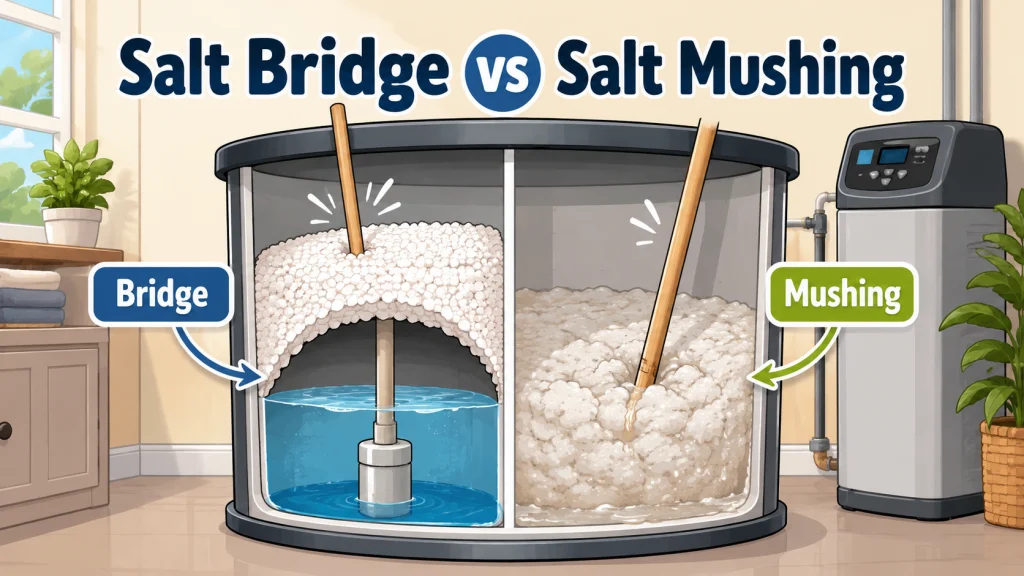
What you are dealing with is either a salt bridge or salt mushing, and it matters which one. A salt bridge forms above the water in the brine tank, cutting off contact between the salt and the water beneath it. Salt mushing happens at the bottom, where old dissolved salt recrystallizes into a sludge that blocks the brine valve from drawing up any solution. Same symptom from the outside. Very different situation inside. I have walked homeowners through both over the years, and the ones who guessed wrong spent an afternoon doing the wrong job and still had a softener that was not working.
The good news is that diagnosing the difference takes about 30 seconds with a broom handle.
What a Salt Bridge Is and How to Find It
A salt bridge is a hardened crust of salt that forms a dome or shelf partway down the brine tank, with an air gap and water below it. The salt on top looks perfectly normal. You open the lid, see what appears to be a tank half-full of salt, and assume everything is fine. But the water sitting at the bottom has no salt in contact with it, so no brine is forming, and the softener is running regeneration cycles through plain water. The resin never gets recharged, and the water coming out of your taps stays hard.
To check for a salt bridge, push a broom handle or long dowel rod straight down through the center of the salt. If you hit solid resistance before you reach the water level, there is a bridge. You should be able to push all the way down to the water without any hard obstruction. A true salt bridge will stop the handle short, and you will notice a hollow thump if you knock against it from the side.
Field Note: One of the patterns I see consistently is salt bridges in tanks where the homeowner tops off the salt every time they open the lid, even if it is still mostly full. Overfilling is the most common contributor. The salt compresses under its own weight, humidity does the rest, and you end up with a shelf of cemented crystals that looks completely normal until you poke it.
Bridges tend to form more often with solar crystals than with evaporated pellets, and more often in humid environments like basements and crawl spaces where temperature swings and moisture work on the salt over time. If you are in a humid climate and have been using crystals, a bridge is the more likely culprit.
How to Fix a Salt Bridge
Break it up. Push the broom handle firmly down through the crust, work it around in a circular motion, and it will usually shatter back into loose salt crystals. Do not use anything sharp. I have seen brine tanks with holes punched in the bottom by homeowners who got impatient and grabbed a screwdriver. The brine tank holds no pressure, but a punctured tank leaks salt water onto your floor and needs replacing.
Once the bridge is broken, let the tank sit for a few hours so fresh brine can form. Then run a manual regeneration cycle. If the system starts pulling salt again, the problem is solved. If the salt level starts dropping on schedule over the next few weeks, you are back to normal operation. A broken bridge does not damage the resin or the control valve, so there is nothing else to check once the brine is flowing again.

Refined to 99.8% purity, these pellets minimize tank residue and are specifically formulated to resist clumping and salt bridges that can cause system malfunctions. By removing hard minerals like calcium and magnesium, they help extend the life of your dishwasher, washing machine, and water heater while preventing scale buildup in pipes. Compatible with all major water softening systems, the 50-pound bag features a patented dual-handle design for easier and safer lifting and pouring.
Check On AmazonIf you click this link and buy, we earn a commission at no additional cost to you.
What Salt Mushing Is and Why It Is Different
Salt mushing is a different problem entirely. Instead of a crust forming above the water, mushing happens when salt that has already dissolved into the brine solution recrystallizes at the very bottom of the tank as a thick, dense sludge. It looks like wet sand, or sometimes like chunky slush. It packs into the sump area at the base of the tank and blocks the brine valve from drawing up solution during the brine draw step of regeneration.
When you push a broom handle down through mushed salt, it goes all the way to the bottom without resistance. The salt is not bridged, it is not crusted. The problem is not visible from the top at all. The telltale sign is a tank where the salt level drops slowly or not at all, but when you add more salt it just sits on top of the mush rather than dissolving cleanly.
| Feature | Salt Bridge | Salt Mushing |
|---|---|---|
| Where it forms | Partway down the tank, above the water | At the bottom of the tank, in the sump |
| What it looks like | Hard crust, solid shelf | Wet sand, thick slush, recrystallized clumps |
| Broom handle test | Solid resistance before water level | Passes all the way through, no resistance |
| Fix complexity | Low, break it up and done | High, requires emptying and cleaning the tank |
| Main cause | Overfilling, humidity, crystals | Low-purity salt, infrequent regen, high humidity |
Mushing is the more labor-intensive problem to fix, and it is also the one more closely tied to salt quality. Lower-purity salt contains more impurities, and those impurities end up as sludge faster. A tank that was running on rock salt or low-grade crystals for a few years will accumulate mush at a much faster rate than one running on high-purity evaporated pellets.
How to Fix Salt Mushing
There is no shortcut for salt mushing. The brine tank has to be emptied, the mush removed, and the interior cleaned before you refill with fresh salt. Here is the full sequence:
- Put the softener in bypass mode before opening the brine tank or disconnecting anything.
- Scoop or bail out the remaining good salt from the top and set it aside if it is clean pellets worth keeping.
- Disconnect the brine line from the brine valve at the bottom of the tank, place it in a bucket to catch any residual water.
- Tip or scoop out the mush. On smaller tanks this is straightforward. On larger cabinet-style tanks it may require a wet-dry vacuum to get the bottom clean.
- Rinse the inside of the tank with clean water and wipe out any residue. You do not need any cleaners beyond water unless there is heavy mineral discoloration.
- Reconnect the brine line, refill with high-purity evaporated pellets to about one-third capacity.
- Allow the brine to form for a few hours, then run a manual regeneration to verify the system is drawing brine properly.
This is not a difficult job, but it is a wet, salty one. Lay down some towels and have a bucket nearby. The whole process usually takes 45 minutes to an hour once you have done it once.

This compact 4-gallon shop vac runs on a 5 peak HP motor and handles both dry debris like sawdust and small liquid spills without needing a battery. The hose repositions in seconds to convert the unit into a blower producing up to 90 CFM, making it useful on hard surfaces and in vehicles. The flexible hose stretches from 2 to 7 feet and the 20-foot power cord with cord wrap gives you extended reach across the garage or jobsite. It includes 2 extension wands, a cartridge filter, a utility nozzle, and a crevice nozzle, all with dedicated onboard storage.
Check On AmazonIf you click this link and buy, we earn a commission at no additional cost to you.
Why Each Problem Happens and How to Prevent Both
Salt bridges and salt mushing share one contributor: humidity. High-humidity environments give salt more moisture to work with, which accelerates both crusting and recrystallization. If your brine tank is in a basement with high ambient moisture, you are going to see these problems more often than someone in a dry climate. That is just the reality of storing hygroscopic material in a humid space.
Beyond humidity, the two problems have different drivers. Bridges are primarily caused by overfilling and using crystals instead of pellets. If you keep the salt at half-tank or slightly below rather than topping it off constantly, and you use high-purity evaporated pellets, the conditions for bridging rarely develop. I switch customers over from crystals to pellets specifically for this reason. The pellet formulation resists mushing and bridging in a way that crystals simply do not.
Mushing ties more closely to salt purity and regeneration frequency. Low-purity salt leaves behind impurities that accumulate faster. Infrequent regeneration means salt sits in solution longer, giving dissolved minerals more time to recrystallize into sludge. If your softener regenerates on a fixed timer and your household water use is low, a metered or demand-initiated system is worth considering the next time you replace or upgrade the control valve. It prevents unnecessary cycles and reduces how long dissolved salt sits in the tank between uses.
Key point: Keep salt at half-tank or below rather than filling to the top. Overfilling is the single most controllable factor in salt bridge formation. Let the tank run down before adding a full bag.
One practical example from a job in a well-water home a few years back: the homeowner was adding a full bag of salt every week regardless of how much was used, and the tank was running on rock salt because it was cheaper at the local co-op. Within 18 months there was an inch of brown sludge at the bottom and a solid crust forming above it at the same time. Both problems at once. We cleaned the tank, switched to high-purity pellets, and I showed him how to check the level before adding rather than adding on a calendar schedule. No recurrence since. If you are curious about how different salt types compare for long-term maintenance, the guide to water softener salt types covers the purity differences and when each type is appropriate.
Prevention for both comes down to three habits: use high-purity evaporated pellets, do not overfill, and check the brine tank every month when you check the salt level. The broom handle test takes five seconds. If you make it a routine, you will catch either problem early, before it has been running dry through multiple regeneration cycles.
Pro Tips: If you live in a humid climate, focus on airflow around the brine tank and avoid storing it in a sealed, damp corner. Do not overfill the tank, because compacted salt in a humid space is what usually starts the problem. Next time you buy salt, look for high-purity evaporated pellets and avoid rock salt or low-grade crystals if your tank has already had bridging or mushing once.
How to Confirm the Fix Actually Worked
After breaking a salt bridge or cleaning out mush, run a manual regeneration cycle and then watch the brine tank over the following two to four weeks. The clearest sign the fix worked is simple: the salt level drops. If the tank was not using salt before and now the level is visibly lower week over week, brine is drawing normally and the resin is getting recharged.
You can also test the water directly. Use a basic hardness test strip at an indoor cold water tap, not an outdoor hose bib, which pulls from upstream of the softener. If the reading is at or near zero GPG, the system is working. If hardness is still showing after a week of normal use, either the fix did not fully clear the problem or something else is limiting the brine draw. At that point the next thing to check is the venturi valve and brine line, not the salt tank itself. That is a separate issue and worth looking at in a dedicated troubleshooting article rather than repeating here.
One practical note: after cleaning out mushing, the first manual regen may draw weak brine because you only refilled the tank to one-third and the brine has not had much time to form. Give it a few hours before the regen cycle if you can. The second regen will be fully charged and the water test after that is the one that tells you whether the system is back to normal.

This kit lets you test drinking water, pool water, or any water source in seconds using a simple dip-and-read method with an oversized color chart ranging from red to green, covering 0 to 25 GPG and 0 to 425 PPM. All 100 strips are protected by FreshSeal technology across a ready-to-use bottle and two sealed pouches for long-term accuracy. Each purchase also funds a full year of clean water for someone in the Central African Republic.
Check On AmazonIf you click this link and buy, we earn a commission at no additional cost to you.
Final Thoughts: Know Which Problem You Have Before You Start Fixing
The broom handle test is genuinely all you need to separate these two problems, and it is worth doing before anything else. Resistance before water level means a bridge. No resistance means look at the bottom for mush. Knowing which one you are dealing with saves you from spending an afternoon on the wrong fix.
A salt bridge is a 10-minute repair. Salt mushing is closer to an hour of cleaning, but it is still a straightforward homeowner job with no special tools required. Neither problem means the softener is failing. Both are maintenance issues that come back around if you do not adjust the salt type or fill habits afterward. Make the adjustment once, and you usually do not see the same problem again for years. For the broader context of how salt maintenance fits into everything else a softener needs over time, the water softener installation and maintenance guide covers the full picture from setup through long-term upkeep.
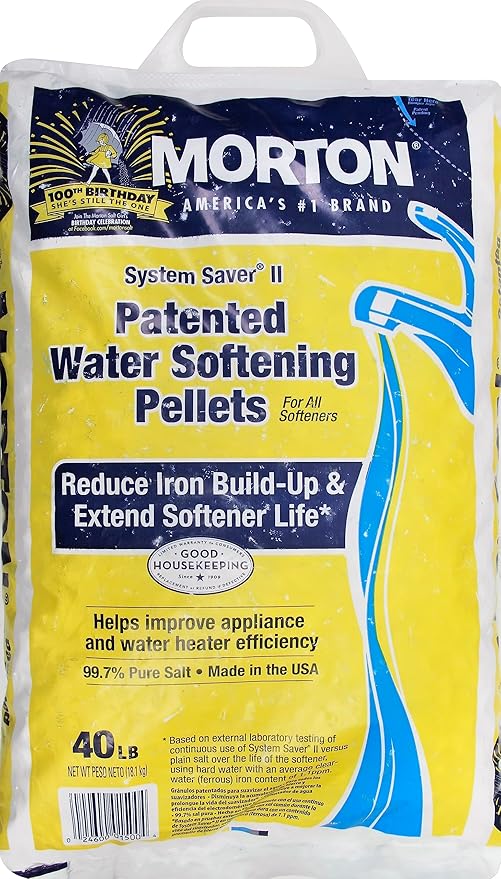
This 40-pound bag of USA-made System Saver pellets is designed to improve the taste of your water while helping extend the life of your appliances and water softener. Simple to use, just add the pellets directly to your softener's brine tank as needed.
Check On AmazonIf you click this link and buy, we earn a commission at no additional cost to you.
FAQs
🧂 How do I know if my water softener has a salt bridge?
Push a broom handle straight down through the center of the salt in the brine tank. If you hit solid resistance before reaching the water at the bottom, there is a bridge. Normal salt should allow the handle to pass all the way down without obstruction. If you hear a hollow sound when you knock against the side wall of the tank, that also confirms an air gap below the crust.
🪣 What does salt mushing look like?
Salt mushing looks like wet sand or thick slush at the very bottom of the brine tank. It is a dense, recrystallized sludge that collects in the sump area and blocks the brine valve. Unlike a salt bridge, it is not visible from the top of the tank. The broom handle passes through without resistance, but the tank bottom will feel packed and gritty when you reach the sump.
🔧 Can I fix a salt bridge without emptying the brine tank?
Yes. A salt bridge does not require emptying the tank. Push a broom handle or dowel rod firmly through the crust to break it apart. The shattered pieces dissolve into the water below. Let it sit for a few hours to form brine, then run a manual regeneration. Salt mushing is a different situation and does require emptying and cleaning the tank.
💧 Why does my water softener have a salt bridge?
The most common causes are overfilling the brine tank, using solar crystals instead of evaporated pellets, and high ambient humidity. Salt compresses under its own weight and humidity causes it to fuse. Keeping the tank at half capacity or below and switching to high-purity evaporated pellets prevents most bridges from forming.
⏱️ How long does it take to clean out salt mushing?
Plan on 45 minutes to an hour for a standard two-tank residential system. You need to scoop out the remaining salt, remove the mush from the sump, rinse the interior, reconnect the brine line, and refill with fresh pellets. It is a one-person job with no special tools beyond a scoop or bucket and a wet-dry vacuum for stubborn residue at the bottom.
🛡️ What type of salt prevents both salt bridges and mushing?
High-purity evaporated pellets, typically 99.6% purity or above, are formulated specifically to resist both mushing and bridging. Solar crystals are more prone to mushing under humidity. Rock salt leaves impurities that accelerate sludge buildup. For most residential softeners, evaporated pellets are the right choice for long-term brine tank health.