Why the Standard Product Page Misses Almost Everything That Matters
The first time someone asks me which water softener they should buy, I usually answer with a question: what valve does it run? Most homeowners don’t know. Most product pages don’t say. That one omission tells me almost everything I need to know about how much the seller wants you to ask questions before you buy.
There’s no shortage of water softener marketing that leads with grain capacity, NSF certifications, and promises of whisper-quiet regeneration. Those details exist and they matter, to a point. But the specs that determine whether a system will still be running well a decade from now, and whether someone other than the original dealer can service it, those tend not to make it onto the product page. The frame most homeowners use when shopping is the wrong one. Grain capacity is easy to inflate on a spec sheet. Price reflects where a system is sold, not what’s inside it. Understanding how a water softener actually works helps give context to why these criteria matter, but even without that background, the checklist below gives you a practical filter for separating systems worth buying from systems worth skipping.
Criterion 1: The Control Valve
The control valve is the brain of the system. It manages every stage of the softening and regeneration cycle, and it’s the component most likely to need service over the life of the unit. What I look for first, before anything else, is whether the system specifies the valve brand. Most don’t.
The two valves I consider field-serviceable for residential use are Fleck (manufactured by Pentair) and Clack. These are the valves that water treatment professionals can diagnose and repair, that have rebuild kits stocked at distributors across the country, and that have track records of 15 to 20-plus years in service. Every O-ring, piston, seal, injector, and spacer for both valves is a cataloged item available from any water treatment distributor. If something fails, you don’t have to call the company you bought the system from. That independence matters more than most buyers realize. When the system needs a $40 repair and the only person who can do it is a dealer 45 minutes away charging $180 for the visit, the valve choice you made at purchase becomes a real expense.
Field Note: I’ve seen buyers call four different plumbers trying to find someone willing to look at a softener with a no-name proprietary valve. Not because the repair was complicated. The fix turned out to be a $22 O-ring and a drive cam. The part itself took one phone call to find once I had the valve brand. The homeowner had been without soft water for two weeks before calling me.
A system that doesn’t name its control valve is running either a generic import valve or a proprietary design tied to a specific dealer or manufacturer. Neither is automatically broken from day one, but both put you in a dependent position for any service work. Ask before you buy. If the seller can’t tell you the valve brand, treat that as a meaningful signal about what comes after the sale.
Criterion 2: Resin Crosslink Percentage
This is the spec most product listings omit entirely. Standard softener resin is manufactured with 8% crosslink, meaning 8% divinylbenzene in the polymer matrix. It works. It’s also the cheaper option, and it degrades faster in the presence of chlorine. City water treated at municipal levels will accelerate the breakdown of 8% crosslink resin over time. The bead structure weakens, the resin fragments, and eventually you’re seeing reduced softening capacity and, in some cases, fine resin particles getting through downstream.
What I look for is 10% crosslink resin for any city water application. The extra crosslinking makes the bead physically tougher and substantially more resistant to oxidation from chlorine. The practical difference in service life is real. On well water with iron present, the spec changes again. You need fine mesh resin specifically, because standard resin beads foul with iron over time and lose capacity faster than any manufacturer’s numbers would suggest.
The reason most listings don’t mention crosslink percentage is straightforward: 8% resin is cheaper, and most buyers don’t know to ask. A listing that proactively states the crosslink percentage is telling you something worth noticing. A listing that omits it, and where the seller can’t answer when pressed, is worth scrutinizing. This one omission has a direct, measurable effect on how long the resin bed performs before it needs replacement.
“High-capacity resin for superior softening performance.” No crosslink percentage disclosed. Grain capacity listed at maximum salt dose without explanation.
Crosslink percentage stated explicitly: 10% for city water, fine mesh for any iron application. If it’s not on the listing, ask. If the seller doesn’t know, move on.
Criterion 3: Demand-Initiated Regeneration
There are two ways a softener triggers its regeneration cycle: on a fixed timer schedule, or based on actual measured water use. Timer-based regeneration runs on a preset interval regardless of what your household has actually consumed. Metered (demand-initiated) regeneration counts gallons through a turbine and triggers only when the resin bed has reached its capacity, not when the clock says it’s time.
Above 7 GPG, demand-initiated regeneration is non-negotiable for me. Timer systems waste salt regenerating when the resin doesn’t need it, and they can underperform during high-use days when consumption exceeds the timer interval. Demand-initiated systems avoid both failure modes. Salt savings of 30 to 50 percent compared to a timer system are common in real-world installations. That is not a marketing number. It is simply the difference between regenerating when the resin needs it and regenerating on a schedule set at install. Over two or three years, that adds up to a real dollar figure.
Most systems sold today are metered, but not all of them. Budget-tier units and older inventory sometimes aren’t. More important: “digital” and “programmable” on a product listing do not automatically mean metered. Both terms can describe a more sophisticated timer interface rather than a gallonage meter. Ask specifically whether regeneration is triggered by measured water usage or by a time interval. The answer matters.
Criterion 4: Warranty Structure
A warranty is only as useful as what it actually covers. The three components that fail most often in a residential water softener are the control head electronics, the resin, and (less commonly) the brine tank. A complete warranty addresses all three separately, because they have different expected lifespans and different failure modes. The mineral tank almost never fails. It’s a fiberglass vessel. Yet “lifetime warranty on the mineral tank” is the headline claim on a lot of listings, while the electronics get five years and the resin gets nothing.
What I consider a reasonable baseline: electronics coverage of at least five years, tank warranty of ten years, and resin covered separately for at least five years. Anything shorter on the electronics side is worth noting, because the control head is where failures actually happen. Read the full warranty document before the return window closes, not just the bullet points on the product page.
Key Point: Some warranties require purchasing salt or filter products from the original dealer to maintain coverage. It’s in the fine print, not the headline. I’ve seen homeowners unknowingly void a warranty by buying a different brand of salt at the hardware store. This clause isn’t rare. Read it before you need it.
The pattern I’ve seen repeat across dealer brands is warranty terms structured to sound comprehensive while covering only the components least likely to fail. A lifetime warranty on a mineral tank is almost noise. Five years on the electronics is more meaningful. No coverage on resin is a gap worth knowing about before you buy.
Criterion 5: Independent Parts Availability
This connects back to the control valve question, but it goes further. The test I apply is simple: can you buy a replacement O-ring, valve seal, injector, or drive gear without calling the company you bought the system from? If the answer is no, you’re locked into one service relationship for the entire life of the system, at whatever pricing and scheduling that relationship dictates.
For a system built around a Fleck or Clack valve, the answer is yes. Rebuild kits and individual components are stocked by third-party water treatment distributors and sold online from multiple suppliers. The valves are documented, the part numbers are public, and there are technicians across the country who can work on them without any certification from the original manufacturer. For a proprietary control head, the answer is typically no, or only through an authorized service center at their rates.
The practical gap shows up the moment you need a repair. A $40 parts order from a distributor versus a $200 service call with parts markup is a meaningful difference in the cost of ownership over a decade. There are several types of water softener systems that handle this tradeoff differently. Twin-tank systems, for example, add a layer of complexity that makes serviceability even more important as a purchasing criterion. Whatever design you’re evaluating, the question about independent parts is worth asking explicitly.
Criterion 6: What the Listing Doesn’t Say
The last thing I look for isn’t a spec. It’s the absence of information that should be there. A few omission patterns show up consistently enough to be worth knowing about.
- Crosslink percentage not stated. If a listing doesn’t mention crosslink percentage, you’re almost certainly looking at 8% resin. That’s usable for some applications, but you should know what you’re buying before you buy it, not after.
- Grain capacity at maximum salt dose. Manufacturers typically rate capacity at the highest salt setting, often 15 or more pounds of salt per regeneration cycle. At a properly programmed efficiency setting, the same system may deliver meaningfully fewer grains between regenerations. A system marketed at 48,000 grains may run closer to 30,000 grains at a salt-efficient setting. The headline number isn’t dishonest. It’s just calculated at a setting you’d never want to run long-term.
- Flow rate without stated conditions. Flow rate specs are sometimes measured under specific pressure and capacity conditions that don’t reflect simultaneous household use. A high flow rate claim without any disclosure of test conditions is a number worth verifying independently.
- Valve brand not disclosed. If the valve brand isn’t in the specs, ask. A seller who knows what they’re selling will answer immediately.
Every one of these omissions benefits the seller, not the buyer. The fix is to ask the questions before you commit, not after you’re outside the return window.
| Criterion | What to Look For | Red Flag |
|---|---|---|
| Control valve | Fleck or Clack, named explicitly in the specs | No valve brand disclosed; “proprietary” or unnamed control head |
| Resin crosslink % | 10% crosslink for city water; fine mesh for iron applications | Crosslink percentage not stated anywhere; seller can’t answer |
| Regeneration type | Demand-initiated, metered by gallons used | Timer-based only; “programmable” without confirming it’s metered |
| Warranty structure | Electronics 5+ years, tank 10+ years, resin covered separately | “Lifetime warranty” with no component breakdown; salt-purchase clause |
| Parts availability | Parts available from third-party distributors without dealer involvement | Service requires authorized dealer only; no independent parts supply |
| Grain capacity disclosure | Salt dose used for capacity rating is stated; efficiency setting discussed | Maximum grain capacity only, salt dose not disclosed |
If a seller can answer all six clearly, valve brand, resin spec, regeneration type, warranty breakdown, parts availability, and how grain capacity is calculated, that seller understands what they are selling. That combination is less common than it should be.
Before You Apply This Checklist
These six criteria are for evaluating a system you’re already considering. They assume you’ve already established what your water actually requires. The checklist will help you separate a well-built system from a mediocre one, but a well-built system that’s the wrong size for your hardness level and household usage is still the wrong system. Confirming your GPG comes before any of this, and sizing a water softener correctly for your household is the next step before you evaluate specific options.
The systems that consistently pass all six criteria without prompting tend to fall into three categories: DIY builds assembled around a documented Fleck or Clack valve with resin sourced separately, direct-to-consumer brands willing to state crosslink percentage on the product page, and dealer-installed systems built on Clack valves with published resin specs. What they have in common is that none of the six questions above requires you to dig. The information is there upfront, or the seller produces it immediately when asked. Price doesn’t predict this. A $650 system with a named valve and a stated resin spec will often outlast and outservice a $1,400 system with a proprietary head and a warranty full of conditions. The information exists to tell the difference. Most product pages just make it hard to find.
Final Thoughts: If the Seller Can’t Answer These Six Questions, Skip the System
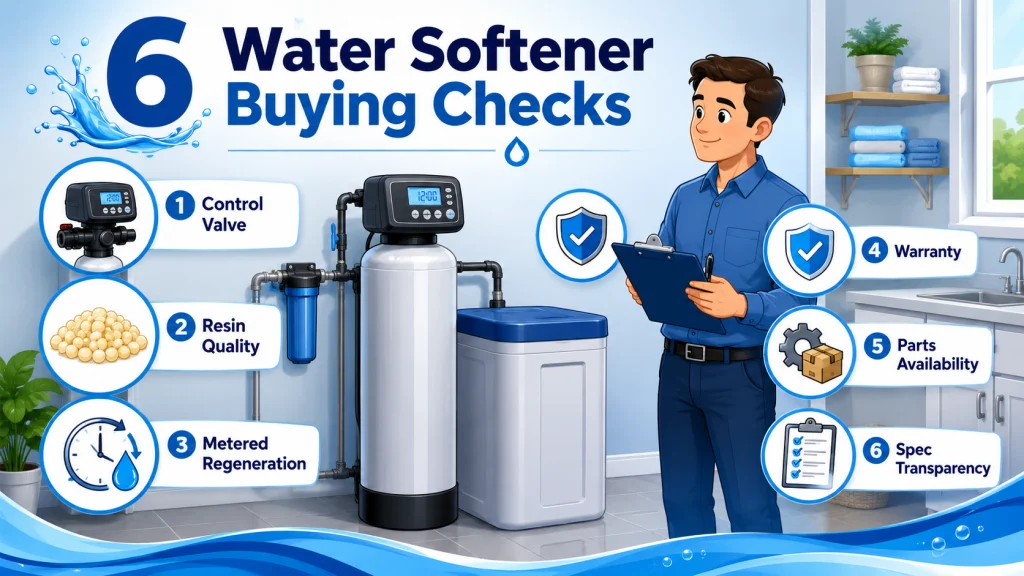
Valve brand. Resin crosslink percentage. Demand-initiated regeneration. Warranty component breakdown. Independent parts availability. How grain capacity is calculated. These six checks take about five minutes and surface most of what a product page won’t tell you.
If a seller can answer all six clearly and without hesitation, that’s a strong signal. If they deflect, don’t know, or the listing simply omits the information entirely, treat that as a decision. There are enough well-documented systems in the market that you don’t have to buy something that requires you to trust the seller’s word on the specs that matter most. When you’re ready to look at specific systems through this lens, my picks for the best water softeners walk through which systems meet all six criteria and why.
Sources & References
This article draws primarily from field installation and service experience. The external references below confirm specific factual claims.
- SpringWell Salt-Based Water Softener System, product page (springwellwater.com): Confirms that at least one major direct-to-consumer brand publicly documents its 10% crosslink resin specification. Used to illustrate that the disclosure is possible and that sellers who omit it are making a choice, not facing a limitation.
- AnandTech Forums, “Is it difficult to install a water softener?”: Community discussion among DIY installers and water treatment professionals confirming Fleck and Clack as the recognized field-serviceable valve standards for residential systems.
- TractorByNet Forums, “Water Softener Repair”: Real-world service thread where a Fleck valve is identified by model and repaired using standard components. Illustrates the practical difference between a serviceable valve and a proprietary one.
FAQs
🔧 What does the control valve brand tell you about a water softener?
It tells you whether the system can be independently serviced. Valves made by Fleck and Clack have publicly available parts sold by third-party distributors. A proprietary or undisclosed valve means you’re dependent on the original dealer for any repairs, at their pricing and scheduling. That dependency has a real cost over the life of the system.
🧪 What is 10% crosslink resin and why does it matter?
Crosslink percentage refers to the proportion of divinylbenzene in the resin polymer matrix. Higher crosslink density makes the resin more physically durable and more resistant to chlorine degradation over time. For city water applications, 10% crosslink resin lasts meaningfully longer than the standard 8% used in most box store units. On well water with iron, neither is ideal. Fine mesh resin is the correct spec for that application.
⏱️ What is the difference between metered and timer-based regeneration?
Metered (demand-initiated) regeneration triggers based on actual measured water usage, counted in gallons. Timer-based regeneration runs on a fixed schedule regardless of whether the resin actually needs it. Metered systems use considerably less salt over time and are the standard recommendation for any application above 7 GPG hardness.
🔨 Can I service a residential water softener myself?
On a system with a Fleck or Clack valve, most common repairs (O-ring replacement, injector cleaning, drive cam replacement) are DIY-capable with basic tools and parts that cost $20 to $50 from a water treatment distributor. On a system with a proprietary or undisclosed valve, self-service is often impractical because parts require dealer sourcing.
📊 Why do grain capacity numbers vary so much between similar systems?
Grain capacity is typically rated at the maximum salt dose setting, often 15 or more pounds of salt per regeneration cycle. At a properly programmed efficiency setting, the same system delivers fewer grains between regenerations. A system marketed at 48,000 grains may run closer to 30,000 grains at a salt-efficient setting. Always ask what salt dose the rated capacity is calculated at before comparing numbers across brands.
📋 What warranty terms should I read before buying a water softener?
Look for how the warranty is split across components. Electronics, mineral tank, resin, and brine tank are often covered under separate and very different terms. Watch for clauses requiring you to purchase salt or maintenance products from the original dealer to keep coverage valid. “Lifetime warranty” almost always refers to the mineral tank only, which is also the component least likely to fail.
💧 How do I know if a water softener listing is being honest about its specs?
Ask six questions: What valve does it use? What is the resin crosslink percentage? Is regeneration metered or timer-based? What does the warranty actually cover for electronics and resin? Can parts be purchased independently of the dealer? And what salt dose is the grain capacity calculated at? Sellers who can answer all six clearly are generally selling what they say they’re selling.