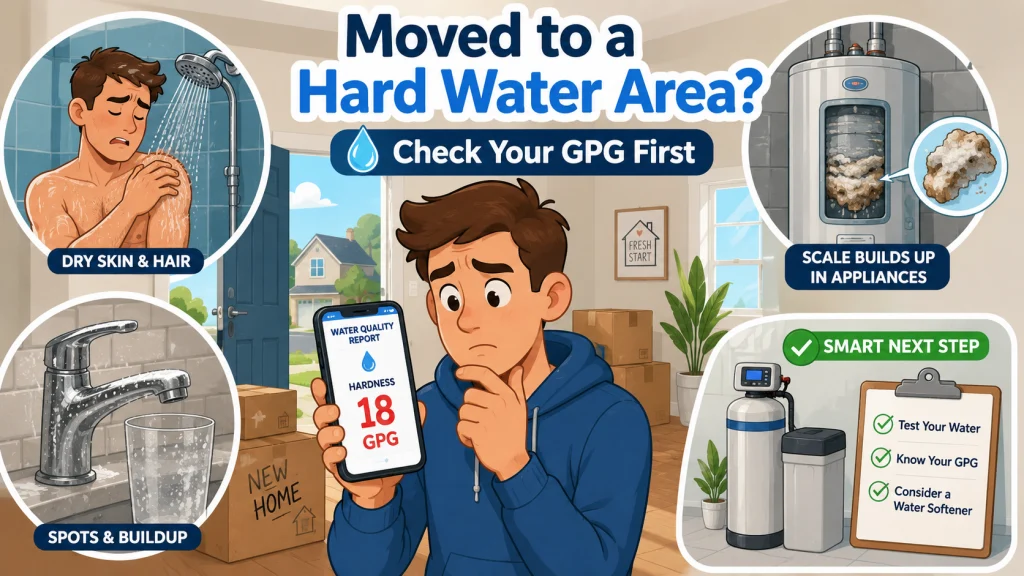
Start With Your GPG, Not Your Wallet
The first thing I tell anyone asking what to do when you move to a hard water area is to find your hardness number before you do anything else. That one number changes every decision that follows. Moving from the Pacific Northwest to Phoenix means going from roughly 3 GPG to 18 GPG overnight. Moving from Seattle to Las Vegas can put you even higher. Those are not abstract figures. They translate directly into how fast scale forms in your pipes, how quickly your water heater loses efficiency, and how soon you actually need to act.
Your first move is to pull your utility’s Consumer Confidence Report. Every municipal water supplier in the United States is required to publish one annually. A search for “[your city] water quality report” usually gets you there in five minutes, and it’s free. Hardness may be listed in parts per million (PPM). Divide that number by 17.1 to convert to grains per gallon. If your hardness reads 300 PPM, that’s roughly 17.5 GPG. If it reads 120 PPM, you’re at about 7 GPG. That distinction matters. For more detail on reading and interpreting your results, the guide on how to test for hard water covers both DIY test kits and lab options.
One pattern I run into constantly with people who have just moved is skipping this step entirely. A salesperson shows up ten days after the move, the homeowner doesn’t know their GPG, and they end up sized for a system based on a quick test strip reading performed by someone who profits from the outcome. That is not the order you want to do things in. Get the number first. Then decide.
Field Note: I have been on follow-up service calls in homes where a water softener was sold during the first month after a move, before anyone actually confirmed the water hardness. In one case, the family had moved from 14 GPG to 9 GPG. The softener was real and functional, but it was significantly oversized for what the water actually required. The dealer’s test strip said “hard water.” It was not wrong. It just wasn’t the full picture.
What Your Body and Your Fixtures Are Telling You
Hard water makes itself known fast. Within the first week in a new area, you will likely notice several things that seem unrelated but all come from the same source.
- Dry skin and hair after showering. This is the most common complaint I hear. Hard water leaves a thin film of mineral residue that can interfere with how your skin retains moisture. It is uncomfortable, especially if you came from soft water, but it is not a health concern.
- Soap and shampoo that won’t lather properly. Calcium and magnesium in the water react with soap, reducing lather and leaving a residue. You may find yourself using noticeably more product than before and still not feeling clean.
- White spotting on dishes, glasses, and faucets. These are mineral deposits left behind when hard water evaporates. At 18 GPG you will see them on glass surfaces within a matter of days. At 7 GPG, it may take a few weeks to become obvious.
- A filmy or crunchy buildup around faucet aerators and showerheads. This starts forming immediately. In moderate hardness it’s a slow accumulation. Above 15 GPG, a showerhead can begin restricting flow within months.
These are all real inconveniences, and they are worth solving. But none of them are signals that something is wrong with your water supply or your health. Hard water is a nuisance, not a hazard. What I want you to pay attention to is what’s happening in places you cannot see.
What Your Water Heater Is Going Through Right Now
Scale accumulation on your water heater’s heating element starts from the first time you use it in hard water. You will not see it. You will not hear it for a while. But it is happening, and it compounds over time in ways that cost real money.
The Battelle Memorial Institute conducted a study for the Water Quality Research Foundation that quantified this directly. Gas water heaters operating on hard water lost up to 24% of their original efficiency rating through scale buildup over a 90-day test period. Electric heaters fared worse in some configurations. The efficiency loss is not a steady decline either. It accelerates as the scale layer thickens, meaning the damage compounds faster the longer you wait. For a full breakdown of what hard water does to appliances and fixtures over time, the article on what hard water is and how it damages your home covers this in more detail.
At 18 GPG, this process is fast. I have been on service calls to homes where the water heater was only a few years old and already running significantly below rated efficiency because nobody addressed the incoming water hardness. The homeowner had felt the higher energy bills but attributed them to other causes. At 7 GPG, the same heater might run fine for its full rated lifespan with basic annual flushing. The GPG number is not just a comfort issue. It is a cost-of-ownership variable.
Pro Tip: Before your softener is installed, keep up with your water heater’s regular annual flush schedule to slow sediment accumulation. Some manufacturers note that periodic high-temperature operation can reduce the rate at which new scale adheres to the element, but check your unit’s manual and your household’s safety setup before adjusting temperature settings. This is a bridge measure while you work toward a permanent solution, not a substitute for one.
The Showerhead Problem Is Faster Than You Think
Independent testing has shown that showerheads running on hard water can lose up to 75% of their flow rate in under 18 months. That number comes from the same Battelle research program cited above, and it tracks with what I’ve observed on job sites. A brand new showerhead installed in a home with 20 GPG water is not going to perform the way it did at six months. If you are in a high-hardness area and you notice the pressure dropping, scale is almost always the culprit before any pipe issue would be.
How to Prioritize Based on Your Actual GPG
Not every hardness level requires the same urgency. The right first step at 6 GPG is different from the right first step at 20 GPG, and acting as if they’re equivalent is how people either overbuy or underprepare. Here is how I frame it based on what I’ve seen across a wide range of water conditions.
| Hardness Level | Classification | What I’d Do in the First 30 Days |
|---|---|---|
| Under 7 GPG | Soft to moderately hard | Watch and wait. Minor scale may appear on fixtures over time. A softener is an option, not a priority. Annual water heater flushing is a good habit at any hardness level. |
| 7 to 12 GPG | Hard | Start researching. Budget for a softener in the next three to six months. In the meantime, a shower filter provides immediate relief for skin and hair without committing to a full system. |
| 12 to 15 GPG | Very hard | Move faster. This is the range where appliance wear accelerates measurably. Plan for a softener within 60 days and use a shower filter as a bridge. If your water heater is already a few years old, that timeline becomes more urgent. |
| 15+ GPG | Extremely hard | First-month priority. At these levels efficiency loss on water-using appliances accumulates quickly, showerhead flow restriction arrives within months, and scale on fixtures becomes an active maintenance problem. Do not wait. |
If iron is present alongside hardness, the decision changes. At well water hardness of 15 GPG with 1 PPM of iron, a standard softener alone may not be the right answer. Iron at that concentration requires a system that can handle it without fouling the resin bed prematurely. Get the full picture on your water chemistry before you commit to any equipment.
Key Point: Here is how the first 30 days should actually play out. Day 1: find your CCR online, or order a lab test if you are on well water. Days 2 to 7: notice what your skin, hair, dishes, and faucets are telling you, and note your water heater’s age. Week 2: classify your hardness using the table above and decide your urgency tier. Days 15 to 30: if you are at 12 GPG or below, use this time to research systems without pressure. If you are at 15 GPG or above, start comparing systems in earnest and get your household size and daily water use figured out before you talk to anyone.
The Well Water Version of This Scenario
Moving to a home on a private well adds a layer of complexity that a Consumer Confidence Report cannot solve, because the report does not exist for private wells. Your water is entirely your responsibility, and it can look like anything.
What I’ve seen repeatedly is that people moving to rural properties get surprised by iron or sulfur they never anticipated, sometimes sitting right alongside hardness that was never disclosed in the home inspection. A well at 16 GPG with 2 PPM of iron and a sulfur odor is a fundamentally different problem than city water at the same hardness. The treatment path is longer, the sizing considerations are different, and the consequences of getting it wrong are more expensive to correct.
Before you make any treatment decision on well water, get a lab test that covers hardness, iron, manganese, and pH at minimum. Depending on where you are and the local geology, testing for sulfur, tannins, or bacterial presence may also be warranted. Many county extension offices offer low-cost water testing for exactly this scenario. The hardness number alone is not enough to design a treatment solution for well water. Get the full picture first, then decide what equipment makes sense.
Note: The GPG table above applies to city water scenarios. For well water, treat the table as a starting point only. Iron content, pH, and other dissolved minerals all affect what a softener can and cannot handle on its own.
What If the Home Already Has a Water Softener?
This situation comes up more than people expect. You move into a house, there is a water softener already installed, and you have no idea whether it is working, how old it is, or whether it was ever sized correctly for the water. The temptation is to assume it is running and leave it alone. That is usually a mistake.
The first thing I do when I walk into a home with an existing softener is check the brine tank. If there is no salt in it, the system has not been regenerating. The water has been running unsoftened for however long the previous owner left it that way. Next, I look at the control head to see whether the unit is bypassed. A bypassed softener means all water is flowing around it entirely, often a sign that something broke and the previous owner just switched it off rather than repair it. Neither situation is obvious to someone who has never used a water softener before.
What to check in the first week if a softener is already present:
- Brine tank salt level. It should have salt in it. If it is bone dry, add salt and give the system a manual regeneration cycle before assuming it works.
- Bypass valve position. Most softeners have a bypass valve on the back. Make sure it is in the service position, not the bypass position.
- Hardness before and after the softener. Test the water at an outdoor hose bib (which is typically unsoftened) and then at an indoor faucet. If both readings are the same, the softener is not doing its job.
- Regeneration schedule and settings. Check the control head settings. If the system is set to a fixed timer schedule rather than metered demand, it may be regenerating on a schedule that made sense for the previous household but not yours.
If the existing system tests out fine and is softening water correctly, you may not need to do anything right away. If it is bypassed, empty, or producing no measurable hardness reduction, treat it as a non-functional system and research a replacement the same way you would if there were no softener at all. Do not spend money on a new system until you know what the existing one is actually doing.
Final Thoughts: Make the Call Before Someone Makes It for You
Hard water is solvable. The decision just needs to be yours, made with your actual GPG number in hand, not a salesperson’s test strip and a six-year financing offer. The first 30 days in a hard water area are largely about not getting rushed into anything. Get your CCR. Confirm your hardness. Watch what your fixtures and your skin are telling you. Then decide with a clear picture of what you’re actually dealing with.
The shower filter is worth buying in the first week if you are at 10 GPG or above. It is cheap, it is immediate, and it removes the urgency that salespeople tend to exploit. Beyond that, the timeline depends almost entirely on your GPG. A household moving to 8 GPG has months before the situation becomes costly. A household at 20 GPG should be researching seriously within the first two weeks.
When you are ready to choose a system, the criteria matter more than the brand name. Grain capacity for your actual household water use, resin specification, valve brand, and parts availability are the variables that determine whether a system serves you well for 15 years or turns into a headache. Our guide to choosing the right water softener for your home covers those criteria in full, including sizing guidance for different water conditions. Start there before you talk to any dealer.
Sources & References
- Water Quality Association, Softened Water Benefits Studies: Covers the Battelle Memorial Institute research on energy efficiency loss in water heaters and fixture performance degradation from hard water scale. Includes the 24% efficiency loss figure for gas water heaters. wqa.org/resources/softened-water-benefits-studies/
- U.S. Geological Survey, Hardness of Water: USGS overview of water hardness by region, including classification thresholds and geographic distribution across the United States. Useful for understanding baseline hardness expectations by area. usgs.gov/water-science-school/science/hardness-water
- TractorByNet Forum, Calcium Water Heater Questions: Community thread documenting real homeowner experiences with calcium buildup causing premature element failure and reduced water heater performance in hard water areas. tractorbynet.com/forums/threads/calcium-water-heater-questions.477244/
FAQs
💧 How do I know if I moved to a hard water area?
Pull your utility’s Consumer Confidence Report, which every municipal water provider in the US is required to publish annually. Search for “[your city] water quality report” to find it. If you are on well water, order a lab test. Both will give you a hardness reading in PPM or GPG.
🚿 Why does my skin feel dry after moving to a new city?
Dry skin after showering is one of the most common signs of moving to harder water. Calcium and magnesium interfere with how soap rinses off and can leave a thin mineral residue on skin. A shower filter rated for hard water can reduce this noticeably while you research a longer-term solution.
⏱️ How soon does hard water start damaging a water heater?
Scale begins forming on the heating element from the first time you use it in hard water. At high hardness levels, measurable efficiency loss can accumulate within months. Regular flushing and following your water heater manufacturer’s safe temperature guidance can help reduce buildup, but a water softener is the only reliable long-term protection against scale.
🗺️ What states have the hardest water?
The Southwest and Great Plains generally have the hardest water in the US. Arizona, Nevada, Utah, Texas, Kansas, and Indiana consistently show very high hardness levels. The Pacific Northwest, New England, and parts of the Southeast tend to have softer water. Within any state, hardness can vary significantly by city or well depth.
🏡 Do I need a water softener if I just moved to a hard water area?
It depends on your GPG. Below 7 GPG, a softener is optional. Between 7 and 12 GPG, it’s worth planning for in the coming months. Above 12 GPG, appliance efficiency and fixture lifespan start to be meaningfully affected, and a softener becomes a practical financial decision, not just a comfort one.
🌊 What should I test for if I moved to a home with well water?
At minimum, test for hardness, iron, manganese, and pH. Depending on your area, also consider testing for sulfur, tannins, and bacterial contamination. Well water varies significantly based on local geology, and hardness alone doesn’t tell you what treatment you actually need.
🛡️ Can a shower filter help while I wait for a water softener?
Yes, for skin and hair specifically. A shower filter designed for hard water can reduce the immediate dryness and soap residue issues while you take time to research and size a proper whole-house system. It won’t protect your water heater or other appliances, but it addresses the most noticeable daily discomfort quickly and inexpensively.