What Culligan Actually Sells You
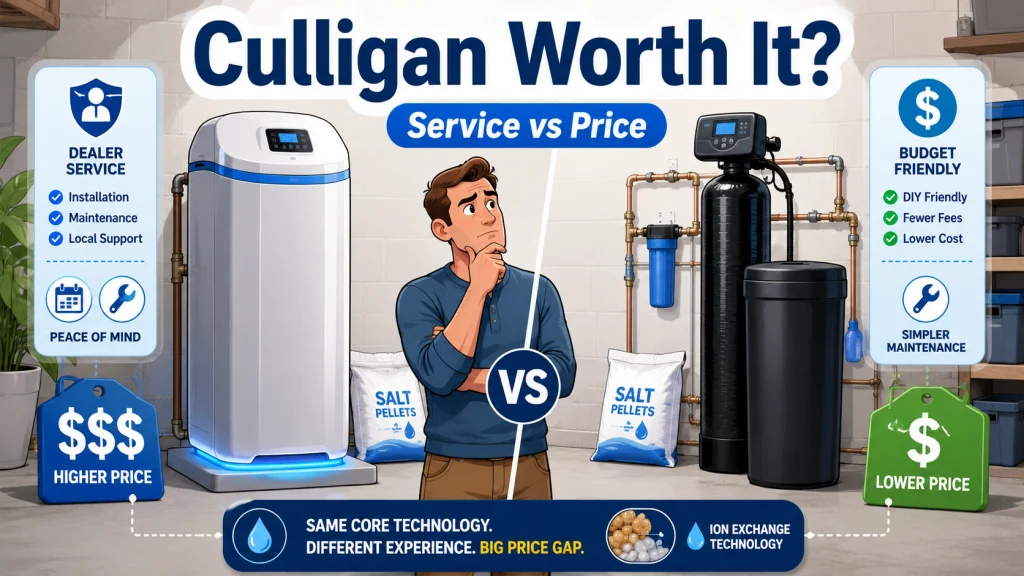
The most common reaction I see when a homeowner watches me pull open a Culligan system is surprise. They expected something proprietary inside. What’s usually in there is a Clack or Fleck valve, dealer-configured with a timer or metered regeneration program, sitting on a standard mineral tank with cation exchange resin. It is the same fundamental hardware that powers direct-to-consumer systems at a fraction of the price. This is not unique to Culligan. Dealer brands across the industry work this way. The differentiation has never been in the components.
What Culligan is actually selling is installation by a certified local dealer, an ongoing service relationship, and a warranty backed by that same dealer’s labor. For a subset of homeowners, that package has real value. The problem starts when buyers assume the price premium reflects better technology inside the cabinet. It doesn’t. Once you understand that, the question becomes whether the service model alone is worth the cost difference, and that answer depends entirely on your situation. If you want a foundation for evaluating this, understanding how a water softener actually works at the component level makes it much easier to read a dealer quote with clear eyes.
The Valve Reality, and What It Means for Service
Fleck and Clack valves are the two platforms that the water treatment industry has built around for decades. Parts are available from distributors everywhere. O-rings, injectors, pistons, and seals are stocked items, not special orders. Any technician who works on water softeners knows both platforms. That is by design: these valves became industry standards because they are reliable, repairable, and not tied to a single manufacturer’s supply chain.
When Culligan uses a Clack or Fleck valve inside their residential systems, those components carry the same serviceability they would in any other install. The Culligan business model routes service through the dealer, parts through the dealer, and structures the warranty around dealer labor. That is not a design flaw. It is the product. What it means in practice is that the valve you’re paying for could also power a system that any independent technician in the country can service, order parts for, and repair without calling the original dealer. Whether that independence is worth the price gap is the actual decision in front of you.
| Feature | Culligan Dealer Install | Fleck 5600SXT (direct-to-consumer) |
|---|---|---|
| Control valve | Clack or Fleck (same platform) | Fleck 5600SXT |
| Typical system + basic install cost | $2,500-5,000 | $700-1,500 |
| Regeneration type | Timer or metered (confirm before signing) | Demand-initiated (metered) standard |
| Parts availability | Through dealer | Any water treatment distributor |
| Service model | Dealer-dependent | DIY or any independent technician |
| Salt sourcing | Dealer delivery or retail | Any home improvement store |
| Best for | Buyers who want full-service, zero involvement | Buyers who want cost control and service independence |
The table above is not an argument against Culligan. It is a map of what you are actually choosing between. If the dealer column aligns with what you want, the price can be justified. If you read that column and the service model sounds like a liability rather than a feature, that is useful information before you sign a contract.
The Salt Consumption Problem
This is where I have seen the most frustration from homeowners after a Culligan install. Some configurations, particularly older installs or those set up on a fixed timer, regenerate on a schedule regardless of how much water the household has actually used. A timer-based system running every three days burns through salt whether you’ve used 300 gallons or 2,000. Over the course of a year, that gap between what you need and what the system uses adds up to a meaningful number of bags.
Field Note: One pattern I see repeat is homeowners calling me after a Culligan install, reporting they go through two bags of salt a month. When I look at the configuration, the system is timer-based and set to regenerate more frequently than their actual water use demands. The same hardware reprogrammed to demand-initiated regeneration, or replaced with a metered equivalent, often cuts that usage by half or more. The salt isn’t disappearing because the softener is broken. It’s because nobody set it up to respond to how the household actually uses water.
A homeowner on an AnandTech forum thread described their Culligan as constantly breaking down and consuming two bags of salt per month. They replaced it with a box-store system for $350, and reported it used roughly one bag every two and a half months on hard well water, running without problems for over ten years. That comparison is worth sitting with. The water conditions were the same. The gap in salt use came down to how the regeneration was configured, not the quality of the water treatment itself.
Before committing to a Culligan quote, ask the dealer specifically whether the proposed configuration uses demand-initiated regeneration and what the salt programming is set to. A dealer who answers that question clearly and confidently is telling you something. One who gets vague is also telling you something.
The Supply Cost Trap
The installation quote is not the last number that matters. What many homeowners don’t factor in is the ongoing cost of supplies when those supplies flow through the dealer.
A real example from a TractorByNet forum thread: a homeowner who inherited a Culligan system found that Culligan would deliver Iron Fighter salt at $8.99 per bag. The same product was available at Home Depot for $4.59. That is roughly a 95 percent markup for the convenience of dealer delivery. Salt is not a proprietary item. Iron Fighter salt, solar salt, and standard pellets are available at any home improvement store. If your dealer is pricing supplies at double the retail rate, you are paying for a delivery service you almost certainly did not factor into the total cost of ownership when you compared quotes.
The same logic extends to replacement filters on any associated reverse osmosis system, service call rates, and any consumable supplies under the system’s umbrella. These costs are not hidden, but they are rarely discussed during the initial sales conversation. Over five to ten years of ownership, the supply markup alone can close a significant portion of the gap between a dealer install and a direct-to-consumer alternative. Once you understand the upfront cost and the ongoing operating cost, the question that remains is whether the convenience of the dealer service model is worth what’s left of that premium. That depends on the buyer.
Who Culligan Makes Sense For, and Who Should Look Elsewhere
I want to be fair about this because the answer is not simply that Culligan is overpriced across the board. There are homeowners for whom the Culligan model is a reasonable choice.
- Buyers who genuinely want zero involvement after installation. If the idea of managing a service relationship with an independent technician sounds like a hassle you don’t want, a Culligan dealer who handles everything, salt delivery included, removes that friction. That convenience is real, and some buyers are happy to pay for it.
- Households with no DIY capacity at all. Not every homeowner can or wants to troubleshoot a control valve, replace a resin bed, or call an independent plumber. For someone who needs a true full-service model, the dealer network provides it.
- Rural properties where dealer support is genuinely the only local option. In some areas, the Culligan dealer is the only water treatment professional within a reasonable distance. That changes the calculus considerably.
- Buyers where the price gap is smaller than expected after accounting for plumber installation on a direct-to-consumer system. In high-labor markets, the difference between a dealer install and a direct-to-consumer system plus professional installation can shrink. Run the full math before assuming the gap is as wide as the sticker prices suggest.
Where it stops making sense: if you are being quoted $4,000 or more for a standard residential softener on city water in the 10-18 GPG range with no iron, walk away and compare. The hardware inside that quote performs the same ion exchange process as a properly built Fleck system that often costs far less before dealer labor and service premiums enter the picture. The water tests the same on the other side. What the extra money buys is the dealer relationship, not better softening. I’ve replaced enough Culligan systems to know that the homeowners who felt burned were almost always the ones who assumed the price meant something different was happening inside the cabinet. It doesn’t. That one fact is worth knowing before you sign.
How to Read a Culligan Quote Before You Sign
Most homeowners evaluate a Culligan quote on total price and monthly payment. That’s the wrong frame. The numbers that matter more are the ones that don’t appear on the front page of the proposal. Here is what I would check before putting a signature on anything.
| Quote item | What to ask |
|---|---|
| Regeneration type | Is it demand-initiated (metered) or timer-based? Timer wastes salt. |
| Control valve | Is the valve Clack, Fleck, or proprietary? Ask by name. |
| Resin specification | Is the resin crosslink percentage stated? 10% crosslink for city water with chlorine. |
| Installation labor | Is labor included in the quoted price, and for what scope of work? |
| Out-of-warranty service rate | What is the hourly or flat rate for a service call after warranty expires? |
| Salt delivery | Is dealer salt delivery optional or required? What is the per-bag price? |
| Five-year ownership cost | Install price plus estimated salt and service over five years. Compare this number, not just day-one price. |
A dealer who welcomes these questions and answers them without deflection is telling you something useful. A dealer who gets vague on the valve platform, the resin spec, or the out-of-warranty service rate is also telling you something. The quote document rarely contains all of this. You have to ask.
What the Alternative Actually Looks Like
A properly sized Fleck 5600SXT metered system with 10% crosslink resin delivers demand-initiated regeneration and field-serviceable components at $700-1,500 for the system, often landing well below a Culligan quote even after basic installation labor is added. At that range, the break-even point against a $4,000 Culligan quote happens inside the first year when you factor in supply costs at retail rates.
The more significant long-term difference is independence. A system built on a Fleck 5600SXT valve can be serviced by any water treatment technician in the country. If the company that installed it closes, moves, or raises rates, you are not stranded. Parts are available at distributors everywhere. The person who does your next service call can look up the valve and order the same O-ring kit as the person who did the last one. That serviceability has real value over ten to fifteen years of ownership, and it is rarely part of the conversation when a dealer is walking you through a quote.
For a full breakdown of what to look for by water condition and household size, the water softener recommendations with specs and selection criteria give you a practical framework for making that comparison on your own terms.
Final Thoughts: Culligan Works. The Price Has to Make Sense.
The technology is not the question. Culligan installs systems that soften water, and the dealer network provides genuine value for homeowners who want full-service support with no involvement on their end. What I’m saying, after seeing a number of installs go both ways, is that the price difference between a Culligan quote and a comparably equipped alternative is significant, and it should be weighed against what you’re actually receiving in return.
If the service relationship is what you’re buying, go in knowing that clearly. The hardware performing the softening is the same platform available elsewhere. The salt will cost more if it comes from the dealer. The service calls will be routed through one company for the life of the system. For some households, that is exactly what they want. For others, the same money covers a system that will outlast the Culligan contract and leave them with full control over who services it and what they pay for supplies.
The decision is yours to make. The information above is what I’d want in front of me before making it.
Sources & References
- AnandTech Forums: “Water softener recommendation required”. Community thread in which a homeowner reported a Culligan unit that broke down repeatedly and consumed two bags of salt per month, with a direct comparison to a box-store replacement used without issues for over ten years on hard well water. Confirmed live.
- TractorByNet Forums: “Culligan Water Supplies”. First-hand account of Culligan dealer salt pricing at $8.99 per bag against the same Iron Fighter product at Home Depot for $4.59, with discussion of third-party supply alternatives. Confirmed live.
FAQs
💰 Is Culligan more expensive than other water softeners?
Dealer-installed Culligan systems typically run $2,500-5,000 for a standard residential install. A comparable direct-to-consumer system with a Fleck valve often falls in the $700-1,500 range, with final cost depending on local installation labor. The hardware performing the softening is largely the same. You are paying for the dealer service model.
🔧 Can I buy Culligan parts myself if something breaks?
Parts are routed through the dealer in the Culligan model, which means you are dependent on that service relationship for repairs. If the valve inside your system is a Clack or Fleck, the underlying parts are available through water treatment distributors, but Culligan’s service structure does not encourage that path.
🧂 Why does my Culligan use so much salt?
High salt use is commonly caused by timer-based regeneration, which runs on a fixed schedule regardless of actual water use. A demand-initiated (metered) configuration regenerates only when the resin capacity has been used. Ask your dealer to confirm which setup your system is running and what the salt programming is set to.
🏡 Is Culligan worth it for well water?
Well water with iron or sulfur requires specific resin and pre-filtration that any competent installer should configure regardless of brand. Culligan can handle well water applications, but so can a properly built Fleck system with iron-rated resin and a sediment pre-filter. The brand is not the deciding factor for well water. The configuration is.
🔄 What is the difference between Culligan and Fleck water softeners?
Culligan is a dealer brand. Fleck (made by Pentair) is a control valve platform used inside many softener systems, including some Culligan installs. A Fleck-based direct-to-consumer system gives you the same valve with independent parts access and no dealer dependency. The water softening performance between equivalent configurations is comparable.
📦 Can I buy salt for my Culligan from somewhere other than the dealer?
Yes. Salt is not proprietary. Iron Fighter salt, solar salt, and standard pellets are available at Home Depot, Lowe’s, Walmart, and most hardware stores. Dealer delivery is a convenience service, not a requirement. Buying retail is typically significantly cheaper.