I Have Installed Kinetico Systems. I Have Also Replaced Them.
Both outcomes told me something useful. When I installed a Kinetico, it usually worked exactly as described. When I replaced one, it was almost never because the softener had failed. It was because the homeowner received a parts bill they were not expecting, or because their dealer relationship had changed and the service side had quietly fallen apart. The hardware is not the issue. The business model around it is where the problem sometimes starts.
That distinction matters if you are sitting on a $4,500 quote right now, because what you are actually evaluating is not just a water softener. You are evaluating a long-term service arrangement with a single point of contact. Whether that arrangement is worth the premium is the real question, and the answer depends almost entirely on your specific situation.
What Kinetico Actually Is
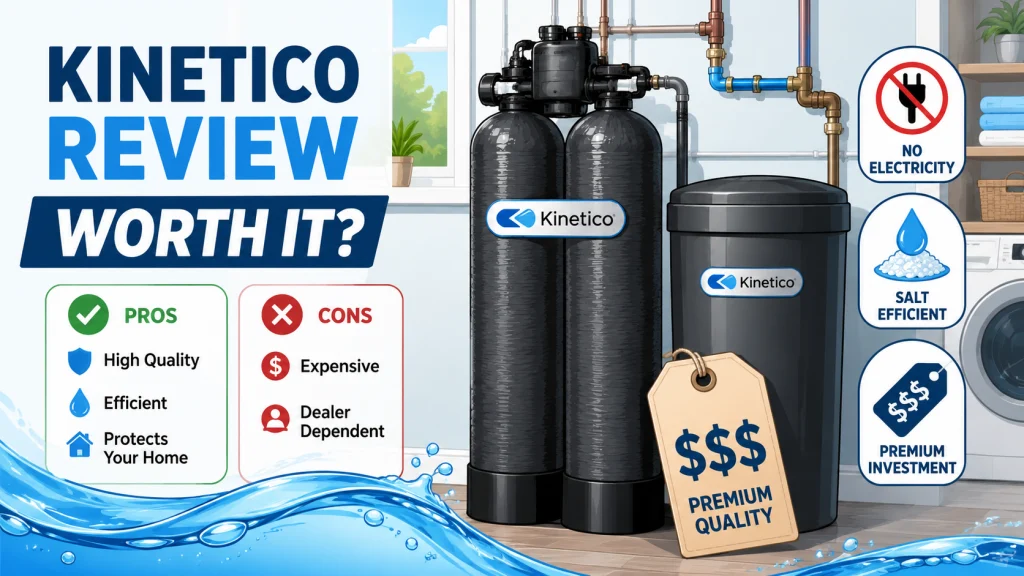
The defining characteristic of Kinetico is the power source. A conventional residential softener uses electricity to run a control head that manages the regeneration cycle. Kinetico uses the kinetic energy of moving water to drive that cycle. No electricity, no timer, no electronic control board to fail. The system also operates with twin resin tanks. One tank stays in service while the other regenerates, which means continuous soft water with no scheduled downtime between cycles.
Both of these are technical advantages worth understanding, not marketing language. Demand-initiated metered regeneration is exactly what I look for in any quality softener. The non-electric design is a meaningful differentiator in areas where power reliability is a concern. I give Kinetico full credit for both of those features. The rest of this article is about what they cost and what you give up along the way.
What Kinetico Does Well
Salt efficiency stands out as a real-world benefit. Because the system regenerates based on actual water consumption rather than a fixed schedule, it does not burn through a full cycle when the house sits empty. I have seen timer-based systems consume a full bag of salt every month in households that barely tax the capacity, simply because the clock runs regardless of demand. Kinetico avoids that. Over the course of a year, the difference in salt and water use is measurable, and it adds up.
The continuous soft water from twin-tank operation matters more than it sounds in households with high morning demand. No one showers in hard water because the regeneration cycle happened to run at 6 a.m. For a household of four or five people on well water at 18 GPG, that reliability is something they notice immediately after installation.
For anyone on rural property with unreliable power, the non-electric design is the deciding feature. Some conventional softeners may lose their settings or require checking after an outage before they are back on schedule. A Kinetico keeps running through any outage without any of that. If you are in an area that loses power several times a year, that reliability has a real dollar value.
The Price Reality
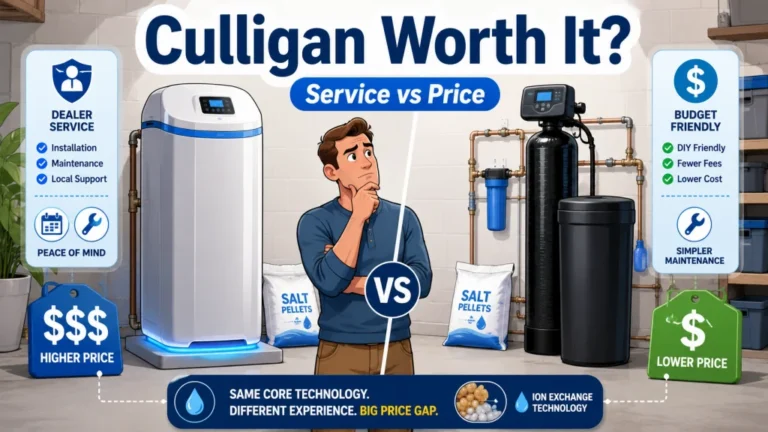
Kinetico systems are sold exclusively through authorized dealers. There is no published price list, no online checkout, and no way to compare quotes between two dealers serving different areas. You get whatever number your local representative puts together, and the range is wide. In my experience, standard residential softener installs run $3,000 to $6,000 depending on the market. Add a reverse osmosis unit and $7,000 or higher is not unusual.
A Houzz forum discussion documents one homeowner who received a quote of $7,240 for a softener and RO combination for a standard household. After getting an independent water test and doing more research, she concluded the price was outrageous and felt uncomfortable depending entirely on one rep for any future service needs. She went with a Fleck system instead. That response is common enough that I have stopped being surprised by it.
Field Note: The most common question I get from homeowners who have received a Kinetico quote is not whether the system is any good. It is whether they can get a second opinion from someone who does not sell Kinetico. That one question tells you more about dealer-exclusive pricing than any comparison chart would.
For context, a properly built Fleck 5600SXT twin-tank system with 10% crosslink resin delivers equivalent softening performance and continuous soft water. Typical pricing for a quality direct-to-consumer build runs $1,200 to $1,800. The gap between those numbers and a typical Kinetico quote is the honest foundation for this comparison, and it is a gap worth understanding before you sign anything.
Quote Check: Before you sign a Kinetico quote, get answers to these five questions. What is the total installed price including all hardware and labor? What does a service call cost once the warranty period ends? How long does the warranty cover both parts and labor separately? How long has this specific local dealer been operating in your area? And if the dealer changes ownership or closes, who services your system? If your dealer cannot answer all five clearly, take more time before committing.
The Serviceability Problem
This is where the Kinetico conversation changes for most buyers who do any research before committing. Kinetico does not sell parts through retail or independent distribution channels. There is no part number you can look up and order from a water treatment supply house. If a seal fails, a valve sticks, or a component needs replacing, you call your dealer. That is the only path.
The cost of that arrangement is not abstract. One parts buyer documented being quoted $580 by Kinetico for a replacement filter housing head, plus $200 for the service call, because they do not sell parts across the counter. The same component was available from an independent water treatment supplier for $100. That is a single repair. Over a system life of 10 to 15 years, that pricing gap compounds significantly.
On a Fleck 5600SXT, a rebuild kit, an O-ring set, or a replacement injector can be sourced same-day from distributors anywhere in the country. Most water treatment technicians familiar with Fleck valves can work on it without ordering anything special. I have watched homeowners replace valve seals themselves after watching a short video online. That level of access does not exist on the Kinetico side, and it is worth being clear-eyed about that before installation.
A Kinetico owner on a TractorByNet forum thread put it plainly: the system is overpriced but works well and uses little salt, the installer and service contact is good, but you cannot fix it yourself because there are no parts. That is not a complaint about the softener’s performance. It is an accurate description of the ownership arrangement.
Note: Kinetico reliability is generally well-regarded, and most owners never run into a serious failure. The concern is not whether it will break. It is whether having one service option for the life of the system is a trade-off you are comfortable making.
Who Should Buy a Kinetico, and Who Should Not
Most homeowners who make the right call buying Kinetico fit a recognizable profile. They are in an area with unreliable grid power. They want zero involvement with their water system after installation. Or they have a local dealer with a strong, long-standing reputation and a history of standing behind the product. If any of that describes you, Kinetico is a defensible choice at the right price point.
| Kinetico is a reasonable fit if | Consider alternatives if |
|---|---|
| Frequent power outages are a regular issue in your area | You want to be able to source parts or handle basic service yourself |
| You want hands-off ownership and have a trusted local dealer | Your quote exceeds $4,000 for a standard residential softener |
| Your local Kinetico dealer has a long, well-reviewed track record | Your dealer is newer, recently changed ownership, or has mixed service reviews |
| Upfront cost is not a primary constraint in your decision | You are comparing performance to direct-to-consumer systems at $1,200 to $1,800 |
| You are on well water in a rural area with no reliable service alternatives | You plan to sell the home within 3 to 5 years |
One practical benchmark: if your quote exceeds $4,000 for a standard residential softener without an RO system, compare it against a Fleck or Clack twin-tank build before signing. The performance gap does not justify that margin for most homes. The service arrangement might, but only if your dealer and situation actually match what is in the left column of that table.
The dealer quality point carries more weight than the table suggests. A long-established Kinetico dealer with decades of local history offers something no direct-to-consumer system can replicate out of the box: reliable local labor, warranty service coverage, and a single contact who knows your specific installation. That arrangement has real value for the right buyer. The issue is that dealer quality varies significantly by market, and you are locked into whoever covers your area for as long as you own the system. Research your local dealer as carefully as you research the hardware.
Anyone who values independent serviceability, wants flexibility in who handles their system, or is trying to close a $3,000 gap in their budget will find better options in the Fleck and Clack valve ecosystem. If you are still working through what those options look like, reviewing the full range of residential water softener systems is a useful step before committing. The performance differences between categories are smaller than dealer salespeople suggest, and the cost differences are larger.
What You Give Up When You Skip Kinetico
To be fair about the comparison: a non-electric twin-tank system from a dealer with genuine local support is not a bad product. If you decide Kinetico is not the right fit, there are a few things to keep in mind when looking at alternatives.
- Dual-tank metered systems are available in the direct-to-consumer market. A Fleck 5600SXT twin-tank build delivers continuous soft water the same way Kinetico does, at a significantly lower price point. The difference is the valve and the service model, not the softening result.
- 10% crosslink resin matters, especially on city water with chlorine. Standard 8% crosslink resin degrades faster in chlorinated municipal water. If you are comparing systems, ask specifically what crosslink percentage the resin is rated at. Most box-store listings do not state it.
- Demand-initiated regeneration is not unique to Kinetico. Most quality systems at any price tier support metered regen. It is a baseline expectation, not a differentiator you should pay a premium for.
- No dealer service is not the same as no service options. With a Fleck valve, most water treatment technicians can service the system, and parts are widely available through independent distributors. The service network is broader, not narrower.
The point of that list is not to dismiss Kinetico. It is to make clear that the features Kinetico markets as differentiators are available elsewhere at lower cost. What is genuinely exclusive to Kinetico is the non-electric design and the dealer service model. If those two things matter to you, the conversation is different.
Final Thoughts: The Honest Answer on Kinetico
Kinetico makes a well-engineered water softener. The technical design is sound, the salt efficiency holds up in practice, and I am not dismissing the buyers for whom it is the right fit.
What I am saying is that for most standard residential applications, the premium covers a service model, not a meaningful gap in softening performance. A properly built alternative at $1,200 to $1,800 does the same job, with parts sourced from any distributor and a wider pool of technicians who can work on it. Whether the Kinetico markup is worth it depends on whether your situation actually calls for the non-electric design and whether your local dealer is one you can rely on for the long term.
If you are on rural well water in an area with unreliable power and a trusted local dealer, Kinetico is a reasonable choice at the right price. If you are a standard city or suburban homeowner who received a $4,500 quote and wants to know if there is a better path, there is. My full breakdown of which systems I recommend is at the best water softener guide.
Sources & References
The community quotes and pricing data referenced in this article are drawn from the following verified sources.
- TractorByNet: “Water treatment advice” thread. Forum owner quote confirming Kinetico works well but is overpriced and has no available parts for owner service. Used to document the serviceability limitation from an actual owner perspective.
- Houzz: “Kinetico water softener overpriced? Need suggestions” discussion. Homeowner quote documenting a $7,240 Kinetico quote and the decision to switch to a Fleck system after independent research. Used to illustrate real quote ranges and the buyer confidence issue with dealer-exclusive pricing.
FAQs
💧 Is Kinetico a good water softener?
Yes, the hardware is well-regarded. The non-electric twin-tank design sets it apart from most residential softeners, and salt efficiency is measurably better than timer-based systems. The concerns are cost and the dealer-only service model, not softening performance.
💰 Why is Kinetico so expensive?
Kinetico sells exclusively through authorized dealers with no published pricing. Each dealer sets their own quotes, and because buyers cannot easily compare dealer quotes or shop direct-to-consumer alternatives, prices tend to stay high. You are paying for the service model as much as the hardware.
🔧 Can I fix a Kinetico softener myself?
In most cases, no. Kinetico does not sell replacement parts through retail or independent distribution. If a component fails, you need to contact your authorized dealer for service. There is no equivalent to ordering a Fleck rebuild kit online and doing a DIY repair.
⚖️ Is Kinetico better than Fleck?
For softening performance, the difference is not significant in most residential applications. Kinetico has a clear advantage with the non-electric design in areas with unreliable power. Fleck wins on parts availability, service flexibility, and upfront cost. Which is better depends on which of those factors matters more to your situation.
📋 What does a Kinetico water softener cost installed?
Standard residential installs commonly run $3,000 to $6,000. Adding a reverse osmosis system can push the total to $7,000 or higher. Pricing varies by dealer and market, and there is no way to comparison shop between dealers since pricing is not publicly listed.
⚡ Does Kinetico really not use electricity?
Correct. Kinetico uses the kinetic energy of water flow to drive the regeneration cycle. There is no control board, no timer, and no electrical connection required. This is how the system is engineered, not a marketing position, and it makes Kinetico a practical option for off-grid or rural properties with unreliable power.
🏡 Is Kinetico worth it for well water?
It depends on your water profile and power situation. For high-hardness well water in a rural area with frequent outages, the non-electric design is a clear advantage. For standard well water at 10 to 20 GPG with reliable power, a properly sized Fleck or Clack system handles the same load at significantly lower cost and with better parts access.