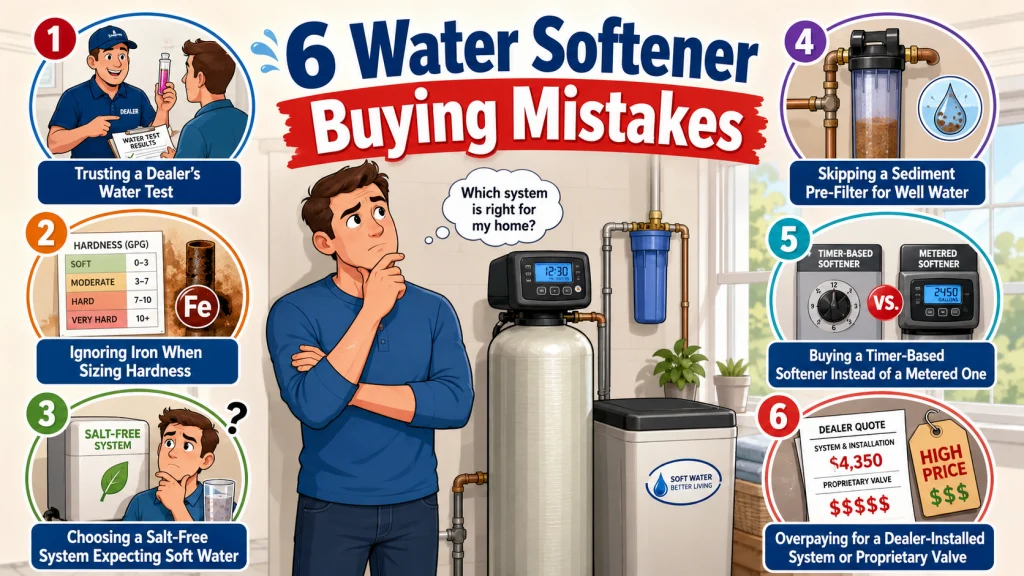
The Same Six Mistakes, Hundreds of Homes
Water softeners are not complicated appliances. The technology hasn’t changed much in decades. What has changed is the number of ways a homeowner can end up with the wrong system, the wrong size, or a $3,000 bill for something that should have cost $900. In my experience, the mistakes that cost people the most money aren’t the technical ones. They’re the decision-making ones: the assumptions people carry into the buying process before they’ve tested a single thing or talked to anyone who isn’t trying to sell them something.
What follows is the short list. Not every possible mistake, just the six I see most often, documented well enough that I can point to evidence beyond my own installs. If even one of these matches where you’re at right now, it’s worth slowing down before you commit.
Mistake 1: Trusting the Dealer’s Water Test
This is the one that generates the most real-world damage, and it’s been documented in enough places that it no longer surprises me when I hear about it. The scenario is always similar: a salesperson comes to the home, runs a free in-home water test, shows the homeowner alarming results, and uses those results to close a sale. The test is designed to sell, not to inform.
CBC News in Ottawa documented a case where a 74-year-old man signed a contract for what he believed was a free, government-supplied water purifier. He ended up on the hook for $65 a month for ten years, nearly $8,000 total, for a water softener he didn’t need and didn’t understand he was paying for. What I’ve seen on actual installs tracks with this. A dealer test result is not a neutral measurement. It is a sales tool.
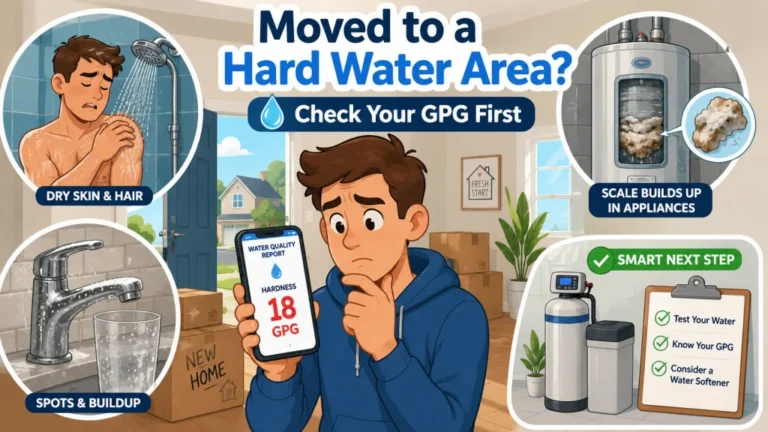
Field Note: I’ve followed up on homes after a dealer visit and run the same water through a calibrated test kit. The hardness numbers didn’t match. Not slightly. Meaningfully. If you want an honest GPG number, check your utility’s Consumer Confidence Report online. Most utilities publish it annually and hardness data is often included. If yours doesn’t list it clearly, call the utility directly or send a sample to your state-certified lab. Either way, get the number before you talk to anyone selling a softener.
Your GPG is your baseline. It costs nothing to find it, and it puts you in a completely different position when a salesperson shows you their test results.
Mistake 2: Sizing for GPG Without Adjusting for Iron
This one primarily hits well water buyers, and it’s one of the most consistent sizing errors I see. A homeowner gets their water tested, finds out they have 12 GPG of hardness, and sizes a softener for a 4-person household at 12 GPG. Sounds reasonable. The problem is that if their water also contains 2 parts per million (ppm) of iron, which is common with well water, they should be sizing as though their hardness were closer to 20 to 22 GPG. The rule of thumb most water treatment professionals use is to add 4 to 5 GPG per ppm of iron when sizing the system.
Nobody tells the well water buyer this. Not the box store. Not the online listing. Often not even the dealer, because it would push the buyer toward a larger, more expensive system that might be harder to justify at the time of sale. The result is a softener that’s technically operational but running near or at capacity constantly, regenerating more often than it should, and struggling to deliver fully treated water at peak usage times.
| Actual GPG | Iron (ppm) | Size as | 4-person grain capacity needed |
|---|---|---|---|
| 10 GPG | 0 ppm | 10 GPG | ~32,000 grains |
| 10 GPG | 2 ppm | 18 to 20 GPG | ~48,000 grains |
| 15 GPG | 3 ppm | 27 to 30 GPG | ~64,000+ grains |
If you’re on well water, test for iron alongside hardness. Then size using the adjusted number, not the raw GPG. Undersizing a softener for well water with iron is one of the fastest ways to shorten its service life. For a more complete walkthrough of how to get your grain capacity right, the guide on how to size a water softener correctly covers the full calculation, including the iron adjustment, in detail.
Mistake 3: Buying a Salt-Free Conditioner Expecting Soft Water
This is the one that generates the most disappointed follow-up calls. A homeowner buys a salt-free conditioner, often marketed with language that implies softening, and then contacts the seller weeks later because nothing feels different. Their skin still feels dry after a shower. The soap still doesn’t lather the way they expected. The water still tests hard on a strip kit.
Salt-free conditioners are real products that do real things. What they do is prevent mineral scale from adhering to pipes and appliances through a process called template-assisted crystallization. What they do not do is remove hardness minerals from the water. RKIN, a company that sells both types of systems, states it clearly on their product pages: salt-free conditioners “do not create the soft water feel associated with traditional softeners.” The TDS reading doesn’t change. The minerals are still there. If your goal is protecting your plumbing and appliances from scale buildup, a salt-free conditioner is a legitimate option. If your goal is the skin and hair improvements, the lather, the slick feel of true soft water, you need ion exchange. That is a salt-based softener, and there is no workaround that delivers the same outcome without removing the minerals.
Note: The confusion here is partly a naming problem. “Salt-free water softener” is a common marketing label for systems that condition water rather than soften it. If you see that phrase on a product, read the fine print carefully before purchasing. True softening means ion exchange, and it requires salt.
Mistake 4: Skipping the Sediment Pre-Filter for Well Water
Well water buyers who install a softener without a sediment pre-filter often end up blaming the softener brand when problems show up within the first year or two. What they’re usually dealing with is fouled resin: resin that has been progressively coated with sediment, iron particles, or fine silt to the point where it can no longer exchange ions effectively. The system still runs. Salt still goes in. But softening performance degrades quietly over time, and by the time it’s noticeable, significant damage to the resin bed has already occurred.
A sediment pre-filter, typically a 5-micron cartridge filter installed upstream of the softener, catches the particles that foul resin before they reach it. On city water this is usually optional. On well water it’s not. I’ve replaced resin beds on systems that were less than two years old because the pre-filter was omitted, and in every case the homeowner thought the softener brand was defective. The softener was fine. The setup was incomplete.
If you’re on well water with any iron content at all, a fine mesh resin is also worth specifying. Standard 8% crosslink resin handles city water with chlorine but struggles with iron over time. These are the kinds of spec decisions that most product listings don’t surface, but they matter significantly for the service life of the system.
Mistake 5: Choosing Timer Regeneration Over Demand-Initiated
Older softener designs used a timer to trigger regeneration on a fixed schedule: every three days, every week, whatever was programmed in. The system would regenerate whether it needed to or not. Demand-initiated regeneration, also called metered, works differently. A meter tracks actual water usage, and the system regenerates only when the resin bed has been depleted based on the calculated load. Same softened water output, significantly less salt used to achieve it.
The difference in salt consumption is substantial. Demand-initiated systems commonly use 30 to 50% less salt than equivalent timer-based systems in real household conditions. That’s not a manufacturer claim. It reflects how often a timer-based system regenerates on days when the household used very little water. The salt is still consumed. The regeneration still runs. Nothing is gained.
Many current residential softeners are demand-initiated by default, so this matters most when evaluating older systems or lower-cost units that may still use timer-based control. Check the spec before buying. If it doesn’t say metered or demand-initiated, ask the seller directly how regeneration is triggered.
Choosing a timer-based softener because it’s $80 cheaper, then spending an extra $15 to $25 per month on salt year after year because the system regenerates on schedule regardless of actual water use.
Paying slightly more upfront for a demand-initiated system, letting actual household usage determine when regeneration happens, and spending significantly less on salt over the system’s service life of 10 to 15 years.
Mistake 6: Assuming the Dealer Brand Justifies the Price
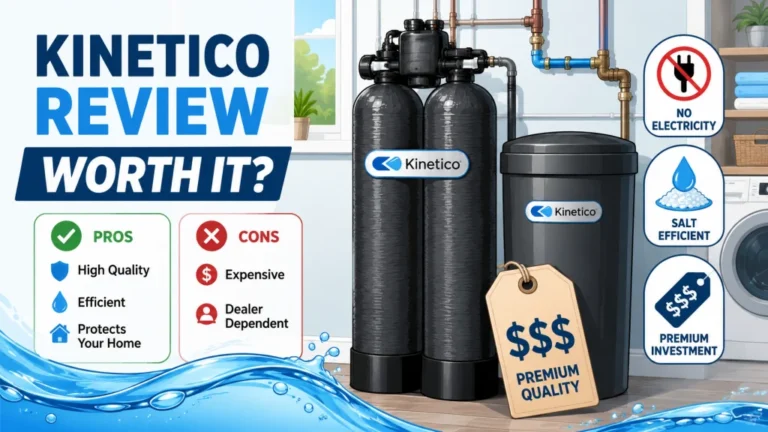
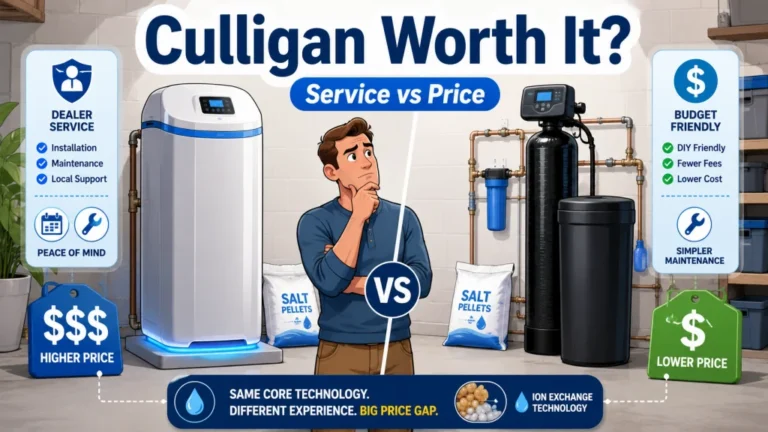
This one is harder to say bluntly, but it’s documented well enough that I’ll say it. Major dealer brands, the household names in residential water softening, use control valves that are either manufactured by or functionally identical to the same valves found in systems that sell for a fraction of the price. The Fleck 5600SXT and Clack WS1 valves are the workhorses of the industry. They show up in dealer-branded systems at one price and in direct-to-consumer systems at another. The valve is the same. The resin is the same. What you’re paying for with the dealer brand is the dealer network, the service contract, and the name on the tank.
That’s not always a bad trade. If you genuinely want a local dealer to handle everything from installation to salt delivery to service calls, that relationship has real value. What it’s not worth is an additional $1,500 to $2,500 on top of a comparable independently purchased system with the same core components. Knowing this one fact before you get a dealer quote can change how you evaluate what you’re being offered and whether the markup is justified by what you’re actually getting in return.
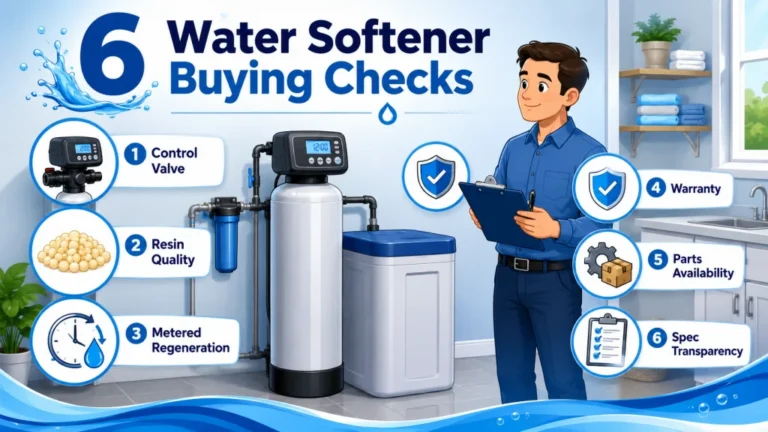
Before committing to any system, compare it on the basis of control valve brand, resin specification, warranty terms, and parts availability. That framework, not the brand name on the tank, is what tells you whether the price makes sense. The full picture of what to buy and how to evaluate options is covered in the guide to the best water softeners available right now, including which systems pass the evaluation on specs that actually matter.
Before You Buy: A 10-Minute Pre-Purchase Checklist
Every mistake in this article comes down to going into the buying process without the right information. The checklist below takes about ten minutes to work through and covers the questions that will most directly affect whether you end up with the right system at the right price. Bring it when you’re comparing products or sitting across from a dealer.
- Is your GPG verified from a neutral source? Your utility’s Consumer Confidence Report or a state-certified lab, not a dealer’s in-home test.
- Have you tested for iron? If you’re on well water, iron content determines your real sizing requirement. A standard hardness number alone is not enough.
- Is your goal true soft water or scale prevention? Ion exchange softening removes minerals and produces the soft water feel. Salt-free conditioning prevents scale but leaves hardness minerals in the water. They are not the same product.
- Have you planned for a sediment pre-filter? On well water, this is not optional. If you have any iron, fine mesh resin is worth specifying alongside it.
- Does the system regenerate on demand? Look for “metered” or “demand-initiated” in the spec sheet. If it’s not listed, ask before buying.
- What control valve does it use? Fleck (Pentair) or Clack are the two valves with proven long-term track records and parts available from any water treatment distributor.
- Is the resin crosslink percentage stated? 10% crosslink for city water with chlorine. Fine mesh resin if there’s iron. Most box store listings don’t include this. Ask.
- What does the warranty actually cover? Control head, tanks, and resin should all be listed separately. Read the fine print for conditions that could void coverage.
- Can you buy parts independently? If the answer is no, or if you’d have to go through the original dealer for an O-ring, you’re tied to that service relationship for the life of the system.
- Does the total price reflect the core components? If you know the control valve and resin spec, you can cross-reference what those components cost elsewhere. The delta tells you what you’re paying for beyond the hardware.
None of these questions are difficult to get answers to. Most manufacturers who build solid systems have no problem stating their specs clearly. The ones who don’t are usually the ones hoping you won’t ask.
Final Thoughts: All Six Mistakes Are Avoidable
None of these are obscure technical errors. They’re buying decisions that go wrong because the homeowner didn’t have the right frame before entering the process. Trust the dealer’s test without verifying. Size for GPG without adjusting for iron. Assume a salt-free system does the same job as a salt-based one. Skip the pre-filter on well water. Buy timer-based to save money upfront. Pay the dealer premium without understanding what’s behind it. Every one of these is avoidable with a small amount of preparation.
The pattern I’ve watched repeat across hundreds of installs is this: the homeowners who do the least research tend to spend the most money and end up with systems that underperform for their specific water situation. The ones who verify their GPG first, understand what they’re buying, and compare on specs rather than brand names almost always get better outcomes at lower cost. That’s not a coincidence. It reflects what you get when you go into the process with the right information.
Sources & References
- CBC News Ottawa: Ottawa man scammed into $8K water softener at the door. Documented case of a door-to-door salesperson misrepresenting a water softener contract as a free government-supplied purifier, resulting in a 10-year payment obligation.
- Water Quality Association: Softened Water Benefits Studies (Battelle Study). Summary of the 2009 Battelle Memorial Institute study commissioned by the Water Quality Research Foundation, covering appliance efficiency and scale accumulation in hard water conditions.
- RKIN: Water Softener vs Salt-Free Conditioner Guide. Manufacturer-published comparison confirming that salt-free conditioners prevent scale but do not produce the soft water feel associated with ion exchange systems.
- TractorByNet forum: Water Softeners, Do It Yourself Systems. Community thread with firsthand accounts of dealer pricing markups and the case for independently purchased systems with identical core components.
FAQs
🧪 How do I know if a dealer’s water test is accurate?
In most cases you can’t, and that’s the problem. In-home dealer tests are not conducted by a neutral party. Verify your water hardness independently: check your utility’s Consumer Confidence Report, published annually online, or send a sample to your state-certified lab. That number is your baseline. Don’t commit to a system based on a test provided by the person selling it.
🔩 What size water softener do I need for well water with iron?
Start with your actual GPG hardness reading, then add 4 to 5 GPG for each ppm of iron in your water before sizing the system. A household with 12 GPG and 2 ppm iron should size as though they have 20 to 22 GPG. Skipping this adjustment is one of the most common reasons well water softeners underperform or fail early.
💧 Does a salt-free water softener actually soften water?
No, not in the way most people mean. Salt-free conditioners prevent mineral scale from adhering to pipes and appliances, but they don’t remove the calcium and magnesium from the water. Hardness minerals remain present, so the water will still test hard and you won’t notice the skin, hair, or lather improvements that come from true ion exchange softening. Both types of systems have legitimate uses, but they solve different problems.
🏠 Do I need a sediment filter before a water softener?
On city water, it depends on sediment levels and is often optional. On well water, it’s strongly recommended and in many cases necessary. Fine particles and iron in well water foul resin beds over time, degrading softening performance and shortening the system’s service life. A 5-micron sediment pre-filter installed upstream of the softener is an inexpensive step that protects a much larger investment.
⏱️ What is the difference between timer and demand-initiated regeneration?
Timer-based systems regenerate on a fixed schedule, every few days, regardless of actual water usage. Demand-initiated (metered) systems track how much water has been used and regenerate only when the resin bed needs it. In practice, demand-initiated systems use 30 to 50% less salt because they don’t run unnecessary regeneration cycles. Many modern softeners are demand-initiated; if a system doesn’t specify, ask before buying.
💰 Are dealer water softeners worth the higher price?
It depends on what you’re actually buying. Major dealer brands often use the same Fleck or Clack control valves found in direct-to-consumer systems. The markup covers the dealer network and service relationship, not different core components. If you value local service, installation, and ongoing support, that relationship may be worth something to you. If you’re comparing on specs alone, the premium is harder to justify. Know what’s inside the tank before you decide.