Water Softener Rental Makes Sense in Exactly One Scenario
If you are planning to move within 18 months, renting is the right call. You get soft water without committing to a system you will have to either sell, transfer, or abandon when you leave. That is the whole list. For everyone else, buying wins on pure math, and the gap is not close.
I have seen homeowners renting the same softener for six, seven, eight years. They know the monthly payment, but they have stopped thinking about what they have paid in total. Nobody frames it that way when they sign the agreement. Once the decision is made, the payment just becomes background noise, the same as the electric bill. The math is easy to miss when you never add it up.
What Renting a Water Softener Actually Costs
According to HomeAdvisor cost data, dealer-supplied water softener rentals typically run $25 to $50 per month. Some packages include salt delivery, which sounds convenient until you notice the markup: dealer-delivered salt consistently runs twice what you would pay at any home improvement store. The monthly payment you agreed to may be just the start of what you are spending.
At $40 per month, which is right in the middle of the typical range, the annual cost comes to $480. At $50 per month, you are looking at $600 per year. Most homeowners do not stay in a home for two years. They stay for ten, fifteen, twenty. Run the number that far out and the rental total is hard to ignore.
Field Note: I have looked at a lot of homes where the previous owner had been renting a softener. The unit is usually five or six years old, and it is a system you could have bought new, installed, and owned outright for what they paid in the first two years. What they are renting past that point is nothing more than inertia.
The Break-Even Math: When Buying Pays for Itself
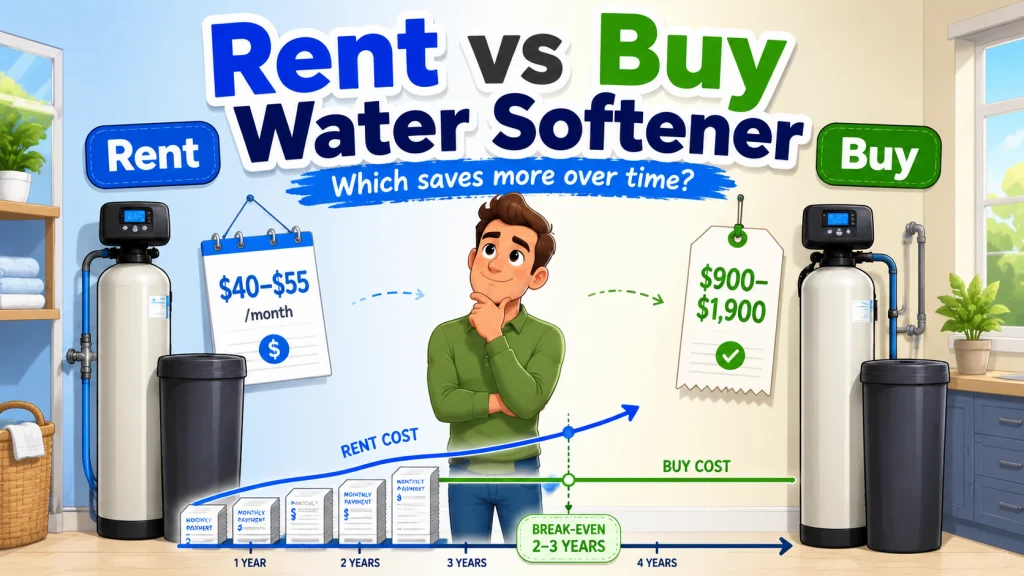
A quality single-tank system with a demand-initiated control valve costs $700 to $1,500, purchased outright. Installation, if you hire it out, adds $150 to $500 depending on complexity and your location. Call it $1,000 to $2,000 total, all in, for a system you own. After that, your main recurring cost is salt, roughly $100 to $200 per year depending on your water hardness and household size.
Here is what the comparison looks like over time at a $40 per month rental rate versus buying at the midpoint:
| Year | Total Rental Cost ($40/mo) | Total Ownership Cost (purchase + salt) |
|---|---|---|
| 1 | $480 | $1,100 (purchase) + $150 salt = $1,250 |
| 2 | $960 | $1,400 |
| 3 | $1,440 | $1,550 |
| 5 | $2,400 | $1,850 |
| 10 | $4,800 | $2,600 |
| 15 | $7,200 | $3,350 |
Break-even happens somewhere between years two and three. Everything after that is money you are paying to not own the equipment sitting in your utility room. By year ten, the ownership path has saved you roughly $2,200. By year fifteen, it is closer to $3,850. Those are not small numbers.
The case looks even sharper if you are on the higher end of the rental range. At $50 per month, you spend $6,000 over ten years. A $1,500 system with salt runs about $2,750 over the same period. The gap is $3,250. Put another way, every year you continue renting past the break-even point costs you roughly $480 to $600 for zero additional value.
Key point: Break-even on ownership typically falls between 24 and 36 months at standard rental rates. Past that point, you are funding the dealer’s business, not your own water treatment.
The Contract Trap Most People Miss
What I see fairly often is that the homeowner thinks they can cancel at any time. Sometimes that is true. More often, the agreement has a multi-year term baked in, often with early termination fees that make canceling expensive. The time to read that language is before you sign, not six months later when you have found a system you want to buy.
A comment that keeps coming up in homeowner forums captures this well. One user on TractorByNet put it directly: “I think water softener rental is way overpriced, so I plan to purchase a water softener and install it myself.” That is not an unusual position to reach, but it is a lot easier to act on before you are locked into a contract than after.
Some agreements also require that you purchase salt through the dealer, or that maintenance and repairs are handled exclusively by them. That sounds like convenience, and it is, but it also means you have no leverage on price and no option to comparison shop. The service relationship that got sold to you as a benefit becomes a financial dependency.
Warning: Before signing any rental agreement, confirm the contract term, the early termination fee, and whether the agreement restricts where you purchase salt or who can service the unit. These terms vary widely and are not always disclosed upfront.
What You Give Up With a Rental
Beyond the cost, there are a few structural disadvantages to renting that do not show up in the monthly payment.
- No equity. You are paying for water treatment, not building ownership of anything. If you cancel, the unit goes back. You are left with soft water memories and a lighter wallet.
- No control over service costs. When the dealer sets pricing for maintenance visits, repairs, or salt delivery, you either pay it or look for an exit that may cost you more in termination fees than compliance would.
- No ability to upgrade. If your household grows, your water hardness changes, or a better technology becomes available, you are stuck waiting for the contract to allow a change, usually at the dealer’s discretion and pricing.
- Salt supply dependency. Dealers who offer salt delivery as a bundled service often charge a significant premium. Buying salt at a home improvement store for $5 to $10 per 40-pound bag and paying $20 to $30 for the same bag through a dealer adds up across years of ownership.
- Transfer complications at sale. Selling a home with a rented softener introduces a wrinkle for buyers who do not want to assume the contract. This sometimes requires canceling the agreement before closing, which can trigger termination fees at exactly the moment you least want an unexpected expense.
None of these are deal-breakers in isolation, but stacked together they paint a picture of a product structured to keep you paying rather than to serve your long-term interest.
When Renting Actually Makes Sense
I said it at the top and I will repeat it here: there are real situations where renting is the right answer. Not many, but they exist.
If you are renting your home and cannot make permanent plumbing modifications, buying is often off the table entirely. Some portable softener options exist, but they are not suited for whole-house treatment. A month-to-month rental arrangement fills the gap without requiring installation work you do not have permission to do.
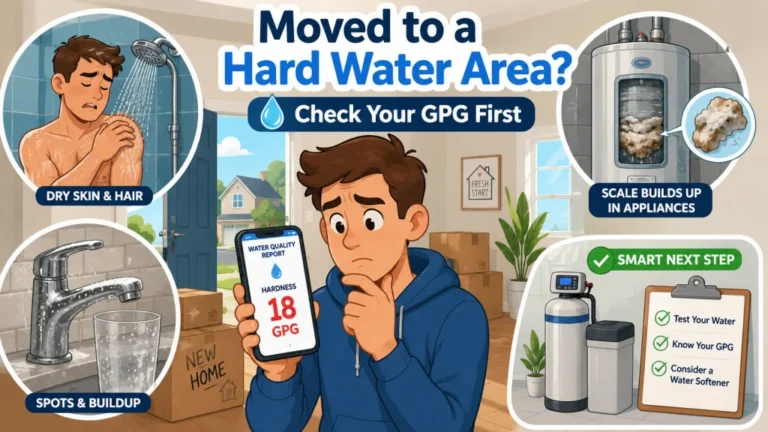
If you have recently moved and have not yet confirmed your water hardness level or what size system you need, a short-term rental gives you soft water while you figure out the right purchase. Buying the wrong size system because you were in a hurry is a mistake that costs more than a few months of rental fees. In this case, renting is buying yourself time to make a better decision, not a long-term commitment.
And if capital is genuinely the constraint, meaning you need soft water now but do not have $1,000 to $1,500 available for an outright purchase, a rental can bridge the gap. The key is to treat it as temporary. Once you have saved the purchase amount, the math strongly favors switching.
Note: If you are renting long-term with no plan to buy, you are in the most expensive position available. A month-to-month rental without a clear exit is the scenario the break-even math is warning against.
Pro Tip: Already renting? Do this before your next payment.
- Add up every month you have paid and multiply by your monthly rate. That number is what you have spent so far with nothing to show for it.
- Ask the dealer for the cancellation fee and any buyout option, in writing.
- Price a comparable owned system, including installation, and compare the two totals.
- If you are past month 24, you have already hit or are approaching break-even. Every payment from here is a decision you are actively making, not a default you fell into.
The Practical Alternative to Renting
The alternative is straightforward: buy a system outright and have it installed. A quality single-tank ion exchange softener with a demand-initiated control valve is available in the $700 to $1,200 range for the unit alone. If you are not comfortable doing the installation yourself, hiring a plumber typically adds $150 to $500. Total cost, done correctly, lands in the $1,000 to $1,500 range for most standard residential applications.
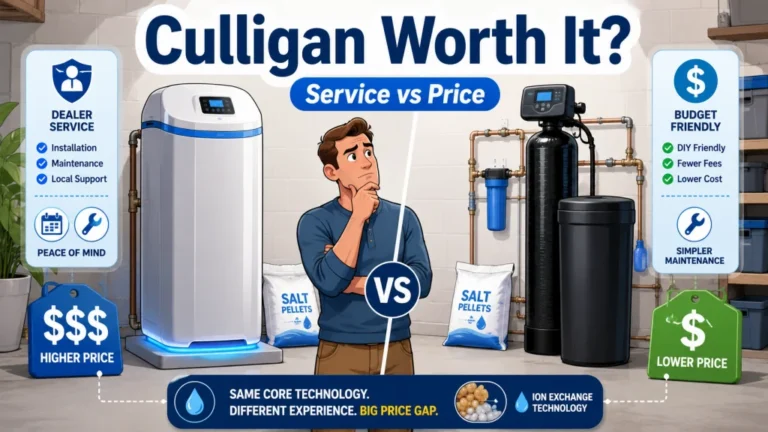
What you get in return is a system you own, parts you can buy independently, and a service relationship with anyone you choose rather than whoever sold you the contract. If something needs repair five years from now, you call a local plumber, order the part from a water treatment distributor, and handle it. You are not waiting on a dealer or paying their labor rate for a standard valve repair.
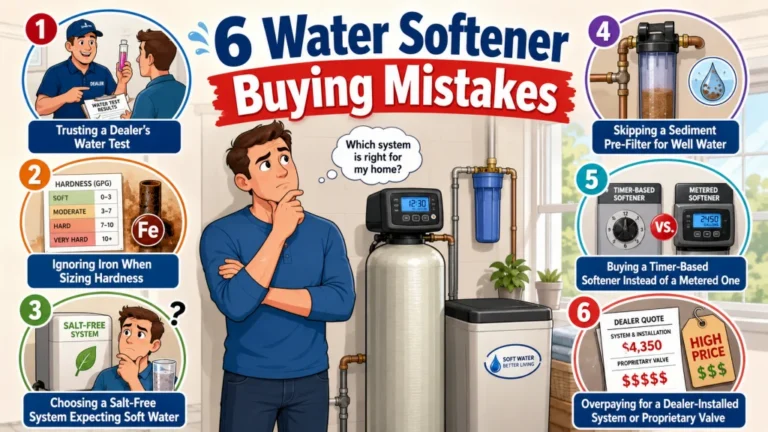
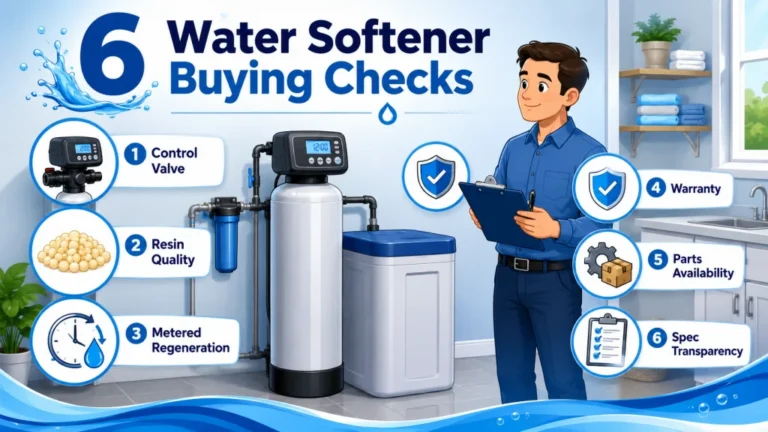
For the actual purchase decision, the evaluation process matters as much as the price. What to look for in a control valve, resin specification, and warranty terms is a separate conversation, covered in detail in my guide to choosing the best water softener for your home. The short version: demand-initiated regeneration, a serviceable control valve, and a resin crosslink percentage that matches your water chemistry. Get those three things right and the system will run reliably for 15 to 20 years. If you are staying in your home longer than three years, start comparing owned systems instead of rental contracts. The math makes that the obvious next step.
On the installation side, the process is simpler than most homeowners expect, but the specifics depend on your existing plumbing, bypass valve configuration, and whether a drain line is accessible. A full breakdown of what the installation actually involves, including when to hire versus DIY, is in my article on water softener installation. Getting the setup right the first time is worth the time to understand what you are dealing with before the plumber arrives.
Final Thoughts: The Math Does Not Lie, But the Framing Does
Rental agreements are sold on convenience and low monthly cost. Both of those things are real. What gets left out of the conversation is what happens at month 37 when you have spent $1,480 at $40 per month and still own nothing, or at month 120 when you have crossed $4,800 and still have the same unit sitting in your utility room with no equity, no exit, and no leverage.
If you are planning to stay in your home longer than three years, the decision is already settled. The smartest next step is not asking for another rental quote. It is pricing an owned system against your actual water hardness, household size, and installation situation, then comparing that number to what you have already paid and whatever remains on the current agreement. Do that math once, and the path forward tends to become obvious.
Sources & References
The cost figures and rental ranges cited in this article are drawn from the following sources, verified as of the publication date.
- HomeAdvisor: Water Softener Installation Cost (2025 Data): Rental cost range of $25 to $50 per month and purchase installation range of $200 to $6,000; the primary source for cost benchmarks used in the break-even table.
- TractorByNet: Water Hardness Forum Thread: Community discussion on renting vs. buying; source of the homeowner quote on rental being overpriced and the decision to self-install.
FAQs
💸 How much does it cost to rent a water softener per month?
Most dealer-supplied water softener rentals run $25 to $50 per month, based on HomeAdvisor cost data. Some agreements bundle salt delivery at an additional markup. Always confirm whether the monthly fee covers maintenance and what the contract term requires before signing.
📐 When does buying a water softener pay for itself vs. renting?
At the median rental rate of $40 per month, a purchased system typically reaches break-even somewhere between 24 and 36 months depending on what you paid upfront. After that point, every rental payment is money you are spending with no return. Most homeowners who stay in their home past the three-year mark are better off owning.
🔒 Can you cancel a water softener rental contract early?
Depends entirely on the agreement. Some are month-to-month and can be canceled with 30 days notice. Others have multi-year terms with early termination fees. Read the contract before signing and specifically look for the termination clause and any supply or service exclusivity requirements.
🏠 Is renting a water softener worth it if I rent my home?
It can be, if you cannot make permanent plumbing modifications or your landlord prohibits installation. In that case, a rental or a portable unit is often the only practical option. If your lease allows installation, buying and removing the system when you leave is still the better financial decision in most cases.
🔧 What happens to a rented water softener when you sell your house?
The unit goes back to the dealer. If you are mid-contract, you may owe an early termination fee. Buyers typically do not want to assume a rental agreement, so this often becomes a closing issue. It is worth factoring this into the timing if you are planning to sell within the next few years.
⚖️ Is a water softener lease the same as a rental?
Functionally, yes. Both involve paying for the use of equipment you do not own. A lease may have stricter contractual terms or a longer minimum period. Neither results in ownership at the end of the agreement unless there is an explicit purchase option written in, which is uncommon in the residential water softener market.