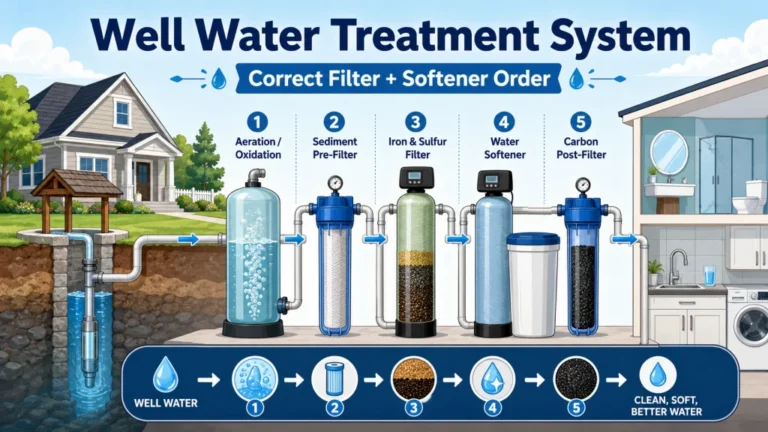

The $350 Unit That Ran for 10 Years
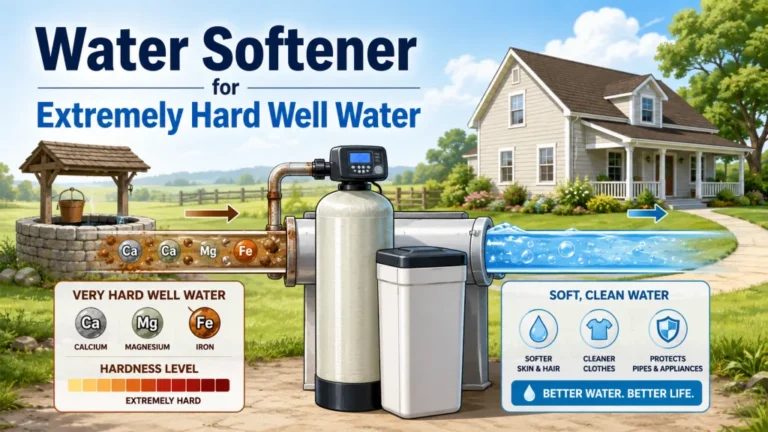
The most widely shared budget softener story in water treatment communities goes like this: a homeowner with very hard well water replaces a dealer-installed system, purchased for roughly $3,500, with a box store unit bought for $350. The dealer system had been breaking down repeatedly and running through two bags of salt per month. The replacement brought that down to one bag every two and a half months. It is still running 10 years later, on the same well water, without major service. That story gets repeated because it matches what I have seen on installs: the core technology is the same, and price alone does not determine how well a softener works.
Ion exchange removes hardness minerals the same way regardless of what you paid for the cabinet. Calcium and magnesium exchange for sodium ions across the resin bed. The control valve manages regeneration timing. A $350 unit does this. A $3,500 dealer unit does this. The outcome at the tap, measured in grains per gallon of remaining hardness, is identical if both systems are properly sized and the resin is appropriate for the water chemistry. What the price difference reflects is dealer overhead, service margins, and component quality, not a fundamentally different softening result.
That said, the $350 story has conditions. The unit was correctly sized for that household. The water was well water without chlorine, which is easier on resin long-term. And the homeowner was willing to handle basic maintenance. Remove any one of those conditions and the outcome could look different. Understanding exactly which conditions matter is where the rest of this article starts.
What Budget Systems Actually Give Up
Resin crosslink percentage is the first spec I check. Most under-$500 units ship with 8% crosslink resin. For well water without chlorine, that is generally adequate and the 10-year forum story above is plausible because well water does not carry chlorine. For city water, which delivers chlorine from municipal treatment continuously, 8% crosslink resin degrades meaningfully faster than 10% crosslink. Chlorine attacks the resin polymer structure over time, reducing capacity and eventually causing hardness breakthrough earlier than the unit’s rated lifespan suggests. If you are on city water and planning to keep the system for a decade, this spec matters more than anything else on the listing page.
Control valve quality is the second tradeoff. The industry benchmark valves have a service history going back decades and are field-serviceable with parts available through any water treatment distributor. Budget units often use off-brand valves that work fine initially but are difficult to source replacement parts for later. That distinction is invisible during the first few years. It becomes relevant when something fails at year seven and the valve head is discontinued.
Warranty coverage follows the same pattern. Budget units typically cover the control valve electronics for three years. Mid-range systems tend to run five years or longer on valve electronics, with some lifetime coverage on specific components. The three-year window is the one to pay attention to for a system you expect to run 10 to 15 years.
What budget systems tend not to give up is demand-initiated regeneration. Decent units in the $300 to $500 range regenerate based on actual water usage, not a fixed timer. Timer-based regeneration runs the cycle on schedule regardless of whether the resin is exhausted, wasting 30 to 50 percent more salt per year. If the unit you are evaluating only offers a timer, that cost gap closes faster than the purchase price suggests.

This whole-home water softener comes pre-loaded with 1.5 cubic feet of high capacity resin in a black USA-made mineral tank, paired with a USA brine tank featuring a safety float. The on-demand digital metered system ensures efficient water treatment, and the included 1-inch Noryl plastic bypass valve makes installation straightforward. Toll-free customer support is available whenever you need help.
Check On AmazonIf you click this link and buy, we earn a commission at no additional cost to you.
What Budget Systems Actually Deliver
The softening itself. I have pulled dealer-installed systems out of homes and put in direct-to-consumer units at a fraction of the price. The water test after installation shows the same result: hardness drops to 0 to 1 GPG, pipes stop scaling, dishes come out without spotting. The chemistry does not care what is printed on the control valve head. What often changes between the dealer system and the replacement is salt consumption, typically lower with the new unit, because dealer systems are frequently set to regenerate on an aggressive service schedule rather than based on actual water use.
The place this falls apart is undersizing, and that is where almost every legitimate budget softener complaint I have encountered actually originates. Someone buys a 24,000-grain unit because it is the cheapest option on the shelf, installs it for a household of four at 12 GPG, and the unit cycles every two to three days. The resin does not exhaust fully before regeneration kicks in, efficiency drops, salt use goes up, and the homeowner decides budget softeners do not work. The chemistry was fine. The capacity was wrong.
Field Note: I have had the same conversation more times than I can count with homeowners who blamed a budget unit for problems that were purely a sizing issue. A 24k system cycling every two days for a family of four at moderate hardness is not a bad unit. It is the right unit in the wrong house. The same homeowner with a 48k system at a similar price point runs once a week and never shows up in a forum complaint. Capacity determines day-to-day performance. Everything else is secondary.
The Crosslink Question for City Water Buyers
Many listings at this price point do not state the resin crosslink percentage. That absence is not reassuring. Before buying, contact the manufacturer or locate the full technical spec sheet and ask specifically. If they cannot tell you, that is a signal. If the answer is 8% and you are on chlorinated municipal water, you are making a tradeoff you should make consciously, not by accident.
For well water without chlorine, the 8% versus 10% distinction matters less. Chlorine is the primary driver of oxidative resin degradation in residential systems. Without it, 8% crosslink resin on well water can perform for 15 or more years under normal use. The concern is specifically city water, daily chlorine exposure, and a unit cycling multiple times per week over a decade.
Some manufacturers in this price range do offer 10% crosslink. It requires asking directly, because the spec is not consistently surfaced in retail listings. The other path is a whole-house carbon block pre-filter upstream of the softener, which removes chlorine before it reaches the resin. That extends resin life regardless of the crosslink percentage and costs $80 to $150 for the housing and filter. If you are on city water and buying in this price range, either get the crosslink confirmed in writing or add the pre-filter to your budget.

This three-stage whole house filter removes up to 99% of chlorine, sediment, rust, and herbicides while preserving beneficial minerals that reverse osmosis systems strip away. The first stage captures particles as small as 5 microns through a clear housing that lets you monitor buildup at a glance, while the second and third stages use high-quality coconut shell carbon block filters independently tested to NSF/ANSI standards. With a 30,000-gallon capacity, the system provides up to 6 months of clean water for a family of four, and connects easily via 3 quarter inch NPT inlet and outlet fittings with step-by-step YouTube installation support. An extended warranty and lifetime U.S.-based technical support are available with online registration.
Check On AmazonIf you click this link and buy, we earn a commission at no additional cost to you.
Sizing Within a Budget
Most under-$500 units top out at 32,000 to 48,000 grains of capacity. Here is what those numbers actually cover at realistic hardness levels, using the standard formula: people times 75 gallons per day times GPG times 7 days.
| Household Size | Daily Water Use | Weekly Load at 10 GPG | Weekly Load at 15 GPG | Recommended Capacity |
|---|---|---|---|---|
| 1 to 2 people | 75 to 150 gal/day | 5,250 to 10,500 gr/week | 7,875 to 15,750 gr/week | 24k to 32k sufficient |
| 3 to 4 people | 225 to 300 gal/day | 15,750 to 21,000 gr/week | 23,625 to 31,500 gr/week | 32k works for 3-4 people at 10 GPG; 48k better at 15 GPG or high-use households |
| 4 to 5 people | 300 to 375 gal/day | 21,000 to 26,250 gr/week | 31,500 to 39,375 gr/week | 48k at 10 GPG; 48k minimum for 4 people at 15 GPG; 5 people at 15 GPG may exceed the comfortable under-$500 range |
At 10 GPG and three people, a 32k unit handles the weekly grain load with room to spare, regenerating about once a week. At 15 GPG and four people, the weekly load climbs to 31,500 grains, right at the 32k ceiling with no buffer. A 48k unit at a similar or slightly higher price point is the correct call there, not a luxury. At 15 GPG and five people, the weekly load of 39,375 grains pushes above what most under-$500 units offer in grain capacity, and that is worth knowing before buying rather than after.
Well water buyers need to add the iron adjustment before picking a capacity. Add 4 to 5 GPG for every 1 PPM of ferrous iron in your test result. A household with 12 GPG hardness and 2 PPM iron should size for an effective 20 to 22 GPG, which changes the math significantly. For the full sizing calculation by household, the water softener sizing guide by household and water hardness walks through the numbers step by step.
The Real Total Cost Under $500
The sticker price on a budget softener is not what you will actually spend. Most buyers find out about the additional costs after the unit arrives, and for some situations they add up quickly. It is worth running through them before committing.
Installation hardware is the first addition. Unless your plumbing already has a bypass valve and appropriate inlet/outlet connections, you will need fittings, a bypass assembly, drain line tubing, and possibly a brine line connection kit. That typically runs $30 to $80 depending on what your setup requires. If you are hiring a plumber, add $100 to $200 for labor on a straightforward installation, more if the location is inconvenient or requires additional pipe work.
City water buyers should factor in the carbon pre-filter if the unit does not ship with 10% crosslink resin confirmed. That is $80 to $150 upfront and a filter replacement every three to six months at $15 to $30 per filter. Over 10 years that can add a few hundred dollars to more than $1,000 depending on replacement frequency and filter price, which is still less than an early resin replacement from chlorine degradation on an 8% crosslink bed.
Salt is ongoing regardless of price tier. A correctly sized demand-initiated system uses far less salt than an oversized timer-based setup. For many households at moderate hardness, that can mean one 40-pound bag every few weeks to once every couple of months, depending on water hardness, daily use, and regeneration settings. A timer-based system at the same household uses meaningfully more. Budget correctly for ongoing salt before deciding the sticker price is all that matters.
The question at the end of this calculation is not whether the unit costs under $500. It is whether the installed, correctly sized, properly equipped setup stays within your actual budget. For some households it does. For others, once you add installation, pre-filter, and first salt fill, the under-$500 unit has become a $700 installation, at which point the next price tier might offer better resin, a longer warranty, and a valve with known parts availability for roughly the same total spend.
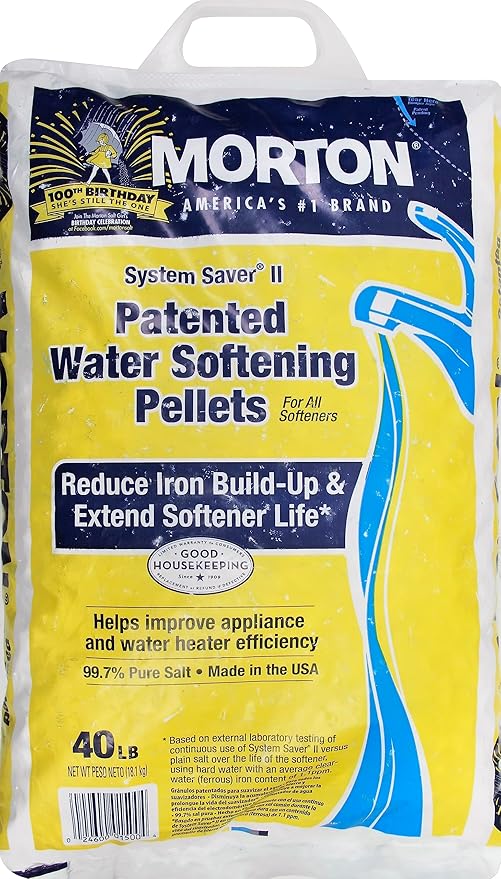
This 40-pound bag of USA-made System Saver pellets is designed to improve the taste of your water while helping extend the life of your appliances and water softener. Simple to use, just add the pellets directly to your softener's brine tank as needed.
Check On AmazonIf you click this link and buy, we earn a commission at no additional cost to you.
Five Things to Verify Before You Buy
Most buyers in this price range skip the spec verification step entirely. That is where problems start. Five questions that take ten minutes to answer before purchase prevent most of the dissatisfaction I see come up in service calls and forums years later.
- Resin crosslink percentage: Ask if the listing does not state it. For city water with chlorine, 10% crosslink matters for long-term resin life. For well water without chlorine, 8% is generally acceptable.
- Regeneration type: Demand-initiated only. Timer-based regeneration wastes 30 to 50 percent more salt annually. If the spec sheet does not say demand-initiated, metered, or on-demand, ask before ordering.
- Grain capacity against your weekly grain load: Run the calculation before choosing a unit. Multiply daily water use by GPG by 7. Buy at least 15 to 20 percent more capacity than that number. Do not skip this step in a price-sensitive purchase.
- Valve parts availability: Check whether rebuild kits and replacement parts exist for the control valve. A valve you cannot service has a fixed lifespan determined by the first internal component to fail.
- Warranty terms in full: What is covered, for how long, and what voids it. Some warranties require professional installation to remain valid. Know this before the unit ships.
None of these questions require technical expertise to ask. Manufacturers and customer support teams answer them regularly. The homeowners who do ask tend to stay satisfied for years. The ones who skip it tend to be the ones posting forum questions three years later wondering whether the unit is broken or they just need to add salt.
Who Should Buy Under $500, and Who Should Not
This price range is genuinely the right choice for some households and the wrong one for others. The difference comes down to water chemistry, household size, and how much hands-on involvement you are willing to take on.
Small household of one to three people. City water or well water without significant iron. Hardness in the 7 to 12 GPG range. Willing to verify the resin crosslink spec and add a carbon pre-filter if needed for city water. Comfortable with basic self-service: checking salt levels, occasional resin cleaning. Goal is soft water, not a long service relationship with a dealer.
Household of four or more at 15 GPG or higher. Well water with iron above 1 PPM, which requires a higher effective grain capacity after iron adjustment. Strong preference for a valve with known long-term parts availability. Need for professional installation with a warranty that requires it. Wanting smart monitoring or Bluetooth control. Expected high daily water use from large family or water-intensive appliances.
The dealer premium is worth something specific: access to local service when something goes wrong without needing to diagnose it yourself. If that peace of mind matters, it has a real value. But if the gap between a dealer quote and a direct-to-consumer unit at this price range is $2,000 or more for identical core components, that is a service relationship cost, not a performance cost. Know what you are paying for.

This kit lets you test drinking water, pool water, or any water source in seconds using a simple dip-and-read method with an oversized color chart ranging from red to green, covering 0 to 25 GPG and 0 to 425 PPM. All 100 strips are protected by FreshSeal technology across a ready-to-use bottle and two sealed pouches for long-term accuracy. Each purchase also funds a full year of clean water for someone in the Central African Republic.
Check On AmazonIf you click this link and buy, we earn a commission at no additional cost to you.
Final Thoughts: When Budget Is the Right Call
A $350 box store softener ran for 10 years on hard well water while using a fraction of the salt that a $3,500 dealer unit consumed. That outcome is real and repeatable, but only when the unit is correctly sized, the water chemistry fits the resin spec, and the buyer is willing to do ten minutes of verification before purchasing. Under $500 is not a compromise if those conditions are met. It is only a compromise when you skip the sizing math, ignore the crosslink question, and buy the cheapest option without checking whether the grain capacity fits the household.
If your household and water situation fit the profile above, the chemistry delivers the same soft water at this price that it does at two or three times the cost. If they do not fit, spending an extra $150 to $200 for a larger capacity, a better valve, or a confirmed 10% crosslink spec is money that earns its keep over 10 to 15 years of daily use. The full picture of which situations call for which approach is covered in the water softener guide by situation and water type, which is a useful starting point if you are still deciding whether any softener makes sense before committing to a budget.

Designed for homes with 4 or more bathrooms, this professional-grade softener treats 64,000 grains of hardness by removing calcium and magnesium to deliver soft water from every outlet while protecting appliances like dishwashers, washing machines, and water heaters from scale buildup. The fully programmable backlit digital metered control head allows customizable auto-flush intervals based on your water quality and usage for efficient, hands-free operation. Built with a fiberglass-lined polyethylene tank and prefilled premium resin, it is backed by a 30-day money-back guarantee, 5-year manufacturer warranty, and lifetime free US-based tech support with online product activation.
Check On AmazonIf you click this link and buy, we earn a commission at no additional cost to you.
FAQs
💧 Do cheap water softeners actually work?
Yes, if correctly sized for your household and water hardness. Ion exchange chemistry is the same at any price point. The tradeoffs at the budget end are resin crosslink percentage, control valve longevity, and warranty length, not softening effectiveness. A $350 unit sized for your actual grain load delivers the same GPG result as a $3,500 system using the same chemistry.
🔢 What grain capacity do I need under $500?
Multiply your household size by 75 gallons per person per day, then by your water hardness in GPG, then by 7. That is your weekly grain load. Buy a system with 15 to 20 percent more capacity than that number. Well water buyers should add 4 to 5 GPG per 1 PPM of dissolved iron before running the calculation.
🧪 Is 8% crosslink resin a problem in this price range?
For well water without chlorine, not particularly. For city water with ongoing chlorine exposure, 8% crosslink resin degrades faster than 10% crosslink over 10 to 15 years of daily use. Ask the manufacturer for the crosslink spec before buying, and consider adding a carbon pre-filter if you are on municipal water and the spec is 8%.
🏡 Can a budget softener handle hard well water?
It can, provided the grain capacity accounts for both hardness and iron. Add 4 to 5 GPG per 1 PPM of ferrous iron to your hardness number before choosing capacity. Well water at 10 to 12 GPG with minimal iron is well within what a correctly sized budget unit handles. The 10-year forum example cited above was on very hard well water.
💰 What is the real total cost of a budget water softener?
Add installation fittings ($30 to $80), plumber labor if applicable ($100 to $200), a carbon pre-filter for city water if the resin is 8% crosslink ($80 to $150 upfront plus ongoing filter replacements), and first salt fill. For many moderate-hardness households, ongoing salt use may be closer to one 40-pound bag every few weeks to once every couple of months, depending on hardness, daily water use, and regeneration settings. The sticker price is the starting point, not the final number.
🔧 Is a used or refurbished softener worth considering?
A used unit with a known, field-serviceable control valve and a confirmed resin replacement in the last five years is worth evaluating. The key risk is resin age: original resin from a city water installation that is 10 or more years old may need replacement ($80 to $150), which adds to the actual cost. Factor that in before deciding the used price is a deal.